
500k Signatures Can Save California Schools! Fix the System, Secure Our Future
The Issue
Despite California having one of the largest education budgets in the nation, our state continues to rank among the lowest in K–12 performance. Teacher shortages, overcrowded classrooms, and persistent achievement gaps leave millions of children without the quality education they deserve.
Parents, teachers, and students are frustrated with a system that spends more but delivers less. California’s future depends on strong public education, yet too many children are falling behind
.
Who is impacted?
California’s failing education system impacts millions of children, their families, and their communities. Students are stuck in overcrowded classrooms where teachers are stretched too thin to provide individual support. Low-income families and communities of color face the harshest consequences, as underfunded schools widen the achievement gap and limit opportunities. Teachers themselves are leaving the profession due to low pay, burnout, and lack of support, leaving even fewer qualified educators for the students who need them most.
What is at stake?
If the system continues as it is, California risks creating a generation of students who are unprepared for college, careers, or civic life. That means fewer innovators, fewer skilled workers, and a weaker economy in the long term. On the other hand, fixing the education system would give every child the chance to succeed, strengthen California’s workforce, and restore the state as a leader in innovation and opportunity. The stakes are not just about test scores — they are about the future health, safety, and prosperity of California.
Why is now the time to act?
We can no longer afford to delay. Despite California’s massive budget, student performance has not improved, and teacher shortages are worsening every year. Each school year that passes without reform leaves another class of students behind. The longer we wait, the deeper the achievement gaps grow, and the harder they will be to close. Now is the moment for bold action — to demand accountability, invest in teachers and students, and finally give California’s children the education they deserve.
Despite California having one of the largest education budgets in the nation, our state continues to rank among the lowest in K–12 performance. Teacher shortages, overcrowded classrooms, and persistent achievement gaps leave millions of children without the quality education they deserve.
Parents, teachers, and students are frustrated with a system that spends more but delivers less. California’s future depends on strong public education, yet too many children are falling behind.
What We’re Asking For:
We call on California’s leaders to:
Address Teacher Shortages — Increase salaries, benefits, and support for teachers to recruit and retain top talent.Reduce Class Sizes — Set enforceable limits on student-to-teacher ratios, particularly in early grades.Close the Achievement Gap — Provide targeted funding, tutoring, and mentorship programs for underserved communities.
California’s teacher shortage at the heart of newly proposed legislation
Improve Accountability — Ensure education dollars are spent directly on classrooms, not wasted on bureaucracy.
Expand Career & Technical Education — Prepare students for both college and the workforce with modern vocational training.
Modernize Facilities & Resources — Invest in updated classrooms, technology, and safe learning environments.
Prioritize Student Mental Health — Increase access to school counselors and support programs.
What’s really going on with kids’ mental health
https://youtu.be/ZIodXMxeOV0
Why This Matters:
Education is the foundation of opportunity. If California wants to lead in innovation, business, and social progress, we must invest wisely in our children’s future. Every student, regardless of zip code, deserves access to an excellent education — not an overcrowded classroom with overworked teachers and underfunded resources.
By signing this petition, you’re demanding real reform and accountability in California’s education system. Our kids deserve better. Our state deserves better.
Sign now to stand with parents, teachers, and students fighting for the future of California’s children.
Comprehensive solutions to California’s education system:
1. Teacher Recruitment & Retention
Competitive Salaries & Benefits: Raise teacher pay to be nationally competitive, especially in high-cost areas.
Loan Forgiveness Programs: Offer debt relief for teachers who commit to serving 5–10 years in California schools.
Housing Assistance: Provide affordable housing stipends or partnerships for teachers in expensive cities.
Mentorship & Support: Pair new teachers with veteran educators to reduce burnout and turnover.
2. Reduce Overcrowded Classrooms
Class Size Caps: Enforce strict student-to-teacher ratio limits, especially in grades K–3.
More Schools & Facilities: Expand infrastructure in high-growth areas to balance enrollment.
Mobile & Satellite Classrooms: Use temporary modular spaces while building permanent facilities.
3. Closing the Achievement Gap
Equitable Funding: Allocate more resources to schools in underserved communities, not just equal per-student spending.
Tutoring & Mentorship Programs: Fund after-school and summer tutoring for students who fall behind.
Family & Community Engagement: Partner with local nonprofits and parents to create wraparound support systems.
Culturally Relevant Curriculum: Ensure lessons reflect California’s diverse student population.
4. Increase Accountability
Transparent Spending: Require annual public reports showing how every education dollar is used.
Audit Bureaucracy: Reduce administrative waste and redirect funds to classrooms.
Performance Benchmarks: Hold schools accountable to clear, measurable goals in literacy, math, and graduation rates.
5. Career & Workforce Readiness
Expand Career & Technical Education (CTE): More high school programs in coding, trades, and healthcare.
Internship & Apprenticeship Programs: Partner with local businesses to give students hands-on experience.
Community College Pipeline: Strengthen pathways from high school to community colleges and universities.
6. Modernize Facilities & Technology
21st-Century Classrooms: Invest in updated facilities, labs, and digital learning tools.
Broadband for All: Ensure every student has internet access at school and at home.
Green Schools: Retrofit schools with sustainable energy and safe, modern infrastructure.
7. Student Mental Health & Support
Counselor-to-Student Ratio: Hire more counselors, aiming for at least 1 per 250 students (current average is double that).
On-Campus Health Services: Provide access to mental health professionals in schools.
Anti-Bullying & Inclusion Programs: Create safe environments that support emotional growth as well as academics.
8. Innovation & Pilot Programs
Charter + Public Hybrid Solutions: Encourage innovation while ensuring accountability.
Community Schools Model: Schools that serve as hubs for social, health, and educational services.
Early Childhood Education: Expand universal pre-K to give kids a strong start.
Structural reforms and future-facing elements:
1. Early Childhood Education
Universal Pre-K: Research shows kids who attend quality preschool perform better long-term.
Affordable Childcare Partnerships: Help working families and prepare children earlier for K–12 success.
2. Special Education & Inclusion
Stronger Support for Special Needs: More resources, aides, and individualized education plans (IEPs).
Inclusive Learning Models: Training teachers to better support neurodiverse students.
3. Parental & Community Engagement
Parent Training Programs: Workshops that help parents support learning at home.
School-Community Partnerships: Engage local businesses, nonprofits, and universities in student success.
4. Teacher Pipeline Reform
Alternative Certification Programs: Attract mid-career professionals (STEM, trades, healthcare) into teaching.
Streamline Credentialing: Cut red tape so qualified candidates can enter the classroom faster.
5. Accountability Beyond Test Scores
Broader Metrics: Evaluate schools on creativity, problem-solving, and social-emotional learning, not just standardized tests.
Project-Based Learning: Encourage innovation and real-world problem solving in the curriculum.
6. Funding Equity Reform
Property Tax Dependency Fix: California schools still rely heavily on local property taxes, creating unequal funding. A petition could call for restructuring state-level funding formulas.
Weighted Student Funding: Allocate more per student based on need (poverty level, language barriers, disability).
7. Higher Education & Affordability
Community College Expansion: Make the first two years free or nearly free.
Debt-Free Pathways: Better support for transfer students to CSU/UC systems.
Vocational Track Options: Give students affordable, respected non-college pathways.
8. Long-Term Vision
Education Innovation Labs: Pilot experimental schools to test new models.
AI & Future Tech in Curriculum: Prepare students for future careers (AI, green tech, robotics).
Civic & Financial Literacy: Strengthen life skills, not just academics.
Ideal Outcome of This Petition
By gathering 500,000 signatures, we will demonstrate to California’s leaders that the public demands urgent reform in our schools. This petition will:
Force Lawmakers to Act — A show of half a million voices will pressure the Governor, Legislature, and California Department of Education to prioritize education reform and mental health in schools.
Secure Funding Commitments — Achieve commitments for more counselors, smaller class sizes, and direct classroom funding instead of administrative waste.
Launch Pilot Programs — Push the state to implement pilot programs in high-need districts focused on teacher retention, student mental health, and equitable funding.
Create Public Accountability — With widespread public support, state leaders will be held accountable to measurable improvements (higher test scores, better counselor ratios, reduced teacher shortages).
Build Momentum for Long-Term Change — A successful campaign will not just highlight California’s education crisis but spark an ongoing movement to keep student success at the top of the policy agenda.
striking statistics that show how severe California’s school issues are:
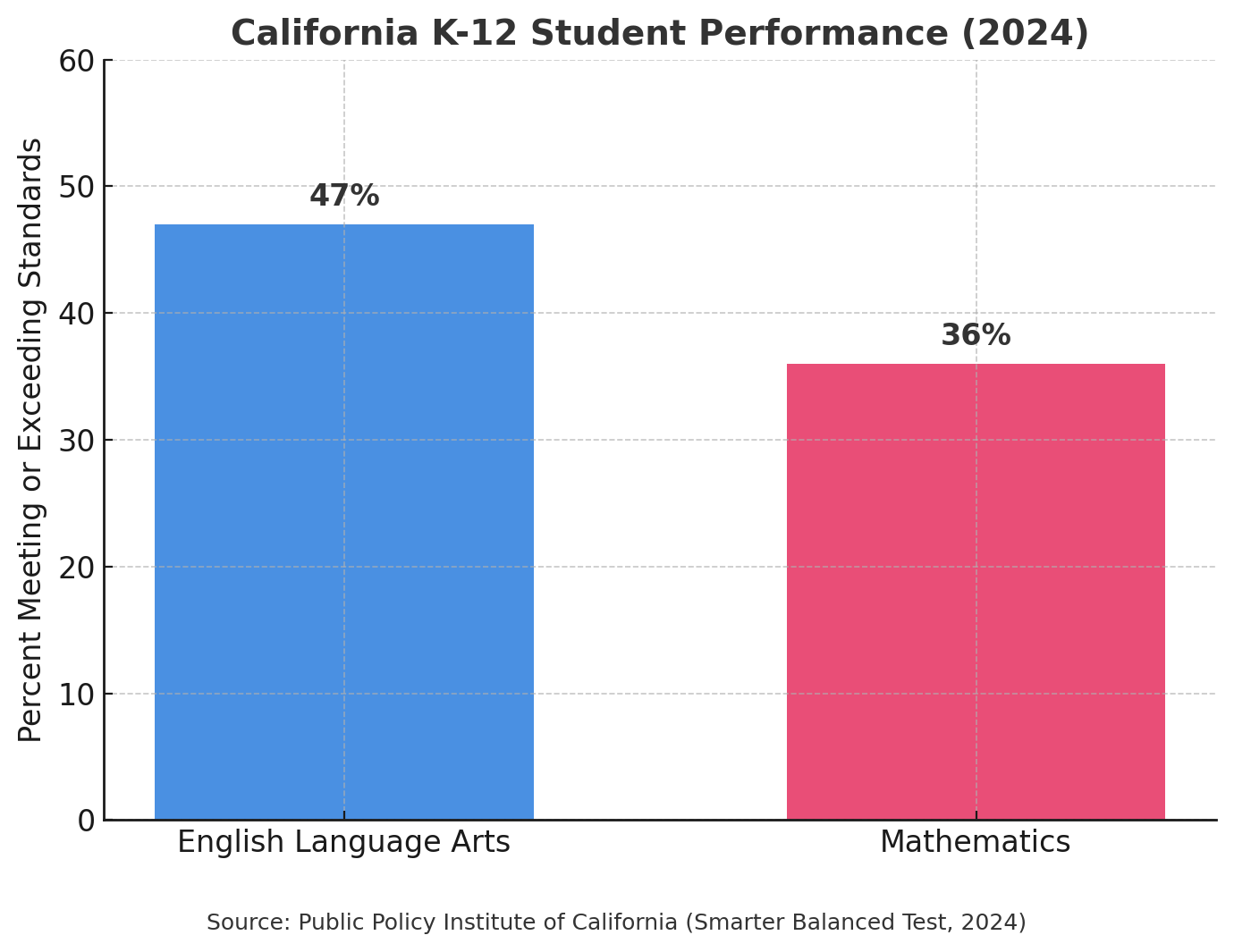
Only 47% of students meet or exceed state standards in English Language Arts, and just 36% do so in mathematics, per 2024 Smarter Balanced test results. Public Policy Institute of California
In the same 2023–24 assessment cycle, less than half the student body passed ELA, and barely one in three passed math. edpolicyinca.org
There are over 10,000 teacher vacancies in California public schools. Elevate K12+2Learning Policy Institute+2
76% of educators say overcrowded classes and lack of staffing are “serious issues.” California Teachers Association
84% of teachers report that inadequate resources (e.g. materials, support) is a major concern, and the same proportion cite underfunding. California Teachers Association
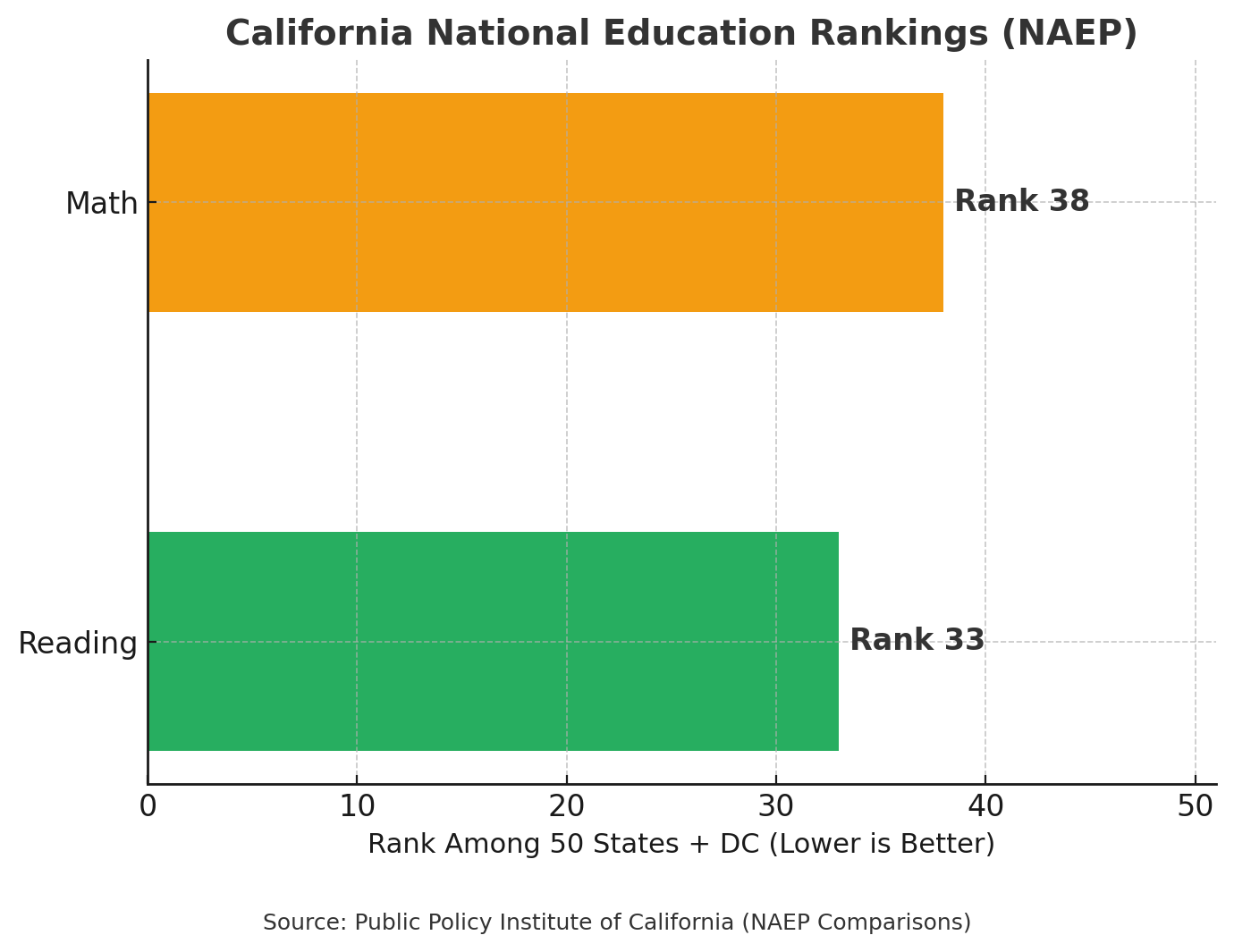
California ranks 38th in math and 33rd in reading among the 50 states + DC, based on NAEP comparisons. Public Policy Institute of California
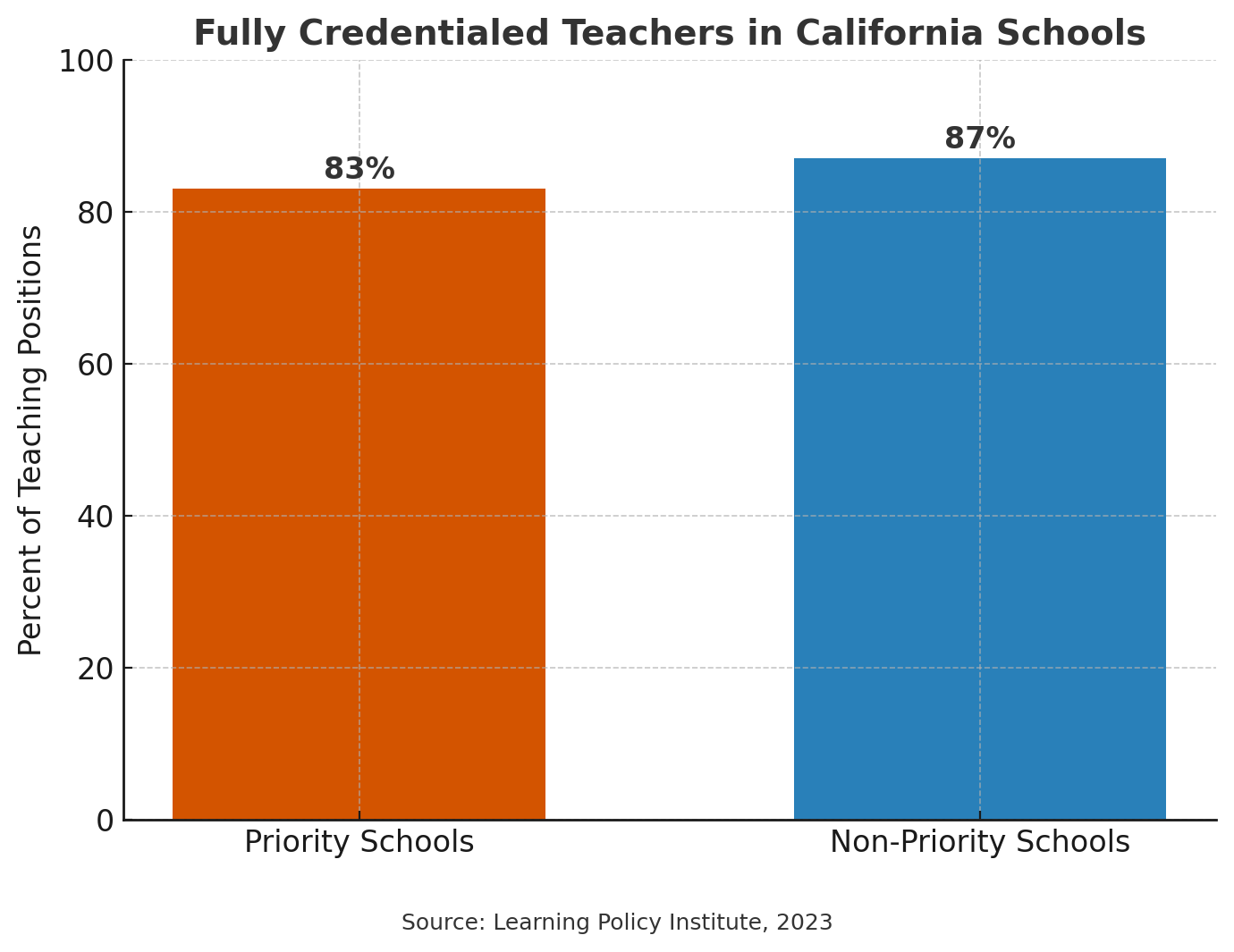
In high-need (“priority”) schools, only 83% of full-time teaching positions are held by fully credentialed teachers — lower than non-priority schools (87%). Learning Policy Institute
In recent years, “substandard credentials and permits” (i.e. less-qualified teaching authorizations) have tripled, making up over half of new credentials issued in 2023. Learning Policy Institute
34% of new teacher hires in California have had “substandard credentials” (i.e. not yet fully certified) in some years. National University
The average public school classroom in California has 10.8 more students per teacher than the average private school class — a 47.8% difference. Fusion Academy
Next Steps After 500,000 Signatures
Petition Delivery
Deliver the signed petition to the Governor’s office, the State Superintendent of Public Instruction, and leaders of the California State Legislature.
Hold a press event at the State Capitol in Sacramento with students, parents, and educators speaking directly to lawmakers.
Public Awareness Campaign
Use the petition’s success to generate news coverage in TV, radio, newspapers, and online outlets.
Launch a social media blitz highlighting the demand for change and the power of 500,000 voices.
Legislative Action
Work with education advocates to draft legislation addressing counselor shortages, mental health funding, and class size reduction.
Present the petition to lawmakers during committee hearings as evidence of public demand.
Community Mobilization
Organize rallies, town halls, and school-based events to keep momentum alive.
Partner with parent associations, student groups, teacher unions, and nonprofits to expand support.
Ongoing Accountability
Create a public “Education Report Card” to track whether leaders follow through.
Keep petition signers updated and engaged so they can apply pressure year after year until reforms are delivered.
500,000 signatures is not just a number — it’s a mandate. Together, we can demand that California finally put students first.

6
The Issue
Despite California having one of the largest education budgets in the nation, our state continues to rank among the lowest in K–12 performance. Teacher shortages, overcrowded classrooms, and persistent achievement gaps leave millions of children without the quality education they deserve.
Parents, teachers, and students are frustrated with a system that spends more but delivers less. California’s future depends on strong public education, yet too many children are falling behind
.
Who is impacted?
California’s failing education system impacts millions of children, their families, and their communities. Students are stuck in overcrowded classrooms where teachers are stretched too thin to provide individual support. Low-income families and communities of color face the harshest consequences, as underfunded schools widen the achievement gap and limit opportunities. Teachers themselves are leaving the profession due to low pay, burnout, and lack of support, leaving even fewer qualified educators for the students who need them most.
What is at stake?
If the system continues as it is, California risks creating a generation of students who are unprepared for college, careers, or civic life. That means fewer innovators, fewer skilled workers, and a weaker economy in the long term. On the other hand, fixing the education system would give every child the chance to succeed, strengthen California’s workforce, and restore the state as a leader in innovation and opportunity. The stakes are not just about test scores — they are about the future health, safety, and prosperity of California.
Why is now the time to act?
We can no longer afford to delay. Despite California’s massive budget, student performance has not improved, and teacher shortages are worsening every year. Each school year that passes without reform leaves another class of students behind. The longer we wait, the deeper the achievement gaps grow, and the harder they will be to close. Now is the moment for bold action — to demand accountability, invest in teachers and students, and finally give California’s children the education they deserve.
Despite California having one of the largest education budgets in the nation, our state continues to rank among the lowest in K–12 performance. Teacher shortages, overcrowded classrooms, and persistent achievement gaps leave millions of children without the quality education they deserve.
Parents, teachers, and students are frustrated with a system that spends more but delivers less. California’s future depends on strong public education, yet too many children are falling behind.
What We’re Asking For:
We call on California’s leaders to:
Address Teacher Shortages — Increase salaries, benefits, and support for teachers to recruit and retain top talent.Reduce Class Sizes — Set enforceable limits on student-to-teacher ratios, particularly in early grades.Close the Achievement Gap — Provide targeted funding, tutoring, and mentorship programs for underserved communities.
California’s teacher shortage at the heart of newly proposed legislation
Improve Accountability — Ensure education dollars are spent directly on classrooms, not wasted on bureaucracy.
Expand Career & Technical Education — Prepare students for both college and the workforce with modern vocational training.
Modernize Facilities & Resources — Invest in updated classrooms, technology, and safe learning environments.
Prioritize Student Mental Health — Increase access to school counselors and support programs.
What’s really going on with kids’ mental health
https://youtu.be/ZIodXMxeOV0
Why This Matters:
Education is the foundation of opportunity. If California wants to lead in innovation, business, and social progress, we must invest wisely in our children’s future. Every student, regardless of zip code, deserves access to an excellent education — not an overcrowded classroom with overworked teachers and underfunded resources.
By signing this petition, you’re demanding real reform and accountability in California’s education system. Our kids deserve better. Our state deserves better.
Sign now to stand with parents, teachers, and students fighting for the future of California’s children.
Comprehensive solutions to California’s education system:
1. Teacher Recruitment & Retention
Competitive Salaries & Benefits: Raise teacher pay to be nationally competitive, especially in high-cost areas.
Loan Forgiveness Programs: Offer debt relief for teachers who commit to serving 5–10 years in California schools.
Housing Assistance: Provide affordable housing stipends or partnerships for teachers in expensive cities.
Mentorship & Support: Pair new teachers with veteran educators to reduce burnout and turnover.
2. Reduce Overcrowded Classrooms
Class Size Caps: Enforce strict student-to-teacher ratio limits, especially in grades K–3.
More Schools & Facilities: Expand infrastructure in high-growth areas to balance enrollment.
Mobile & Satellite Classrooms: Use temporary modular spaces while building permanent facilities.
3. Closing the Achievement Gap
Equitable Funding: Allocate more resources to schools in underserved communities, not just equal per-student spending.
Tutoring & Mentorship Programs: Fund after-school and summer tutoring for students who fall behind.
Family & Community Engagement: Partner with local nonprofits and parents to create wraparound support systems.
Culturally Relevant Curriculum: Ensure lessons reflect California’s diverse student population.
4. Increase Accountability
Transparent Spending: Require annual public reports showing how every education dollar is used.
Audit Bureaucracy: Reduce administrative waste and redirect funds to classrooms.
Performance Benchmarks: Hold schools accountable to clear, measurable goals in literacy, math, and graduation rates.
5. Career & Workforce Readiness
Expand Career & Technical Education (CTE): More high school programs in coding, trades, and healthcare.
Internship & Apprenticeship Programs: Partner with local businesses to give students hands-on experience.
Community College Pipeline: Strengthen pathways from high school to community colleges and universities.
6. Modernize Facilities & Technology
21st-Century Classrooms: Invest in updated facilities, labs, and digital learning tools.
Broadband for All: Ensure every student has internet access at school and at home.
Green Schools: Retrofit schools with sustainable energy and safe, modern infrastructure.
7. Student Mental Health & Support
Counselor-to-Student Ratio: Hire more counselors, aiming for at least 1 per 250 students (current average is double that).
On-Campus Health Services: Provide access to mental health professionals in schools.
Anti-Bullying & Inclusion Programs: Create safe environments that support emotional growth as well as academics.
8. Innovation & Pilot Programs
Charter + Public Hybrid Solutions: Encourage innovation while ensuring accountability.
Community Schools Model: Schools that serve as hubs for social, health, and educational services.
Early Childhood Education: Expand universal pre-K to give kids a strong start.
Structural reforms and future-facing elements:
1. Early Childhood Education
Universal Pre-K: Research shows kids who attend quality preschool perform better long-term.
Affordable Childcare Partnerships: Help working families and prepare children earlier for K–12 success.
2. Special Education & Inclusion
Stronger Support for Special Needs: More resources, aides, and individualized education plans (IEPs).
Inclusive Learning Models: Training teachers to better support neurodiverse students.
3. Parental & Community Engagement
Parent Training Programs: Workshops that help parents support learning at home.
School-Community Partnerships: Engage local businesses, nonprofits, and universities in student success.
4. Teacher Pipeline Reform
Alternative Certification Programs: Attract mid-career professionals (STEM, trades, healthcare) into teaching.
Streamline Credentialing: Cut red tape so qualified candidates can enter the classroom faster.
5. Accountability Beyond Test Scores
Broader Metrics: Evaluate schools on creativity, problem-solving, and social-emotional learning, not just standardized tests.
Project-Based Learning: Encourage innovation and real-world problem solving in the curriculum.
6. Funding Equity Reform
Property Tax Dependency Fix: California schools still rely heavily on local property taxes, creating unequal funding. A petition could call for restructuring state-level funding formulas.
Weighted Student Funding: Allocate more per student based on need (poverty level, language barriers, disability).
7. Higher Education & Affordability
Community College Expansion: Make the first two years free or nearly free.
Debt-Free Pathways: Better support for transfer students to CSU/UC systems.
Vocational Track Options: Give students affordable, respected non-college pathways.
8. Long-Term Vision
Education Innovation Labs: Pilot experimental schools to test new models.
AI & Future Tech in Curriculum: Prepare students for future careers (AI, green tech, robotics).
Civic & Financial Literacy: Strengthen life skills, not just academics.
Ideal Outcome of This Petition
By gathering 500,000 signatures, we will demonstrate to California’s leaders that the public demands urgent reform in our schools. This petition will:
Force Lawmakers to Act — A show of half a million voices will pressure the Governor, Legislature, and California Department of Education to prioritize education reform and mental health in schools.
Secure Funding Commitments — Achieve commitments for more counselors, smaller class sizes, and direct classroom funding instead of administrative waste.
Launch Pilot Programs — Push the state to implement pilot programs in high-need districts focused on teacher retention, student mental health, and equitable funding.
Create Public Accountability — With widespread public support, state leaders will be held accountable to measurable improvements (higher test scores, better counselor ratios, reduced teacher shortages).
Build Momentum for Long-Term Change — A successful campaign will not just highlight California’s education crisis but spark an ongoing movement to keep student success at the top of the policy agenda.
striking statistics that show how severe California’s school issues are:
Only 47% of students meet or exceed state standards in English Language Arts, and just 36% do so in mathematics, per 2024 Smarter Balanced test results. Public Policy Institute of California
In the same 2023–24 assessment cycle, less than half the student body passed ELA, and barely one in three passed math. edpolicyinca.org
There are over 10,000 teacher vacancies in California public schools. Elevate K12+2Learning Policy Institute+2
76% of educators say overcrowded classes and lack of staffing are “serious issues.” California Teachers Association
84% of teachers report that inadequate resources (e.g. materials, support) is a major concern, and the same proportion cite underfunding. California Teachers Association
California ranks 38th in math and 33rd in reading among the 50 states + DC, based on NAEP comparisons. Public Policy Institute of California
In high-need (“priority”) schools, only 83% of full-time teaching positions are held by fully credentialed teachers — lower than non-priority schools (87%). Learning Policy Institute
In recent years, “substandard credentials and permits” (i.e. less-qualified teaching authorizations) have tripled, making up over half of new credentials issued in 2023. Learning Policy Institute
34% of new teacher hires in California have had “substandard credentials” (i.e. not yet fully certified) in some years. National University
The average public school classroom in California has 10.8 more students per teacher than the average private school class — a 47.8% difference. Fusion Academy
Next Steps After 500,000 Signatures
Petition Delivery
Deliver the signed petition to the Governor’s office, the State Superintendent of Public Instruction, and leaders of the California State Legislature.
Hold a press event at the State Capitol in Sacramento with students, parents, and educators speaking directly to lawmakers.
Public Awareness Campaign
Use the petition’s success to generate news coverage in TV, radio, newspapers, and online outlets.
Launch a social media blitz highlighting the demand for change and the power of 500,000 voices.
Legislative Action
Work with education advocates to draft legislation addressing counselor shortages, mental health funding, and class size reduction.
Present the petition to lawmakers during committee hearings as evidence of public demand.
Community Mobilization
Organize rallies, town halls, and school-based events to keep momentum alive.
Partner with parent associations, student groups, teacher unions, and nonprofits to expand support.
Ongoing Accountability
Create a public “Education Report Card” to track whether leaders follow through.
Keep petition signers updated and engaged so they can apply pressure year after year until reforms are delivered.
500,000 signatures is not just a number — it’s a mandate. Together, we can demand that California finally put students first.
Petition Updates
Share this petition
Petition created on September 25, 2025