Social media advocacy: 13 creative ways to grow your petition

Social media advocacy: 13 creative ways to grow your petition
Creative, powerful, and easy ways to use social media to grow your petition, reach new supporters, and build momentum.Often, social media can make or break your petition’s success. The difference between an advocacy campaign that quietly fades away and one that attracts significant support often comes down to how effectively it's promoted online.
The good news? Creating an online petition is an ideal way to build a digital campaign hub that can be easily shared across any social media channel or community. Growing your petition through social media doesn’t require a huge following or complicated strategy. With a little creativity and consistency, you can reach the right people and build powerful momentum.
Below are 13 smart, creative, and easy ways to promote your petition.
1. Incorporate feedback from your supporters in your content
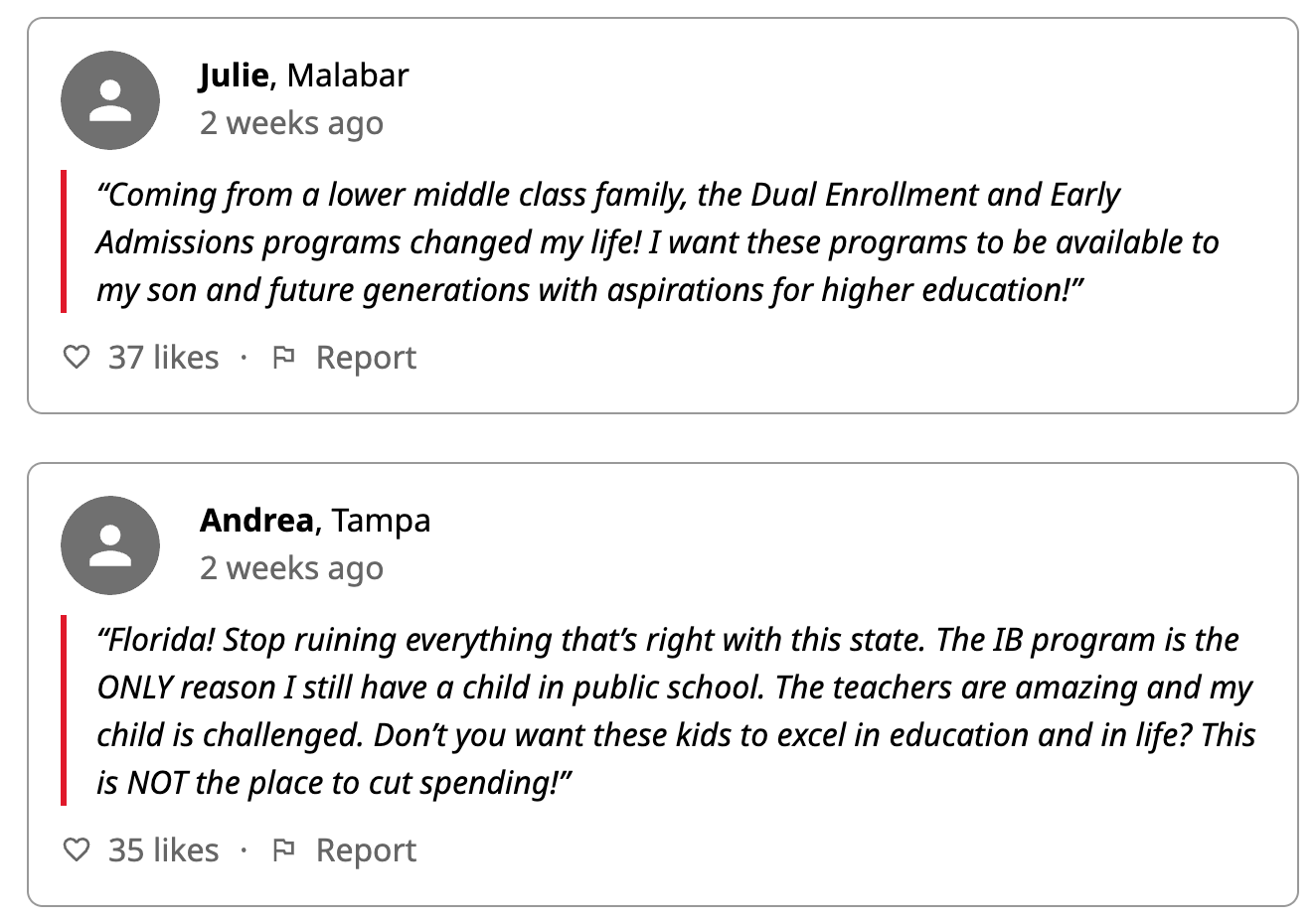
Whether it’s static posts, videos, Stories, Reels, or any other available format — spotlight the voices of your supporters. Incorporating comments from supporters on petitions is a powerful way to add detail and demonstrate the community impact of your issue.
Simply screenshot the comments and add them to your video, or post them as images. You can can add text or further design comment images using built-in tools on social media apps or other external apps.
These reactions and personal stories from supporters enhance the authenticity and relatability of your content. Sprout Social found out that 64% of consumers want brands to connect with them, not just sell to them, and this applies to petitions as well.
To build momentum and engagement, publicly thank those who comment by tagging those individuals and encourage others to leave their reasons for signing, which can be another post on its own!
2. Talk to people and share your conversations
Create videos talking to petition supporters and people impacted by the issue in your community. Post them on TikTok, or as Reels and Stories on Instagram and other relevant channels. These personal narratives help humanize your cause and research shows that people are more likely to act when emotionally engaged.
Short-form interviews also help build credibility and prove that the issue really is a problem. If your petition is local, tag the town or city to increase the chances of people discovering it.Don’t forget to add a link to your petition on your post or in the bio of each channel you use.
The Society of Authors, the largest union for writers, illustrators and literary translators in the UK, is currently fighting Meta for the unlicensed use of authors’ work in AI training. At the beginning of April 2025, their petition had almost 43,000 signatures.
In addition to organizing in-person protests, their strong social media strategy includes interviews with authors who attended those protests.
3. Don’t forget about niche social media
Platforms like Reddit, Discord, Nextdoor, and Peanut host tight-knit, active communities. Joining relevant subreddits or Discord servers where your petition’s issue is already being discussed is a valuable tool.
Share your petition with context on these channels and invite conversation, rather than just dropping a link. This builds trust, motivates discussion, and can lead to higher engagement.
Each platform has its own etiquette. On Reddit, for example, detailed and well-researched posts perform best, so share all the facts and data you have. While on Nextdoor, using a neighborly tone and a local focus will resonate more. Take time to learn the culture and familiarize yourself with the apps.
Facebook has plenty of specific groups (private and public) for any interest imaginable. Join relevant groups to share your petition, its goals, and why it matters to the members of that group to maximize your outreach.
Related resource: Complete guide to growing your petition online
4. Take advantage of hashtags
Create a unique hashtag for your campaign and encourage others to share their own content about your petition using it.
Tailor your hashtag(s) to your issue. For example, in 2022, activist Lauren Taylor started a petition to stop Home Depot from selling invasive species of plants. In an interview with Change.org, she explains how TikTokers helped spread the message. Supporters created videos showing all the invasive plants Home Depot was selling using #invasiveplants and #homedepot.
This helped the petition reach over 81,000 signatures.
Encourage others to post relevant content using a hashtag for your campaign and link to your petition. Authentic, user-generated content helps petitions spread in a way that feels natural.
Keep the hashtag short and simple, but memorable and relevant. Promote it consistently in your captions and bios.
5. Tap into social media trends
What are the influencers you follow doing at the moment? Is there a sound byte that’s become popular? A particular type of Reel? A dance? Create content using current trends and adapt it to the message of your petition.
Stay up to date with the latest trends and content styles by following accounts like @creators on Instagram and using TikTok’s Creative Center for recommendations and guidance. Check your discovery page on Instagram and the For You page on TikTok regularly to see what type of content keeps popping up.
Don’t overthink it and seize the moment when you see an opportunity. Trends can come and go quickly in the world of social media.

Related resource: TikTok tactics to grow your petition
6. Showcase your most compelling details
A plain background with bold text can be surprisingly powerful. Use key statistics and quotes from your petition, such as “1 in 3 students go to school without breakfast,” to catch people’s attention and keep them from scrolling.
Use reputable sources for your statistics and facts, such as the World Health Organization or the World Wildlife Foundation. Attribute data to your sources in small print and tag their accounts for further reach. Content with accurate, verified data builds trust and increases shares among fact-conscious audiences.
For example, this petition to support a 25% reduction in the global dairy herd used Instagram to spread their message. Their Reels, carousel posts, and single images included jaw-dropping facts and statistics.
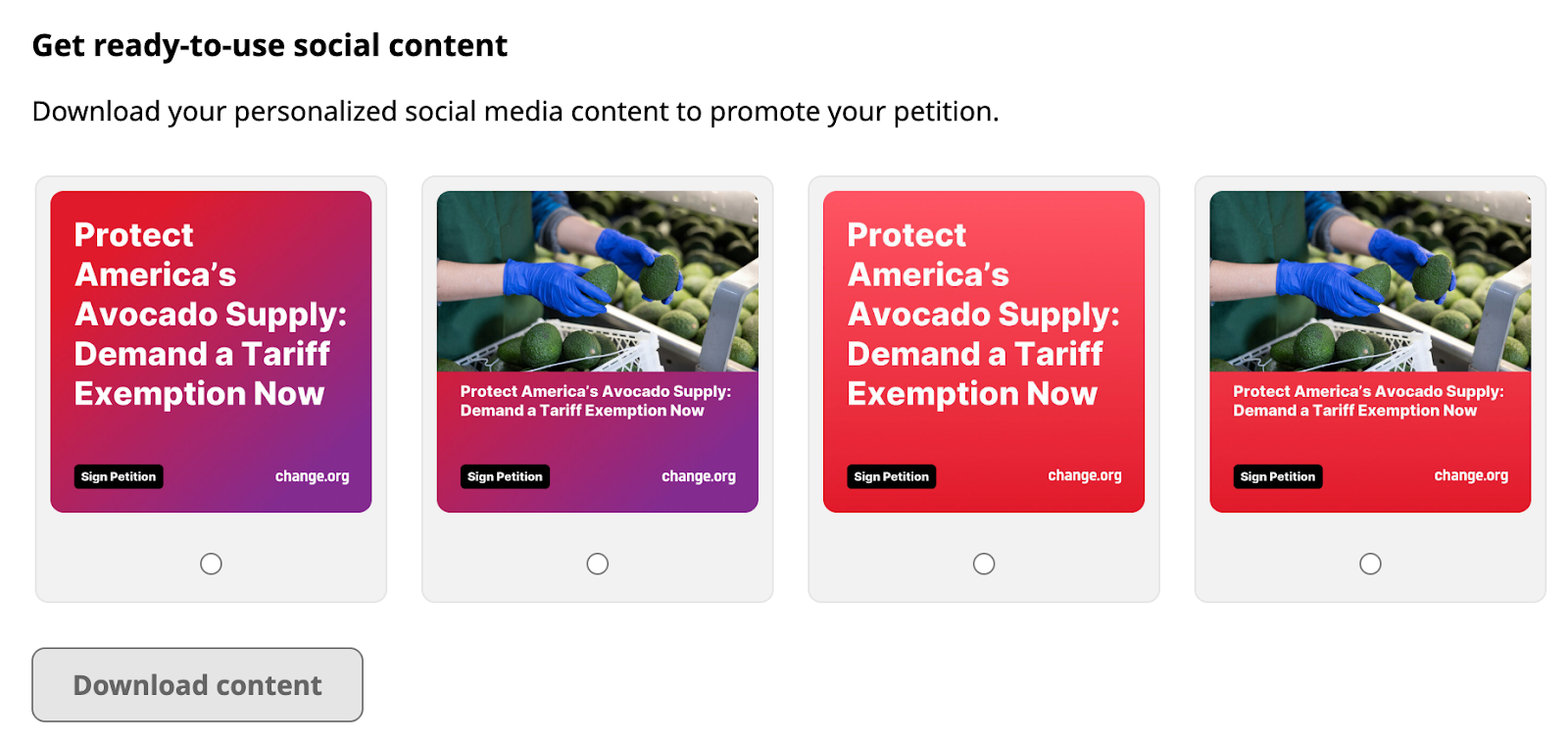
Keep visuals uncluttered. Most people scroll quickly through social media, so bold headlines and contrasting colors have a higher chance of grabbing their attention. Change.org makes this easy. Petition starters can access automatically generated social media posts in the petition’s dashboard to download, like in the example below.
7. Target decision makers directly
Craft posts detailing what your goals and calls to action are, and tag the public figures or organizations that can respond to them. For example, if you are petitioning a school board of a particular district or a retailer like Target, tag those accounts and ask followers to do the same. This can create public pressure.
Consider writing open letters as posts or carousels on Instagram, TikTok, or Facebook, tagging relevant parties and asking followers to reshare or tag the same people in comments.
Be polite but firm — respectful and constructive posts get better results than hostile ones.
8. Post about your petition in the comments of social media posts
One often-overlooked strategy: comment sections.
When a relevant public figure, brand, or news outlet posts about an issue related to your petition, jump into the conversation by leaving a thoughtful comment that includes a short mention of your petition.
This tactic can help:
Catch the eye of the decision-maker you’re targeting
Reach their broader audience (many people scroll the comments!)
Drive interest from people already engaged with the topic
But context matters. Don’t copy-paste the same message everywhere—that reads as spam. Instead, make your comment conversational, relevant, and helpful. For example:
“This is such an important issue — in [Your City], something similar is happening, and there’s a grassroots petition to stop it. You can check it out via the link in my bio.”
Keep it short, respectful, and on-topic. Engaging comments can spark conversation, earn likes, and boost visibility—especially when others reply or reshare.
9. Link your petition in your bios
In certain platforms like Instagram and TikTok, linking to your petition in comments or post captions won’t let users open it. It needs to be linked on Stories or in your bio. Your bio is your storefront. Include a clear call-to-action with your link, such as “Sign the petition to protect local wildlife 🐾👇”.
Double-check that the link is working. It’s easy to delete a character by accident and end up with an unusable link. You can simplify your link and make it unique by creating a custom short link in your petition dashboard.
If using a link hub (a link to a tool that allows multiple links), keep it clean. Don’t overload it with too many links. Monitor the social media analytics for each channel to see how many clicks you’re getting and from where to optimize your social media strategy based on what drives action.
10. Engage and partner with micro-influencers
Catching the attention of influencers with millions of followers isn’t impossible, but it’s a lot more difficult than reaching out to micro-influencers with substantial but smaller followings.
Micro-influencers (typically with under 50,000 followers) often have highly engaged audiences built around specific interests or communities. Because of their smaller size, they’re also more likely to respond to messages and genuinely support causes that align with their values.
Why micro-influencers work
Higher engagement rates: Micro-influencers often have stronger connections with their audience, which means their followers are more likely to take action.
Niche reach: They usually focus on specific topics — whether it’s environmental justice, education, local politics, or animal welfare — making it easier to find influencers who care about your petition’s issue.
Authenticity: Their audiences trust them. A share from a micro-influencer often feels more personal and sincere than a celebrity endorsement.
How to find the right micro-influencers
Search relevant hashtags on Instagram, TikTok, or X (formerly Twitter) related to your petition’s issue (e.g. #climatejustice, #schoolfunding, #disabilityrights).
Look for creators who consistently post about your cause area or are based in your petition’s region.
Use tools like Heepsy, Upfluence, or even simple online searches (e.g. “eco-influencers under 50k followers”) to discover aligned voices.
How to reach out
Start by genuinely engaging with their content—like, comment, or share posts that relate to your issue. Then, when you’re ready to make the ask, send a short and respectful message. Here’s an example:
“Hi! I love the work you do to raise awareness of (insert issue here). I recently started a petition to (insert goal), and it would help so much if you shared it with your followers.
Here’s the link (insert link). Let me know what you think and if you have any questions. This would really make a difference in reaching our goal. Thanks a lot!“
Keep your tone friendly and sincere. Remember: they’re doing you a favor, and a little kindness goes a long way.
11. Reach out to journalists
Getting media attention can take your petition to the next level by reaching a much wider audience and putting public pressure on decision-makers. Even a short mention in a local news outlet, blog, or newsletter can result in a surge of signatures and awareness.
Start with journalists already covering your issue. Look for journalists and outlets that have written about similar topics in the past by:
Searching keywords related to your petition on Google News
Checking bylines in articles shared on social media
Use tools like Muck Rack or Hunter.io to find contact info
Once you’ve identified a few relevant journalists, start by tagging them in a post about your petition. For example:
“@journalistname you’ve done such important work covering [topic]. I recently launched a petition calling for change in [location/issue], and would love to share more with you. Link in bio!”
This introduces your cause in a public way and may catch their attention if they’re looking for new stories.
Send a short, compelling pitch. If tagging doesn’t get a response, reach out via direct message or email with a brief, personalized pitch. Make sure to include:
A timely news angle: Why is this story important right now?
What’s at stake: Who is affected, and what change are you calling for?
A human element: Personal stories or quotes from petition supporters add emotional depth
Any traction: Share stats like “10,000 signatures in 3 days” or “endorsed by [group name]”
A link to your petition and your contact info
If you don’t hear back right away, don’t be discouraged — many journalists are busy or on tight deadlines. A polite follow-up after a few days can make a difference.
💡Tip: Focus on local media if your petition is tied to a specific area. Local outlets are often more responsive and interested in grassroots stories from their community.
12. Learn about shadowbanning
Some platform’s algorithms may deprioritize posts including certain terms like “war.” “protest,” or “climate change,” a practice called shadowbanning, lowering the reach of your posts.
A way to go around it is to use alternative phrasing or emojis to keep posts visible while staying true to your message. Instead of “Sign my petition”, you can try things such as “Support this cause 🔗 in bio” or “Join us in making change 🌱.”
Shadowbanning is hard to detect, but tools like Instagram Insights or TikTok analytics can show sudden drops in reach.
Adjust your language and hashtags if needed. Avoid copying and pasting the same caption multiple times, as this can trigger spam filters. Check what influencers in the same field are doing with key terms, as they’ll likely be aware of what works well!
13. Take offline measures to support online efforts
Social media is powerful, but don’t underestimate the impact of offline, in-person action. Bringing your petition into physical spaces can spark conversations with people who may not be reached through algorithms — and you can use that offline momentum to create even more online engagement.
Print flyers with a QR code. Design a simple, eye-catching flyer that includes:
A brief summary of your petition (what it’s about and why it matters)
A QR code that links directly to your petition
A strong visual or headline as the focal point
Distribute your flyers at community centers, local businesses, libraries, schools, faith centers, bulletin boards, or events related to your cause. Be sure to get permission when needed—and keep a friendly, respectful tone when asking.
Document offline actions and share them online. Take photos or short videos of yourself and supporters putting up flyers, tabling at events, or talking to people about the petition. Then post that content to your social media channels to show you're taking real action, inspire others to get involved, and build credibility for your campaign
Example caption:
“Spent the afternoon at the [local farmer’s market/library/town hall] spreading the word about our petition to [insert goal]. Every conversation counts. Want to help too? Download a flyer and share it in your neighborhood—link in bio!”
Consistency is key for social media advocacy success
When it comes to promoting your petition on social media, it’s not about doing everything at once — it’s about showing up regularly. Even small actions, taken consistently, can build momentum over time.
Start now: Pick one idea from this list and post about your petition today!
Don’t have a petition yet? Check out our quick-start guides for tips on launching your campaign on Change.org.