Yes to a U District Tiny House Village
The Issue
The U District is the densest and one of the most diverse neighborhoods in Seattle. A majority of businesses in the U District are ground floor retailers and a majority of businesses on the Ave are BIPOC and/or women owned. The U District Community Council is incredibly proud of our diverse and inclusive neighborhood and we want to be part of the solution to the heartbreaking impacts of unsheltered homelessness. The facts below show why a tiny house village in the U District can provide much needed capacity to the homelessness response system.
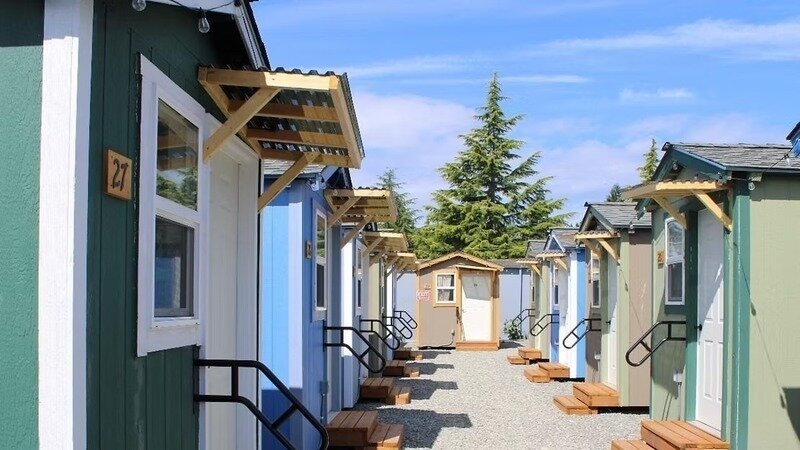
They are faster AND cheaper to build
- Cost to build: $28,000 start to finish for a Tiny House compared to $300,000 to $400,000 per apartment unit or $148,000 to $363,000 per hotel-based Emergency Housing unit
- Time to build: Approximately 3-4 tiny houses can be built in a week, compared to 22+ months for an apartment building with 20+ units
Tiny House Villages provide much needed capacity to our homelessness response system by increasing the diversity of emergency shelter options
- A lack of tiny houses is the number one reason why folks who are outside refuse shelter offers
- There are 3871 emergency shelter beds in King County with about 15%, or approximately 600, being tiny houses across 17 villages
- Most, though not all, tiny house villages run on a model of guest participation and “clean and sober” living. Adding tiny house capacity will allow operators of “enhanced” shelters to prioritize beds for individuals for severe mental health and substance use challenges
Tiny house villages cannot be the only intervention within our homelessness response system. We need more supportive housing and more emergency shelters that provide intensive support for the 34% of unsheltered individuals who have a serious mental illness and the 47% of unsheltered individuals who have a substance use disorder. However, tiny houses are clearly undersupplied for the demand and your signature on this petition is an affirmation of: “Yes, we want our unhoused neighbors to live with dignity, to live without fear of street violence, and to have the stability they need to reach their goals.”

81
The Issue
The U District is the densest and one of the most diverse neighborhoods in Seattle. A majority of businesses in the U District are ground floor retailers and a majority of businesses on the Ave are BIPOC and/or women owned. The U District Community Council is incredibly proud of our diverse and inclusive neighborhood and we want to be part of the solution to the heartbreaking impacts of unsheltered homelessness. The facts below show why a tiny house village in the U District can provide much needed capacity to the homelessness response system.
They are faster AND cheaper to build
- Cost to build: $28,000 start to finish for a Tiny House compared to $300,000 to $400,000 per apartment unit or $148,000 to $363,000 per hotel-based Emergency Housing unit
- Time to build: Approximately 3-4 tiny houses can be built in a week, compared to 22+ months for an apartment building with 20+ units
Tiny House Villages provide much needed capacity to our homelessness response system by increasing the diversity of emergency shelter options
- A lack of tiny houses is the number one reason why folks who are outside refuse shelter offers
- There are 3871 emergency shelter beds in King County with about 15%, or approximately 600, being tiny houses across 17 villages
- Most, though not all, tiny house villages run on a model of guest participation and “clean and sober” living. Adding tiny house capacity will allow operators of “enhanced” shelters to prioritize beds for individuals for severe mental health and substance use challenges
Tiny house villages cannot be the only intervention within our homelessness response system. We need more supportive housing and more emergency shelters that provide intensive support for the 34% of unsheltered individuals who have a serious mental illness and the 47% of unsheltered individuals who have a substance use disorder. However, tiny houses are clearly undersupplied for the demand and your signature on this petition is an affirmation of: “Yes, we want our unhoused neighbors to live with dignity, to live without fear of street violence, and to have the stability they need to reach their goals.”
The Decision Makers


Supporter Voices
Petition Updates
Share this petition
Petition created on May 6, 2026