Would You Want a Pickleball Court 100 Feet from your Bedroom?

Would You Want a Pickleball Court 100 Feet from your Bedroom?
The Issue
Would You Want a Pickleball Court 100 Feet from your Bedroom?
Fairfax County's zoning regulations are being applied in a manner that would permit outdoor pickleball courts on residential properties without adequate protections for nearby homes — a situation made possible because current zoning and noise ordinances fail to address the sport’s uniquely disruptive noise, leaving nearby homes vulnerable to constant disturbance.
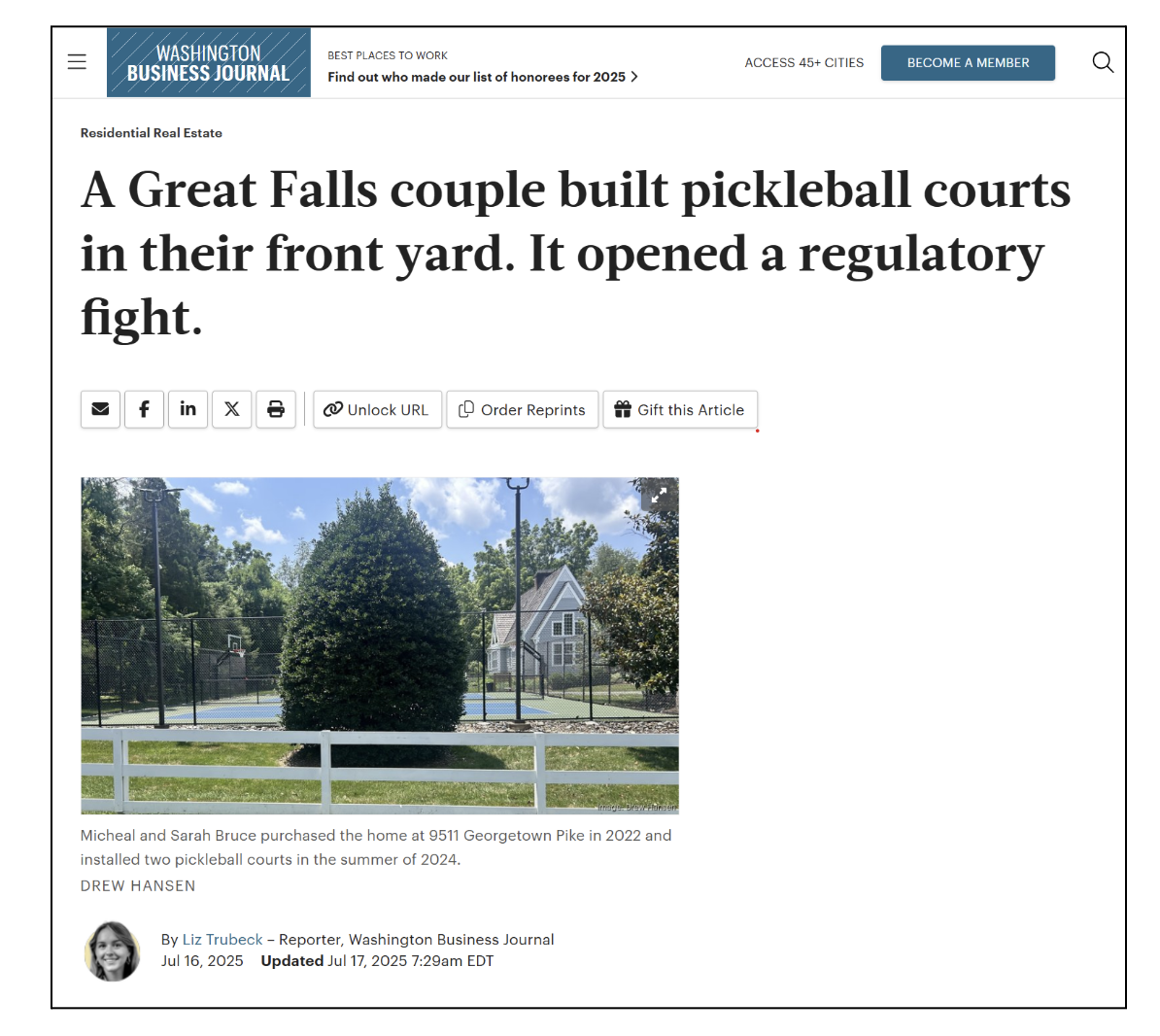
View the article here.
Pickleball is here to stay. We support recreation but reject poorly planned development that harms residents.
We urge the Fairfax County Board of Supervisors to act now
Unregulated pickleball noise is not just an annoyance—it’s a documented health and property risk. The science is clear. The community is united. It’s time for Fairfax County to lead by adopting zoning and noise standards that reflect the harmful characteristics and impacts of impulsive noise from pickleball. Protect neighborhoods. Protect health. Protect home values.
We, the undersigned residents of Fairfax County, respectfully petition the Board of Supervisors and the Park Authority to adopt and enforce stronger zoning regulations on the placement and operation of pickleball courts, based on the growing and well-documented evidence that pickleball noise constitutes a significant nuisance to residential communities.
Background and Rationale
Pickleball has seen explosive demand evidenced by a 293% increase in dedicated pickleball courts since 2021 at Fairfax County Park Authority parks, according to FCPA’s FY24 Sports Court Update. While recreation and community engagement are important, the expansion of this sport has introduced harmful and sustained noise into residential areas—noise that science, federal guidance, and local experience affirm as uniquely disruptive.
Scientific and Regulatory Evidence of Harm
- Highly Impulsive Noise Requires Correction:
The distinctive “pop” of pickleball is not like the three sources of impulsive noise listed in the County noise ordinance: weapons fire, pile drivers, and blasting. And the requirements for measuring those noises include use of the “fast” setting on sound meters, which averages sound pressure over an eighth (0.125) of a second. The much briefer peak noise from a pickleball strike (only 0.005 seconds) is averaged out to near zero by the fast setting. And while pile drivers can cause actual hearing loss, the impact of pickleball noise is to annoy and stress listeners. Such impacts are not cured by limiting the sound levels in dBA appropriate for continuous noises such as vehicles, aircraft, or loudspeakers make. The impacts will be realized if the pickleball noise can be heard above background noise levels. Relevant standards and measurement methods need to be specified in County ordinances.”
- Impacts:
Impulse noise is more irritating than steady noise. Also, the pickleball pop has an average peak frequency near 1200 Hz, which falls within the highly sensitive range for human hearing, and matches the frequencies used in vehicle backup alarms that are designed to demand attention.
- Expert Consensus on Irritation: In a published news story, Fairfax County Park Authority Director Jai Cole was quoted about shutting down a pickleball court: “It’s unethical of me to force even one resident to endure the sounds that we ourselves have identified as being a nuisance.” According to sound engineer Bill Bulté, quoted in the New York Times (June 30, 2023), "pickleball noise is annoying to humans." Over 1,000 public comments on that article echoed the same.
- Impact on Property Values: Independent analyses suggest that proximity to pickleball courts lowers home values, particularly when courts are within 200–300 feet of residential properties. Homeowners have expressed growing concerns about long-term equity erosion due to constant, unavoidable noise.
Failures in Current Regulation
The only impulsive noises addressed in the County’s current noise ordinance—pile drivers, weapons firing, and blasting—pose risks of hearing loss and are measured by standard noise monitors using their “fast” setting. Appropriate noise monitoring tools for pickleball need to be specified, and a new basis for setback distances and noise mitigation measures is needed.
Petition Demands
We, the residents, call upon Fairfax County to take the following actions: Update its Zoning Ordinance to Prevent Poorly Sited Pickleball Courts and Update Standards for Noise Enforcement. Specifically, we ask:
- Setback from Residential Properties
Various authorities, like the EPA guidance and acoustic studies, have recommended separation distances between pickleball courts and residential properties ranging from 250 to 1,200 feet. County staff should research this dimension as it would be applied to courts without any noise mitigation measures and select a default distance. For proposed courts less than the adopted default distance, a qualified acoustic engineer having experience assessing pickleball noises should be retained to conduct a noise impact assessment prepared in accordance with ISO 9613 and ANSI S12.62, demonstrating that impulsive noise can be attenuated to a level that cannot be discerned from background noise at all boundaries with residential properties. - Bring Fairfax County Park Authority's Courts in Compliance with the Amended Ordinances
Fund the Fairfax County Park Authority to contract for noise impact assessments for pickleball courts within the default distance, and either provide noise mitigation measures or remove the courts as indicated. - Include Community Input in Site Selection
Require Board of Zoning public notification and a hearing before the siting or expansion of any court within 500 feet of homes. - Adopt Impulse Noise-Based Metrics
Revise measurement protocols to account for impulse noise per ANSI/EPA guidance and not rely solely on Leq or A-weighted dBA averages, which are scientifically inadequate for impulsive sounds. - Suspend Court Additions in Residential Areas
Until the above regulations are adopted, pause the construction or conversion of any new pickleball facilities within 500 feet of homes.
Conclusion
Pickleball is here to stay. We support recreation but reject poorly planned development that harms residents. The question is whether we plan for it or react to it. Currently, courts are being sited without considering their unique sound profile or the physical and psychological impacts of the sounds on neighbors. That’s not fair to players or residents.
Fairfax County has the opportunity—and the responsibility—to lead on this issue. By updating its zoning and noise ordinances, the County can ensure that this popular sport can continue to grow—without generating unnecessary conflict or harm.
Fairfax County must act now to protect quality of life, public health and property values.
Sign the petition. Contact your local Supervisor. Spread the word.
Let’s keep our neighborhoods livable — and our zoning smart.

152
The Issue
Would You Want a Pickleball Court 100 Feet from your Bedroom?
Fairfax County's zoning regulations are being applied in a manner that would permit outdoor pickleball courts on residential properties without adequate protections for nearby homes — a situation made possible because current zoning and noise ordinances fail to address the sport’s uniquely disruptive noise, leaving nearby homes vulnerable to constant disturbance.
View the article here.
Pickleball is here to stay. We support recreation but reject poorly planned development that harms residents.
We urge the Fairfax County Board of Supervisors to act now
Unregulated pickleball noise is not just an annoyance—it’s a documented health and property risk. The science is clear. The community is united. It’s time for Fairfax County to lead by adopting zoning and noise standards that reflect the harmful characteristics and impacts of impulsive noise from pickleball. Protect neighborhoods. Protect health. Protect home values.
We, the undersigned residents of Fairfax County, respectfully petition the Board of Supervisors and the Park Authority to adopt and enforce stronger zoning regulations on the placement and operation of pickleball courts, based on the growing and well-documented evidence that pickleball noise constitutes a significant nuisance to residential communities.
Background and Rationale
Pickleball has seen explosive demand evidenced by a 293% increase in dedicated pickleball courts since 2021 at Fairfax County Park Authority parks, according to FCPA’s FY24 Sports Court Update. While recreation and community engagement are important, the expansion of this sport has introduced harmful and sustained noise into residential areas—noise that science, federal guidance, and local experience affirm as uniquely disruptive.
Scientific and Regulatory Evidence of Harm
- Highly Impulsive Noise Requires Correction:
The distinctive “pop” of pickleball is not like the three sources of impulsive noise listed in the County noise ordinance: weapons fire, pile drivers, and blasting. And the requirements for measuring those noises include use of the “fast” setting on sound meters, which averages sound pressure over an eighth (0.125) of a second. The much briefer peak noise from a pickleball strike (only 0.005 seconds) is averaged out to near zero by the fast setting. And while pile drivers can cause actual hearing loss, the impact of pickleball noise is to annoy and stress listeners. Such impacts are not cured by limiting the sound levels in dBA appropriate for continuous noises such as vehicles, aircraft, or loudspeakers make. The impacts will be realized if the pickleball noise can be heard above background noise levels. Relevant standards and measurement methods need to be specified in County ordinances.”
- Impacts:
Impulse noise is more irritating than steady noise. Also, the pickleball pop has an average peak frequency near 1200 Hz, which falls within the highly sensitive range for human hearing, and matches the frequencies used in vehicle backup alarms that are designed to demand attention.
- Expert Consensus on Irritation: In a published news story, Fairfax County Park Authority Director Jai Cole was quoted about shutting down a pickleball court: “It’s unethical of me to force even one resident to endure the sounds that we ourselves have identified as being a nuisance.” According to sound engineer Bill Bulté, quoted in the New York Times (June 30, 2023), "pickleball noise is annoying to humans." Over 1,000 public comments on that article echoed the same.
- Impact on Property Values: Independent analyses suggest that proximity to pickleball courts lowers home values, particularly when courts are within 200–300 feet of residential properties. Homeowners have expressed growing concerns about long-term equity erosion due to constant, unavoidable noise.
Failures in Current Regulation
The only impulsive noises addressed in the County’s current noise ordinance—pile drivers, weapons firing, and blasting—pose risks of hearing loss and are measured by standard noise monitors using their “fast” setting. Appropriate noise monitoring tools for pickleball need to be specified, and a new basis for setback distances and noise mitigation measures is needed.
Petition Demands
We, the residents, call upon Fairfax County to take the following actions: Update its Zoning Ordinance to Prevent Poorly Sited Pickleball Courts and Update Standards for Noise Enforcement. Specifically, we ask:
- Setback from Residential Properties
Various authorities, like the EPA guidance and acoustic studies, have recommended separation distances between pickleball courts and residential properties ranging from 250 to 1,200 feet. County staff should research this dimension as it would be applied to courts without any noise mitigation measures and select a default distance. For proposed courts less than the adopted default distance, a qualified acoustic engineer having experience assessing pickleball noises should be retained to conduct a noise impact assessment prepared in accordance with ISO 9613 and ANSI S12.62, demonstrating that impulsive noise can be attenuated to a level that cannot be discerned from background noise at all boundaries with residential properties. - Bring Fairfax County Park Authority's Courts in Compliance with the Amended Ordinances
Fund the Fairfax County Park Authority to contract for noise impact assessments for pickleball courts within the default distance, and either provide noise mitigation measures or remove the courts as indicated. - Include Community Input in Site Selection
Require Board of Zoning public notification and a hearing before the siting or expansion of any court within 500 feet of homes. - Adopt Impulse Noise-Based Metrics
Revise measurement protocols to account for impulse noise per ANSI/EPA guidance and not rely solely on Leq or A-weighted dBA averages, which are scientifically inadequate for impulsive sounds. - Suspend Court Additions in Residential Areas
Until the above regulations are adopted, pause the construction or conversion of any new pickleball facilities within 500 feet of homes.
Conclusion
Pickleball is here to stay. We support recreation but reject poorly planned development that harms residents. The question is whether we plan for it or react to it. Currently, courts are being sited without considering their unique sound profile or the physical and psychological impacts of the sounds on neighbors. That’s not fair to players or residents.
Fairfax County has the opportunity—and the responsibility—to lead on this issue. By updating its zoning and noise ordinances, the County can ensure that this popular sport can continue to grow—without generating unnecessary conflict or harm.
Fairfax County must act now to protect quality of life, public health and property values.
Sign the petition. Contact your local Supervisor. Spread the word.
Let’s keep our neighborhoods livable — and our zoning smart.
152
Supporter Voices
Petition created on August 5, 2025