Message aux signatairesSecretive and Harmful Sums Up the CDC Lyme Corps Program
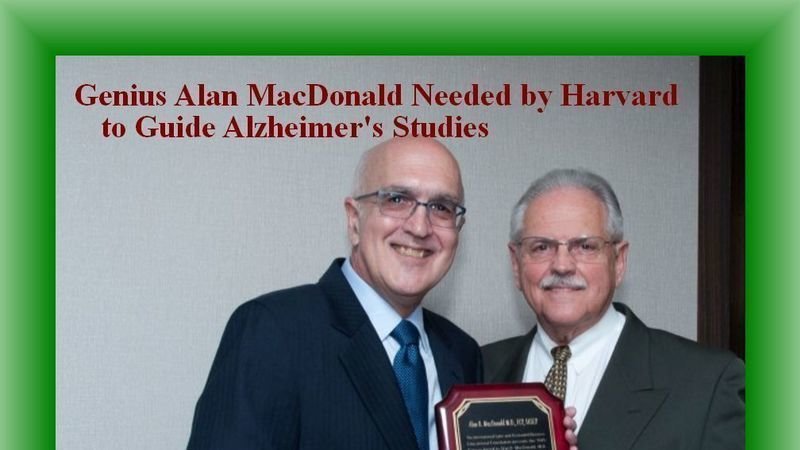
Genius Alan MacDonald Needed by Harvard to Guide Alzheimer’s Studies

Jenna Luche-ThayerRoan Mountain, TN, Estados Unidos
7 de jun. de 2016
Greetings from Jenna,
With all due respect Harvard, Dr Alan MacDonald has been investigating and publishing findings on how bacteria might cause Alzheimer’s and other neurodegenerative diseases for over 30 years. MacDonald is not the first person to pose this theory. However, he has added significantly to the emerging body of knowledge.
Let me tell you how I met Alan MacDonald, the jovial genius. I had been seeking answers for my strange array of medical symptoms since 1997. I had never shown a bullseye rash and therefore the possibility of Lyme disease was excluded.
I went on to be misdiagnosed with chronic fatigue syndrome, fibromyalgia, lupus-like illness, Parkinson-like illness, possibly multiple sclerosis, irritable bowel syndrome and so on and so on and so on. However, none of these diagnoses corresponded to my range of symptoms so I rejected them and the suggested medicines.
In July 2012, I was finally diagnosed with late stage Lyme disease. By this time, my ability to sort my way through this complex and marginalized illness was challenged by my compromised nervous system and cognitive capacity.
I remember reading the CDC information about Lyme disease and their promotion of the Infectious Diseases Society of America’s (IDSA) treatment protocol. To this day, I recall my visceral rejection of the CDC and IDSA Lyme hogwash.
I returned to the internet for information. I remember how the words on the computer screen would change into gobbledygook before the end of the paragraph. I remember sitting in front of my computer, my legs going numb, my fingers and arms tingling, my eyesight blurring - then clearing - then blurring again, fasciculations ranging at odd moments across my body.
And then, I stumbled across YouTube videos that featured master herbalist Stephen Harrod Buhner and Lyme specialist Dr. Joseph J. Burrascano. One week later I found a healthcare practitioner who had personal experience with the seriousness of Lyme disease. I gave my healthcare practitioner a copy of Burrascano’s 'Advanced Topics in Lyme Disease – Diagnostic Hints and Treatment Guidelines for Lyme and Other Tick Borne Illnesses - Sixteenth Edition', Copyright October, 2008 and began an integrative treatment for late stage Lyme.
I doubt I would be functioning or even alive today without the knowledge and guidance shared by Burrascano and Buhner, and the understanding and compassion of my health care practitioner.
By 2014, my health had significantly improved. This is when I discovered Borrelia expert and pathologist Alan MacDonald’s 'The Biology of Lyme Disease: An Expert's Perspective (Part 1, 2 and 3)' YouTube videos.
There are so many phenomenal Lyme experts. However, I treasure Alan MacDonald.
I remember watching his three videos. And then I watched them all again. Not because I had difficulty following his lectures but because I enjoyed them so very much. This is a man who clearly loves his work and enjoys sharing his knowledge. In addition to being an extremely innovative investigator, he is a born educator. Prior to watching his videos I had a good understanding of Lyme disease. However, when he spoke to me across cyberspace, I gained respect for this pathogen.
After watching Alan’s videos I searched for his name on the internet. This search led me deep into the world of those who understand, treat and advocate on behalf of chronic Lyme and coinfections.
By connecting to Alan via YouTube, Alan then connected me to the writings of Pamela Weintraub, the devotion of Ray Jones, Jemsek and Ken Liegner, the world of Lyme advocates, and the many Lyme friends and foundational connections that make up my life today.
In 2015, I was elated to meet Alan MacDonald and Joseph Burrascano in person at the Ft. Lauderdale International Lyme and Associated Diseases Society (ILADS) conference. This gathering was a wonderful experience for me on many levels. I met incredible people and gained a deep sense of connection and support.
Therefore, I was quite miffed when one of my personal heroes was not mentioned in the May 27, 2016 article 'Harvard Researchers Unveil New Alzheimer's Theory'. The article states,
“Researchers at Harvard this week offered a new theory of Alzheimer’s Disease that - if true - would upend our understanding of the disease and suggest new routes for treatment and prevention… In this view, Alzheimer’s would be triggered by a normal immune response gone astray or into over-drive in response to bacteria or other pathogens, according to the paper’s authors, Rudy Tanzi and Robert Moir, both of Harvard Medical School and Massachusetts General Hospital.” [Ref 1]
Actually, I was more than miffed. I recognize that Harvard is a very prestigious and well-funded institution. As such, I imagine they did a literature review regarding possible causes of Alzheimer’s and dementia. Harvard should have found a number of references to Alan MacDonald’s innovative work on Alzheimer’s and Borrelia. Particularly as a number of MacDonald’s specimens came from the Harvard Mclean Brain Bank.
Alan MacDonald has been theorizing that bacteria might contribute to Alzheimer’s since the late 1980s. He has been suggesting that autoimmunity may play a related role since 2006.
More than 30 years ago, MacDonald accessed four intact Alzheimer’s brains from the National Alzheimer’s Disease Brain Bank. He theorized that these brains were damaged by Borrelia and “within a few months the vats were swarming with spirochetes” cultured from these brain samples. [Ref 2] A 1989 Journal of American Medical Association publication included MacDonald’s report in the form of a letter.
University of Lausanne’s Swiss scientist Judith Miklossy reported finding spirochetes in the blood, cerebrospinal fluid and brain tissue of 14 autopsied Alzheimer’s patients. Miklossy’s replication of MacDonald’s decade old work gives substantial weight to his theory that bacteria may contribute to or cause Alzheimer’s and dementia. [Ref 3]
In 2006, the advancements of diagnostic and investigative technologies allowed MacDonald to detect Borrelia DNA in the 10 Alzheimer’s brains he ordered from the Harvard McLean brain bank. MacDonald found evidence of a “transfection” in the cells of seven of those brains. Transfection is a DNA sequence that appears to be part human and part spirochete. It appears the “proteins causing illness are no longer manufactured by the B burgdorferi spirochetes but by the genes of the patients themselves [autoimmunity].” He found the hybrid DNA in the areas rich in the plaque causing Alzheimer’s. MacDonald reported his findings in a six article series in the journal Medical Hypothesis. [Ref 4]
MacDonald has a related article, 'Cystic borrelia in Alzheimer’s disease and in non-dementia neuroborreliosis', in Alzheimer’s & Dementia: The Journal of the Alzheimer’s Association, 2 (3), Supplement, Page S433, July 2006. [Ref 5]
On May 19, 2016 the PR Newswire carried the story 'Lyme Bacteria Hides Inside Parasitic Worms, Causing Chronic Brain Diseases - Recent discovery confirmed by state-of-the-art Molecular Beacon DNA probes.' This article details MacDonald’s findings of three Borrelia pathogens - including the Borrelia that causes Lyme - alive inside parasites in the brain tissue of nineteen deceased patients. These parasites are nematodes and a tick bite delivers the nematode into the human body.
For this recent investigation, The Rocky Mountain Multiple Sclerosis (MS) Center Tissue Bank provided MacDonald ten specimens from deceased MS patients. All ten specimens showed evidence of Borrelia infected nematodes. Infected nematodes were also found in five brain specimens from persons who died of the Glioblastoma multiforme brain tumor. [Ref 6]
Thomas Edison said, “Genius is 1 percent inspiration, 99 percent perspiration.” By this definition, MacDonald is most certainly a genius. These achievements on the part of Alan MacDonald were largely done on his personal time and without the substantial research dollars that Harvard enjoys.
I suggest that Harvard’s Rudy Tanzi and Robert Moir bring in Alan MacDonald as a paid advisor for their research efforts on 'how Alzheimer’s may be triggered by an abnormal immune response to bacteria or other pathogens'. Tanzi and Moir may learn a great deal and they will certainly enjoy MacDonald’s good company.
Thanks - Jenna
Bio - Jenna Luché-Thayer’s expertise includes government transparency and accountability and the integration of marginalized groups. Luché-Thayer is informed by three decades of professional policy and grassroots experience in 40 countries. She has extensive experience in congressional relations, testimony and legislation. She has worked with governments, the United Nations, nonprofits and the corporate world and has over 65 sponsored publications. Luché-Thayer received the International Woman’s Day Award for Exemplary Dedication and Contributions to Improving the Political and Legal Status of Women (US government) and built the Highest Ranking Technical Area in Accomplishment, Innovation & Comparative Advantage for United Nations Capital Development Fund.
[Ref 1] Karen Weintraub, Special for USA TODAY - http://www.usatoday.com/story/news/2016/05/26/harvard-researchers-unveil-new-alzheimers-theory/85004894/
[Ref 2] Cure Unknown - Inside the Lyme Epidemic, by Pamela Weintraub
[Ref 3] Cure Unknown - Inside the Lyme Epidemic, by Pamela Weintraub.
[Ref 4] Cure Unknown - Inside the Lyme Epidemic, by Pamela Weintraub.
[Ref 5] http://www.alzheimersanddementia.com/article/S1552-5260(06)03848-9/fulltext
[Ref 6] http://www.prnewswire.com/news-releases/lyme-bacteria-hides-inside-parasitic-worms-causing-chronic-brain-diseases-300270742.html
Copier le lien
WhatsApp
Facebook
Nextdoor
E-mail
X