
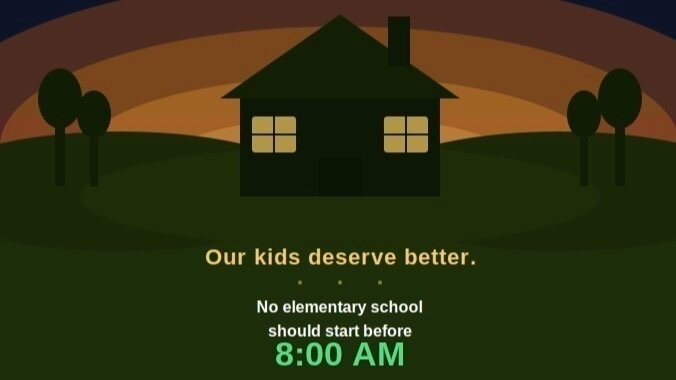
One community, one ask: no Edmonds student starts before 8 AM
The Issue
Visit our website to learn more: https://esdparentsunited.org
To the Edmonds School District Board of Directors:
We, the parents and guardians of elementary school students in the Edmonds School District, urge you to reverse the proposed 2027–2028 bell schedule that assigns 12 elementary schools to Tier 1 (7:20 AM start / 1:50 PM dismissal).
This schedule is not supported by research, creates serious hardship for working families, and disproportionately harms our youngest and most vulnerable students.
What Is Being Proposed
The district’s proposed bell schedule would place 12 elementary schools — including Beverly, Cedar Valley, Chase Lake, College Place, Hilltop, Martha Lake, Meadowdale, Mountlake Terrace, Oak Heights, Terrace Park, Westgate, and others — in Tier 1, requiring school to begin at 7:20 AM.
For most of these children, that means waking up at 6:00–6:30 AM to catch a bus or get ready for school.
Meanwhile, several middle schools would start at 8:45 AM, and Madrona K-8 — also an elementary school — is slated for a 9:25 AM start.
This is not fair. This is not supported by science. And this is not acceptable.
Why This Is Wrong
1. This is a biology problem
The district’s implicit argument is that parents should simply put children to bed earlier. But sleep science does not work that way. Young children’s circadian biology means many cannot fall asleep before 9:00–9:30 PM, regardless of parental effort. A 7:20 AM start requires a 6:00–6:30 AM wake-up — leaving children with 8–9 hours of sleep at best, below the 9–12 hours recommended by the American Academy of Pediatrics, the CDC, and the American Academy of Sleep Medicine.
Chronic sleep deprivation in elementary-age children is linked to:
• Reduced attention span and academic performance
• Increased emotional dysregulation and behavioral problems
• Weakened immune function and growth impacts
• Long-term developmental consequences
No credible research recommends a 7:20 AM start for elementary students.
2. This is an equity problem
The district is applying the scientific consensus on adolescent sleep — that teenagers need later start times — by shifting the burden onto the students least able to bear it: six- and seven-year-olds. High school students can self-manage early mornings; elementary children cannot. High school students can drive or arrange their own transportation; elementary children depend entirely on parents and buses.
Solving a high school scheduling problem by making elementary kids wake up earlier is not equity. It is the opposite.
3. Research does not support early starts for elementary students
A peer-reviewed study of over 1,900,000 student records found that schools with the earliest start times showed higher absenteeism trends and no academic benefit compared to later-starting schools. The study found no evidence that early start times help elementary students — and directional evidence that they increase absences.
The district’s own justification — that elementary students are “less affected” than high schoolers — conflates “less affected than teens” with “not affected.” These are not the same thing.
Moreover, research tested an 8:00 AM start — and even then found elementary students lost sleep because they couldn’t fall asleep proportionally earlier. The study’s own authors wrote that the key unanswered question is “how early is too early.” ESD is proposing 7:20 AM — 40 minutes earlier than the study ever tested. You cannot cite research about 8:00 AM to justify 7:20 AM. By the researchers’ own words, the science to support 7:20 AM does not exist.
4. The 1:50 PM dismissal creates a childcare crisis for working families
A 1:50 PM dismissal means children are released more than three hours before most working parents finish their workday. This gap:
• Forces single parents and dual-income households into impossible choices
• Significantly increases after-school care costs for families already stretched thin
• Falls hardest on lower-income families with the fewest childcare options — making this a direct equity issue
5. The bus scheduling rationale does not justify harming all elementary students
We understand that bus fleet constraints require staggered start times. However:
• Bus scheduling affects an estimated minority of families
• The correct solution is to identify specific bus gaps and address them — not shift the entire elementary school day
6. The community surveys never asked elementary families if they support a 7:20 AM start
The district has conducted three rounds of community input since 2024. But a review of the survey history reveals a critical gap:
• The May 2024 districtwide survey gathered input on possible changes and revealed community interest in starting high school later — not elementary school earlier.
• The March 2025 survey presented two schedule options and removed one based on feedback.
• The January 2026 survey asked whether there is “broad support” for adjusting start and end times — framed around the high school sleep issue.
At no point were elementary families directly asked: “Do you support a 7:20 AM start time for your elementary-age children?” That is a fundamentally different question from whether the community supports later high school start times.
The district should not use community support for later high school starts as a mandate to impose earlier elementary starts. These are not the same policy, and they were never put to the same vote.
7. Choice schools face compounded inequity
Terrace Park Elementary is one of the district's few choice schools, meaning its students travel
significantly farther than neighborhood school students. Assigning Terrace Park to a 7:20 AM tier
means families driving 20–30 minutes must wake their children at 5:30–6:00 AM. Meanwhile
Madrona K-8 — another elementary school — starts at 9:25 AM. This disparity within the same
district is difficult to justify
What We Are Asking
We call on the Edmonds School District Board of Directors to:
1. Withdraw the proposed Tier 1 (7:20 AM) assignment for elementary schools from the 2027–2028 bell schedule.
2. Adopt a schedule where no elementary school starts before 8:00 AM, consistent with research recommendations and peer district practices.
3. Shift start times later across all tiers rather than solving high school scheduling needs at the expense of elementary students.
4. Conduct a new survey that directly asks elementary families whether they support a 7:20 AM start time for their children — separately from the high school start time question.
5. Publish the full results of all prior surveys, broken down by school level and tier, so the community can assess whether elementary families were fairly represented in the process.
6. Hold a dedicated community meeting before any final vote, with adequate notice and interpretation services, to hear from affected families.
Join Us at the June 9 Board Meeting
Tuesday, June 9, 2026 — 6:30 PM
Educational Services Center Boardroom, 20420 68th Avenue West, Lynnwood, WA 98036
Also livestreamed. Sign up for public comment at the door, or submit written comment via BoardDocs (agenda posted by June 8).
Please sign this petition and share it with every Edmonds School District family you know.
Our children deserve to wake up rested. Let’s make sure the school board hears us.

2,334
The Issue
Visit our website to learn more: https://esdparentsunited.org
To the Edmonds School District Board of Directors:
We, the parents and guardians of elementary school students in the Edmonds School District, urge you to reverse the proposed 2027–2028 bell schedule that assigns 12 elementary schools to Tier 1 (7:20 AM start / 1:50 PM dismissal).
This schedule is not supported by research, creates serious hardship for working families, and disproportionately harms our youngest and most vulnerable students.
What Is Being Proposed
The district’s proposed bell schedule would place 12 elementary schools — including Beverly, Cedar Valley, Chase Lake, College Place, Hilltop, Martha Lake, Meadowdale, Mountlake Terrace, Oak Heights, Terrace Park, Westgate, and others — in Tier 1, requiring school to begin at 7:20 AM.
For most of these children, that means waking up at 6:00–6:30 AM to catch a bus or get ready for school.
Meanwhile, several middle schools would start at 8:45 AM, and Madrona K-8 — also an elementary school — is slated for a 9:25 AM start.
This is not fair. This is not supported by science. And this is not acceptable.
Why This Is Wrong
1. This is a biology problem
The district’s implicit argument is that parents should simply put children to bed earlier. But sleep science does not work that way. Young children’s circadian biology means many cannot fall asleep before 9:00–9:30 PM, regardless of parental effort. A 7:20 AM start requires a 6:00–6:30 AM wake-up — leaving children with 8–9 hours of sleep at best, below the 9–12 hours recommended by the American Academy of Pediatrics, the CDC, and the American Academy of Sleep Medicine.
Chronic sleep deprivation in elementary-age children is linked to:
• Reduced attention span and academic performance
• Increased emotional dysregulation and behavioral problems
• Weakened immune function and growth impacts
• Long-term developmental consequences
No credible research recommends a 7:20 AM start for elementary students.
2. This is an equity problem
The district is applying the scientific consensus on adolescent sleep — that teenagers need later start times — by shifting the burden onto the students least able to bear it: six- and seven-year-olds. High school students can self-manage early mornings; elementary children cannot. High school students can drive or arrange their own transportation; elementary children depend entirely on parents and buses.
Solving a high school scheduling problem by making elementary kids wake up earlier is not equity. It is the opposite.
3. Research does not support early starts for elementary students
A peer-reviewed study of over 1,900,000 student records found that schools with the earliest start times showed higher absenteeism trends and no academic benefit compared to later-starting schools. The study found no evidence that early start times help elementary students — and directional evidence that they increase absences.
The district’s own justification — that elementary students are “less affected” than high schoolers — conflates “less affected than teens” with “not affected.” These are not the same thing.
Moreover, research tested an 8:00 AM start — and even then found elementary students lost sleep because they couldn’t fall asleep proportionally earlier. The study’s own authors wrote that the key unanswered question is “how early is too early.” ESD is proposing 7:20 AM — 40 minutes earlier than the study ever tested. You cannot cite research about 8:00 AM to justify 7:20 AM. By the researchers’ own words, the science to support 7:20 AM does not exist.
4. The 1:50 PM dismissal creates a childcare crisis for working families
A 1:50 PM dismissal means children are released more than three hours before most working parents finish their workday. This gap:
• Forces single parents and dual-income households into impossible choices
• Significantly increases after-school care costs for families already stretched thin
• Falls hardest on lower-income families with the fewest childcare options — making this a direct equity issue
5. The bus scheduling rationale does not justify harming all elementary students
We understand that bus fleet constraints require staggered start times. However:
• Bus scheduling affects an estimated minority of families
• The correct solution is to identify specific bus gaps and address them — not shift the entire elementary school day
6. The community surveys never asked elementary families if they support a 7:20 AM start
The district has conducted three rounds of community input since 2024. But a review of the survey history reveals a critical gap:
• The May 2024 districtwide survey gathered input on possible changes and revealed community interest in starting high school later — not elementary school earlier.
• The March 2025 survey presented two schedule options and removed one based on feedback.
• The January 2026 survey asked whether there is “broad support” for adjusting start and end times — framed around the high school sleep issue.
At no point were elementary families directly asked: “Do you support a 7:20 AM start time for your elementary-age children?” That is a fundamentally different question from whether the community supports later high school start times.
The district should not use community support for later high school starts as a mandate to impose earlier elementary starts. These are not the same policy, and they were never put to the same vote.
7. Choice schools face compounded inequity
Terrace Park Elementary is one of the district's few choice schools, meaning its students travel
significantly farther than neighborhood school students. Assigning Terrace Park to a 7:20 AM tier
means families driving 20–30 minutes must wake their children at 5:30–6:00 AM. Meanwhile
Madrona K-8 — another elementary school — starts at 9:25 AM. This disparity within the same
district is difficult to justify
What We Are Asking
We call on the Edmonds School District Board of Directors to:
1. Withdraw the proposed Tier 1 (7:20 AM) assignment for elementary schools from the 2027–2028 bell schedule.
2. Adopt a schedule where no elementary school starts before 8:00 AM, consistent with research recommendations and peer district practices.
3. Shift start times later across all tiers rather than solving high school scheduling needs at the expense of elementary students.
4. Conduct a new survey that directly asks elementary families whether they support a 7:20 AM start time for their children — separately from the high school start time question.
5. Publish the full results of all prior surveys, broken down by school level and tier, so the community can assess whether elementary families were fairly represented in the process.
6. Hold a dedicated community meeting before any final vote, with adequate notice and interpretation services, to hear from affected families.
Join Us at the June 9 Board Meeting
Tuesday, June 9, 2026 — 6:30 PM
Educational Services Center Boardroom, 20420 68th Avenue West, Lynnwood, WA 98036
Also livestreamed. Sign up for public comment at the door, or submit written comment via BoardDocs (agenda posted by June 8).
Please sign this petition and share it with every Edmonds School District family you know.
Our children deserve to wake up rested. Let’s make sure the school board hears us.
The Decision Makers

Supporter Voices
Petition Updates
Share this petition
Petition created on June 3, 2026