VOTE NO CONFIDENCE IN BOARD CHAIR AND EXECUTIVE DIRECTOR

VOTE NO CONFIDENCE IN BOARD CHAIR AND EXECUTIVE DIRECTOR
The Issue
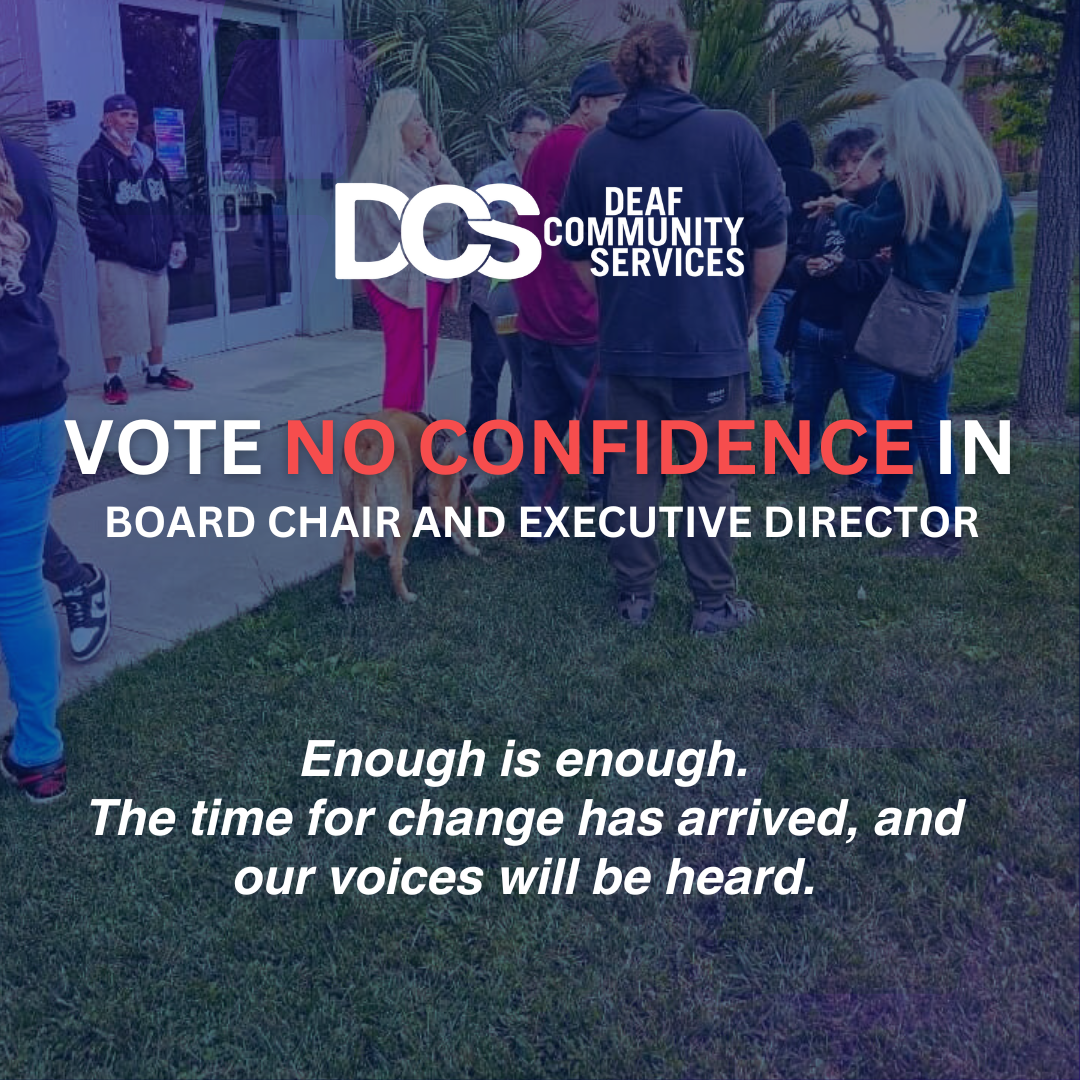
The current situation exposes troubling patterns of neglect and opacity (lack of transparency) within the organization's leadership. The Board Chair and Executive Director have consistently failed to prioritize the needs of the Deaf community, neglecting their duties and fostering an atmosphere of mistrust. A recent incident, where community members were barred from a meeting advertised as open, highlights a concerning lack of transparency and engagement. Compounding these issues, the Executive Director's one-sided unilateral decision-making and dismissive attitude towards staff and community feedback exacerbate (increase) existing tensions. To restore faith in the organization and its commitment to effectively serving the Deaf community, it is crucial to address these concerns promptly and transparently.
In a non-profit organization like Deaf Community Services of San Diego (DCS), good management and regular leadership changes are important for success in serving the community. Board Chairs have a term limit of three years? This helps prevent burnout and makes sure the leadership team can adapt to changes. The current Board Chair has been in their role for more than three years. To keep DCS strong and make sure it can achieve its mission of empowering the Deaf community, it's important to choose a new chair. This person should understand the community's changing needs and be able to lead the organization effectively.
The Executive Director has allowed their Leadership Team to share private information about employees with other staff members. This breaches workplace confidentiality laws and has led to gossip, damaging trust in the leadership. Employees now struggle to trust their bosses to keep information private and secure. This adversely affects the work environment, and immediate action is needed from the Executive Director to rectify the situation and improve the workplace.
Lack of Commitment: The San Diego nonprofit's Board Chair and Executive Director have consistently neglected their essential roles, failing to prioritize the Deaf community's needs. Their unwillingness to engage with the community and address concerns openly reveals a clear lack of dedication.
As evident in this YouTube video:
https://www.youtube.com/watch?v=qcbMxZp_K04&t=13s
The Executive Director made a commitment to actively listen and communicate with staff members and the community. However, her later actions show a clear disregard for these promises, leaving both staff and community members feeling disappointed and ignored.
This shows the difference between what the Executive Director said she would do and what she actually did, emphasizing how her actions affected those involved.
Furthermore, their unwillingness to develop and implement necessary policies to improve service quality shows a lack of attention to their duties. Adding to this issue, they have consistently failed to support hardworking staff and volunteers, indicating a need for more effort in nurturing a strong, lasting organization committed to serving San Diego's Deaf community.
Worse still, the Executive Director is virtually nearly invisible to many Deaf individuals, rarely making an appearance or checking in on the community they were appointed to serve. It's painfully obvious: the Deaf community's needs have been pushed to the bottom of the priority list, a heartbreaking reality that can't be ignored any longer.
No Transparency: April 24,2024 at 6pm; In a deceitful move, the board advertised a meeting on social media, asking the public to attend and voice their concerns. The deaf community, committed to engaging with their leadership, arrived on time and ready to share their needs.
However, they faced a shocking act of betrayal when the Executive Director and Board Chair barred them from entering the meeting. Incredibly, they even called the police to protect them from the very community they claimed to represent. Incredibly, they even called the police before the meeting, claiming it was to protect them from the very community they were supposed to represent. Insisting on a 30-person limit under the pretense (excuse) of safety concerns, they silenced the community's requests for accommodations. This exposed their indifference towards the deaf community, this showed their lack of care for the Deaf community causing feelings of neglect and frustration. Now, the community questions their leadership's motives and searches for answers in the face of such injustice.
The Executive Director's actions have left the community and staff in a state of confusion and mistrust. She had clearly promised transparent communication and regular updates on important information. However, her lack of follow-through on this commitment has led to a feeling of betrayal among the community and staff.
Moreover, the Executive Director's refusal to disclose essential information, such as details about fundraisers and budget allocations, raises significant concerns about her transparency and accountability. This behavior makes it difficult for the deaf community to understand the organization's financial health and how resources are being used to support their needs.
Ultimately, the community and staff feel left in the dark and question the Executive Director's intentions. The lack of open communication and financial transparency undermines the foundation of trust that is crucial for a healthy relationship between leadership and the community they serve.
Adding to the list of concerns, the Executive Director's management style has created an atmosphere of fear and instability among the staff. In particular, her tendency to abruptly terminate employees without prior warning or explanation, often at the end of the workday, has left staff members feeling anxious and uncertain about their job security.
This sudden and seemingly arbitrary (randon) dismissal of employees not only disrupts the work environment but also raises questions about the fairness and professionalism of the organization's leadership. A pattern of such actions can erode (weaken) trust, lower morale, and ultimately hinder the organization's ability to effectively serve the needs of the deaf community.
To maintain a healthy and productive work environment, it is crucial for the Executive Director to foster open communication, demonstrate transparency in decision-making, and handle personnel matters in a considerate and professional manner.
Neglect: Since 2022, the deaf community has asked the Board Chair and Executive Director for a town hall meeting, but their requests have been ignored. Even in 2024, the leadership continues to dismiss these concerns.
By refusing to hold a town hall, the Board Chair and Executive Director are silencing the voices of the deaf community and making them feel unimportant. This neglect harms the relationship between the leadership and the community they should be serving.
For several months, DCS staff have asked the leadership team, including the Executive Director, to provide an ASL-signed handbook. The Executive Director has ignored this request because they do not value staff feedback and expect employees to follow their preferences without question.
This unwillingness to listen to staff concerns creates a difficult work environment where employees feel frustrated and unheard. Ignoring these issues damages teamwork and cooperation in the workplace.
Lack of Communication: Poor communication from the Executive Director and leadership team has created a toxic environment filled with confusion, drama, and frustration. By favoring certain employees and only sharing important information with them, the Executive Director has left most staff feeling ignored and isolated.
The Executive Director's poor listening skills and lack of communication have also made the deaf community feel unheard and confused. This lack of transparency and inclusion hurts the organization's ability to work together and serve its community effectively.
The Executive Director made a decision to move the Deaf Community Services headquarters to National City without consulting the deaf community. This has upset many people because the new location is far away and makes it harder for them to access important services.
The Executive Director also signed the lease without input from advisory committee members, ignoring proper procedures and teamwork. By making this decision without considering the community's needs, the Executive Director has risked the organization's reputation and ability to serve the people who rely on it.
Lack of Resources: The Executive Director has not addressed the needs of different members of the deaf community, such as deaf-blind people and senior citizens. By not providing information in accessible formats like ASL-signed vlogs, the Executive Director is making it harder for these individuals to access resources and feel included. This lack of support goes against the organization's mission to serve the community and makes people feel neglected. To create a supportive environment, the Executive Director must prioritize inclusivity for all members of the deaf community.
No Collaboration: The San Diego Deaf Community Services has a serious teamwork problem. Staff, the deaf community, and leadership struggle to work together. The Board Chair and Executive Director prioritize leadership issues over community concerns, creating a sense of oppression.
The Executive Director's absence at local deaf events shows their disconnect from the community. Deaf staff feel ignored compared to hearing staff, causing tension between the groups. Some hearing staff are supportive, but the Executive Director favors them, excluding deaf employees. This favoritism creates conflict instead of unity.
The Executive Director focuses on small issues like performance reviews, pushing staff to work harder without giving recognition or rewards. This makes staff feel unappreciated and fearful of criticism. Morale suffers as the gap between leadership and staff grows.
The Candy Cane Winter Party faced criticism for not considering the needs of deaf attendees. Some people with diabetes or dietary restrictions couldn't enjoy the sugar-focused event.
Organizers didn't ask the deaf community for their input through surveys or other methods, showing they didn't involve the community in planning. This neglect caused an unsatisfactory event and emphasized the disconnect between organizers and the community.
If organizers had asked for feedback and included community needs, the Winter Party could have been successful. Instead, it showed the importance of communication and inclusion for a strong community.
Abuse of Power: There is an issue within the organization that needs immediate attention. It is crucial to address the Board Chair's involvement in allowing the Executive Director to maintain a toxic work environment full of emotional and mental manipulation. This includes controlling behavior, unfairly blaming staff members, spreading harmful gossip, and creating an environment where problem-solving is neglected in favor of blame.
Disturbingly, the Executive Director not only ignores instances of supervisors mistreating staff members but also supports such behavior by defending those responsible, without ever considering the employees' side of the story. This clear favoritism has created an atmosphere of fear, anxiety, anger, and frustration among staff members, who feel ignored and disrespected.
The toxic nature of the workplace has far-reaching consequences, as it not only negatively impacts staff morale but also undermines their ability to serve clients effectively. The Executive Director's apparent satisfaction in suddenly firing staff members, under the excuse of restructuring and while holding personal grudges, shows the urgent need for openness and responsibility within the organization. Such harmful and dishonest practices cannot be accepted, as they break down trust and put at risk the well-being of dedicated employees who work tirelessly to improve the community.
By addressing these issues head-on with transparency, accountability, and a genuine commitment to change, the organization can begin to rebuild trust within the Deaf community and create a more inclusive and supportive environment for all. It is crucial that the Board Chair and Executive Director take immediate action to correct these troubling patterns of neglect and abuse of power, ensuring that Deaf Community Services of San Diego lives up to its mission of empowering and serving the Deaf community.

393
The Issue
The current situation exposes troubling patterns of neglect and opacity (lack of transparency) within the organization's leadership. The Board Chair and Executive Director have consistently failed to prioritize the needs of the Deaf community, neglecting their duties and fostering an atmosphere of mistrust. A recent incident, where community members were barred from a meeting advertised as open, highlights a concerning lack of transparency and engagement. Compounding these issues, the Executive Director's one-sided unilateral decision-making and dismissive attitude towards staff and community feedback exacerbate (increase) existing tensions. To restore faith in the organization and its commitment to effectively serving the Deaf community, it is crucial to address these concerns promptly and transparently.
In a non-profit organization like Deaf Community Services of San Diego (DCS), good management and regular leadership changes are important for success in serving the community. Board Chairs have a term limit of three years? This helps prevent burnout and makes sure the leadership team can adapt to changes. The current Board Chair has been in their role for more than three years. To keep DCS strong and make sure it can achieve its mission of empowering the Deaf community, it's important to choose a new chair. This person should understand the community's changing needs and be able to lead the organization effectively.
The Executive Director has allowed their Leadership Team to share private information about employees with other staff members. This breaches workplace confidentiality laws and has led to gossip, damaging trust in the leadership. Employees now struggle to trust their bosses to keep information private and secure. This adversely affects the work environment, and immediate action is needed from the Executive Director to rectify the situation and improve the workplace.
Lack of Commitment: The San Diego nonprofit's Board Chair and Executive Director have consistently neglected their essential roles, failing to prioritize the Deaf community's needs. Their unwillingness to engage with the community and address concerns openly reveals a clear lack of dedication.
As evident in this YouTube video:
https://www.youtube.com/watch?v=qcbMxZp_K04&t=13s
The Executive Director made a commitment to actively listen and communicate with staff members and the community. However, her later actions show a clear disregard for these promises, leaving both staff and community members feeling disappointed and ignored.
This shows the difference between what the Executive Director said she would do and what she actually did, emphasizing how her actions affected those involved.
Furthermore, their unwillingness to develop and implement necessary policies to improve service quality shows a lack of attention to their duties. Adding to this issue, they have consistently failed to support hardworking staff and volunteers, indicating a need for more effort in nurturing a strong, lasting organization committed to serving San Diego's Deaf community.
Worse still, the Executive Director is virtually nearly invisible to many Deaf individuals, rarely making an appearance or checking in on the community they were appointed to serve. It's painfully obvious: the Deaf community's needs have been pushed to the bottom of the priority list, a heartbreaking reality that can't be ignored any longer.
No Transparency: April 24,2024 at 6pm; In a deceitful move, the board advertised a meeting on social media, asking the public to attend and voice their concerns. The deaf community, committed to engaging with their leadership, arrived on time and ready to share their needs.
However, they faced a shocking act of betrayal when the Executive Director and Board Chair barred them from entering the meeting. Incredibly, they even called the police to protect them from the very community they claimed to represent. Incredibly, they even called the police before the meeting, claiming it was to protect them from the very community they were supposed to represent. Insisting on a 30-person limit under the pretense (excuse) of safety concerns, they silenced the community's requests for accommodations. This exposed their indifference towards the deaf community, this showed their lack of care for the Deaf community causing feelings of neglect and frustration. Now, the community questions their leadership's motives and searches for answers in the face of such injustice.
The Executive Director's actions have left the community and staff in a state of confusion and mistrust. She had clearly promised transparent communication and regular updates on important information. However, her lack of follow-through on this commitment has led to a feeling of betrayal among the community and staff.
Moreover, the Executive Director's refusal to disclose essential information, such as details about fundraisers and budget allocations, raises significant concerns about her transparency and accountability. This behavior makes it difficult for the deaf community to understand the organization's financial health and how resources are being used to support their needs.
Ultimately, the community and staff feel left in the dark and question the Executive Director's intentions. The lack of open communication and financial transparency undermines the foundation of trust that is crucial for a healthy relationship between leadership and the community they serve.
Adding to the list of concerns, the Executive Director's management style has created an atmosphere of fear and instability among the staff. In particular, her tendency to abruptly terminate employees without prior warning or explanation, often at the end of the workday, has left staff members feeling anxious and uncertain about their job security.
This sudden and seemingly arbitrary (randon) dismissal of employees not only disrupts the work environment but also raises questions about the fairness and professionalism of the organization's leadership. A pattern of such actions can erode (weaken) trust, lower morale, and ultimately hinder the organization's ability to effectively serve the needs of the deaf community.
To maintain a healthy and productive work environment, it is crucial for the Executive Director to foster open communication, demonstrate transparency in decision-making, and handle personnel matters in a considerate and professional manner.
Neglect: Since 2022, the deaf community has asked the Board Chair and Executive Director for a town hall meeting, but their requests have been ignored. Even in 2024, the leadership continues to dismiss these concerns.
By refusing to hold a town hall, the Board Chair and Executive Director are silencing the voices of the deaf community and making them feel unimportant. This neglect harms the relationship between the leadership and the community they should be serving.
For several months, DCS staff have asked the leadership team, including the Executive Director, to provide an ASL-signed handbook. The Executive Director has ignored this request because they do not value staff feedback and expect employees to follow their preferences without question.
This unwillingness to listen to staff concerns creates a difficult work environment where employees feel frustrated and unheard. Ignoring these issues damages teamwork and cooperation in the workplace.
Lack of Communication: Poor communication from the Executive Director and leadership team has created a toxic environment filled with confusion, drama, and frustration. By favoring certain employees and only sharing important information with them, the Executive Director has left most staff feeling ignored and isolated.
The Executive Director's poor listening skills and lack of communication have also made the deaf community feel unheard and confused. This lack of transparency and inclusion hurts the organization's ability to work together and serve its community effectively.
The Executive Director made a decision to move the Deaf Community Services headquarters to National City without consulting the deaf community. This has upset many people because the new location is far away and makes it harder for them to access important services.
The Executive Director also signed the lease without input from advisory committee members, ignoring proper procedures and teamwork. By making this decision without considering the community's needs, the Executive Director has risked the organization's reputation and ability to serve the people who rely on it.
Lack of Resources: The Executive Director has not addressed the needs of different members of the deaf community, such as deaf-blind people and senior citizens. By not providing information in accessible formats like ASL-signed vlogs, the Executive Director is making it harder for these individuals to access resources and feel included. This lack of support goes against the organization's mission to serve the community and makes people feel neglected. To create a supportive environment, the Executive Director must prioritize inclusivity for all members of the deaf community.
No Collaboration: The San Diego Deaf Community Services has a serious teamwork problem. Staff, the deaf community, and leadership struggle to work together. The Board Chair and Executive Director prioritize leadership issues over community concerns, creating a sense of oppression.
The Executive Director's absence at local deaf events shows their disconnect from the community. Deaf staff feel ignored compared to hearing staff, causing tension between the groups. Some hearing staff are supportive, but the Executive Director favors them, excluding deaf employees. This favoritism creates conflict instead of unity.
The Executive Director focuses on small issues like performance reviews, pushing staff to work harder without giving recognition or rewards. This makes staff feel unappreciated and fearful of criticism. Morale suffers as the gap between leadership and staff grows.
The Candy Cane Winter Party faced criticism for not considering the needs of deaf attendees. Some people with diabetes or dietary restrictions couldn't enjoy the sugar-focused event.
Organizers didn't ask the deaf community for their input through surveys or other methods, showing they didn't involve the community in planning. This neglect caused an unsatisfactory event and emphasized the disconnect between organizers and the community.
If organizers had asked for feedback and included community needs, the Winter Party could have been successful. Instead, it showed the importance of communication and inclusion for a strong community.
Abuse of Power: There is an issue within the organization that needs immediate attention. It is crucial to address the Board Chair's involvement in allowing the Executive Director to maintain a toxic work environment full of emotional and mental manipulation. This includes controlling behavior, unfairly blaming staff members, spreading harmful gossip, and creating an environment where problem-solving is neglected in favor of blame.
Disturbingly, the Executive Director not only ignores instances of supervisors mistreating staff members but also supports such behavior by defending those responsible, without ever considering the employees' side of the story. This clear favoritism has created an atmosphere of fear, anxiety, anger, and frustration among staff members, who feel ignored and disrespected.
The toxic nature of the workplace has far-reaching consequences, as it not only negatively impacts staff morale but also undermines their ability to serve clients effectively. The Executive Director's apparent satisfaction in suddenly firing staff members, under the excuse of restructuring and while holding personal grudges, shows the urgent need for openness and responsibility within the organization. Such harmful and dishonest practices cannot be accepted, as they break down trust and put at risk the well-being of dedicated employees who work tirelessly to improve the community.
By addressing these issues head-on with transparency, accountability, and a genuine commitment to change, the organization can begin to rebuild trust within the Deaf community and create a more inclusive and supportive environment for all. It is crucial that the Board Chair and Executive Director take immediate action to correct these troubling patterns of neglect and abuse of power, ensuring that Deaf Community Services of San Diego lives up to its mission of empowering and serving the Deaf community.
393
The Decision Makers
Supporter Voices
Petition Updates
Share this petition
Petition created on April 25, 2024