

Urge White House Officials to Invest in Sustainable Food Practices for Climate Health
The Issue
What does food have to do with climate change? As someone personally invested in this cause, I've come to understand the significant role our food system plays in exacerbating the global climate crisis.
The food we consume, and the processes involved in its production, not only impact our health but also significantly affect the environment. Each stage of food production - from cultivation, processing, transportation, distribution, preparation, consumption, to waste management - emits greenhouse gases that contribute to global warming. It is shocking but true that about a third of all human-caused greenhouse gas emissions are linked to food systems.
The choices we make about what we eat have far-reaching impacts on our planet. Switching to sustainable food practices is a crucial step towards mitigating climate change. It is time our administration recognized this link and actively invested in policies to encourage more sustainable food practices.
I urge the White House to acknowledge the connection between our dietary habits and the climate crisis, and to invest in sustainable food systems that will foster healthier diets and a healthier planet for future generations.
What does food have to do with climate change?
What we eat, and how that food is produced, affects our health but also the environment. Food needs to be grown and processed, transported, distributed, prepared, consumed, and sometimes disposed of. Each of these steps creates greenhouse gases that trap the sun’s heat and contribute to climate change. About a third of all human-caused greenhouse gas emissions is linked to food. The largest chunk of food-related greenhouse gases comes from agriculture and land use. This includes, for instance: methane from cattle’s digestive process,
nitrous oxide from fertilizers used for crop production,
carbon dioxide from cutting down forests for the expansion of farmland,
other agricultural emissions from manure management, rice cultivation, burning of crop residues, and the use of fuel on farms.
A much smaller share of the greenhouse gas emissions of food are caused by:
refrigeration and transport of food, industrial processes such as the production of paper and aluminum for packaging, the management of food waste.
Which foods cause the most greenhouse gas emissions?
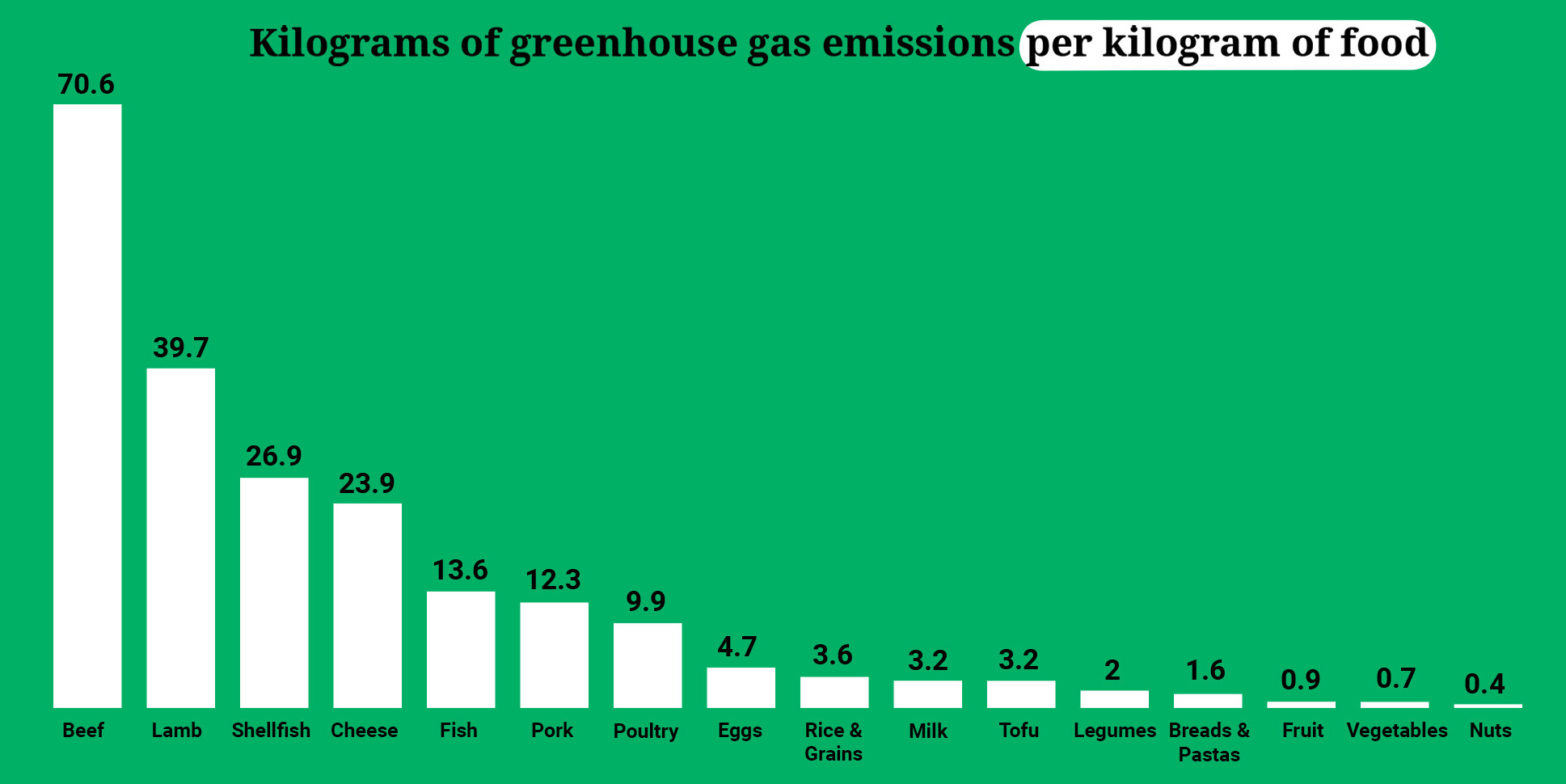
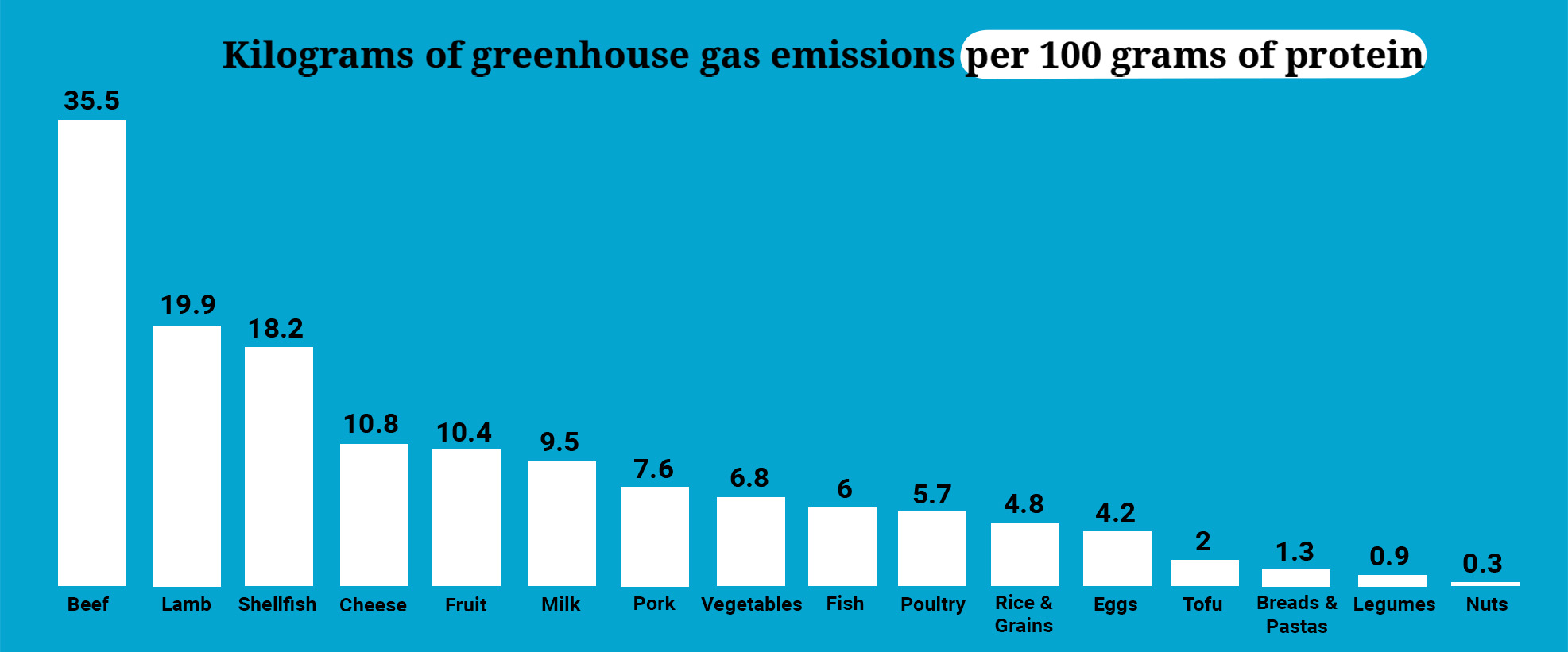
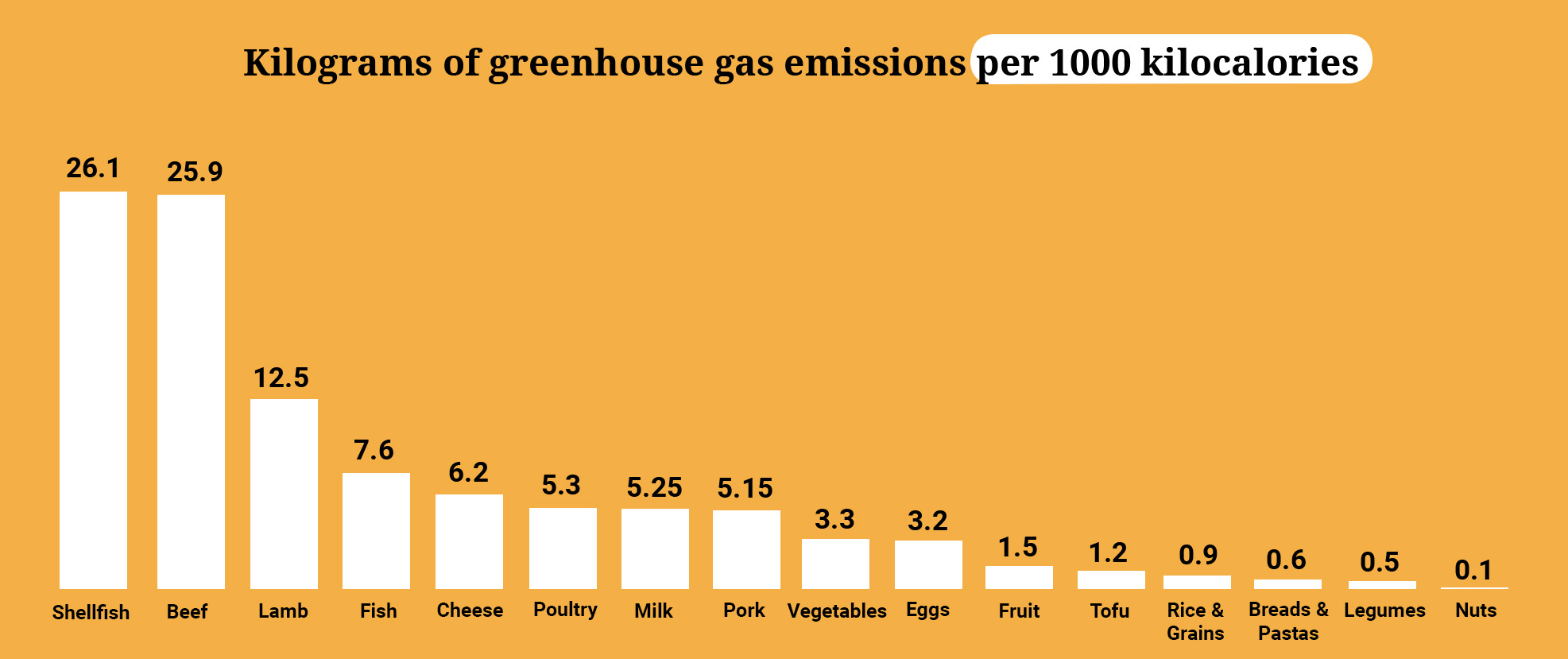
The climate impact of food is measured in terms of greenhouse gas emissions intensity. The emissions intensity is expressed in kilograms of “carbon dioxide equivalents” – which includes not only CO2 but all greenhouse gases – per kilogram of food, per gram of protein or per calorie. Animal-based foods, especially red meat, dairy, and farmed shrimp, are generally associated with the highest greenhouse gas emissions. This is because: Meat production often requires extensive grasslands, which is often created by cutting down trees, releasing carbon dioxide stored in forests. Cows and sheep emit methane as they digest grass and plants. The cattle’s waste on pastures and chemical fertilizers used on crops for cattle feed emit nitrous oxide, another powerful greenhouse gas. Shrimp farms often occupy coastal lands formerly covered in mangrove forests which absorb huge amounts of carbon. The large carbon footprint of shrimp or prawns is mainly due to the stored carbon that is released into the atmosphere when mangroves are cut down to create shrimp farms. Plant-based foods – such as fruits and vegetables, whole grains, beans, peas, nuts, and lentils – generally use less energy, land, and water, and have lower greenhouse gas intensities than animal-based foods.
Here are three charts showing the carbon footprint of different food products. Emissions can be compared based on weight (per kilogram of food), or in terms of nutritional units (per 100 grams of protein or per 1000 kilocalories) which shows us how efficiently different foods supply protein or energy.
Notes:
- Emissions are measured in kilograms of carbon dioxide equivalents, kgCO2eq, which takes into account not only carbon dioxide but also other greenhouse gases, such as methane and nitrous oxide, by converting them to carbon dioxide equivalents with the same global warming potential.
- Beef combines beef cattle and dairy cattle. | Shellfish and fish are farmed. | Cheese and milk include all dairy, i.e. animal sources such as cow, goat, sheep, buffalo, camel.
Sources:
- Babiker, M., G. Berndes, K. Blok, B. Cohen, A. Cowie, O. Geden, V. Ginzburg, A. Leip, P. Smith, M. Sugiyama, F. Yamba, 2022: Cross-sectoral perspectives (Chapter 12). In IPCC, 2022: Climate Change 2022: Mitigation of Climate Change. Contribution of Working Group III to the Sixth Assessment Report of the Intergovernmental Panel on Climate Change [P.R. Shukla, J. Skea, R. Slade, A. Al Khourdajie, R. van Diemen, D. McCollum, M. Pathak, S. Some, P. Vyas, R. Fradera, M. Belkacemi, A. Hasija, G. Lisboa, S. Luz, J. Malley, (eds.)]. Cambridge University Press, Cambridge, UK and New York, NY, USA. doi: 10.1017/9781009157926.005
- Poore, J., & Nemecek, T. (2018). Reducing food’s environmental impacts through producers and consumers. Science, 360(6392), 987-992
- EDGAR-FOOD global emission inventory of GHGs from the food systems
- Our World in Data: Environmental Impacts of Food Production
How can food-related emissions be reduced?
Reducing emissions from the food sector requires changes at all stages, from producers to consumers. Where appropriate, shifting food systems towards plant-rich diets – with more plant protein (such as beans, chickpeas, lentils, nuts, and grains), a reduced amount of animal-based foods (meat and dairy) and less saturated fats (butter, milk, cheese, meat, coconut oil and palm oil) – can lead to a significant reduction in greenhouse gas emissions compared to current dietary patterns in most industrialized countries. Alternative proteins – such as plant-based meat and dairy substitutes, insect-based proteins, and cell-based/cultivated meat – provide promising prospects and are attracting growing demand, financial investment and technological innovation. But animal products remain an important source of food security, nutrition, livelihoods for large numbers of rural populations around the world. Improved feeds and feeding techniques can reduce methane generated during cattle’s digestion as well as the amount of gases released by decomposing manure. Smaller herd sizes, with fewer, more productive animals can also help. And better agricultural practices, such as improved manure and fertilizer management, rotational grazing to maintain healthy soil to store carbon, and the restoration of degraded lands can significantly reduce greenhouse gas emissions. At the same time, reducing food waste is key. Almost 1 billion tons of food – 17 percent of all food available to consumers worldwide – goes into trash bins every year. Producing, transporting, and letting that food rot contribute more than 8 percent of global greenhouse gas emissions. If food waste were a country, it would be the third-largest emitting country in the world.
What can you do?
Eat healthier meals:
Start eating a more plant-rich, balanced diet – one that provides energy and nutrients from several different food groups – and reduce foods that are harder on our planet. Meat and dairy can be important sources of protein and micronutrients, particularly in lower-income countries where diets lack diversity. But in most high-income countries, shifting to more plant-based foods promotes better health and significantly lowers your environmental impact compared to the average meat-based diet. What you eat is much more important than how far that food has travelled or how much packaging it has. Transport and packaging typically account for only a small fraction of foods’ greenhouse gas emission.
Cut your food waste:
Think about how you buy, prepare and dispose of food. When you throw away food, you’re also wasting the energy, land, water, and fertilizer that was used to produce, package, and transport it. Only buy what you need – and use up what you buy. And don’t shy away from buying imperfect-looking fruits and vegetables. They might otherwise get thrown out. Stop the waste, save money, reduce emissions, and help preserve resources for future generations. If you do need to throw out food, composting your leftovers can reduce the amount of methane and CO2 released by the organic waste.
Try a sustainable recipe:
Have a look at these recipes by leading chefs who are cooking up dishes that are not only delicious but also good for you and the planet. (Source: https://www.un.org/sustainabledevelopment/actnow-food-challenge/ )
Shop with a reusable bag:
The production, use and disposal of plastics contribute to climate change. Instead of a plastic bag, use your own reusable bag and reduce the amount of plastic waste in our world.
Please, sign this petition and help pressure our government to make the necessary changes. It is time we treat our environment with the respect it deserves.

1
The Issue
What does food have to do with climate change? As someone personally invested in this cause, I've come to understand the significant role our food system plays in exacerbating the global climate crisis.
The food we consume, and the processes involved in its production, not only impact our health but also significantly affect the environment. Each stage of food production - from cultivation, processing, transportation, distribution, preparation, consumption, to waste management - emits greenhouse gases that contribute to global warming. It is shocking but true that about a third of all human-caused greenhouse gas emissions are linked to food systems.
The choices we make about what we eat have far-reaching impacts on our planet. Switching to sustainable food practices is a crucial step towards mitigating climate change. It is time our administration recognized this link and actively invested in policies to encourage more sustainable food practices.
I urge the White House to acknowledge the connection between our dietary habits and the climate crisis, and to invest in sustainable food systems that will foster healthier diets and a healthier planet for future generations.
What does food have to do with climate change?
What we eat, and how that food is produced, affects our health but also the environment. Food needs to be grown and processed, transported, distributed, prepared, consumed, and sometimes disposed of. Each of these steps creates greenhouse gases that trap the sun’s heat and contribute to climate change. About a third of all human-caused greenhouse gas emissions is linked to food. The largest chunk of food-related greenhouse gases comes from agriculture and land use. This includes, for instance: methane from cattle’s digestive process,
nitrous oxide from fertilizers used for crop production,
carbon dioxide from cutting down forests for the expansion of farmland,
other agricultural emissions from manure management, rice cultivation, burning of crop residues, and the use of fuel on farms.
A much smaller share of the greenhouse gas emissions of food are caused by:
refrigeration and transport of food, industrial processes such as the production of paper and aluminum for packaging, the management of food waste.
Which foods cause the most greenhouse gas emissions?
The climate impact of food is measured in terms of greenhouse gas emissions intensity. The emissions intensity is expressed in kilograms of “carbon dioxide equivalents” – which includes not only CO2 but all greenhouse gases – per kilogram of food, per gram of protein or per calorie. Animal-based foods, especially red meat, dairy, and farmed shrimp, are generally associated with the highest greenhouse gas emissions. This is because: Meat production often requires extensive grasslands, which is often created by cutting down trees, releasing carbon dioxide stored in forests. Cows and sheep emit methane as they digest grass and plants. The cattle’s waste on pastures and chemical fertilizers used on crops for cattle feed emit nitrous oxide, another powerful greenhouse gas. Shrimp farms often occupy coastal lands formerly covered in mangrove forests which absorb huge amounts of carbon. The large carbon footprint of shrimp or prawns is mainly due to the stored carbon that is released into the atmosphere when mangroves are cut down to create shrimp farms. Plant-based foods – such as fruits and vegetables, whole grains, beans, peas, nuts, and lentils – generally use less energy, land, and water, and have lower greenhouse gas intensities than animal-based foods.
Here are three charts showing the carbon footprint of different food products. Emissions can be compared based on weight (per kilogram of food), or in terms of nutritional units (per 100 grams of protein or per 1000 kilocalories) which shows us how efficiently different foods supply protein or energy.
Notes:
- Emissions are measured in kilograms of carbon dioxide equivalents, kgCO2eq, which takes into account not only carbon dioxide but also other greenhouse gases, such as methane and nitrous oxide, by converting them to carbon dioxide equivalents with the same global warming potential.
- Beef combines beef cattle and dairy cattle. | Shellfish and fish are farmed. | Cheese and milk include all dairy, i.e. animal sources such as cow, goat, sheep, buffalo, camel.
Sources:
- Babiker, M., G. Berndes, K. Blok, B. Cohen, A. Cowie, O. Geden, V. Ginzburg, A. Leip, P. Smith, M. Sugiyama, F. Yamba, 2022: Cross-sectoral perspectives (Chapter 12). In IPCC, 2022: Climate Change 2022: Mitigation of Climate Change. Contribution of Working Group III to the Sixth Assessment Report of the Intergovernmental Panel on Climate Change [P.R. Shukla, J. Skea, R. Slade, A. Al Khourdajie, R. van Diemen, D. McCollum, M. Pathak, S. Some, P. Vyas, R. Fradera, M. Belkacemi, A. Hasija, G. Lisboa, S. Luz, J. Malley, (eds.)]. Cambridge University Press, Cambridge, UK and New York, NY, USA. doi: 10.1017/9781009157926.005
- Poore, J., & Nemecek, T. (2018). Reducing food’s environmental impacts through producers and consumers. Science, 360(6392), 987-992
- EDGAR-FOOD global emission inventory of GHGs from the food systems
- Our World in Data: Environmental Impacts of Food Production
How can food-related emissions be reduced?
Reducing emissions from the food sector requires changes at all stages, from producers to consumers. Where appropriate, shifting food systems towards plant-rich diets – with more plant protein (such as beans, chickpeas, lentils, nuts, and grains), a reduced amount of animal-based foods (meat and dairy) and less saturated fats (butter, milk, cheese, meat, coconut oil and palm oil) – can lead to a significant reduction in greenhouse gas emissions compared to current dietary patterns in most industrialized countries. Alternative proteins – such as plant-based meat and dairy substitutes, insect-based proteins, and cell-based/cultivated meat – provide promising prospects and are attracting growing demand, financial investment and technological innovation. But animal products remain an important source of food security, nutrition, livelihoods for large numbers of rural populations around the world. Improved feeds and feeding techniques can reduce methane generated during cattle’s digestion as well as the amount of gases released by decomposing manure. Smaller herd sizes, with fewer, more productive animals can also help. And better agricultural practices, such as improved manure and fertilizer management, rotational grazing to maintain healthy soil to store carbon, and the restoration of degraded lands can significantly reduce greenhouse gas emissions. At the same time, reducing food waste is key. Almost 1 billion tons of food – 17 percent of all food available to consumers worldwide – goes into trash bins every year. Producing, transporting, and letting that food rot contribute more than 8 percent of global greenhouse gas emissions. If food waste were a country, it would be the third-largest emitting country in the world.
What can you do?
Eat healthier meals:
Start eating a more plant-rich, balanced diet – one that provides energy and nutrients from several different food groups – and reduce foods that are harder on our planet. Meat and dairy can be important sources of protein and micronutrients, particularly in lower-income countries where diets lack diversity. But in most high-income countries, shifting to more plant-based foods promotes better health and significantly lowers your environmental impact compared to the average meat-based diet. What you eat is much more important than how far that food has travelled or how much packaging it has. Transport and packaging typically account for only a small fraction of foods’ greenhouse gas emission.
Cut your food waste:
Think about how you buy, prepare and dispose of food. When you throw away food, you’re also wasting the energy, land, water, and fertilizer that was used to produce, package, and transport it. Only buy what you need – and use up what you buy. And don’t shy away from buying imperfect-looking fruits and vegetables. They might otherwise get thrown out. Stop the waste, save money, reduce emissions, and help preserve resources for future generations. If you do need to throw out food, composting your leftovers can reduce the amount of methane and CO2 released by the organic waste.
Try a sustainable recipe:
Have a look at these recipes by leading chefs who are cooking up dishes that are not only delicious but also good for you and the planet. (Source: https://www.un.org/sustainabledevelopment/actnow-food-challenge/ )
Shop with a reusable bag:
The production, use and disposal of plastics contribute to climate change. Instead of a plastic bag, use your own reusable bag and reduce the amount of plastic waste in our world.
Please, sign this petition and help pressure our government to make the necessary changes. It is time we treat our environment with the respect it deserves.
The Decision Makers


Petition Updates
Share this petition
Petition created on September 25, 2024