
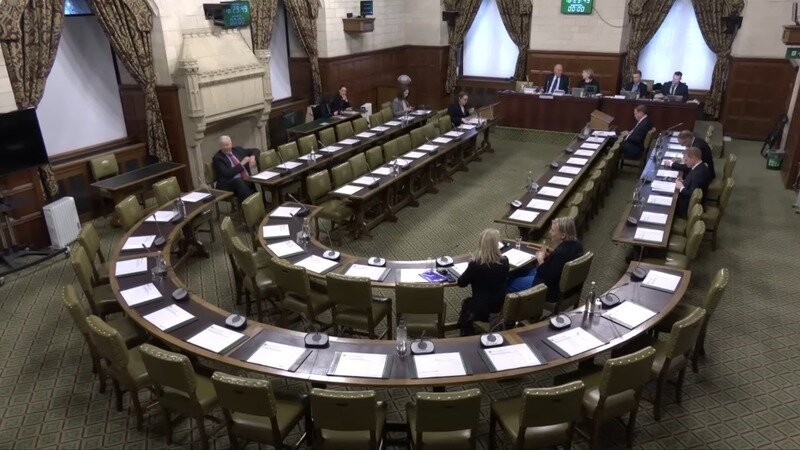
Parliament has debated the petition started by Barry McIlhinney from Perth in Kinross-shire, after it gathered over 129,000 signatures (100,000 is the number required to be considered for debate in Parliament).
As is common with these things, rather than being held in the chamber, it took place in a small committee room, with a tiny number of participants. "Quality rather than quantity", said Dr. Savage who introduced the petition.
You can watch the debate, read the transcript or read the research. I asked ChatGPT to summarise the debate. (I think it's too long to add the content here).
As a (but not the) petition starter I was asked if I was available to take part in a discussion on BBC Radio 5's Matt Chorley show on Monday (starting at 1 hour 48 minutes in), and I was, but in the end they decided to make do with Oxford University constitutional historian, Dr. Luke Blackshill and Chairman of the Newark (defector Robert Jenrick's constituency) Conservative Association, Cllr. Keith Girling. Even though I'm not on it, it is worth a listen.
In February, I asked ChatGPT how many petitions there had been that had been debated and effected change.
35,000+ petitions (with over 100,000 signatures?), 382 debated in parliament, 5 have effected change that I can find:
- Finn's Law (2019): A petition to better protect service animals led directly to the Animal Welfare (Service Animals) Act 2019.
- Upskirting Law (2018): A petition helped force a change in the law to make "upskirting" a specific criminal offence.
- Petitions regarding funding for the cystic fibrosis drug Orkambi
- Improving maternal mortality rates for Black women (e.g., a Maternity Disparities Taskforce in 2022).
- Microbeads Ban (2015): A Change.org (not a Government petitions petition) petition with 1.2M signatures helped influence the UK government to ban plastic microbeads in cosmetics by 2018.
As expected this debate has not effect any change whatsoever. Turkeys voting for Christmas.
Interestingly, but perhaps unsurprisingly, is Wilshire being one of the biggest respondents to the survey with 0.5% of constituents, only beaten by Newark, whose MP is Tory to Reform defectee, Robert Jenrick and Fareham Waterloo MP, Suella Braverman, who did likewise. It's funny how people only start to care about things when it affects them...
Yours,
Craig Poxon
Here’s a clear, concise summary of the Hansard debate on “Member Defections: Automatic By-Elections” (16 March 2026):
🧾 Context
The debate was triggered by a public petition (129,000+ signatures) calling for automatic by-elections when MPs change party.
Currently, MPs can defect and keep their seat; they are not required to seek re-election.
⚖️ Core Issue
The debate centres on a fundamental question:
Do voters elect an individual MP, or a party representative?
👍 Arguments for automatic by-elections
Party matters to voters: Many people vote primarily based on party affiliation rather than the individual candidate.
Democratic fairness: If an MP changes party, voters should have the chance to confirm or reject that change.
Mandate argument: Defection may break the “contract” with voters who supported a party platform.
Accountability: A by-election would test whether the MP still has local support.
👎 Arguments against automatic by-elections
MPs are individuals, not delegates: The UK system elects representatives who must be free to act on conscience and judgment.
Existing recall rules: By-elections are currently triggered only by misconduct (e.g. suspension or criminal conviction), not political decisions.
Risk to independence: Forcing by-elections could:
Discourage MPs from challenging their party
Strengthen party control over MPs
Practical concerns: Could lead to frequent, costly elections.
🏛️ Government position
The Government does not support changing the rules.
It maintains the constitutional principle that:
Voters elect individual candidates, not parties.
🧠 Overall takeaway
There is no consensus.
The debate reflects a tension between two democratic ideas:
Party mandate (voters choose a platform)
Representative independence (MPs act individually)
The discussion was exploratory only (as a petitions debate) and did not lead to a vote or law change.