
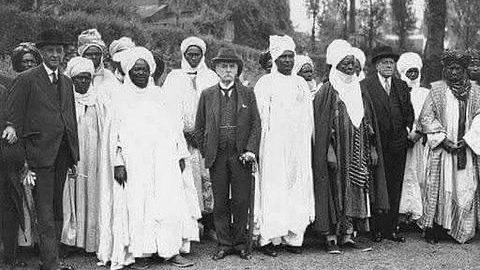
AN ADDRESS by SIR F. LUGARD, HIGH COMMISSIONER to the SULTAN, WAZIRI and ELDERS of SOKOTO, regarding the CONDITIONS of BRITISH RULE, REASONS for the WAR, &c., MARCH 21st, 1903.
Translated to them by Kiari, and checked, word by word, by Major Burdon, Resident, Sokoto (Hausa Schola r) , and others.
Present:---SIR F. LUGARD, COLONEL MORLAND, D.SO., Commandant MAJOR BURDON, Resident, Lieut.-COLONEL McCLINTOCK, Commanding Battalion, MAJOR CUBITT, R.A., brigade Major, CAPTAIN ABADIE, Resident, Zaria, and others. Also the SULTAN elect, the WAZIRI, GALADEMA, MAITURARE, and other Elders of Sokoto.
"The Royal Niger Company made a Treaty with Sokoto many years ago. The Sultan promised friendship and alliance; the Company promised to pay a subsidy, and did so. Three years ago the King of England sent his own officers to administer this country instead of the Company and appointed me as Governor. I at once sent my trusted messenger, Kiari, to take my salutations to the Sultan· of Sokoto, and to say that I held to the promises made by the Company, and looked to the Sultan to fulfill his pledges. I brought money to pay the subsidy when it should fall due. But take note of what happened. My messenger was treated with indignity. It is he who is now interpreting. Ask him what happened and he will remind you. No answer was sent to my letter, which was an insult to me and to my King. Owing to the treaty the Sultan had made with the British, the French could not touch his country. But the Sultan of Sokoto sent no friendly message. The treaty was made in the name of all the Mohammedan Emirates under Sokoto, but they took arms against the British--Nupe, Illorin, and Yola; and Kontagora, and Kano. But I did not wish to denounce the Treaty, and I sent to the Sultan to ask him to nominate an Emir for Kontagora, when Ibrahim fought against us and was driven out. Again he sent no reply, till a year ago I received this letter declaring war.
(Original letter shown to the Elders for identification.)
"So the Treaty was killed by you yourselves and not by me. Then the Magaji of Keffi murdered the Resident--a lame man without arms to defend himself--and he ran to Kano and the Emir Alieu received him with honour. So we went to Kano and fought and drove out Alieu, and the Magaji ran to Sokoto and was treated with honour. Again I wished not to fight with the head of the Musselmans and I sent a friendly letter, but I said that the Magaji must be given up, and that I wished to place a Resident and garrison at Sokoto. I came with troops, for though the Sultan had made a treaty of friendship it was well known that a white man could not come as a friend alone to Sokoto. My letter was put aside and the army of Sokoto came out to fight. We fought and your army was dispersed, and the Sultan fled and no one knows where he is gone. Now it is necessary for me to place a Resident and a garrison here, for this country is close to the country of the French and we are responsible for keeping peace and good order on our frontiers. The Resident is Major Burdon, who comes to you as an advisor and a friend. You will consult him on all matters and be guided by him.
''The old treaties are dead, you have killed them. Now these are the words which I, the High Commissioner, have to say for the future. The Fulani in old times under Dan Fodio conquered this country. They took the right to rule over it, to levy taxes, to depose kings and to create kings. They in turn have by defeat lost their rule which has come into the hands of the British. A1l these things which I have said the Fulani by conquest took the right to do now pass to the British. Every Sultan and Emir and the principal officers of State will be appointed by the High Commissioner throughout all this country. The High Commissioner will be guided by the usual laws of succession and the wishes of the people and chiefs, but will set them aside if he desires for good cause to do so. The Emirs and Chiefs who are appointed will rule over the people as of old time and will take such taxes as are approved by the High Commissioner, but they wil1 obey the 1aws of the Governor and wil1 act in accordance with the advice of the Resident. Buying and selling slayes and enslaving people are forbidden. It is forbidden to import firearms (except flint-locks), and there are other minor matters which the Resident wil1 explain. The Alkalis and the Emirs will hold the law courts as of old, but bribes are forbidden, and mutilation and confinement of men in inhuman prisons are not lawful. The powers of each Court will be contained in a warrant appointing it. Sentences of death will not be carried out without the consent of the Resident.
"The Government will, in future, hold the rights in land which the Fulani took by conquest from the people, and if Government requires land it will take it for any purpose. The Government holds the right of taxation, and will tell the Emirs and Chiefs what taxes they may levy, and what part of them must be paid to Government. The Government will have the right to all minerals, but the people may dig for iron and work in it subject to the approval of the High Commissioner, and may take salt and other minerals subject to any excise imposed by law. Traders wi11 not be taxed by Chiefs, but only by Government. The coinage of the British will be accepted as legal tender, and a rate of exchange for cowries fixed, in consultation with Chiefs, and they will enforce it.
"When an Emirate, or an office of state, becomes vacant, it will only be filled with the consent of the High Commissioner, and the person chosen by the council of Chiefs and approved by the High Commissioner will hold his place only on condition that he obeys the laws of the Protectorate and the conditions of the appointment. Government will in no way interfere with the Mohammedan religion. All men are free to worship God as they please. Mosques and prayer places will be treated with respect by us. Every person, including slaves, has the right to appeal to the Resident, who will, however, endeavor to uphold the power of the native courts to deal with native cases according to the law and custom of the country. If slaves are ill-treated they will be set free as your Koran orders, otherwise Government does not desire to interfere with existing domestic relations. But slaves set free must lie willing to work and not to remain idle or become thieves. The Resident may give permits to trustworthy men to bear firearms. Any person who harbours the Magaji or Keffi will be liable to be arrested and punished. It is his duty to catch him and bring him to the
Resident.
"It is the earnest desire of the King of England that his country shall prosper and grow rich in peace and in contentment, that the population shall increase, and the ruined towns which abound everywhere shall be built up, and that war and trouble shall cease. Henceforth, no Emir or Chief shall levy war or fight, but his case will be settled by law, and if force is necessary Government will employ it. I earnestly hope to give effect in these matters to the wishes of the King.
"In conclusion, I hope that you. will find our rule sympathetic and that the country will prosper and be contented. You need have no fear regarding British rule, it is our wish to learn your customs and fashions, just as you must learn ours. I have little fear that we shall agree, for you have always heard that British rule is just and fair, and people under our King are satisfied. You must not fear to tell the Resident everything and he wi11 help and advise you."
(This outline, of course, was amplified and fully explained in the verbal translation.)
F. D. L.