Ascoltare anche dopo la carriera ; Listening Beyond the Sporting Career

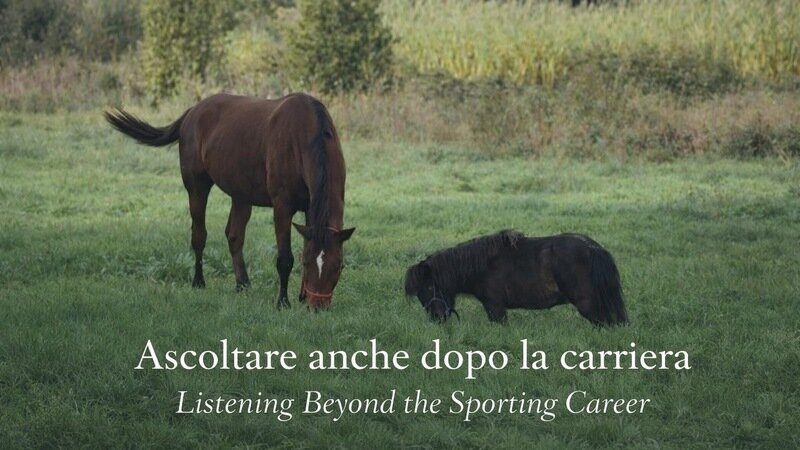
L’equino ha sempre collaborato con l’essere umano: nel lavoro, nel trasporto e, ancora oggi, in molti Paesi, in attività produttive.Nei Paesi europei, questa collaborazione si è progressivamente concentrata nell’ambito delle attività sportive.
L’equino è oggi riconosciuto come animale senziente e tutelato dall’articolo 13 del Trattato sul Funzionamento dell’Unione Europea, che stabilisce il rispetto del suo benessere durante lo svolgimento dell’attività sportiva.
Con il tempo, però, emerge una contraddizione strutturale:
l’articolo 13 tutela il benessere dell’equino durante la fase attiva, ma non garantisce alcuna coerenza né responsabilità dopo la sua conclusione.
Durante la carriera sportiva, l’equino genera valore economico, sociale e pubblico, contribuendo anche alle entrate dello Stato.
Eppure, una volta terminata questa fase, il suo futuro resta spesso fuori dal perimetro di responsabilità del sistema che ne ha beneficiato.
L’equino non è osservato dall’uomo nel suo habitat naturale e in una condizione libera di branco, ma partecipa ad attività strutturate dall’uomo, orientate a obiettivi che non appartengono alla sua specie ma rispondono a interessi umani, accettando questa condizione senza una reale libertà di scelta e adattando il proprio comportamento a richieste e discipline definite dall’uomo.
Proprio per questo, se tale collaborazione produce valore, è necessario che questo valore venga riconosciuto anche oltre la fase produttiva.
In assenza di strumenti che garantiscano continuità e responsabilità, l’equino rischia di uscire dal sistema una volta cessata la sua utilità.
Il Fondo Post-Carriera nasce per colmare questo vuoto:
per rendere coerente ciò che l’articolo 13 afferma durante la fase attiva con ciò che oggi manca dopo.
Tutela senza continuità non è tutela.
È una protezione parziale, e anche il riconoscimento del soggetto resta parziale.
Passo dopo passo.
Grazie a chi firma e condivide questa richiesta.
🇬🇧 English version
Equines have always collaborated with human beings: in work, transport and, still today, in many countries, in productive activities.
In European countries, this collaboration has progressively shifted towards sporting activities.
Today, the equine is recognised as a sentient being and protected under Article 13 of the Treaty on the Functioning of the European Union, which establishes the obligation to respect animal welfare during sporting activity.
Over time, however, a structural contradiction has emerged:
Article 13 protects the equine’s welfare during the active phase, but does not ensure coherence or responsibility after that phase has ended.
During the sporting career, the equine generates economic, social and public value, contributing also to state revenues.
Yet, once this phase ends, the equine’s future often falls outside the system’s sphere of responsibility.
The equine is not simply observed by humans in its natural habitat and in a free herd condition, but takes part in activities structured by humans, oriented towards objectives that do not belong to its species but respond to human interests, accepting this condition without a real freedom of choice and adapting its behaviour to demands and disciplines defined by humans.
For this reason, if such collaboration produces value, that value must also be recognised beyond the productive phase.
In the absence of tools capable of ensuring continuity and responsibility, the equine risks leaving the system once its usefulness has ended.
The Post-Career Fund was conceived to fill this gap:
to make coherent what Article 13 affirms during the active phase with what is currently missing afterwards.
Protection without continuity is not protection.
It is partial protection, and the recognition of the subject remains partial as well.
Step by step.
Thank you to everyone who signs and shares this request.