To reconsider Denial of SB1 Waiver: Bachelor of Music in Music Therapy - Ohio University

To reconsider Denial of SB1 Waiver: Bachelor of Music in Music Therapy - Ohio University
The Issue
Ohio University’s Bachelor of Music in Music Therapy program has been denied an SB1 waiver and has been directed to sunset. Closing the program would end a 75-year legacy as the oldest program in Ohio and reduce access to behavioral health services in Appalachian and rural communities, and across the nation.
Please contact with concerns:
Chancellor Mike Duffey
Mail: 25 South Front Street, Columbus, OH 43215
Email: mduffey@highered.ohio.gov or chancellor@highered.ohio.gov, phone: 614-466-6000
_____________________________________________________________________________________
Introduction
We, the undersigned students, alumni, faculty, clinical partners, and community stakeholders, respectfully petition the Ohio Department of Higher Education to reconsider the denial of the SB1 waiver for the Bachelor of Music in Music Therapy at Ohio University.
This undergraduate program has been a critical pipeline for the music therapy profession in Ohio for decades, providing highly trained clinicians who serve communities in need, particularly in Appalachian Ohio.
_____________________________________________________________________________________
Rationale for Reconsideration
1. Historic Leadership in the Profession
The Ohio University Music Therapy program is the oldest in the state, founded in 1951, and recently celebrated the 75th anniversary of the program.
The Ohio University Music Therapy program is an enhancement to the local and national workforce. The program has trained hundreds of board-certified music therapists (MT-BCs) who contribute to the state of Ohio, the Great Lakes region, and nationally.
The Ohio University Music Therapy Alumni work all over the country, including but not limited to, the following states: Ohio, Illinois, Michigan, Minnesota, Indiana, Pennsylvania, New York, North Carolina, and Wisconsin.
Significant alumni achievements include:
- CEO of Institute for Therapy through the Arts, Chicago, IL
- Founder of the Music Therapy Program at Cleveland Clinic and currently Research Program Manager for Cleveland Clinic’s Arts & Medicine Department
- Group Leader & Manager, Integrative Medicine at Memorial Sloan Kettering Cancer Center, New York
Directors, chairs, professors, adjunct professors, etc. at multiple universities, such as Duquesne, Pacific University, Alverno College, Augsburg University, Saint Mary-of-the-Woods College, Ohio University and others. - Chair of the Certification Board for Music Therapists (CBMT)
- President of the Great Lakes Region of the American Music Therapy Association (GLR-AMTA)
- President of the Association for Ohio Music Therapists (AOMT)
- Co-chair, Workforce Development and Retention Committee for the American Music Therapy Association (AMTA)
- One of the first two State of Ohio CSWMFT Licensing Board Music Therapy Professional Standards Committee Appointment.
- Group Leader & Manager, Integrative Medicine at Memorial Sloan Kettering Cancer Center, New York
- 4 private practice businesses founded and maintained by Ohio University Music Therapy Alumni that have been thriving for over ten years:
- Central Ohio Music Therapy, LLC DBA Ohio Music Therapy Services, LLC (Averages over 50% staffing from OU BM Alumni)
- Rhythm-N-You Music Therapy, Inc (over ⅔ current staff from OU BM Alumni)
- The Groovy Garfoose, LLC (⅔ current staff from OU BM Alumni)
- Mixed Melody Music Center, LLC (formerly the Music Therapy Enrichment Center; both owned and operated by OU BM Alumni)
2. Professional Engagement and Excellence
Ohio University Music Therapy students have had the largest student presence at the Great Lakes Regional Music Therapy Conference (which includes Illinois, Indiana, Michigan, Minnesota, Ohio, and Wisconsin) for four consecutive years, including 25 total undergraduate students attending the most recent conference in Kalamazoo, MI where the 75th anniversary celebration as a program took place.
This demonstrates active professional development and leadership among Ohio University students. They use their knowledge to benefit the community and prioritize innovation in community engagement:
- Very Special Arts Festival–Special Education Arts Festival from 1980-2003
- Strike Down the Stigma–Athens area community mental health fundraiser
- Walk to End Alzheimer's–Raised funds and provided music for the community walk
- Engagement with Bobcat ArtsCare, a university-wide arts-based well-being initiative, including Drumming on the Green as a Mental Health awareness for university students
- Annual Interprofessional Education Event–Music Therapy participates as an interdisciplinary healthcare profession each year in this across campus event, enhancing their understanding and that of other students in a range of healthcare disciplines.
3. Regulated Healthcare Profession
Music therapy is a licensed and regulated profession in Ohio, on par with social work and other healthcare fields under the Counselor, Social Worker, and Marriage and Family Therapist (CSWMFT) Board. Licensure in music therapy was established in October of 2024.
Many existing state regulations require that education and healthcare providers hold a state license. As a result, many current and potential clients have difficulty accessing music therapy services within educational and healthcare facilities. Communication with most state education and healthcare agencies emphasize that service provision procedures require official state recognition—often in the form of a state license—in order for state citizens to access music therapy services (The Certification Board of Music Therapists [CBMT], 2023).
Ohio University Music Therapy Graduates serve in mental health agencies, schools, hospitals, trauma centers, private practices, community arts centers, and autism services.
4. Critical Regional Impact
Closing the undergraduate music therapy program reduces the pipeline of qualified board-certified music therapists in Appalachian Ohio.
Closing the undergraduate music therapy program would worsen existing disparities in access to behavioral and mental health services in the region.
The Ohio University Music Therapy Program prioritizes providing student music therapeutic services required as part of their clinical training at sites that are not able to afford music therapy services due to budget constraints. These facilities have been longstanding community engagement partnerships for the university and will lose access to vital mental health and developmental therapeutic supports if the program closes:
- Beacon School (Athens County Board of Developmental Disabilities)
- Athens City School District (Pre school & Behavioral Intervention Classrooms)
- Alexander School District (Preschool Classrooms)
- Logan-Hocking School District (Behavioral Intervention Classrooms)
- The Gathering Place & Sojourners Resiliency Center
- Hickory Creek & Lindley Inn
- O'Bleness Hospital
- REACH Partial Hospitalization Program
- The Laurels of Athens & Kimes
- Echoing Villages
- Buckeye Community Services Residential Facilities
- Athens County Board of Developmental Disabilities
- Hocking Valley Community Residential Center
- Ohio University Early Childhood Development Center
5. Workforce Demand
The need for quality healthcare workers is growing in healthcare, behavioral health, and educational settings.
- The United States is experiencing a mental health crisis with increased levels of unmet behavioral health needs among people of all ages (CDC, 2025a). The capacity of the behavioral health workforce to meet the demand is limited by supply and distribution challenges.
- Rural counties are more likely than urban counties to lack behavioral health providers. Residents of rural counties are also more likely to receive behavioral health services from primary care providers.
- Behavioral health needs are elevated for children and older adults, as well as in rural and underserved areas. Adequate workforce planning and investments in the behavioral health workforce will be important factors to address these needs.
EXAMPLE: Sam’s Fans is a foundation that was created by Nikki and Dan McCarthy in memory of their daughter Sam to help other children find healing through creative expression. In 2024 alone, Sam’s Fans provided funding for art and music therapy and made the following possible:
- 6,691 individual visits from music and art therapists (up by 2,500 visits from the year before)
- 2,545 unique families receiving service
- 428 group therapy sessions
- 13 partner hospitals and organizations across 3 states, many of which employ board-certified music therapists who were educated at Ohio University
EXAMPLE: Reaching Everyone In Distress (REID) Foundation was created by Rex Elsass and his family in memory of his son Reid who passed from addiction in 2019 and held a deep love for music. In 2025, REID Foundation was able to provide funding for music therapy and therapeutic support programming that made the following possible:
- 8,085 participations (up from 6,154 in 2024) in music therapy and therapeutic music programs provided directly by a music therapist or under the supervision of a music therapist (primarily staffed by OU BM graduates)
- 881 group music therapy sessions and group therapeutic music programs provided
- 12 service sites across 6 Ohio counties
- 9 partnering agencies including the Ohio Department of Rehabilitation & Correction
Eliminating the program actually undermines efforts throughout the state to expand access to mental health, behavioral health, and therapeutic services; including important treatment of substance use disorders and addiction to opioids; promoting health and well-being while decreasing chronic diseases; reducing disparities and targeting health imbalances; addressing social determinants of health; and promoting healthy aging.
These efforts are being supported at the state level by organizations such as the Ohio Department of Health, the Health Policy Institute of Ohio, the Ohio Department of Behavioral Health, Healthy State Alliance, Ohio Mental Health & Addiction Services, Health Impact Ohio, Ohio Department of Aging, Ohio Arts Council, and Creative Ohio. The Appalachian Community Grant Program was created to provide additional support and access to services in Ohio’s Appalachian region, including Athens County. Access to increased mental health, addiction recovery and educational opportunities were among the priorities of this legislation.
The following sites have contracted music therapy services or have hired a music therapist because of the impact of the Ohio University Music Therapy program:
- Bassett House–Adolescent Addiction/Recovery Support
- Beacon School–Specialized School for Developmental Disabilities
- Hickory Creek–Assisted Living Facility
- Hopewell Health Centers–Community Mental Health treatment
- Pivot Point Speech Therapy–Autism developmental support
- Rural Women’s Recovery Program–Inpatient addiction/recovery support
- Serenity Grove–Transitional housing for women in recovery
- The Nest Athens Birth Circle - Resource Center for Families & Young Children
- Athens County Community Singers - A nonprofit organization founded and led by an OU alumni provides a choir for all voices to disabled community members.
6. Conferral Metrics Do Not Reflect Program Quality
Cohorts are intentionally small due to clinical supervision, internship requirements, and accreditation standards, set by the American Music Therapy Association (AMTA) and the National Association for Schools of Music (NASM).
- These requirements include a required bachelor’s degree or equivalency and a 6-month (9-month for school sites) internship (minimum of 1200 total clinical supervised hours by completion) that takes place after all coursework is completed. Students begin the internship at different times (depending on the clinical site start dates and individual student needs), which leads to different graduation “semesters” for the same cohort.
- These varying internship completion dates lead to confusion in graduation data during a calendar year, academic year, or as a cohort.
The state’s three-year conferral threshold penalizes specialized healthcare programs like music therapy.
Graduation numbers since 2020: (*projection based on student class census & internship schedule):
- Class of 2020 - 19
- Class of 2021 - 7
- Class of 2022 - 13
- Class of 2023 - 4
- Class of 2024 - 6
- Class of 2025 - 3
- Class of 2026 - 10*
- Class of 2027 - 6*
- Class of 2028 - 7*
- Class of 2029 - 10*
- 10 year projected average = 8.5 students per year
7. Scarcity of Music Therapy Programs in Ohio
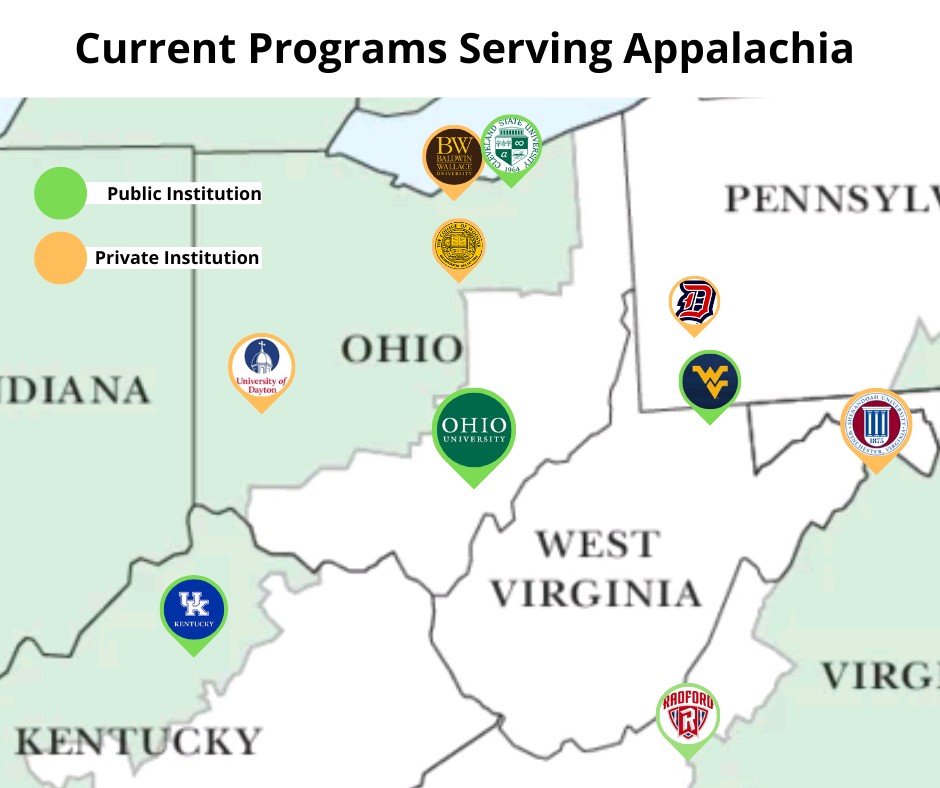
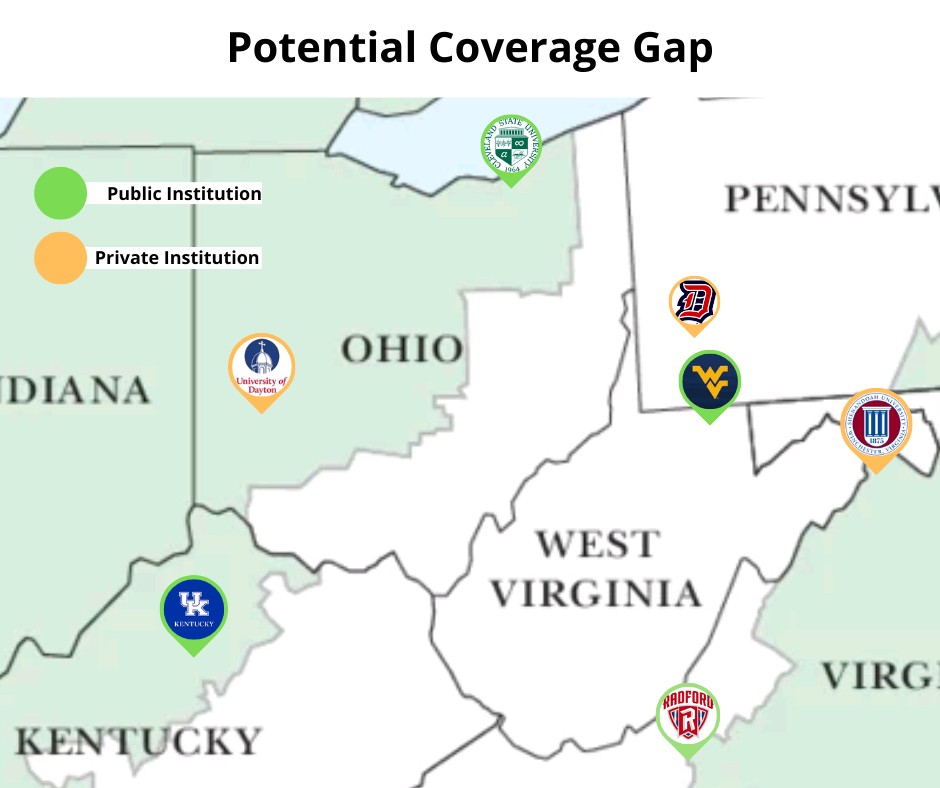
There are currently 4 undergraduate music therapy programs in the entire state of Ohio, representing 5 institutions. At this time, Ohio University and The Cleveland Music Therapy Consortium (The College of Wooster and Baldwin-Wallace University) are planning to sunset their programs over the next 3-4 years. Marietta College’s program ended swiftly in 2023, forcing students to change their area(s) of study or quickly transfer to another school, some transferring to Ohio University. This leaves only three Ohio institutions (see images for visual representation of service gap) that are currently offering a music therapy undergraduate program.
Eliminating OU’s program removes one of the very few pathways for Ohio students to become licensed music therapists.
This will increase regional imbalances, particularly in Appalachian Ohio, and reduce the state’s capacity to train the next generation of licensed clinicians.
Ohio University is one of the highest producing music therapy programs in the region, ranking 5th out of 31 regional MT programs in the number of bachelor's degree graduates.
_________________________________________________________________________________________
Request
We respectfully request that the Ohio Department of Higher Education grant the SB1 waiver for the Bachelor of Music in Music Therapy at Ohio University, allowing the program to continue training the next generation of licensed music therapists and ensuring access to these essential services in Ohio, particularly in underserved Appalachian communities.
____________________________________________________________________________________
Supporting Evidence Appendix
American Music Therapy Association: https://www.musictherapy.org/
State: Music Therapy Ohio Licensure: https://www.aomt.org/state-licensure.html and https://cswmft.ohio.gov/get-licensed/music-therapists
Certification Board for Music Therapists: https://www.cbmt.org/
Research to Support Current Mental Health Crisis:
Ballout, S. (2025). Trauma, mental health workforce shortages, and health equity: A crisis in public health. International Journal of Environmental Research and Public Health, 22(4), 620. https://doi.org/10.3390/ijerph22040620
Centers for Disease Control and Prevention (CDC). (2020). Youth risk behavioral survey data summary & trends report 2009-2019. U.S. Department of Health and Human Services. https://www.cdc.gov/yrbs/dstr/pdf/YRBSDataSummaryTrendsReport2019-508.pdf
Centers for Disease Control and Prevention (CDC). (2024, August 6). Youth risk behavioral survey data summary & trends report 2013-2023. U.S. Department of Health and Human Services. https://www.cdc.gov/yrbs/dstr/index.html
Centers for Disease Control and Prevention (CDC). (2025a, June 9). Protecting the nation’s mental health. U.S. Department of Health and Human Services. Retrieved September 16, 2025, from https://www.cdc.gov/mental-health/about/what-cdc-is-doing.html
Centers for Disease Control and Prevention (CDC). (2025b, June 9). Understanding the opioid overdose epidemic. U.S. Department of Health and Human Services. Retrieved September 16, 2025, from https://www.cdc.gov/overdose-prevention/about/understanding-the-opioidoverdose-epidemic.html and https://bhw.hrsa.gov/sites/default/files/bureau-health-workforce/data-research/Behavioral-Health-Workforce-Brief-2025.pdf
U.S. Bureau of Labor Statistics U.S. Department of Labor (2024, January 9) Strong growth projected in mental health-related employment. TED: The Economics Daily. Retrieved March 19, 2026, https://www.bls.gov/opub/ted/2024/strong-growth-projected-in-mental-health-related-employment.htm
Submission:
Sign and support here at change.org, and/or
Mail: 25 South Front Street, Columbus, OH 43215
Email:
- Chancellor Mike Duffey, chancellor@highered.ohio.gov
- CC: OU President, Provost, Board of Trustees, and local state representatives
- Ohio University President - Lori Gonzalez - president@ohio.edu
- Executive Vice President & Provost - Donald Leo - donleo@ohio.edu
Contacts for Support
Ohio Department of Higher Education – Academic Affairs
Director of Academic Affairs - Tom Sudkamp
- Email: tsudkamp@highered.ohio.gov
- Phone: (614) 466-6000
Ohio University Leadership
President: Dr. Lori Stewart Gonzalez: president@ohio.edu
Provost: Dr. Donald Leo: donleo@ohio.edu
Board of Trustees: trustees@ohio.edu
- Chairman: Matthew Evans
- Vice Chair: Cynthia Calhoun
- Second Vice Chair: Lorrie Platt
- Secretary: Shelly Bean - beans1@ohio.edu
- Dean, Chaddock + Morrow College of Fine Arts: Roxanne Schroeder-Arce - rschroeder-arce@ohio.edu
Director, School of Music: Matthew Talbert - talbertm@ohio.edu
State Legislators – Southeast Ohio / Appalachian Region
Senator Frank Hoagland, Ohio Senate, District 30
- frank.hoagland@ohiosenate.gov
Representative Jay Edwards, Ohio House, District 94 (Athens County Rep!)
- rep94@ohiohouse.gov
Appalachian Caucus Co‑Chairs
- State Rep. Justin Pizzulli – House District covering Scioto County
- State Rep. Kevin Ritter – House District covering Washington County
Professional Organizations
American Music Therapy Association (AMTA): info@musictherapy.org, (301) 589-3300
Certification Board for Music Therapists (CBMT): info@cbmt.org, 1(800) 765-2268
Association of Ohio Music Therapists (AOMT): AOMTpresident@gmail.com AOMTpastpresident@gmail.com
Sam’s Fans: info@samsfans.org, (614) 502-0004
National Association of Schools of Music (NASM): info@arts-accredit.org, (703) 437-0700
Local Community Support (optional)
Athens County Commissioners: Charlie Adkins, Chris Chmiel, Lenny Eliason*
Athens City Officials: Mayor Steve Patterson, Andrew Chiki* City Council President Micah McCarey, and council members as relevant

6,421
The Issue
Ohio University’s Bachelor of Music in Music Therapy program has been denied an SB1 waiver and has been directed to sunset. Closing the program would end a 75-year legacy as the oldest program in Ohio and reduce access to behavioral health services in Appalachian and rural communities, and across the nation.
Please contact with concerns:
Chancellor Mike Duffey
Mail: 25 South Front Street, Columbus, OH 43215
Email: mduffey@highered.ohio.gov or chancellor@highered.ohio.gov, phone: 614-466-6000
_____________________________________________________________________________________
Introduction
We, the undersigned students, alumni, faculty, clinical partners, and community stakeholders, respectfully petition the Ohio Department of Higher Education to reconsider the denial of the SB1 waiver for the Bachelor of Music in Music Therapy at Ohio University.
This undergraduate program has been a critical pipeline for the music therapy profession in Ohio for decades, providing highly trained clinicians who serve communities in need, particularly in Appalachian Ohio.
_____________________________________________________________________________________
Rationale for Reconsideration
1. Historic Leadership in the Profession
The Ohio University Music Therapy program is the oldest in the state, founded in 1951, and recently celebrated the 75th anniversary of the program.
The Ohio University Music Therapy program is an enhancement to the local and national workforce. The program has trained hundreds of board-certified music therapists (MT-BCs) who contribute to the state of Ohio, the Great Lakes region, and nationally.
The Ohio University Music Therapy Alumni work all over the country, including but not limited to, the following states: Ohio, Illinois, Michigan, Minnesota, Indiana, Pennsylvania, New York, North Carolina, and Wisconsin.
Significant alumni achievements include:
- CEO of Institute for Therapy through the Arts, Chicago, IL
- Founder of the Music Therapy Program at Cleveland Clinic and currently Research Program Manager for Cleveland Clinic’s Arts & Medicine Department
- Group Leader & Manager, Integrative Medicine at Memorial Sloan Kettering Cancer Center, New York
Directors, chairs, professors, adjunct professors, etc. at multiple universities, such as Duquesne, Pacific University, Alverno College, Augsburg University, Saint Mary-of-the-Woods College, Ohio University and others. - Chair of the Certification Board for Music Therapists (CBMT)
- President of the Great Lakes Region of the American Music Therapy Association (GLR-AMTA)
- President of the Association for Ohio Music Therapists (AOMT)
- Co-chair, Workforce Development and Retention Committee for the American Music Therapy Association (AMTA)
- One of the first two State of Ohio CSWMFT Licensing Board Music Therapy Professional Standards Committee Appointment.
- Group Leader & Manager, Integrative Medicine at Memorial Sloan Kettering Cancer Center, New York
- 4 private practice businesses founded and maintained by Ohio University Music Therapy Alumni that have been thriving for over ten years:
- Central Ohio Music Therapy, LLC DBA Ohio Music Therapy Services, LLC (Averages over 50% staffing from OU BM Alumni)
- Rhythm-N-You Music Therapy, Inc (over ⅔ current staff from OU BM Alumni)
- The Groovy Garfoose, LLC (⅔ current staff from OU BM Alumni)
- Mixed Melody Music Center, LLC (formerly the Music Therapy Enrichment Center; both owned and operated by OU BM Alumni)
2. Professional Engagement and Excellence
Ohio University Music Therapy students have had the largest student presence at the Great Lakes Regional Music Therapy Conference (which includes Illinois, Indiana, Michigan, Minnesota, Ohio, and Wisconsin) for four consecutive years, including 25 total undergraduate students attending the most recent conference in Kalamazoo, MI where the 75th anniversary celebration as a program took place.
This demonstrates active professional development and leadership among Ohio University students. They use their knowledge to benefit the community and prioritize innovation in community engagement:
- Very Special Arts Festival–Special Education Arts Festival from 1980-2003
- Strike Down the Stigma–Athens area community mental health fundraiser
- Walk to End Alzheimer's–Raised funds and provided music for the community walk
- Engagement with Bobcat ArtsCare, a university-wide arts-based well-being initiative, including Drumming on the Green as a Mental Health awareness for university students
- Annual Interprofessional Education Event–Music Therapy participates as an interdisciplinary healthcare profession each year in this across campus event, enhancing their understanding and that of other students in a range of healthcare disciplines.
3. Regulated Healthcare Profession
Music therapy is a licensed and regulated profession in Ohio, on par with social work and other healthcare fields under the Counselor, Social Worker, and Marriage and Family Therapist (CSWMFT) Board. Licensure in music therapy was established in October of 2024.
Many existing state regulations require that education and healthcare providers hold a state license. As a result, many current and potential clients have difficulty accessing music therapy services within educational and healthcare facilities. Communication with most state education and healthcare agencies emphasize that service provision procedures require official state recognition—often in the form of a state license—in order for state citizens to access music therapy services (The Certification Board of Music Therapists [CBMT], 2023).
Ohio University Music Therapy Graduates serve in mental health agencies, schools, hospitals, trauma centers, private practices, community arts centers, and autism services.
4. Critical Regional Impact
Closing the undergraduate music therapy program reduces the pipeline of qualified board-certified music therapists in Appalachian Ohio.
Closing the undergraduate music therapy program would worsen existing disparities in access to behavioral and mental health services in the region.
The Ohio University Music Therapy Program prioritizes providing student music therapeutic services required as part of their clinical training at sites that are not able to afford music therapy services due to budget constraints. These facilities have been longstanding community engagement partnerships for the university and will lose access to vital mental health and developmental therapeutic supports if the program closes:
- Beacon School (Athens County Board of Developmental Disabilities)
- Athens City School District (Pre school & Behavioral Intervention Classrooms)
- Alexander School District (Preschool Classrooms)
- Logan-Hocking School District (Behavioral Intervention Classrooms)
- The Gathering Place & Sojourners Resiliency Center
- Hickory Creek & Lindley Inn
- O'Bleness Hospital
- REACH Partial Hospitalization Program
- The Laurels of Athens & Kimes
- Echoing Villages
- Buckeye Community Services Residential Facilities
- Athens County Board of Developmental Disabilities
- Hocking Valley Community Residential Center
- Ohio University Early Childhood Development Center
5. Workforce Demand
The need for quality healthcare workers is growing in healthcare, behavioral health, and educational settings.
- The United States is experiencing a mental health crisis with increased levels of unmet behavioral health needs among people of all ages (CDC, 2025a). The capacity of the behavioral health workforce to meet the demand is limited by supply and distribution challenges.
- Rural counties are more likely than urban counties to lack behavioral health providers. Residents of rural counties are also more likely to receive behavioral health services from primary care providers.
- Behavioral health needs are elevated for children and older adults, as well as in rural and underserved areas. Adequate workforce planning and investments in the behavioral health workforce will be important factors to address these needs.
EXAMPLE: Sam’s Fans is a foundation that was created by Nikki and Dan McCarthy in memory of their daughter Sam to help other children find healing through creative expression. In 2024 alone, Sam’s Fans provided funding for art and music therapy and made the following possible:
- 6,691 individual visits from music and art therapists (up by 2,500 visits from the year before)
- 2,545 unique families receiving service
- 428 group therapy sessions
- 13 partner hospitals and organizations across 3 states, many of which employ board-certified music therapists who were educated at Ohio University
EXAMPLE: Reaching Everyone In Distress (REID) Foundation was created by Rex Elsass and his family in memory of his son Reid who passed from addiction in 2019 and held a deep love for music. In 2025, REID Foundation was able to provide funding for music therapy and therapeutic support programming that made the following possible:
- 8,085 participations (up from 6,154 in 2024) in music therapy and therapeutic music programs provided directly by a music therapist or under the supervision of a music therapist (primarily staffed by OU BM graduates)
- 881 group music therapy sessions and group therapeutic music programs provided
- 12 service sites across 6 Ohio counties
- 9 partnering agencies including the Ohio Department of Rehabilitation & Correction
Eliminating the program actually undermines efforts throughout the state to expand access to mental health, behavioral health, and therapeutic services; including important treatment of substance use disorders and addiction to opioids; promoting health and well-being while decreasing chronic diseases; reducing disparities and targeting health imbalances; addressing social determinants of health; and promoting healthy aging.
These efforts are being supported at the state level by organizations such as the Ohio Department of Health, the Health Policy Institute of Ohio, the Ohio Department of Behavioral Health, Healthy State Alliance, Ohio Mental Health & Addiction Services, Health Impact Ohio, Ohio Department of Aging, Ohio Arts Council, and Creative Ohio. The Appalachian Community Grant Program was created to provide additional support and access to services in Ohio’s Appalachian region, including Athens County. Access to increased mental health, addiction recovery and educational opportunities were among the priorities of this legislation.
The following sites have contracted music therapy services or have hired a music therapist because of the impact of the Ohio University Music Therapy program:
- Bassett House–Adolescent Addiction/Recovery Support
- Beacon School–Specialized School for Developmental Disabilities
- Hickory Creek–Assisted Living Facility
- Hopewell Health Centers–Community Mental Health treatment
- Pivot Point Speech Therapy–Autism developmental support
- Rural Women’s Recovery Program–Inpatient addiction/recovery support
- Serenity Grove–Transitional housing for women in recovery
- The Nest Athens Birth Circle - Resource Center for Families & Young Children
- Athens County Community Singers - A nonprofit organization founded and led by an OU alumni provides a choir for all voices to disabled community members.
6. Conferral Metrics Do Not Reflect Program Quality
Cohorts are intentionally small due to clinical supervision, internship requirements, and accreditation standards, set by the American Music Therapy Association (AMTA) and the National Association for Schools of Music (NASM).
- These requirements include a required bachelor’s degree or equivalency and a 6-month (9-month for school sites) internship (minimum of 1200 total clinical supervised hours by completion) that takes place after all coursework is completed. Students begin the internship at different times (depending on the clinical site start dates and individual student needs), which leads to different graduation “semesters” for the same cohort.
- These varying internship completion dates lead to confusion in graduation data during a calendar year, academic year, or as a cohort.
The state’s three-year conferral threshold penalizes specialized healthcare programs like music therapy.
Graduation numbers since 2020: (*projection based on student class census & internship schedule):
- Class of 2020 - 19
- Class of 2021 - 7
- Class of 2022 - 13
- Class of 2023 - 4
- Class of 2024 - 6
- Class of 2025 - 3
- Class of 2026 - 10*
- Class of 2027 - 6*
- Class of 2028 - 7*
- Class of 2029 - 10*
- 10 year projected average = 8.5 students per year
7. Scarcity of Music Therapy Programs in Ohio
There are currently 4 undergraduate music therapy programs in the entire state of Ohio, representing 5 institutions. At this time, Ohio University and The Cleveland Music Therapy Consortium (The College of Wooster and Baldwin-Wallace University) are planning to sunset their programs over the next 3-4 years. Marietta College’s program ended swiftly in 2023, forcing students to change their area(s) of study or quickly transfer to another school, some transferring to Ohio University. This leaves only three Ohio institutions (see images for visual representation of service gap) that are currently offering a music therapy undergraduate program.
Eliminating OU’s program removes one of the very few pathways for Ohio students to become licensed music therapists.
This will increase regional imbalances, particularly in Appalachian Ohio, and reduce the state’s capacity to train the next generation of licensed clinicians.
Ohio University is one of the highest producing music therapy programs in the region, ranking 5th out of 31 regional MT programs in the number of bachelor's degree graduates.
_________________________________________________________________________________________
Request
We respectfully request that the Ohio Department of Higher Education grant the SB1 waiver for the Bachelor of Music in Music Therapy at Ohio University, allowing the program to continue training the next generation of licensed music therapists and ensuring access to these essential services in Ohio, particularly in underserved Appalachian communities.
____________________________________________________________________________________
Supporting Evidence Appendix
American Music Therapy Association: https://www.musictherapy.org/
State: Music Therapy Ohio Licensure: https://www.aomt.org/state-licensure.html and https://cswmft.ohio.gov/get-licensed/music-therapists
Certification Board for Music Therapists: https://www.cbmt.org/
Research to Support Current Mental Health Crisis:
Ballout, S. (2025). Trauma, mental health workforce shortages, and health equity: A crisis in public health. International Journal of Environmental Research and Public Health, 22(4), 620. https://doi.org/10.3390/ijerph22040620
Centers for Disease Control and Prevention (CDC). (2020). Youth risk behavioral survey data summary & trends report 2009-2019. U.S. Department of Health and Human Services. https://www.cdc.gov/yrbs/dstr/pdf/YRBSDataSummaryTrendsReport2019-508.pdf
Centers for Disease Control and Prevention (CDC). (2024, August 6). Youth risk behavioral survey data summary & trends report 2013-2023. U.S. Department of Health and Human Services. https://www.cdc.gov/yrbs/dstr/index.html
Centers for Disease Control and Prevention (CDC). (2025a, June 9). Protecting the nation’s mental health. U.S. Department of Health and Human Services. Retrieved September 16, 2025, from https://www.cdc.gov/mental-health/about/what-cdc-is-doing.html
Centers for Disease Control and Prevention (CDC). (2025b, June 9). Understanding the opioid overdose epidemic. U.S. Department of Health and Human Services. Retrieved September 16, 2025, from https://www.cdc.gov/overdose-prevention/about/understanding-the-opioidoverdose-epidemic.html and https://bhw.hrsa.gov/sites/default/files/bureau-health-workforce/data-research/Behavioral-Health-Workforce-Brief-2025.pdf
U.S. Bureau of Labor Statistics U.S. Department of Labor (2024, January 9) Strong growth projected in mental health-related employment. TED: The Economics Daily. Retrieved March 19, 2026, https://www.bls.gov/opub/ted/2024/strong-growth-projected-in-mental-health-related-employment.htm
Submission:
Sign and support here at change.org, and/or
Mail: 25 South Front Street, Columbus, OH 43215
Email:
- Chancellor Mike Duffey, chancellor@highered.ohio.gov
- CC: OU President, Provost, Board of Trustees, and local state representatives
- Ohio University President - Lori Gonzalez - president@ohio.edu
- Executive Vice President & Provost - Donald Leo - donleo@ohio.edu
Contacts for Support
Ohio Department of Higher Education – Academic Affairs
Director of Academic Affairs - Tom Sudkamp
- Email: tsudkamp@highered.ohio.gov
- Phone: (614) 466-6000
Ohio University Leadership
President: Dr. Lori Stewart Gonzalez: president@ohio.edu
Provost: Dr. Donald Leo: donleo@ohio.edu
Board of Trustees: trustees@ohio.edu
- Chairman: Matthew Evans
- Vice Chair: Cynthia Calhoun
- Second Vice Chair: Lorrie Platt
- Secretary: Shelly Bean - beans1@ohio.edu
- Dean, Chaddock + Morrow College of Fine Arts: Roxanne Schroeder-Arce - rschroeder-arce@ohio.edu
Director, School of Music: Matthew Talbert - talbertm@ohio.edu
State Legislators – Southeast Ohio / Appalachian Region
Senator Frank Hoagland, Ohio Senate, District 30
- frank.hoagland@ohiosenate.gov
Representative Jay Edwards, Ohio House, District 94 (Athens County Rep!)
- rep94@ohiohouse.gov
Appalachian Caucus Co‑Chairs
- State Rep. Justin Pizzulli – House District covering Scioto County
- State Rep. Kevin Ritter – House District covering Washington County
Professional Organizations
American Music Therapy Association (AMTA): info@musictherapy.org, (301) 589-3300
Certification Board for Music Therapists (CBMT): info@cbmt.org, 1(800) 765-2268
Association of Ohio Music Therapists (AOMT): AOMTpresident@gmail.com AOMTpastpresident@gmail.com
Sam’s Fans: info@samsfans.org, (614) 502-0004
National Association of Schools of Music (NASM): info@arts-accredit.org, (703) 437-0700
Local Community Support (optional)
Athens County Commissioners: Charlie Adkins, Chris Chmiel, Lenny Eliason*
Athens City Officials: Mayor Steve Patterson, Andrew Chiki* City Council President Micah McCarey, and council members as relevant
6,421
The Decision Makers
Supporter Voices
Share this petition
Petition created on March 20, 2026