

To Kinoshita Circus (Japan) To Stop Using Animals in Shows !!!
署名活動の主旨
Currently, at the "Kinoshita Circus", the largest circus in Japan, is using,
・White Lions
・Elephants
・Zebras
as performers.
The labor imposed on animals is mainly,
・Performance in an intensive light flashing and very loud volume of music
・Training for acrobatics (including receiving violent trainings)
・Performance on stage for 2 or 3 times in one day
・Life in Cages and repeated long-distance travelings
・Artificial breeding to create new “performers”
・Reception / Customer service including forced to pose for photo sessions
These activities go against the natural ecology of animals and impose a human-centered lifestyle on them.
___________
On February 20th, 2023
Kinoshita Circus Performance in Tachikawa, Tokyo, Japan
These are the scenes where animals were forced to labor on the stage that started at 11:00am.
[First half of the Show]
○ With loud music from the Lion King, a zebra with red decoration on its mane ran in a circle on the stage. It was forced to run through two arched hurdles with real flames about 8 times in total. (The zebra didn't look lively, just following commands and doing tricks indifferently.)
○ In the midst of intense flashing lights and loud music, a caged lion was pulled around the stage by the performer. (The strobe lights were so strong that the viewers' eyes even flickered immediately after the performance. The lion sat still in a cage without any signs of roaring, drooping its head down like a wilted flower.)
[Second half of the show]
○ At the command of a trainer who had a long lunging whip, four white lions were forced to perform acrobatics such as: to sit on pedestals, raise their front legs, roll on the floor, and jump over the other fellow lions. (The duration of this performance was about 10 minutes from 12:08 to 12:18.
The trainer thrashed the floor with a whip and slapped the flank of a lion twice really hard with a bare hand. The lions were not lively at all, and just like the zebras, they all just followed the commands and performed their tricks with no energy shown. At the end of the stage, one lion in a languid manner, just passed through the trainer without really listening to his command and returned backstage.)
○ Two elephants came to the stage along with two male trainers and two female performers. With the performers’ signals, the elephants shake their heads, bow, wave their hands, stand on two hind legs on narrow pedestals. Also, with the performer on their trunks, two of the elephants worked together to walk around the stage. (This performance lasted about 6 minutes from 12:40 to 12:46.) The narrow pedestal can just fit enough the four soles of the elephant's feet. When the elephant was ordered to stand on its two hind legs, it hesitated several times to stand, and then wobbled and lowered its front leg after about 1 to 2 seconds. When two elephants were made to walk on the stage with a performer on their noses, one of the elephants walking on the inside of the stage was hitted with a sharp-edged sickle-shaped metal around its chin by a shaved-headed trainer. I confirmed that it was being slapped several times.→Photo of this signature.)
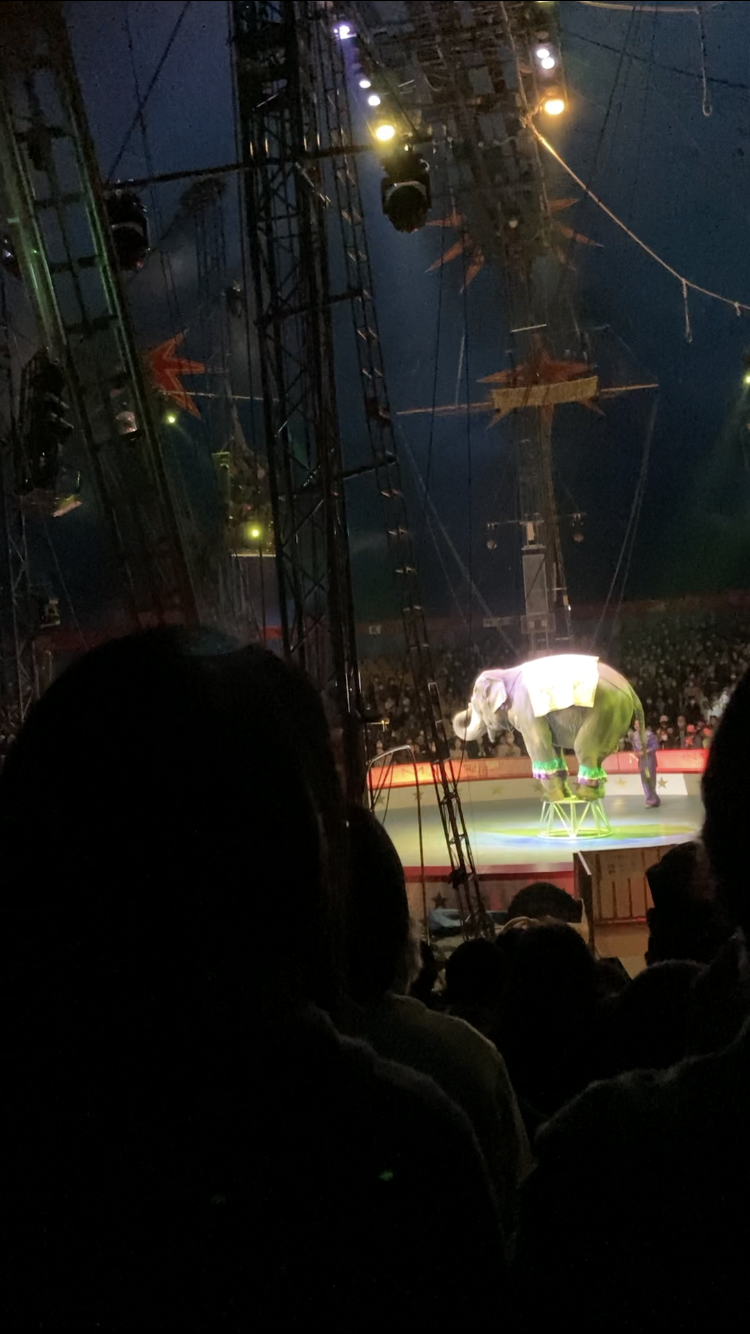
↑An elephant standing on a narrow pedestal
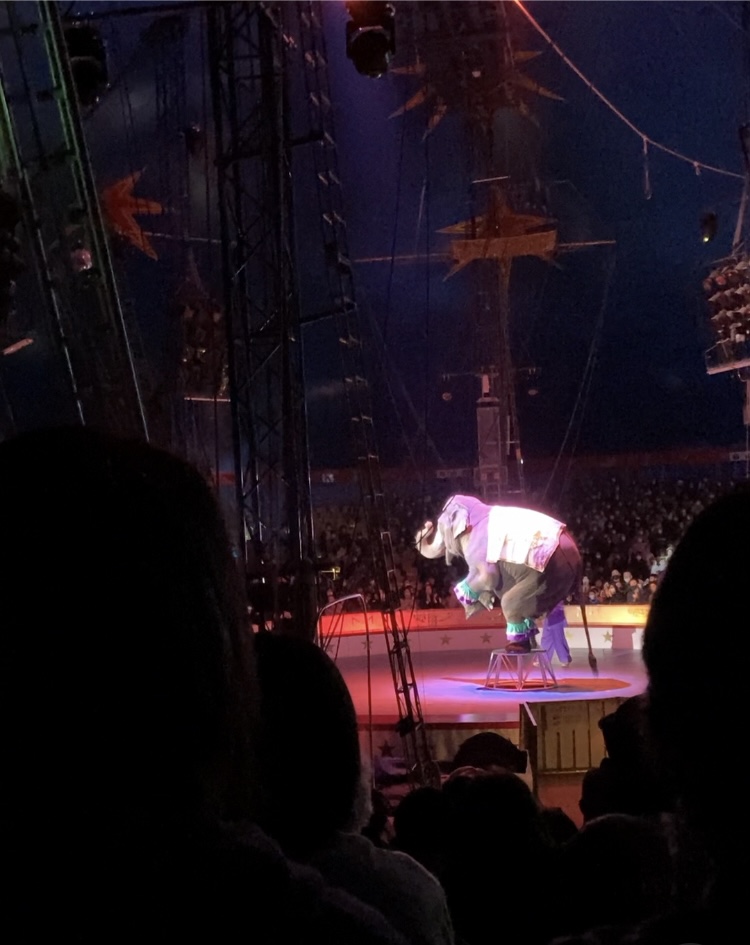
↑An Elephant being forced to raise their front legs on a narrow pedestal
[After the 11:00am show]
○ The two elephants that were on the stage earlier was put on the customer service: "Commemorative photo sessions with an elephant."
At that time, they were forced to raise their noses for photos to make customers satisfied (raising their noses is a gesture that elephants normally do when they are happy).
* If there are 30 groups of customers, they are forced to raise their noses 30 times. It takes about 30 seconds to 1 minute per group.
(The photo was taken inside the tent set up outside. The maximum temperature in Tokyo that day was 14.7°C, and the minimum temperature was 6.9°C. There was no heater placed. The staff was wearing windbreakers. Just a few minutes after the sessions started, the elephant on the right side began stereotypic behavior (swaying body reflexively when stressed). The other elephant on the left, as if lured in, also started stereotypic behavior.)
___________
By these observation results, the situation has been confirmed that;
・The animals are being abused
・The animals are doing stereotypical behaviors caused by excessive stress
【 Concerns from a zoological perspective 】
・Because white lions are intentionally inbred, there is a view that this breeding may cause inbreeding depression (genetic defects, reduced fertility, physical defects). In particular, the American Association of Zoos and Aquariums clearly states that "artificial breeding for the purpose of inheriting rare appearances should not be carried out." If the purpose of breeding is to get them to perform acrobatics in the circus, it is even more of a problem; unethical.
Reference: American Association of Zoos and Aquariums https://www.aza.org/
Reference: Animal Rights Center https://arcj.org/issues/entertainment/horse/circus1255/
・A male elephant weighs about 6 tons, and a female about 4 tons, and their four thin legs are constantly stressed to support their huge bodies. Making them stand on two narrow legs is a dangerous act and constant burden. There is also the risk of serious injury if one happens to slip from a narrow pedestal.
・Elephants have a strong sense of fellowship and are naturally herd animals, so it is wrong to have just two elephants in a small enclosure.
・ The bullhook - also known as an elephant goad, ankus, or elephant hook is used to inflict pain and fear by giving a sharp edge to the “the elephants’ pressure points.” They use not only the area around the nose, mouth, and arms and legs, but also to the most sensitive areas where the skin is thinner such as :behind the ears, around the eyes, and the abdomen. Elephants have good memories, so being threatened with a lethal weapon can be traumatic and can cause mental and physical problems. It is zoologically and ethically wrong that they are beaten, hurt, controlled, and forced to work 24/7 for human entertainment.
Reference: Animal Liberation Organization Lib : https://animal-liberator.net/issue/bullhook/
Reference: What Elephants Taught Me: Elephantology - by Naoko Irie
Reference: PEACE “A circus without animals!”:
https://circuscruelty.animals-peace.net/
___________
This Online Petition is to request to,
①To Kinoshita Circus
To Stop Using Animals in Shows
②To the Ministry of the Environment
To Prohibit the Use of Animals in Domestic Circuses in Japan
In order to show how many people have the same voice and belief that "Animals Should Be Banned in Circuses".
If you agree, please sign this petition and share with others.
Your signature means to appeal your intention to, "There Should Be No Animals in the Circus."
Below is to request to the parties:
TO:
Kinoshita Circus Co., Ltd. Representative Director, President, CEO, Yuji Kinoshita
Times are changing. Now people are aware about respecting animal rights, even if it is a matter of entertainment or business. Your every performance is unique and fantastic without animals and we do not deny your professionalism. However, using animals is cruel. Ban the use of animals and be the best entertainment that Japan can be proud of. Pay respect to the animals who worked as performers. These animals deserve freedom and let them spend the rest of their lives in a sanctuary that does not hold tethers or shows.
TO:
Ministry of the Environment of Japan
Minister of the Environment, Akihito Nishimura
Animal circuses are an outdated, cruel and unnecessary form of "entertainment" that has already been banned in 56 countries around the world and the number keeps increasing. In response to the current situation regarding the treatment of animals in Japan, there are calls from both inside and outside Japan to respect animal rights. In order to make Japanese culture something that can be proud of, please pay attention to animal welfare, public concerns, and global trends, and prohibit and regulate circuses that use animals in Japan.

5,734
署名活動の主旨
Currently, at the "Kinoshita Circus", the largest circus in Japan, is using,
・White Lions
・Elephants
・Zebras
as performers.
The labor imposed on animals is mainly,
・Performance in an intensive light flashing and very loud volume of music
・Training for acrobatics (including receiving violent trainings)
・Performance on stage for 2 or 3 times in one day
・Life in Cages and repeated long-distance travelings
・Artificial breeding to create new “performers”
・Reception / Customer service including forced to pose for photo sessions
These activities go against the natural ecology of animals and impose a human-centered lifestyle on them.
___________
On February 20th, 2023
Kinoshita Circus Performance in Tachikawa, Tokyo, Japan
These are the scenes where animals were forced to labor on the stage that started at 11:00am.
[First half of the Show]
○ With loud music from the Lion King, a zebra with red decoration on its mane ran in a circle on the stage. It was forced to run through two arched hurdles with real flames about 8 times in total. (The zebra didn't look lively, just following commands and doing tricks indifferently.)
○ In the midst of intense flashing lights and loud music, a caged lion was pulled around the stage by the performer. (The strobe lights were so strong that the viewers' eyes even flickered immediately after the performance. The lion sat still in a cage without any signs of roaring, drooping its head down like a wilted flower.)
[Second half of the show]
○ At the command of a trainer who had a long lunging whip, four white lions were forced to perform acrobatics such as: to sit on pedestals, raise their front legs, roll on the floor, and jump over the other fellow lions. (The duration of this performance was about 10 minutes from 12:08 to 12:18.
The trainer thrashed the floor with a whip and slapped the flank of a lion twice really hard with a bare hand. The lions were not lively at all, and just like the zebras, they all just followed the commands and performed their tricks with no energy shown. At the end of the stage, one lion in a languid manner, just passed through the trainer without really listening to his command and returned backstage.)
○ Two elephants came to the stage along with two male trainers and two female performers. With the performers’ signals, the elephants shake their heads, bow, wave their hands, stand on two hind legs on narrow pedestals. Also, with the performer on their trunks, two of the elephants worked together to walk around the stage. (This performance lasted about 6 minutes from 12:40 to 12:46.) The narrow pedestal can just fit enough the four soles of the elephant's feet. When the elephant was ordered to stand on its two hind legs, it hesitated several times to stand, and then wobbled and lowered its front leg after about 1 to 2 seconds. When two elephants were made to walk on the stage with a performer on their noses, one of the elephants walking on the inside of the stage was hitted with a sharp-edged sickle-shaped metal around its chin by a shaved-headed trainer. I confirmed that it was being slapped several times.→Photo of this signature.)
↑An elephant standing on a narrow pedestal
↑An Elephant being forced to raise their front legs on a narrow pedestal
[After the 11:00am show]
○ The two elephants that were on the stage earlier was put on the customer service: "Commemorative photo sessions with an elephant."
At that time, they were forced to raise their noses for photos to make customers satisfied (raising their noses is a gesture that elephants normally do when they are happy).
* If there are 30 groups of customers, they are forced to raise their noses 30 times. It takes about 30 seconds to 1 minute per group.
(The photo was taken inside the tent set up outside. The maximum temperature in Tokyo that day was 14.7°C, and the minimum temperature was 6.9°C. There was no heater placed. The staff was wearing windbreakers. Just a few minutes after the sessions started, the elephant on the right side began stereotypic behavior (swaying body reflexively when stressed). The other elephant on the left, as if lured in, also started stereotypic behavior.)
___________
By these observation results, the situation has been confirmed that;
・The animals are being abused
・The animals are doing stereotypical behaviors caused by excessive stress
【 Concerns from a zoological perspective 】
・Because white lions are intentionally inbred, there is a view that this breeding may cause inbreeding depression (genetic defects, reduced fertility, physical defects). In particular, the American Association of Zoos and Aquariums clearly states that "artificial breeding for the purpose of inheriting rare appearances should not be carried out." If the purpose of breeding is to get them to perform acrobatics in the circus, it is even more of a problem; unethical.
Reference: American Association of Zoos and Aquariums https://www.aza.org/
Reference: Animal Rights Center https://arcj.org/issues/entertainment/horse/circus1255/
・A male elephant weighs about 6 tons, and a female about 4 tons, and their four thin legs are constantly stressed to support their huge bodies. Making them stand on two narrow legs is a dangerous act and constant burden. There is also the risk of serious injury if one happens to slip from a narrow pedestal.
・Elephants have a strong sense of fellowship and are naturally herd animals, so it is wrong to have just two elephants in a small enclosure.
・ The bullhook - also known as an elephant goad, ankus, or elephant hook is used to inflict pain and fear by giving a sharp edge to the “the elephants’ pressure points.” They use not only the area around the nose, mouth, and arms and legs, but also to the most sensitive areas where the skin is thinner such as :behind the ears, around the eyes, and the abdomen. Elephants have good memories, so being threatened with a lethal weapon can be traumatic and can cause mental and physical problems. It is zoologically and ethically wrong that they are beaten, hurt, controlled, and forced to work 24/7 for human entertainment.
Reference: Animal Liberation Organization Lib : https://animal-liberator.net/issue/bullhook/
Reference: What Elephants Taught Me: Elephantology - by Naoko Irie
Reference: PEACE “A circus without animals!”:
https://circuscruelty.animals-peace.net/
___________
This Online Petition is to request to,
①To Kinoshita Circus
To Stop Using Animals in Shows
②To the Ministry of the Environment
To Prohibit the Use of Animals in Domestic Circuses in Japan
In order to show how many people have the same voice and belief that "Animals Should Be Banned in Circuses".
If you agree, please sign this petition and share with others.
Your signature means to appeal your intention to, "There Should Be No Animals in the Circus."
Below is to request to the parties:
TO:
Kinoshita Circus Co., Ltd. Representative Director, President, CEO, Yuji Kinoshita
Times are changing. Now people are aware about respecting animal rights, even if it is a matter of entertainment or business. Your every performance is unique and fantastic without animals and we do not deny your professionalism. However, using animals is cruel. Ban the use of animals and be the best entertainment that Japan can be proud of. Pay respect to the animals who worked as performers. These animals deserve freedom and let them spend the rest of their lives in a sanctuary that does not hold tethers or shows.
TO:
Ministry of the Environment of Japan
Minister of the Environment, Akihito Nishimura
Animal circuses are an outdated, cruel and unnecessary form of "entertainment" that has already been banned in 56 countries around the world and the number keeps increasing. In response to the current situation regarding the treatment of animals in Japan, there are calls from both inside and outside Japan to respect animal rights. In order to make Japanese culture something that can be proud of, please pay attention to animal welfare, public concerns, and global trends, and prohibit and regulate circuses that use animals in Japan.
賛同者からのコメント
オンライン署名の最新情報
このオンライン署名をシェアする
2023年7月8日に作成されたオンライン署名