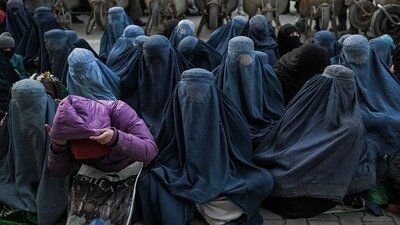

The Women of Afghanistan vs. the Taliban
The Issue
Under rule of the Taliban, women's rights are being eradicated.
Girls are now banned from secondary school and women are banned from universities. As a result, eighty percent of Afghan women between ages eighteen and twenty-nine are out of education, employment, or training. Meaning female doctors are restricted from working and the training for future midwives has been deeply impacted. For whatever reason you may be thinking this isn’t a large issue, and reasoning that they can just go to male doctors… you are wrong. Restrictions also prevent women from being treated by male doctors. Meaning they must be accompanied by a mahram (a male relative chaperone) to travel and be seen by healthcare professionals; however, the economic collapse of Afghanistan's economy has impacted Afghans ability to seek healthcare. Roughly eighty percent of households are in debt, leaving them unable to afford basic healthcare on its own. There is an estimate of twenty-eight million Afghans living in poverty; people who don’t have much money to spend tend to prioritise vital survival resources such as food or water over healthcare. Additionally, women having to be accompanied by a mahram doubles transportation costs for every medical visit, in households where a male relative has to leave their day-labor to act as a chaperone, that family loses a full day wage just to get the woman to a clinic. Ambulances also routinely deny service to unaccompanied women. These factors have triggered a devastating rise in maternal mortality, and inevitably affected the workforce gender gaps. In fact, Afghanistan now has one of the largest workforce gendergaps in the world.
On top of the healthcare, education, and working struggles, women have been entirely excluded from the justice system. They cannot serve as judges, attorneys, or prosecutors and female legal professionals face immense danger since the Taliban have put these rules in place. These dangers stem from male convicts they previously sentenced for violent crimes who were freed from prison by the Taliban. Thankfully, many of these female legal professionals were able to evacuate to foreign countries, but hundreds remain stranded in Afghanistan, living in hiding. Nowadays, Afghan women are four times less likely than men to access or utilize any formal justice mechanisms; with only fourteen percent of women able to access these services compared to fifty-three percent of men.
Upon researching for possible solutions to this problem, I propose that people world-wide come together to enhance the Rome Statute of the International Criminal Court to include gender apartheid—commonly described as the subjugation of women and girls (severe segregation, restrictions on movement, and bans on education and employment)—as a crime against humanity. This would require international governments to completely cut off the Taliban from the rest of the world, preventing any ongoing communication, trade agreements, or official recognition until women's rights are fully restored. However, I do understand that this may be an unrealistic goal hold up for an eighth grade civics action project. So in the meantime, I will strive to bring attention to the issue within my community while simultaneously advertising funds that secretly provide the women in Afghanistan with education, healthcare, and advocacy for their rights. Such platforms include the Malala Fund, Sahar, ICRC, CARE, and Ideas Beyond Borders.
Women are dying. They are dying from the foolishness and misogynistic beliefs of the Taliban. What have women done to deserve their human rights to be stripped from them? What have women done to deserve losing their voice? What have women done to deserve their futures being taken away from their grasps by men who hold abusive power? Why must a little girl be forced out of education by discriminatory laws that she will never have the chance to understand? Women in Afghanistan are being pushed further out of public life—and closer to being erased from it altogether.
~~~~~~~~~~~~~~~~~~~~~~~~~~~~~~~~~~~~~~~~~~~~~~~~~~~~~~~~~~~~~~~~~~~~~~~~~~~~~~~~~~~~
Cites Used:
Afghanistan: Ten facts about the world’s most severe women’s rights crisis | UN Women – Headquarters
~~~~~~~~~~~~~~~~~~~~~~~~~~~~~~~~~~~~~~~~~~~~~~~~~~~~~~~~~~~~~~~~~~~~~~~~~~~~~~~~~~~~
Platforms Mentioned:
Afghan girls are seeds | Malala Fund
Afghanistan: A year of providing healthcare and institutional support | ICRC
CARE provides lifesaving mobile healthcare to vulnerable Afghans
Secret Scholars Online — Sahar - Education for Afghan Girls
Underground Schools: Funding Secret Education in Afghanistan – Ideas Beyond Borders

46
The Issue
Under rule of the Taliban, women's rights are being eradicated.
Girls are now banned from secondary school and women are banned from universities. As a result, eighty percent of Afghan women between ages eighteen and twenty-nine are out of education, employment, or training. Meaning female doctors are restricted from working and the training for future midwives has been deeply impacted. For whatever reason you may be thinking this isn’t a large issue, and reasoning that they can just go to male doctors… you are wrong. Restrictions also prevent women from being treated by male doctors. Meaning they must be accompanied by a mahram (a male relative chaperone) to travel and be seen by healthcare professionals; however, the economic collapse of Afghanistan's economy has impacted Afghans ability to seek healthcare. Roughly eighty percent of households are in debt, leaving them unable to afford basic healthcare on its own. There is an estimate of twenty-eight million Afghans living in poverty; people who don’t have much money to spend tend to prioritise vital survival resources such as food or water over healthcare. Additionally, women having to be accompanied by a mahram doubles transportation costs for every medical visit, in households where a male relative has to leave their day-labor to act as a chaperone, that family loses a full day wage just to get the woman to a clinic. Ambulances also routinely deny service to unaccompanied women. These factors have triggered a devastating rise in maternal mortality, and inevitably affected the workforce gender gaps. In fact, Afghanistan now has one of the largest workforce gendergaps in the world.
On top of the healthcare, education, and working struggles, women have been entirely excluded from the justice system. They cannot serve as judges, attorneys, or prosecutors and female legal professionals face immense danger since the Taliban have put these rules in place. These dangers stem from male convicts they previously sentenced for violent crimes who were freed from prison by the Taliban. Thankfully, many of these female legal professionals were able to evacuate to foreign countries, but hundreds remain stranded in Afghanistan, living in hiding. Nowadays, Afghan women are four times less likely than men to access or utilize any formal justice mechanisms; with only fourteen percent of women able to access these services compared to fifty-three percent of men.
Upon researching for possible solutions to this problem, I propose that people world-wide come together to enhance the Rome Statute of the International Criminal Court to include gender apartheid—commonly described as the subjugation of women and girls (severe segregation, restrictions on movement, and bans on education and employment)—as a crime against humanity. This would require international governments to completely cut off the Taliban from the rest of the world, preventing any ongoing communication, trade agreements, or official recognition until women's rights are fully restored. However, I do understand that this may be an unrealistic goal hold up for an eighth grade civics action project. So in the meantime, I will strive to bring attention to the issue within my community while simultaneously advertising funds that secretly provide the women in Afghanistan with education, healthcare, and advocacy for their rights. Such platforms include the Malala Fund, Sahar, ICRC, CARE, and Ideas Beyond Borders.
Women are dying. They are dying from the foolishness and misogynistic beliefs of the Taliban. What have women done to deserve their human rights to be stripped from them? What have women done to deserve losing their voice? What have women done to deserve their futures being taken away from their grasps by men who hold abusive power? Why must a little girl be forced out of education by discriminatory laws that she will never have the chance to understand? Women in Afghanistan are being pushed further out of public life—and closer to being erased from it altogether.
~~~~~~~~~~~~~~~~~~~~~~~~~~~~~~~~~~~~~~~~~~~~~~~~~~~~~~~~~~~~~~~~~~~~~~~~~~~~~~~~~~~~
Cites Used:
Afghanistan: Ten facts about the world’s most severe women’s rights crisis | UN Women – Headquarters
~~~~~~~~~~~~~~~~~~~~~~~~~~~~~~~~~~~~~~~~~~~~~~~~~~~~~~~~~~~~~~~~~~~~~~~~~~~~~~~~~~~~
Platforms Mentioned:
Afghan girls are seeds | Malala Fund
Afghanistan: A year of providing healthcare and institutional support | ICRC
CARE provides lifesaving mobile healthcare to vulnerable Afghans
Secret Scholars Online — Sahar - Education for Afghan Girls
Underground Schools: Funding Secret Education in Afghanistan – Ideas Beyond Borders
The Decision Makers

Supporter Voices
Petition Updates
Share this petition
Petition created on May 20, 2026