
The Trinity of Justice: Why the Jury Must Remain
The Issue
There are growing calls to reduce or remove the role of juries within the UK legal system, placing greater power into the hands of the state alone. I believe this threatens not only justice, but human sovereignty itself.
The right to trial by jury is not merely a legal tradition; it is recognition of the sovereign nature of the people. Christian or not, the foundations upon which our courts operate reflect the moral and spiritual principles upon which England and democratic society were built.
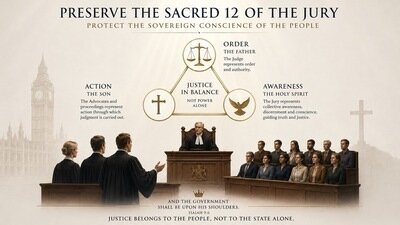
The structure of the courtroom itself reflects the Trinitarian foundation embedded within the infrastructure of both justice and democracy. The Trinity, Father, Son, and Holy Spirit, is not only theological symbolism, but a pattern of functional balance: order, action, and awareness working together as one.
That same structure exists within the court.
The judge represents order and authority, comparable to the Father.
The advocates and legal process represent action, comparable to the Son, through whom judgment is carried into the world.
The jury represents collective awareness, conscience, and discernment, comparable to the Holy Spirit, ensuring truth is weighed not only by power, but by the spirit of the people.
This balance is what prevents justice from becoming tyranny. Remove any one part and the structure collapses. Remove the jury, and you remove the people’s discernment from justice itself.
Scripture tells us, “and the government shall be upon His shoulders” (Isaiah 9:6).
True government must therefore rest upon justice, discernment, and shared moral responsibility, not concentrated power alone. The jury protects this balance by ensuring judgment remains connected to the conscience of the people, not solely the authority of the state. The number twelve carries symbolic meaning. Christ had twelve disciples, ordinary people entrusted with truth and moral responsibility. Likewise, twelve jurors represent the principle that justice belongs not only to institutions, but to the people themselves.
A legal system without a jury risks becoming disconnected from the people it governs. Whether one is personally Christian or not, the principle remains universal: balanced authority, human conscience, and collective discernment protect freedom and human dignity.
The jury safeguards more than legal procedure; it safeguards the living conscience of the nation.
If you love democracy, if you love England, then you have to keep God within the infrastructure because that is what has, and what will forever keep us, the United Kingdom. ✝️🏴

24
The Issue
There are growing calls to reduce or remove the role of juries within the UK legal system, placing greater power into the hands of the state alone. I believe this threatens not only justice, but human sovereignty itself.
The right to trial by jury is not merely a legal tradition; it is recognition of the sovereign nature of the people. Christian or not, the foundations upon which our courts operate reflect the moral and spiritual principles upon which England and democratic society were built.
The structure of the courtroom itself reflects the Trinitarian foundation embedded within the infrastructure of both justice and democracy. The Trinity, Father, Son, and Holy Spirit, is not only theological symbolism, but a pattern of functional balance: order, action, and awareness working together as one.
That same structure exists within the court.
The judge represents order and authority, comparable to the Father.
The advocates and legal process represent action, comparable to the Son, through whom judgment is carried into the world.
The jury represents collective awareness, conscience, and discernment, comparable to the Holy Spirit, ensuring truth is weighed not only by power, but by the spirit of the people.
This balance is what prevents justice from becoming tyranny. Remove any one part and the structure collapses. Remove the jury, and you remove the people’s discernment from justice itself.
Scripture tells us, “and the government shall be upon His shoulders” (Isaiah 9:6).
True government must therefore rest upon justice, discernment, and shared moral responsibility, not concentrated power alone. The jury protects this balance by ensuring judgment remains connected to the conscience of the people, not solely the authority of the state. The number twelve carries symbolic meaning. Christ had twelve disciples, ordinary people entrusted with truth and moral responsibility. Likewise, twelve jurors represent the principle that justice belongs not only to institutions, but to the people themselves.
A legal system without a jury risks becoming disconnected from the people it governs. Whether one is personally Christian or not, the principle remains universal: balanced authority, human conscience, and collective discernment protect freedom and human dignity.
The jury safeguards more than legal procedure; it safeguards the living conscience of the nation.
If you love democracy, if you love England, then you have to keep God within the infrastructure because that is what has, and what will forever keep us, the United Kingdom. ✝️🏴
The Decision Makers

Petition Updates
Share this petition
Petition created on 22 May 2026