

THE R3CLAIM CLIMATE JUSTICE & SUSTAINABILITY CHARTER
The Issue
“The devastation of Hurricane Melissa highlights that change across all industries need's to be made..”
Restoring Balance. Reclaiming Power. Reimagining the Future.
The entertainment industry has the power to influence hearts, minds, and markets. It has shaped culture for generations. Now, it must rise to the challenge of reshaping itself.
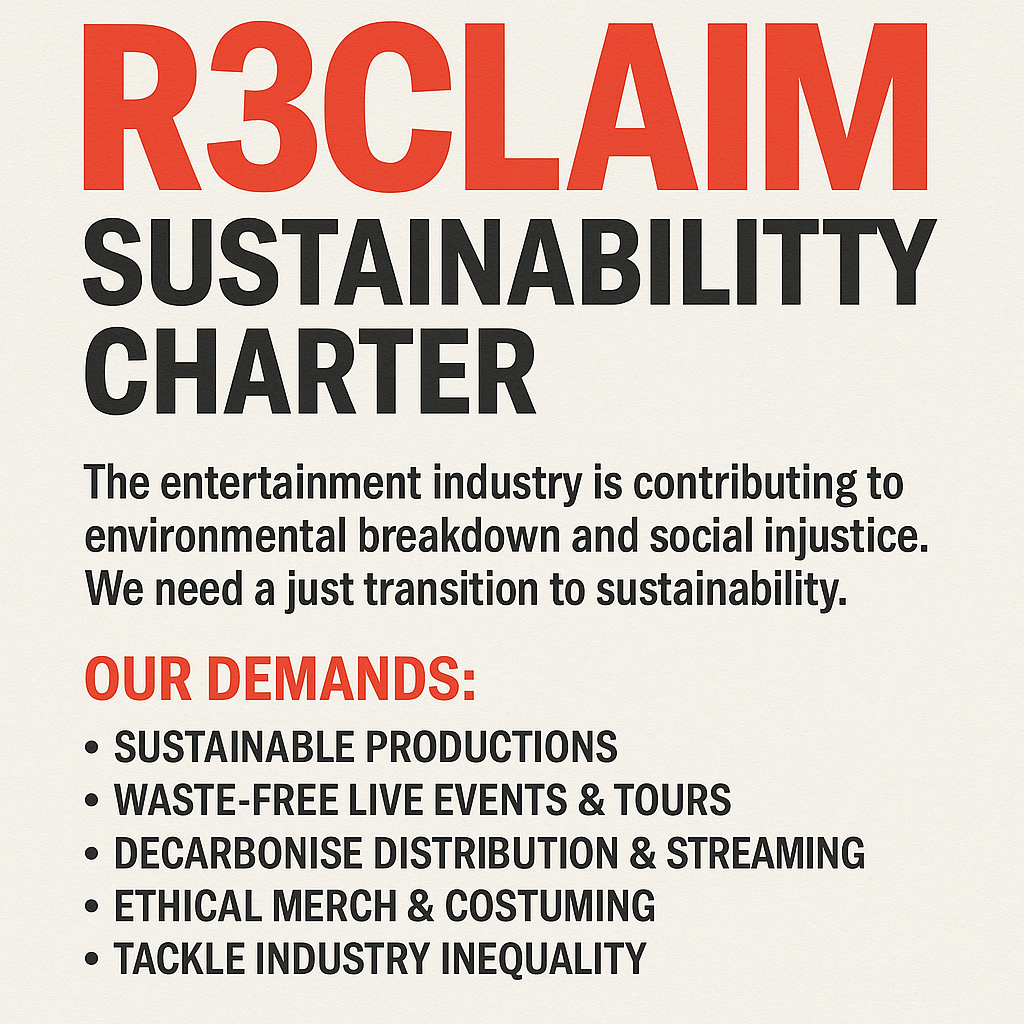
The entertainment industry is one of the most powerful cultural forces in the world but it is also a major contributor to the climate crisis and a system that perpetuates inequality.
The industry is deeply entangled with fossil-fuel power: energy-hungry productions, diesel-powered lighting trucks, carbon-intensive travel, oil-based plastics for sets, costumes, and merch, and corporate partnerships with polluters. Behind the glamour, global screens are propped up by extractive infrastructure that exploits frontline communities and accelerates climate injustice.
• UK live music events: 405,000 tonnes of CO₂/year (Julie’s Bicycle)
• TV production: 13 tonnes of CO₂/hour—equal to 13 London–New York flights (Albert, 2022)
• Streaming & broadcasting: 1–3% of global electricity use, much still fossil-fuel powered
• Artists’ earnings: often just 12–16% of streaming revenue; fewer than 1% of UK artists earn £12k/year from streaming
• Leadership: only 4% of UK entertainment execs are Black or Asian—none lead sustainability strategy (McKinsey, 2021)
The Global South cultures fuel the industry’s creativity, but their communities remain excluded from decision-making and underrepresented in leadership.
A future rooted in justice, creativity, and sustainability is not only necessary, it is possible. The time to R3CLAIM that future is now.
We, the artists, workers, engineers, designers, creatives, organisers, storytellers, and communities that shape the United Kingdom’s entertainment industry, including music, film, television, theatre, live events, energy and digital media, acknowledge that we are operating within a global climate emergency.
The entertainment sector is a aspirational cultural force, capable of influencing public behaviour and policy. However, behind the creative output lies a system that contributes significantly to environmental degradation, waste, and systemic inequality. From carbon-intensive productions and waste-heavy touring to exploitative global supply chains and the underrepresentation of climate-impacted communities, the industry is falling short of its responsibilities.
We also recognise that the Global South communities, those most impacted by the climate crisis, are the least responsible for it. Despite this, they remain excluded from key leadership, decision-making, and financial opportunities across the industry, even as their cultures, stories, and labour continue to drive its success.
This Charter sets out the urgent structural changes required to create a truly sustainable and equitable entertainment industry. We invite all stakeholders to adopt its principles and commit to meaningful action.
Guiding Principles
This Charter is grounded in five core areas of action. Each one addresses a major source of pollution or inequality within the entertainment sector, alongside concrete recommendations to guide industry-wide transformation.
1. Sustainable Production Practices
We call for the decarbonisation of all entertainment production processes, including those in film, fashion, television, music, theatre, and digital content. This includes:
Phasing out diesel generators by 2027 and transitioning to renewable energy across all production sites.
Implementing climate action plans as a mandatory requirement for publicly funded or commissioned projects.
Adopting low-impact set design, ethical catering, efficient transport planning, and green procurement processes.
2. Waste-Free Touring, Events, and Live Performance
We call for the elimination of environmentally harmful practices in festivals, live shows, touring, red carpets, award ceremonies, and large-scale events. This includes:
Banning single-use plastics and unsustainable PVC materials from all events.
Supporting circular infrastructure for staging, props, and audience experience.
Providing resources and subsidies for artists, crews, and organisers to transition to low-carbon or carbon-neutral touring models.
3. Decarbonised Streaming and Digital Distribution
We call for energy transparency and responsible digital practices across all platforms, including streaming services, broadcasters, and online content providers. This includes:
Requiring all digital platforms to transition to 100 percent renewable-powered data centres by 2026.
Publishing annual environmental audits of energy and data usage across content delivery platforms.
Encouraging digital minimalism and consumer awareness campaigns on the environmental impacts of online content.
4. Ethical Merchandising, Costuming, and Fashion
We call for the reform of merchandise production and costuming practices, which are frequently linked to environmental destruction and exploitative labour. This includes:
Banning the use of toxic chemicals. The use of virgin plastic and unsustainable cotton in entertainment-related merchandise by 2030.
Investing in recycled, ethical, and locally produced alternatives through creative partnerships.
Educating consumers and industry stakeholders on the environmental and social impacts of entertainment-linked apparel and design.
5. Addressing Structural Inequality through Climate Justice
We call for a just transition that centres the leadership and priorities of Black, Asian, Indigenous, and Global South creatives and communities. This includes:
Allocating at least 25 percent of sustainability budgets and funding towards initiatives led by historically marginalised communities.
Embedding climate justice education and training in all major creative institutions, talent development pipelines, and industry organisations.
Rebalancing representation and power across all levels of the industry, from funding boards to festival line-ups, production teams, and executive decision-making.
THE R3CLAIM FUND
To support the implementation of this Charter, we are launching the R3CLAIM Fund, an independent financial initiative designed to accelerate environmental and racial justice within the entertainment sector.
The Fund will:
Resource sustainable creative practices led by the Global South artists, collectives, companies and communities.
Invest in local green, earth conscious infrastructure, such as solar-powered studios, ethical manufacturing hubs, and low-carbon technologies.
Support storytelling that addresses climate justice across media platforms through development grants, public commissions, and cross-sector collaboration.
Offer microgrants, mentorship, and training for sustainable fashion designers, production teams, and grassroots cultural organisations.
The flagship model of the R3CLAIM Fund is Art Ain’t Trash, a programme that combines creative expression with direct environmental action. Using this model, artists and communities will clean public spaces, recycle collected waste, and transform it into art, infrastructure, and resources for their communities.
Through the R3CLAIM x Art Ain’t Trash Series, the R3CLAIM FUND will support international outreach programmes (across the global south) to educate and empower communities to use creativity to lead change in their own environment to inspire people globally. Aiding to provide water for the less fortunate and financing in agriculture.
The R3CLAIM Fund will therefore operate with a dual focus: to reduce carbon emissions while addressing legacies of colonial extraction, economic exclusion, and environmental racism. We want to aid the global south in anyway we can with this fund.
CALL TO ACTION
This Charter is a framework for systemic change. It is not a one-off commitment, nor a public relations statement. It is an invitation to transform the foundations of the entertainment industry by embedding climate justice, sustainability, and equity at its core.
We demand that the entertainment industry become a leader in the fight for climate justice.
Publicly sign this Charter and align operations with its demands. Contribute to the R3CLAIM Fund to support collective action and structural change.
Implement these principles in business practices, contracts, creative output, and internal governance. Establish accountability mechanisms, including environmental and social impact reporting.
We call on:
• Artists, designers & creators
• Record labels & production houses
• Streaming & tech companies
• Broadcasters & event organisers
• The fashion industry
• Every industry complicit in climate injustice
• and finally the Audiences & fans
…to sign the Charter, back the R3CLAIM Fund, and help us transform the industry into one that protects both the planet and its people. The future depends on what we do now.
📢 SIGN THE R3CLAIM ENTERTAINMENT INDUSTRY CLIMATE JUSTICE & SUSTAINABILITY CHARTER, FUND & SUPPORT THE MOVEMENT

20
The Issue
“The devastation of Hurricane Melissa highlights that change across all industries need's to be made..”
Restoring Balance. Reclaiming Power. Reimagining the Future.
The entertainment industry has the power to influence hearts, minds, and markets. It has shaped culture for generations. Now, it must rise to the challenge of reshaping itself.
The entertainment industry is one of the most powerful cultural forces in the world but it is also a major contributor to the climate crisis and a system that perpetuates inequality.
The industry is deeply entangled with fossil-fuel power: energy-hungry productions, diesel-powered lighting trucks, carbon-intensive travel, oil-based plastics for sets, costumes, and merch, and corporate partnerships with polluters. Behind the glamour, global screens are propped up by extractive infrastructure that exploits frontline communities and accelerates climate injustice.
• UK live music events: 405,000 tonnes of CO₂/year (Julie’s Bicycle)
• TV production: 13 tonnes of CO₂/hour—equal to 13 London–New York flights (Albert, 2022)
• Streaming & broadcasting: 1–3% of global electricity use, much still fossil-fuel powered
• Artists’ earnings: often just 12–16% of streaming revenue; fewer than 1% of UK artists earn £12k/year from streaming
• Leadership: only 4% of UK entertainment execs are Black or Asian—none lead sustainability strategy (McKinsey, 2021)
The Global South cultures fuel the industry’s creativity, but their communities remain excluded from decision-making and underrepresented in leadership.
A future rooted in justice, creativity, and sustainability is not only necessary, it is possible. The time to R3CLAIM that future is now.
We, the artists, workers, engineers, designers, creatives, organisers, storytellers, and communities that shape the United Kingdom’s entertainment industry, including music, film, television, theatre, live events, energy and digital media, acknowledge that we are operating within a global climate emergency.
The entertainment sector is a aspirational cultural force, capable of influencing public behaviour and policy. However, behind the creative output lies a system that contributes significantly to environmental degradation, waste, and systemic inequality. From carbon-intensive productions and waste-heavy touring to exploitative global supply chains and the underrepresentation of climate-impacted communities, the industry is falling short of its responsibilities.
We also recognise that the Global South communities, those most impacted by the climate crisis, are the least responsible for it. Despite this, they remain excluded from key leadership, decision-making, and financial opportunities across the industry, even as their cultures, stories, and labour continue to drive its success.
This Charter sets out the urgent structural changes required to create a truly sustainable and equitable entertainment industry. We invite all stakeholders to adopt its principles and commit to meaningful action.
Guiding Principles
This Charter is grounded in five core areas of action. Each one addresses a major source of pollution or inequality within the entertainment sector, alongside concrete recommendations to guide industry-wide transformation.
1. Sustainable Production Practices
We call for the decarbonisation of all entertainment production processes, including those in film, fashion, television, music, theatre, and digital content. This includes:
Phasing out diesel generators by 2027 and transitioning to renewable energy across all production sites.
Implementing climate action plans as a mandatory requirement for publicly funded or commissioned projects.
Adopting low-impact set design, ethical catering, efficient transport planning, and green procurement processes.
2. Waste-Free Touring, Events, and Live Performance
We call for the elimination of environmentally harmful practices in festivals, live shows, touring, red carpets, award ceremonies, and large-scale events. This includes:
Banning single-use plastics and unsustainable PVC materials from all events.
Supporting circular infrastructure for staging, props, and audience experience.
Providing resources and subsidies for artists, crews, and organisers to transition to low-carbon or carbon-neutral touring models.
3. Decarbonised Streaming and Digital Distribution
We call for energy transparency and responsible digital practices across all platforms, including streaming services, broadcasters, and online content providers. This includes:
Requiring all digital platforms to transition to 100 percent renewable-powered data centres by 2026.
Publishing annual environmental audits of energy and data usage across content delivery platforms.
Encouraging digital minimalism and consumer awareness campaigns on the environmental impacts of online content.
4. Ethical Merchandising, Costuming, and Fashion
We call for the reform of merchandise production and costuming practices, which are frequently linked to environmental destruction and exploitative labour. This includes:
Banning the use of toxic chemicals. The use of virgin plastic and unsustainable cotton in entertainment-related merchandise by 2030.
Investing in recycled, ethical, and locally produced alternatives through creative partnerships.
Educating consumers and industry stakeholders on the environmental and social impacts of entertainment-linked apparel and design.
5. Addressing Structural Inequality through Climate Justice
We call for a just transition that centres the leadership and priorities of Black, Asian, Indigenous, and Global South creatives and communities. This includes:
Allocating at least 25 percent of sustainability budgets and funding towards initiatives led by historically marginalised communities.
Embedding climate justice education and training in all major creative institutions, talent development pipelines, and industry organisations.
Rebalancing representation and power across all levels of the industry, from funding boards to festival line-ups, production teams, and executive decision-making.
THE R3CLAIM FUND
To support the implementation of this Charter, we are launching the R3CLAIM Fund, an independent financial initiative designed to accelerate environmental and racial justice within the entertainment sector.
The Fund will:
Resource sustainable creative practices led by the Global South artists, collectives, companies and communities.
Invest in local green, earth conscious infrastructure, such as solar-powered studios, ethical manufacturing hubs, and low-carbon technologies.
Support storytelling that addresses climate justice across media platforms through development grants, public commissions, and cross-sector collaboration.
Offer microgrants, mentorship, and training for sustainable fashion designers, production teams, and grassroots cultural organisations.
The flagship model of the R3CLAIM Fund is Art Ain’t Trash, a programme that combines creative expression with direct environmental action. Using this model, artists and communities will clean public spaces, recycle collected waste, and transform it into art, infrastructure, and resources for their communities.
Through the R3CLAIM x Art Ain’t Trash Series, the R3CLAIM FUND will support international outreach programmes (across the global south) to educate and empower communities to use creativity to lead change in their own environment to inspire people globally. Aiding to provide water for the less fortunate and financing in agriculture.
The R3CLAIM Fund will therefore operate with a dual focus: to reduce carbon emissions while addressing legacies of colonial extraction, economic exclusion, and environmental racism. We want to aid the global south in anyway we can with this fund.
CALL TO ACTION
This Charter is a framework for systemic change. It is not a one-off commitment, nor a public relations statement. It is an invitation to transform the foundations of the entertainment industry by embedding climate justice, sustainability, and equity at its core.
We demand that the entertainment industry become a leader in the fight for climate justice.
Publicly sign this Charter and align operations with its demands. Contribute to the R3CLAIM Fund to support collective action and structural change.
Implement these principles in business practices, contracts, creative output, and internal governance. Establish accountability mechanisms, including environmental and social impact reporting.
We call on:
• Artists, designers & creators
• Record labels & production houses
• Streaming & tech companies
• Broadcasters & event organisers
• The fashion industry
• Every industry complicit in climate injustice
• and finally the Audiences & fans
…to sign the Charter, back the R3CLAIM Fund, and help us transform the industry into one that protects both the planet and its people. The future depends on what we do now.
📢 SIGN THE R3CLAIM ENTERTAINMENT INDUSTRY CLIMATE JUSTICE & SUSTAINABILITY CHARTER, FUND & SUPPORT THE MOVEMENT
The Decision Makers
Petition Updates
Share this petition
Petition created on 18 August 2025