
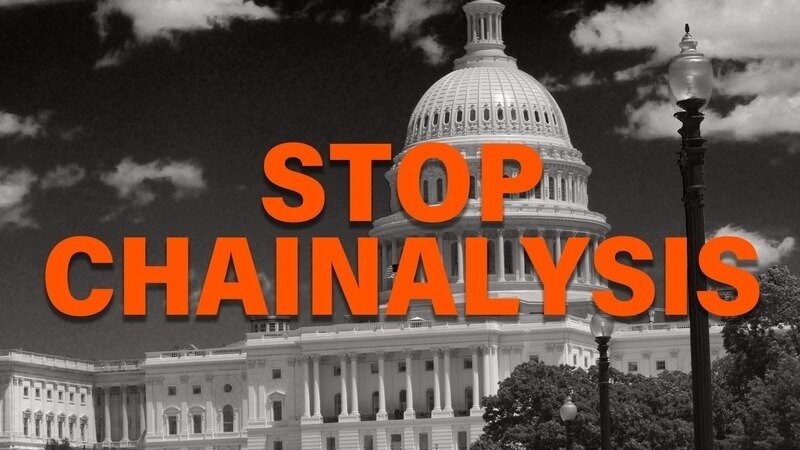
Tell Congress: Stop The Use Of Chainalysis Services
The Issue
Petition To Stop The Use Of Chainalysis Blockchain Forensics Services For Federal Agencies To Protect Our Right To Financial Privacy
Chainalysis offers cryptocurrency investigation software enabling law enforcement to solve and prevent crime by linking the real world to crypto payments.
It is our understanding that Chainalysis Inc. has testified to the lack of scientific evidence for the software’s findings under the Daubert standard(1). In addition, experts in the field have testified to the lack of accuracy for methodologies applied by Chainalysis(2).
It is our belief that the use of non-scientifically proven software and alleged inaccurate methodologies to implicate individuals in the occurrence of crimes puts the people’s right to financial privacy at risk as detailed below.
We therefore petition to stop the use of Chainalysis services by federal agencies until its accuracy is scientifically proven to ensure the protection of the people’s right to financial privacy as guaranteed by Fourth Amendment rights and the Bank Secrecy Act.
The Daubert Standard defines the following scientific methodology to determine the accuracy of expert testimony which cannot be met by Chainalysis Inc. according to their own admittance as well as expert analysis:
Whether it has a known error rate
-> Chainalysis Inc. has admitted to not collecting false positive/negative rates or margins of error in a publicly issued declaration, which reads: “Chainalysis is looking into the potential of trying to collect and record any potential false positives and margin of error, but such a collection does not currently exist.(3)”
Whether it has been subjected to peer review and publication
-> Chainalysis Inc. is not aware of peer reviewed papers or scientific publications proving the accuracy of its software according to its own testimony(4).
Whether the theory or technique employed by the expert is generally accepted in the scientific community
-> Chainalysis’ use of single entity clustering has been found to lead to tracing errors by competing blockchain forensics firms according to expert reports(5).
-> Chainalysis’ use of behavioral clustering is inaccurate, error prone, and over inclusive and therefore refrained from being used by competing blockchain forensics experts according to expert reports(6).
It is our opinion that the people’s right to financial privacy is at risk in the following ways if non-scientifically proven software and inaccurate methods are used to implicate individuals in the occurrence of crime:
Violations of the Protection of Financial Information
Individuals and entities have a reasonable expectation that their financial information will remain private and secure. This expectation cannot be met if exceptional disclosure is warranted based on the use of non-scientifically proven software and inaccurate methods: As anyone can be implicated by such software regardless of their involvement in criminal activity, individuals and entities cannot expect that their financial information is kept private.
Fourth Amendment Violations
The Fourth Amendment requires government agencies to obtain a warrant based on probable cause before conducting searches or seizures, including those related to financial records. The use of non-scientifically proven software and inaccurate methodologies cannot warrant probable cause to obtain financial records if the methods used cannot be guaranteed to produce accurate probability, violating the people’s fourth amendment rights. As anyone can be implicated by such software, regardless of their involvement in criminal activity, the use of such software exposes the people to arbitrary search and seizures.
Bank Secrecy Act Violations
The Bank Secrecy Act requires financial institutions to ensure the confidentiality of customer information. The confidentiality of customer information cannot be ensured if non-scientifically proven software and inaccurate methods are used to determine suspicious activity to grant exceptions to Bank Secrecy Act protections. As anyone can be implicated by such software, regardless of their involvement in criminal activity, the use of such software exposes the people to the arbitrary disclosure of customer information, violating Bank Secrecy Act protections.
We urge Congress to hold the courts accountable to follow the guidance of prior rulings regarding the use of technologies that have failed to meet the Daubert standard in criminal proceedings and stop the use of Chainalysis services by federal agencies until its scientific accuracy is established to protect our rights to financial privacy as defined in United States v. Schaeffer (1998), United States v. Piccinonna (3rd Cir. 1978), State v. Dorsey (N.J. 1980), United States v. Posado (5th Cir. 1993), People v. Leahy (Cal. 1994), State v. Brooks (Mo. 1991), and United States v. Cordoba (D.C. Cir. 2000).
What you can do to help:
- Call/email your representatives and urge them to stop the use of Chainalysis blockchain forensic services by federal agencies to protect your financial privacy rights.
- Research financial privacy protections in your own country and adapt this petition to publish your own. If you are unsure whether your country deploys Chainalysis services, file a freedom of information request if applicable. You can find a non-exhaustive list of countries and agencies known for contracting Chainalysis services via techinquiry.org
- Sign and share the petition to help stop the use of Chainalysis services by federal agencies and protect your financial privacy rights today.
Good to Know:
- Anyone, regardless of residency or citizenship, has the right to petition US Congress. This is particularly important as US financial regulations often set precedent for global policy.
- This petition can be signed pseudonymously. However, it is important to note that signatures which can be allocated towards certain jurisdictions generally hold more weight.
Non-exhaustive list of U.S. agencies known to have contracted Chainalysis blockchain forensics services:
United States:
Department of State, Department of the Treasury: Internal Revenue Service (IRS), Department of Homeland Security: U.S. Immigrations and Customs Enforcement (ICE), Department of Justice: Federal Bureau of Investigation (FBI), Department of Defense: Department of the Air Force (USAF), Department of Justice: Offices, Boards and Divisions, Securities and Exchange Commission (SEC), Department of Justice: Drug Enforcement Administration (DEA)
(1) https://www.coindesk.com/consensus-magazine/2023/07/24/chainalysis-investigations-lead-is-unaware-of-scientific-evidence-the-surveillance-software-works/
(2) https://bitcoinmagazine.com/technical/chainalysis-the-theranos-of-blockchain-forensics
(3) United States v. Sterlingov, Declaration of Elizabeth Bisbee, p.4 https://www.courtlistener.com/docket/59988850/149/1/united-states-v-sterlingov/
(4) “Q. [] You don't have scientific, peer-reviewed papers or anything published anywhere attesting to the accuracy of Chainalysis Reactor, do you? A. No.” United States v. Sterlingov, Defense's Reply To The Government’s Opposition To Defendant’s Motion For Early Return Subpoena To Chainalysis, Inc. Under Fed. R. Crim. P. 17 (C) And Chainalysis’ Opposition To Defendant’s Rule 17(C) Subpoena, August 17th 2023, p. 6 https://storage.courtlistener.com/recap/gov.uscourts.dcd.232431/gov.uscourts.dcd.232431.164.0_1.pdf
(5) “Chainalysis Reactor employs single-entity clustering; that means that for each transaction on a graph, the entire entity will appear to spend funds in that interaction, even if only one address is assigned to that entity transacted. A root address is assigned to the entity which may or may not be the correct address that transacted. This single entity clustering leads to many tracing errors.” United States v. Sterlingov, Defense Expert Report, August 8th 2023, p. 11 https://storage.courtlistener.com/recap/gov.uscourts.dcd.232431/gov.uscourts.dcd.232431.159.1_1.pdf
(6) “Ciphertrace does not utilize Heuristic 2 (behavioral) because it is inaccurate, error-prone, and over inclusive.” United States v. Sterlingov, Defense Expert Report, August 8th 2023, p. 7 https://storage.courtlistener.com/recap/gov.uscourts.dcd.232431/gov.uscourts.dcd.232431.159.1_1.pdf
Background Image: Farragutful, File:2017 US Capitol 02.jpg, modified. License: Creative Commons Attribution-ShareAlike 4.0 International

113
The Issue
Petition To Stop The Use Of Chainalysis Blockchain Forensics Services For Federal Agencies To Protect Our Right To Financial Privacy
Chainalysis offers cryptocurrency investigation software enabling law enforcement to solve and prevent crime by linking the real world to crypto payments.
It is our understanding that Chainalysis Inc. has testified to the lack of scientific evidence for the software’s findings under the Daubert standard(1). In addition, experts in the field have testified to the lack of accuracy for methodologies applied by Chainalysis(2).
It is our belief that the use of non-scientifically proven software and alleged inaccurate methodologies to implicate individuals in the occurrence of crimes puts the people’s right to financial privacy at risk as detailed below.
We therefore petition to stop the use of Chainalysis services by federal agencies until its accuracy is scientifically proven to ensure the protection of the people’s right to financial privacy as guaranteed by Fourth Amendment rights and the Bank Secrecy Act.
The Daubert Standard defines the following scientific methodology to determine the accuracy of expert testimony which cannot be met by Chainalysis Inc. according to their own admittance as well as expert analysis:
Whether it has a known error rate
-> Chainalysis Inc. has admitted to not collecting false positive/negative rates or margins of error in a publicly issued declaration, which reads: “Chainalysis is looking into the potential of trying to collect and record any potential false positives and margin of error, but such a collection does not currently exist.(3)”
Whether it has been subjected to peer review and publication
-> Chainalysis Inc. is not aware of peer reviewed papers or scientific publications proving the accuracy of its software according to its own testimony(4).
Whether the theory or technique employed by the expert is generally accepted in the scientific community
-> Chainalysis’ use of single entity clustering has been found to lead to tracing errors by competing blockchain forensics firms according to expert reports(5).
-> Chainalysis’ use of behavioral clustering is inaccurate, error prone, and over inclusive and therefore refrained from being used by competing blockchain forensics experts according to expert reports(6).
It is our opinion that the people’s right to financial privacy is at risk in the following ways if non-scientifically proven software and inaccurate methods are used to implicate individuals in the occurrence of crime:
Violations of the Protection of Financial Information
Individuals and entities have a reasonable expectation that their financial information will remain private and secure. This expectation cannot be met if exceptional disclosure is warranted based on the use of non-scientifically proven software and inaccurate methods: As anyone can be implicated by such software regardless of their involvement in criminal activity, individuals and entities cannot expect that their financial information is kept private.
Fourth Amendment Violations
The Fourth Amendment requires government agencies to obtain a warrant based on probable cause before conducting searches or seizures, including those related to financial records. The use of non-scientifically proven software and inaccurate methodologies cannot warrant probable cause to obtain financial records if the methods used cannot be guaranteed to produce accurate probability, violating the people’s fourth amendment rights. As anyone can be implicated by such software, regardless of their involvement in criminal activity, the use of such software exposes the people to arbitrary search and seizures.
Bank Secrecy Act Violations
The Bank Secrecy Act requires financial institutions to ensure the confidentiality of customer information. The confidentiality of customer information cannot be ensured if non-scientifically proven software and inaccurate methods are used to determine suspicious activity to grant exceptions to Bank Secrecy Act protections. As anyone can be implicated by such software, regardless of their involvement in criminal activity, the use of such software exposes the people to the arbitrary disclosure of customer information, violating Bank Secrecy Act protections.
We urge Congress to hold the courts accountable to follow the guidance of prior rulings regarding the use of technologies that have failed to meet the Daubert standard in criminal proceedings and stop the use of Chainalysis services by federal agencies until its scientific accuracy is established to protect our rights to financial privacy as defined in United States v. Schaeffer (1998), United States v. Piccinonna (3rd Cir. 1978), State v. Dorsey (N.J. 1980), United States v. Posado (5th Cir. 1993), People v. Leahy (Cal. 1994), State v. Brooks (Mo. 1991), and United States v. Cordoba (D.C. Cir. 2000).
What you can do to help:
- Call/email your representatives and urge them to stop the use of Chainalysis blockchain forensic services by federal agencies to protect your financial privacy rights.
- Research financial privacy protections in your own country and adapt this petition to publish your own. If you are unsure whether your country deploys Chainalysis services, file a freedom of information request if applicable. You can find a non-exhaustive list of countries and agencies known for contracting Chainalysis services via techinquiry.org
- Sign and share the petition to help stop the use of Chainalysis services by federal agencies and protect your financial privacy rights today.
Good to Know:
- Anyone, regardless of residency or citizenship, has the right to petition US Congress. This is particularly important as US financial regulations often set precedent for global policy.
- This petition can be signed pseudonymously. However, it is important to note that signatures which can be allocated towards certain jurisdictions generally hold more weight.
Non-exhaustive list of U.S. agencies known to have contracted Chainalysis blockchain forensics services:
United States:
Department of State, Department of the Treasury: Internal Revenue Service (IRS), Department of Homeland Security: U.S. Immigrations and Customs Enforcement (ICE), Department of Justice: Federal Bureau of Investigation (FBI), Department of Defense: Department of the Air Force (USAF), Department of Justice: Offices, Boards and Divisions, Securities and Exchange Commission (SEC), Department of Justice: Drug Enforcement Administration (DEA)
(1) https://www.coindesk.com/consensus-magazine/2023/07/24/chainalysis-investigations-lead-is-unaware-of-scientific-evidence-the-surveillance-software-works/
(2) https://bitcoinmagazine.com/technical/chainalysis-the-theranos-of-blockchain-forensics
(3) United States v. Sterlingov, Declaration of Elizabeth Bisbee, p.4 https://www.courtlistener.com/docket/59988850/149/1/united-states-v-sterlingov/
(4) “Q. [] You don't have scientific, peer-reviewed papers or anything published anywhere attesting to the accuracy of Chainalysis Reactor, do you? A. No.” United States v. Sterlingov, Defense's Reply To The Government’s Opposition To Defendant’s Motion For Early Return Subpoena To Chainalysis, Inc. Under Fed. R. Crim. P. 17 (C) And Chainalysis’ Opposition To Defendant’s Rule 17(C) Subpoena, August 17th 2023, p. 6 https://storage.courtlistener.com/recap/gov.uscourts.dcd.232431/gov.uscourts.dcd.232431.164.0_1.pdf
(5) “Chainalysis Reactor employs single-entity clustering; that means that for each transaction on a graph, the entire entity will appear to spend funds in that interaction, even if only one address is assigned to that entity transacted. A root address is assigned to the entity which may or may not be the correct address that transacted. This single entity clustering leads to many tracing errors.” United States v. Sterlingov, Defense Expert Report, August 8th 2023, p. 11 https://storage.courtlistener.com/recap/gov.uscourts.dcd.232431/gov.uscourts.dcd.232431.159.1_1.pdf
(6) “Ciphertrace does not utilize Heuristic 2 (behavioral) because it is inaccurate, error-prone, and over inclusive.” United States v. Sterlingov, Defense Expert Report, August 8th 2023, p. 7 https://storage.courtlistener.com/recap/gov.uscourts.dcd.232431/gov.uscourts.dcd.232431.159.1_1.pdf
Background Image: Farragutful, File:2017 US Capitol 02.jpg, modified. License: Creative Commons Attribution-ShareAlike 4.0 International
Petition Updates
Share this petition
Petition created on September 12, 2023