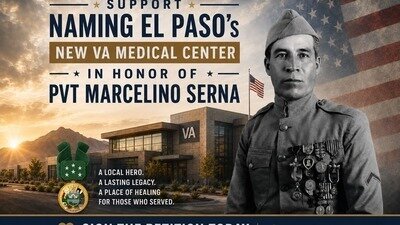

Support naming the new El Paso VA Medical Center after PVT Marcelino Serna
The Issue
Private Marcelino Serna, a Mexican native who made El Paso, Texas his home, was a remarkable hero of World War I. Born on April 26, 1896, Serna courageously enlisted in the American army during a time when opportunities for Mexican immigrants in the military were nearly non-existent. Despite the odds, he became one of the most decorated soldiers from Texas, an achievement that continues to inspire pride within the El Paso community and beyond.
In World War I, Serna was sent overseas and assigned to Company B, 355th Infantry Regiment, 89th Division. When the Army realized that he was a Mexican national, he was offered a discharge. Serna, however, chose to stay with his new friends. Serna's unit was ordered to advance towards the Meuse River and Argonne Forest in France. When his unit arrived at Saint-Mihiel, they encountered a German machine gunner who killed 13 soldiers. Serna crawled up to the machine gunner's left flank. Even though his helmet was hit twice by bullets, Serna was able to get close enough to throw four grenades into the nest. Eight Germans surrendered and the rest were dead. On September 12, 1918, Serna's unit was engaged in combat inside the Meuse-Argonne region when he spotted a German sniper and wounded him with his Enfield rifle. Serna followed the wounded soldier to a trench. He threw three grenades into the trench, which resulted in the death of 26 enemy soldiers and the capture of 24.
Serna was wounded in both of his legs by sniper fire, four days before the Armistice. During his recovery, General John J. Pershing, Commander-in-Chief of the American Expeditionary Forces, pinned on his chest the Distinguished Service Cross, the second highest military decoration of the United States Army to the Medal of Honor. Serna was told by an officer that a "'buck' private" was not eligible for the Medal of Honor, and that he could not be promoted because he did not know enough English. Private David B. Barkley, who also served in the 89th Division, was awarded the Medal of Honor for his actions. Years later, it was discovered that Barkley was Hispanic, thus the only Hispanic recipient of the Medal of Honor in World War I. Field Marshal Ferdinand Foch, Supreme Commander of the Allied forces, awarded Serna the French Croix de Guerre for bravery.
Serna returned to the U.S. as the most decorated soldier from Texas and was discharged at Camp Bowie, Texas in May 1919. In 1924, Serna became a United States citizen and soon after he married and settled down in El Paso, Texas. He went to work at the Peyton Packing Company. In 1960, he retired as a plumber from William Beaumont Hospital. On February 29, 1992, Marcelino Serna died at the age of 95. He was buried with full military honors at Fort Bliss National Cemetery, of El Paso, Texas.
On January 17, 1995, Congressman Ronald D'Emory Coleman introduced legislation before the House of Representatives that requested that Serna be awarded the Medal of Honor posthumously, to no avail.
In 2007 at the 78th Annual LULAC (League of United Latin American Citizens) Convention, the following resolution was adopted by the National Assembly: Congressional Medal of Honor Recommendation for Guy Louis Gabaldon, Rafael Peralta and Marcelino Serna.
On September 29, 2016, the United States designated the Customs and Border Protection Port of Entry located at 1400 Lower Island Road in Tornillo, Texas, as the "Marcelino Serna Port of Entry."
In 2020 it was reported that "Private Marcelino Serna did not receive the Medal of Honor due to him being a Mexican American and an immigrant.”
On March 2, 2022, Serna was awarded the Texas Legislative Medal of Honor for his actions on September 12, 1918.
Serna's heroism is well-documented; he was awarded the Distinguished Service Cross, the Purple Heart, and the World War I Victory Medal, among others. His bravery in battle demonstrated his unwavering dedication to his adopted country, yet he never received the national recognition he truly deserved. Naming the El Paso VA clinic after PVT Marcelino Serna is an opportunity to honor his legacy, celebrating his contributions to our nation's history and the protection of freedoms we hold dear today.
El Paso has always cherished its veterans and their sacrifices, and naming this new VA Medical Center would be a fitting tribute to Serna while inspiring future generations to uphold values of bravery, honor, and service. This small act of recognition will foster a sense of pride among local veterans and their families, reminding them of the extraordinary acts of valor accomplished by one of their own.
Now is the time to act, ensuring that the legacy of PVT Marcelino Serna is appropriately memorialized in the city he called home. By signing this petition, you are supporting a cause that both respects the rich history of our American military and the contributions to our great nation. Let us come together to ensure that future generations will know the name and the courage of PVT Marcelino Serna.
Key points on the naming procedure:
*The Congressional Representatives named are not the ultimate decision makers; all members of the state's congressional delegation must provide written support.
*State-level chapters of major veteran's service organizations must also provide written support.
*After the requirements mentioned in the letter are met a Member of Congress may introduce a bill which must pass both the House and Senate.
Please join us in calling for this recognition of courage and sacrifice. Sign this petition to show your support for naming the El Paso VA Medical Center in honor of PVT Serna. Together, let us ensure this tribute is realized.
Sign this petition to urge local authorities to name the El Paso VA Medical Center after PVT Marcelino Serna, creating a lasting tribute to his service and sacrifice.
74
The Issue
Private Marcelino Serna, a Mexican native who made El Paso, Texas his home, was a remarkable hero of World War I. Born on April 26, 1896, Serna courageously enlisted in the American army during a time when opportunities for Mexican immigrants in the military were nearly non-existent. Despite the odds, he became one of the most decorated soldiers from Texas, an achievement that continues to inspire pride within the El Paso community and beyond.
In World War I, Serna was sent overseas and assigned to Company B, 355th Infantry Regiment, 89th Division. When the Army realized that he was a Mexican national, he was offered a discharge. Serna, however, chose to stay with his new friends. Serna's unit was ordered to advance towards the Meuse River and Argonne Forest in France. When his unit arrived at Saint-Mihiel, they encountered a German machine gunner who killed 13 soldiers. Serna crawled up to the machine gunner's left flank. Even though his helmet was hit twice by bullets, Serna was able to get close enough to throw four grenades into the nest. Eight Germans surrendered and the rest were dead. On September 12, 1918, Serna's unit was engaged in combat inside the Meuse-Argonne region when he spotted a German sniper and wounded him with his Enfield rifle. Serna followed the wounded soldier to a trench. He threw three grenades into the trench, which resulted in the death of 26 enemy soldiers and the capture of 24.
Serna was wounded in both of his legs by sniper fire, four days before the Armistice. During his recovery, General John J. Pershing, Commander-in-Chief of the American Expeditionary Forces, pinned on his chest the Distinguished Service Cross, the second highest military decoration of the United States Army to the Medal of Honor. Serna was told by an officer that a "'buck' private" was not eligible for the Medal of Honor, and that he could not be promoted because he did not know enough English. Private David B. Barkley, who also served in the 89th Division, was awarded the Medal of Honor for his actions. Years later, it was discovered that Barkley was Hispanic, thus the only Hispanic recipient of the Medal of Honor in World War I. Field Marshal Ferdinand Foch, Supreme Commander of the Allied forces, awarded Serna the French Croix de Guerre for bravery.
Serna returned to the U.S. as the most decorated soldier from Texas and was discharged at Camp Bowie, Texas in May 1919. In 1924, Serna became a United States citizen and soon after he married and settled down in El Paso, Texas. He went to work at the Peyton Packing Company. In 1960, he retired as a plumber from William Beaumont Hospital. On February 29, 1992, Marcelino Serna died at the age of 95. He was buried with full military honors at Fort Bliss National Cemetery, of El Paso, Texas.
On January 17, 1995, Congressman Ronald D'Emory Coleman introduced legislation before the House of Representatives that requested that Serna be awarded the Medal of Honor posthumously, to no avail.
In 2007 at the 78th Annual LULAC (League of United Latin American Citizens) Convention, the following resolution was adopted by the National Assembly: Congressional Medal of Honor Recommendation for Guy Louis Gabaldon, Rafael Peralta and Marcelino Serna.
On September 29, 2016, the United States designated the Customs and Border Protection Port of Entry located at 1400 Lower Island Road in Tornillo, Texas, as the "Marcelino Serna Port of Entry."
In 2020 it was reported that "Private Marcelino Serna did not receive the Medal of Honor due to him being a Mexican American and an immigrant.”
On March 2, 2022, Serna was awarded the Texas Legislative Medal of Honor for his actions on September 12, 1918.
Serna's heroism is well-documented; he was awarded the Distinguished Service Cross, the Purple Heart, and the World War I Victory Medal, among others. His bravery in battle demonstrated his unwavering dedication to his adopted country, yet he never received the national recognition he truly deserved. Naming the El Paso VA clinic after PVT Marcelino Serna is an opportunity to honor his legacy, celebrating his contributions to our nation's history and the protection of freedoms we hold dear today.
El Paso has always cherished its veterans and their sacrifices, and naming this new VA Medical Center would be a fitting tribute to Serna while inspiring future generations to uphold values of bravery, honor, and service. This small act of recognition will foster a sense of pride among local veterans and their families, reminding them of the extraordinary acts of valor accomplished by one of their own.
Now is the time to act, ensuring that the legacy of PVT Marcelino Serna is appropriately memorialized in the city he called home. By signing this petition, you are supporting a cause that both respects the rich history of our American military and the contributions to our great nation. Let us come together to ensure that future generations will know the name and the courage of PVT Marcelino Serna.
Key points on the naming procedure:
*The Congressional Representatives named are not the ultimate decision makers; all members of the state's congressional delegation must provide written support.
*State-level chapters of major veteran's service organizations must also provide written support.
*After the requirements mentioned in the letter are met a Member of Congress may introduce a bill which must pass both the House and Senate.
Please join us in calling for this recognition of courage and sacrifice. Sign this petition to show your support for naming the El Paso VA Medical Center in honor of PVT Serna. Together, let us ensure this tribute is realized.
Sign this petition to urge local authorities to name the El Paso VA Medical Center after PVT Marcelino Serna, creating a lasting tribute to his service and sacrifice.
The Decision Makers


Petition Updates
Share this petition
Petition created on May 27, 2026