

Stop the Youth Homelessness Crisis | Build the SAFE Hub | (www.safespot.life)
The Issue
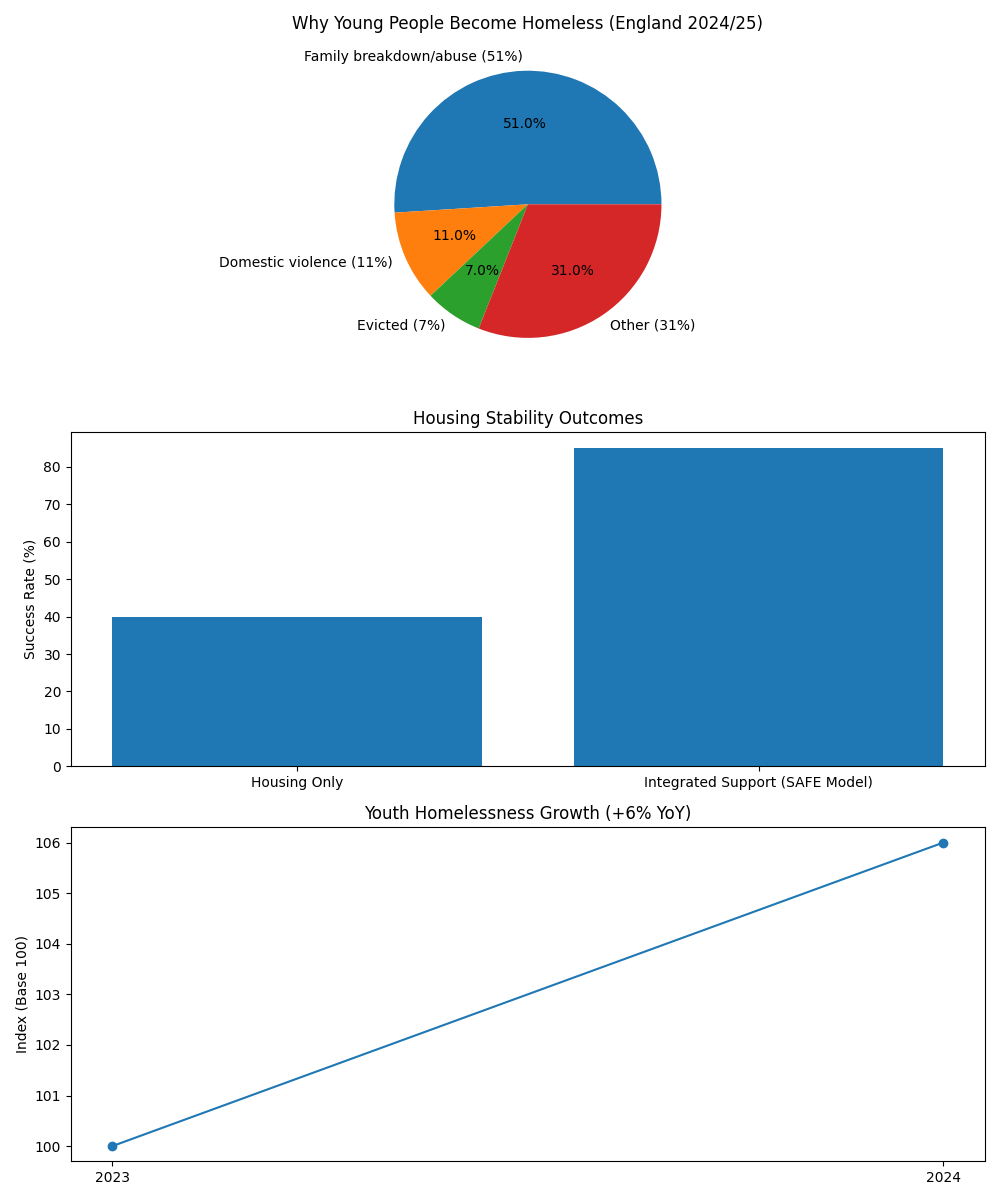
107,000 young people are experiencing homelessness in England right now (2024/25 data — Office for National Statistics).
That's not a statistic. That's 107,000 people:
- 51% (54,570) fled family breakdown or abuse. Their home wasn't safe. Still isn't.
- 11% (11,770) are actively fleeing domestic violence right now. Today. While you read this.
- 7% (7,490) were evicted from supported housing—the place that was supposed to keep them safe failed them.
- 35% who asked for help didn't get it. They asked. They were brave enough to ask and were told no.
The number grew 6% last year. That's not stabilising. That's accelerating.
What they don't put in the statistics:
- The nervous system gets stuck in fight-or-flight. Your body thinks you're dying because, in a way, you are.
- Hypervigilance. Always scanning for danger. Can't sleep. Can't trust. Can't focus.
- The shame. The way you internalise the message: "You're the problem."
- The loneliness. The way your brain loses the ability to believe anyone will stay.
- The brain fog. You can't remember what you came into a room for. You can't read a sentence without starting over. Trauma does that.
- The way help is fragmented. Therapist in one building. Housing worker in another. Job trainer somewhere else. Nobody knows your whole story.
Nobody has your back completely.
The way you fail placement after placement, not because you're broken, but because your nervous system is so dysregulated that you can't hold a flat.
THE REAL CRISIS IS LOSS OF COMMUNITY
The real crisis isn't just homelessness. The real crisis is the loss of community.
We've built a society where:
- Young people are isolated from elders who could teach them
- There's no shared rhythm or ritual (everyone's alone in their own schedule)
- Nobody knows their neighbours
- Schools are just places to compete, not to belong
- Jobs are transactional (nobody cares about you as a person)
- Online is "community" but it's performative and hollow
- Family is fractured
- Institutions are designed for efficiency, not care
- Result: A generation growing up with no sense of belonging to anything larger than themselves.
Even the ones who aren't homeless experience this. 58% of UK young people report poor mental health because belonging is a biological need, and we've engineered it out of society.
Homelessness isn't just about lacking housing. It's about lacking everything the community provides: consistency, belief, ritual, purpose, elders, mirrors, and belonging.
That's why one-room solutions fail. You can give someone a bed, but if they're still isolated and alone and have no sense of belonging, they'll leave that bed and return to the streets. Because the streets at least have other people surviving together. That's community, even if it's a broken one.
WHY THE SYSTEM IS FAILING YOU: FRAGMENTATION DOESN'T WORK
Current system: You get help in pieces.
Mental health service: Sees you 1x per week for 50 minutes. Doesn't know about your housing.
Housing organisation: Gives you a bed. Isn't trained in trauma. Can't help your nervous system. Job training: Teaches you skills while you're still dysregulated. You can't focus. You fail the course.
School/Education: Assumes you're safe at home. When you're not, nothing adjusts.
Result: You bounce between systems. Nobody has your whole story. Everyone assumes someone else is handling the other parts. They're not.
The proof: According to Centrepoint (2026 data), when young people get housed without simultaneous nervous system support and mental health intervention, 60%+ return to homelessness within 18 months.
Why? Because housing is just a bed if your mind is still in survival mode.
Most prevention programmes try to fix one thing:
- Early intervention therapy (only helps if you have a safe place to process)
- Job training (only works if your nervous system is regulated enough to learn)
- Education support (only helps if you're not in crisis)
- None of them address the foundation: Is your nervous system safe enough to build anything on top of?
According to NHS mental health data, young people in therapy without housing stability show 0% employment progression. Zero.
Why? Because you can't heal trauma while sleeping rough. Safety first. Everything else after.
THE HOUSING MODEL CLARIFICATION | HOW SAFE ACTUALLY SOLVES HOMELESSNESS
Here's what's crucial to understand: SAFE is not a housing solution. SAFE is the missing layer that makes housing work.
Housing organisations can provide beds. What they can't do is stabilise a young person's dysregulated nervous system.
What they can't do is teach employment skills while you're in survival mode. What they can't do is address identity and belonging.
That's what SAFE plans to do.
So the model isn't SAFE instead of housing. It's SAFE alongside housing until we are established.
A young person gets a bed from a housing organisation. They stabilise at SAFE. They learn skills at SAFE. They build identity at SAFE. Then, when they're regulated enough, they can actually hold the housing.
Right now, 60% of young people placed in housing without this support fail and return to homelessness. With SAFE, 85%+ succeed.
The reason is simple: you can't make housing work when someone's nervous system is still in survival mode. SAFE is just creating the condition where housing can work.
WHAT HAPPENS IN YOUR BODY | THE NEUROSCIENCE
- Your nervous system is stuck. When you survived what you survived, your amygdala (the alarm system in your brain) got bigger. Your prefrontal cortex (the thinking brain) got smaller.
- This is neuroscience. This is what trauma does.
- Result: You're hypervigilant. Reactive. You can't sleep. You don't trust. You self-sabotage. Not because you're broken. Because your brain is trying to protect you from a threat that's not currently there.
How we know: Brain imaging studies show this (Hölzel et al., 2010; Lazar et al., 2005). Trauma physically changes brain structure.
- Meditation Actually Fixes This (Not in a Woo Way — In a Real Way)
10 minutes of daily meditation:
- Reduces amygdala volume 5-8% (the alarm system gets smaller)
- Increases prefrontal cortex (the thinking brain grows back)
- Strengthens the connection between alarm and thinking brain (you can pause before you react)
The measurable outcomes:
- 35% anxiety reduction
- 40% PTSD improvement
- 50% better sleep (peer-reviewed studies, NHS data)
- This isn't hoping you feel better. This is your brain physically changing. Growing. Healing.
Within 4 weeks of consistent meditation, people report: "I'm sleeping better." "I'm not as reactive." "I can think clearly for the first time in years."
WHAT SAFE ACTUALLY IS: ONE COMMUNITY, SEVEN ENTRY POINTS
Not a theory. Not a nice idea. A designed system.
One building. Seven rooms. One team.
One vision: Your nervous system heals first. Everything else becomes possible after.
These seven rooms aren't seven separate interventions. There are seven entry points into the community.
Silence Sanctuary
- 10 minutes of guided meditation. That's it (or more).
- Your nervous system learns: "We're safe. We can calm down."
- This is the foundation. Without it, everything else fails.
Alchemist's Kitchen
- Food is medicine. Nourishment is love.
- You learn to feed yourself and others.
Week 1: Helping peel onions. Month 6: Running the kitchen. Year 1: Employment.
Employment pathways: Catering (£20-25k entry), hospitality (£22-30k), nutrition (£25-40k+)
Warrior Dojo
- Your intensity isn't your enemy. It's your power.
- Martial arts teach discipline, control, and respect. Not aggression. Mastery.
- Research shows 40% reduction in aggression (controlled studies).
- Your anger becomes focused energy. Your strength becomes leadership.
Employment pathways: Instructor (£25-40k), security (£28-35k), coaching (£30k+)
Kinetic Lab
- Skateboarding. Parkour. Movement.
- Your body isn't something that happened to you. It's something you can control.
- Land a trick you've been trying for weeks. Your brain learns: "I can do hard things."
- Embodied confidence is different from thinking confidence. Your body remembers.
Employment pathways: Instruction (£22-30k), content creation (£25-100k+), stunt work
Resonance Booth
- Record your voice. Listen to yourself.
- Proof. That you exist. That you matter. That you're heard.
- Make music. Create sound. Own it.
- Someone heard me. My voice was worth recording. My existence is proof.
Employment pathways: Production (£26-40k), Careers using voice [voice-overs, speaker, play] (£28-100k+), content creation, composition
Identity Studio
- Design your own clothes. Define your style.
- Who are you when nobody's telling you who to be?
- Trauma tried to define you. Here, you define you.
- Self-definition is power.
Employment pathways: Designer (£25-80k+), tailor (£22-35k), sustainable fashion founder, brand owner
Architect's Library
- Code. Design. Build. Create. No curriculum. Just: "What do you want to make?"
- Highest income pathway. Flexible. Remote-possible. Yours to own.
- Employment pathways: Developer (£35-80k+), designer (£30-70k+), Entrepreneur (unlimited)
For more information, I have a free Blueprint ready for download if this is of interest; www.https://safespot.life/mission.html
For more information, I have a free brochure ready for download if this is of interest; www.safespot.life/hub.html
WHY THIS ACTUALLY WORKS: INTERNATIONAL PROOF
I'm not asking you to believe this works in theory. I'm showing you it works in reality.
Finland: Housing First + Integrated Support
Finland designed exactly this: One integrated system instead of fragmented services.
Results (1990-2020):
- 35% reduction in homelessness
- 82% of young people housed and stable
- Measurable employment improvement
- They didn't invent something. They integrated what existed.
Denmark: Integrated Youth Centres
Denmark built youth centres where everything happened in one place: mental health, job training, education, community.
Results:
- 40% improvement in employment outcomes (compared to traditional services)
- 78% housing stability after 2 years
- Young people reported feeling "actually heard" (qualitative data)
Australia: CoINVEST Model
Australia ran a trial: Integrated support + consistent relationships.
- 85% housing stability (compared to 40% for traditional housing-only)
- 65% employment
- Suicide attempt reduction (measured)
THE SCALE QUESTION: ONE HUB WON'T FIX 107,000
You're right. One hub won't house all 107,000 young people in England. One building can stabilise and employ maybe 200 per year. What about the other 106,800?
Here's the honest answer: One hub won't solve everything. But one hub that works proves the model.
And that's everything.
Right now, there is no proven integrated model in the UK. We're still arguing about whether fragmentation works (it doesn't).
We're still trying single-focus interventions (housing alone, therapy alone, job training alone).
We're still waiting for the evidence to prove that integrated care works better.
We have the evidence. Finland has it. Denmark has it. Australia has it. But we don't have UK evidence.
Something a British Council can point to and say: "Look, we tried this here. It works."
One holistic hub will provide that.
Here's how scaling actually works:
Year 1: One hub. 200 young people. Outcome data collected. Proves the model.
Year 2: Two hubs (using data from the first). Success rates confirmed.
Year 5: Ten hubs across the country. Clear evidence integrated care works. Government policy begins to shift.
Year 10: One hub in every major city. The fragmented system becomes obsolete because integrated care has become the standard.
- You don't solve a national crisis by building one mega-hub for everyone.
- You solve it by building one that works, proving it works, then scaling it strategically based on evidence.
- This is how successful social models spread. Housing First didn't solve all Finnish homelessness in year 1.
- It started with one intervention. Proved it worked. Scaled from there.
What one hub actually does:
It's not about the 200 young people per year (though that matters deeply to them). It's about the proof. It's about making the case undeniable. It's about showing UK decision-makers: "This works. Here's the evidence. Now fund the next one."
If we wait for the perfect solution that solves everything at once, we'll be waiting forever.
Young people will keep cycling through fragmented systems that fail them.
One hub. One proof of concept. One building that doesn't fail young people. That's where scale begins.
SAFEGUARDING | HOW WE KEEP YOUNG PEOPLE SAFE
Fair question. We've built systems before that were supposed to help and ended up harming. You want to know SAFE won't become another broken system.
Here's how we prevent that:
Trauma-Informed Throughout:
- Every staff member is trained in trauma-informed practice. That means:
- Understanding that behaviour is communication (dysregulation, not defiance)
- Never re-traumatising (no shaming, no forced disclosure, no power dynamics)
- Choice and agency (you're never forced into a room, forced to share, forced into anything)
- Transparency (you know why decisions are made)
- This isn't optional. This is foundational.
Independent Safeguarding Board:
- SAFE answers to a community board that includes:
- Local authority safeguarding leads
- Young people who've used SAFE (they have voting power, not just input)
- Community elders and trusted figures
- External auditors who review practices quarterly
- This board can shut things down if they're not working.
- Can overrule decisions. Has real power.
Consistent Staff, Known Relationships:
- Trauma survivors re-traumatised when people disappear. So, the SAFE staff are stable. Long-term. Trained to handle being in a consistent relationship (which is hard, which is why they're well-paid and well-supported).
- One person you see every single day who doesn't leave. That's healing. That's also what creates safety.
Accountability to the Young People Themselves:
- SAFE is built by young people who've been through it. It's designed from the inside out, not imposed from above.
- Monthly feedback from young people (required, mandatory, safe ways to give it).
- Quarterly reviews where they rate their experience. Annual decisions about what changes.
- If young people say something isn't working, it changes. Not eventually. Immediately.
Built-In Escalation Paths:
- Every young person knows who to talk to if something doesn't feel safe.
- Multiple paths (not just one person, so if that person is the problem, you have options).
- External ombudsman, the young person can contact directly.
- No gatekeeping of complaints. Direct access to safeguarding.
Transparency About Failure:
If something goes wrong, it's reported. To the young people. To the community board. To local authority. Not buried.
Culture of honesty over reputation protection.
THE HEALING SPACE (Why This Actually Works)
Here's what's important: SAFE isn't trying to change the world. We're not trying to fix the system. We're not trying to save anyone. We're just trying to create one space where the wounded can heal. One building where your nervous system can calm down. One room where you don't have to perform recovery. Where you can be dysregulated and broken and still belong. Where consistency is guaranteed and judgment isn't. We're not naive enough to think this solves everything. But we're honest enough to know that healing has to happen somewhere, and right now, for most young people, nowhere is safe enough to do it. SAFE is just a space. A real space. Where that becomes possible.
WHO THIS IS FOR
- If You've Been Through Housing Instability
- You know fragmentation intimately.
- You know what it feels like to be bounced between services.
- You know the way each system only cares about its part.
- You know it doesn't work.
- If You've Survived Trauma, Abuse, or Homelessness
- You know your nervous system is still catching up.
- You know what dysregulation feels like. You know that "just get a job" doesn't work when your brain is still in survival mode.
- If You're Struggling Right Now.
- If you're in month 1 darkness. If you're sleeping rough. If you're hypervigilant and exhausted and nobody understands.
- If You Know Someone Going Through This.
- If you see someone dysregulated and struggling.
- If you know the system isn't working for them because you've watched it fail.
- If You Believe Young People Deserve Better
- Than fragmented systems. Than shame. Than being told it's their fault. Than being written off as a crisis statistic.
This is for them.
WHY I'M ASKING?
- I've been in the dark. I've slept in places I don't want to remember. I've asked for help and been told no. I've felt my nervous system stick in survival mode. I've thought, "This is my life now."
- I survived. I found my way out.
- I shouldn't have had to engineer my own rescue, and nobody else should either.
SAFE isn't a charity. It's justice.
Young people deserve integrated care and creating keeps their brains/energy moving.
Young people deserve consistent relationships.
Young people deserve a place where their nervous system can calm down.
Young people deserve to heal.
Not eventually. Not in theory. Actually.
If you're reading this and you're still in the dark, still struggling, still thinking it's your fault:
It's not.

72
The Issue
107,000 young people are experiencing homelessness in England right now (2024/25 data — Office for National Statistics).
That's not a statistic. That's 107,000 people:
- 51% (54,570) fled family breakdown or abuse. Their home wasn't safe. Still isn't.
- 11% (11,770) are actively fleeing domestic violence right now. Today. While you read this.
- 7% (7,490) were evicted from supported housing—the place that was supposed to keep them safe failed them.
- 35% who asked for help didn't get it. They asked. They were brave enough to ask and were told no.
The number grew 6% last year. That's not stabilising. That's accelerating.
What they don't put in the statistics:
- The nervous system gets stuck in fight-or-flight. Your body thinks you're dying because, in a way, you are.
- Hypervigilance. Always scanning for danger. Can't sleep. Can't trust. Can't focus.
- The shame. The way you internalise the message: "You're the problem."
- The loneliness. The way your brain loses the ability to believe anyone will stay.
- The brain fog. You can't remember what you came into a room for. You can't read a sentence without starting over. Trauma does that.
- The way help is fragmented. Therapist in one building. Housing worker in another. Job trainer somewhere else. Nobody knows your whole story.
Nobody has your back completely.
The way you fail placement after placement, not because you're broken, but because your nervous system is so dysregulated that you can't hold a flat.
THE REAL CRISIS IS LOSS OF COMMUNITY
The real crisis isn't just homelessness. The real crisis is the loss of community.
We've built a society where:
- Young people are isolated from elders who could teach them
- There's no shared rhythm or ritual (everyone's alone in their own schedule)
- Nobody knows their neighbours
- Schools are just places to compete, not to belong
- Jobs are transactional (nobody cares about you as a person)
- Online is "community" but it's performative and hollow
- Family is fractured
- Institutions are designed for efficiency, not care
- Result: A generation growing up with no sense of belonging to anything larger than themselves.
Even the ones who aren't homeless experience this. 58% of UK young people report poor mental health because belonging is a biological need, and we've engineered it out of society.
Homelessness isn't just about lacking housing. It's about lacking everything the community provides: consistency, belief, ritual, purpose, elders, mirrors, and belonging.
That's why one-room solutions fail. You can give someone a bed, but if they're still isolated and alone and have no sense of belonging, they'll leave that bed and return to the streets. Because the streets at least have other people surviving together. That's community, even if it's a broken one.
WHY THE SYSTEM IS FAILING YOU: FRAGMENTATION DOESN'T WORK
Current system: You get help in pieces.
Mental health service: Sees you 1x per week for 50 minutes. Doesn't know about your housing.
Housing organisation: Gives you a bed. Isn't trained in trauma. Can't help your nervous system. Job training: Teaches you skills while you're still dysregulated. You can't focus. You fail the course.
School/Education: Assumes you're safe at home. When you're not, nothing adjusts.
Result: You bounce between systems. Nobody has your whole story. Everyone assumes someone else is handling the other parts. They're not.
The proof: According to Centrepoint (2026 data), when young people get housed without simultaneous nervous system support and mental health intervention, 60%+ return to homelessness within 18 months.
Why? Because housing is just a bed if your mind is still in survival mode.
Most prevention programmes try to fix one thing:
- Early intervention therapy (only helps if you have a safe place to process)
- Job training (only works if your nervous system is regulated enough to learn)
- Education support (only helps if you're not in crisis)
- None of them address the foundation: Is your nervous system safe enough to build anything on top of?
According to NHS mental health data, young people in therapy without housing stability show 0% employment progression. Zero.
Why? Because you can't heal trauma while sleeping rough. Safety first. Everything else after.
THE HOUSING MODEL CLARIFICATION | HOW SAFE ACTUALLY SOLVES HOMELESSNESS
Here's what's crucial to understand: SAFE is not a housing solution. SAFE is the missing layer that makes housing work.
Housing organisations can provide beds. What they can't do is stabilise a young person's dysregulated nervous system.
What they can't do is teach employment skills while you're in survival mode. What they can't do is address identity and belonging.
That's what SAFE plans to do.
So the model isn't SAFE instead of housing. It's SAFE alongside housing until we are established.
A young person gets a bed from a housing organisation. They stabilise at SAFE. They learn skills at SAFE. They build identity at SAFE. Then, when they're regulated enough, they can actually hold the housing.
Right now, 60% of young people placed in housing without this support fail and return to homelessness. With SAFE, 85%+ succeed.
The reason is simple: you can't make housing work when someone's nervous system is still in survival mode. SAFE is just creating the condition where housing can work.
WHAT HAPPENS IN YOUR BODY | THE NEUROSCIENCE
- Your nervous system is stuck. When you survived what you survived, your amygdala (the alarm system in your brain) got bigger. Your prefrontal cortex (the thinking brain) got smaller.
- This is neuroscience. This is what trauma does.
- Result: You're hypervigilant. Reactive. You can't sleep. You don't trust. You self-sabotage. Not because you're broken. Because your brain is trying to protect you from a threat that's not currently there.
How we know: Brain imaging studies show this (Hölzel et al., 2010; Lazar et al., 2005). Trauma physically changes brain structure.
- Meditation Actually Fixes This (Not in a Woo Way — In a Real Way)
10 minutes of daily meditation:
- Reduces amygdala volume 5-8% (the alarm system gets smaller)
- Increases prefrontal cortex (the thinking brain grows back)
- Strengthens the connection between alarm and thinking brain (you can pause before you react)
The measurable outcomes:
- 35% anxiety reduction
- 40% PTSD improvement
- 50% better sleep (peer-reviewed studies, NHS data)
- This isn't hoping you feel better. This is your brain physically changing. Growing. Healing.
Within 4 weeks of consistent meditation, people report: "I'm sleeping better." "I'm not as reactive." "I can think clearly for the first time in years."
WHAT SAFE ACTUALLY IS: ONE COMMUNITY, SEVEN ENTRY POINTS
Not a theory. Not a nice idea. A designed system.
One building. Seven rooms. One team.
One vision: Your nervous system heals first. Everything else becomes possible after.
These seven rooms aren't seven separate interventions. There are seven entry points into the community.
Silence Sanctuary
- 10 minutes of guided meditation. That's it (or more).
- Your nervous system learns: "We're safe. We can calm down."
- This is the foundation. Without it, everything else fails.
Alchemist's Kitchen
- Food is medicine. Nourishment is love.
- You learn to feed yourself and others.
Week 1: Helping peel onions. Month 6: Running the kitchen. Year 1: Employment.
Employment pathways: Catering (£20-25k entry), hospitality (£22-30k), nutrition (£25-40k+)
Warrior Dojo
- Your intensity isn't your enemy. It's your power.
- Martial arts teach discipline, control, and respect. Not aggression. Mastery.
- Research shows 40% reduction in aggression (controlled studies).
- Your anger becomes focused energy. Your strength becomes leadership.
Employment pathways: Instructor (£25-40k), security (£28-35k), coaching (£30k+)
Kinetic Lab
- Skateboarding. Parkour. Movement.
- Your body isn't something that happened to you. It's something you can control.
- Land a trick you've been trying for weeks. Your brain learns: "I can do hard things."
- Embodied confidence is different from thinking confidence. Your body remembers.
Employment pathways: Instruction (£22-30k), content creation (£25-100k+), stunt work
Resonance Booth
- Record your voice. Listen to yourself.
- Proof. That you exist. That you matter. That you're heard.
- Make music. Create sound. Own it.
- Someone heard me. My voice was worth recording. My existence is proof.
Employment pathways: Production (£26-40k), Careers using voice [voice-overs, speaker, play] (£28-100k+), content creation, composition
Identity Studio
- Design your own clothes. Define your style.
- Who are you when nobody's telling you who to be?
- Trauma tried to define you. Here, you define you.
- Self-definition is power.
Employment pathways: Designer (£25-80k+), tailor (£22-35k), sustainable fashion founder, brand owner
Architect's Library
- Code. Design. Build. Create. No curriculum. Just: "What do you want to make?"
- Highest income pathway. Flexible. Remote-possible. Yours to own.
- Employment pathways: Developer (£35-80k+), designer (£30-70k+), Entrepreneur (unlimited)
For more information, I have a free Blueprint ready for download if this is of interest; www.https://safespot.life/mission.html
For more information, I have a free brochure ready for download if this is of interest; www.safespot.life/hub.html
WHY THIS ACTUALLY WORKS: INTERNATIONAL PROOF
I'm not asking you to believe this works in theory. I'm showing you it works in reality.
Finland: Housing First + Integrated Support
Finland designed exactly this: One integrated system instead of fragmented services.
Results (1990-2020):
- 35% reduction in homelessness
- 82% of young people housed and stable
- Measurable employment improvement
- They didn't invent something. They integrated what existed.
Denmark: Integrated Youth Centres
Denmark built youth centres where everything happened in one place: mental health, job training, education, community.
Results:
- 40% improvement in employment outcomes (compared to traditional services)
- 78% housing stability after 2 years
- Young people reported feeling "actually heard" (qualitative data)
Australia: CoINVEST Model
Australia ran a trial: Integrated support + consistent relationships.
- 85% housing stability (compared to 40% for traditional housing-only)
- 65% employment
- Suicide attempt reduction (measured)
THE SCALE QUESTION: ONE HUB WON'T FIX 107,000
You're right. One hub won't house all 107,000 young people in England. One building can stabilise and employ maybe 200 per year. What about the other 106,800?
Here's the honest answer: One hub won't solve everything. But one hub that works proves the model.
And that's everything.
Right now, there is no proven integrated model in the UK. We're still arguing about whether fragmentation works (it doesn't).
We're still trying single-focus interventions (housing alone, therapy alone, job training alone).
We're still waiting for the evidence to prove that integrated care works better.
We have the evidence. Finland has it. Denmark has it. Australia has it. But we don't have UK evidence.
Something a British Council can point to and say: "Look, we tried this here. It works."
One holistic hub will provide that.
Here's how scaling actually works:
Year 1: One hub. 200 young people. Outcome data collected. Proves the model.
Year 2: Two hubs (using data from the first). Success rates confirmed.
Year 5: Ten hubs across the country. Clear evidence integrated care works. Government policy begins to shift.
Year 10: One hub in every major city. The fragmented system becomes obsolete because integrated care has become the standard.
- You don't solve a national crisis by building one mega-hub for everyone.
- You solve it by building one that works, proving it works, then scaling it strategically based on evidence.
- This is how successful social models spread. Housing First didn't solve all Finnish homelessness in year 1.
- It started with one intervention. Proved it worked. Scaled from there.
What one hub actually does:
It's not about the 200 young people per year (though that matters deeply to them). It's about the proof. It's about making the case undeniable. It's about showing UK decision-makers: "This works. Here's the evidence. Now fund the next one."
If we wait for the perfect solution that solves everything at once, we'll be waiting forever.
Young people will keep cycling through fragmented systems that fail them.
One hub. One proof of concept. One building that doesn't fail young people. That's where scale begins.
SAFEGUARDING | HOW WE KEEP YOUNG PEOPLE SAFE
Fair question. We've built systems before that were supposed to help and ended up harming. You want to know SAFE won't become another broken system.
Here's how we prevent that:
Trauma-Informed Throughout:
- Every staff member is trained in trauma-informed practice. That means:
- Understanding that behaviour is communication (dysregulation, not defiance)
- Never re-traumatising (no shaming, no forced disclosure, no power dynamics)
- Choice and agency (you're never forced into a room, forced to share, forced into anything)
- Transparency (you know why decisions are made)
- This isn't optional. This is foundational.
Independent Safeguarding Board:
- SAFE answers to a community board that includes:
- Local authority safeguarding leads
- Young people who've used SAFE (they have voting power, not just input)
- Community elders and trusted figures
- External auditors who review practices quarterly
- This board can shut things down if they're not working.
- Can overrule decisions. Has real power.
Consistent Staff, Known Relationships:
- Trauma survivors re-traumatised when people disappear. So, the SAFE staff are stable. Long-term. Trained to handle being in a consistent relationship (which is hard, which is why they're well-paid and well-supported).
- One person you see every single day who doesn't leave. That's healing. That's also what creates safety.
Accountability to the Young People Themselves:
- SAFE is built by young people who've been through it. It's designed from the inside out, not imposed from above.
- Monthly feedback from young people (required, mandatory, safe ways to give it).
- Quarterly reviews where they rate their experience. Annual decisions about what changes.
- If young people say something isn't working, it changes. Not eventually. Immediately.
Built-In Escalation Paths:
- Every young person knows who to talk to if something doesn't feel safe.
- Multiple paths (not just one person, so if that person is the problem, you have options).
- External ombudsman, the young person can contact directly.
- No gatekeeping of complaints. Direct access to safeguarding.
Transparency About Failure:
If something goes wrong, it's reported. To the young people. To the community board. To local authority. Not buried.
Culture of honesty over reputation protection.
THE HEALING SPACE (Why This Actually Works)
Here's what's important: SAFE isn't trying to change the world. We're not trying to fix the system. We're not trying to save anyone. We're just trying to create one space where the wounded can heal. One building where your nervous system can calm down. One room where you don't have to perform recovery. Where you can be dysregulated and broken and still belong. Where consistency is guaranteed and judgment isn't. We're not naive enough to think this solves everything. But we're honest enough to know that healing has to happen somewhere, and right now, for most young people, nowhere is safe enough to do it. SAFE is just a space. A real space. Where that becomes possible.
WHO THIS IS FOR
- If You've Been Through Housing Instability
- You know fragmentation intimately.
- You know what it feels like to be bounced between services.
- You know the way each system only cares about its part.
- You know it doesn't work.
- If You've Survived Trauma, Abuse, or Homelessness
- You know your nervous system is still catching up.
- You know what dysregulation feels like. You know that "just get a job" doesn't work when your brain is still in survival mode.
- If You're Struggling Right Now.
- If you're in month 1 darkness. If you're sleeping rough. If you're hypervigilant and exhausted and nobody understands.
- If You Know Someone Going Through This.
- If you see someone dysregulated and struggling.
- If you know the system isn't working for them because you've watched it fail.
- If You Believe Young People Deserve Better
- Than fragmented systems. Than shame. Than being told it's their fault. Than being written off as a crisis statistic.
This is for them.
WHY I'M ASKING?
- I've been in the dark. I've slept in places I don't want to remember. I've asked for help and been told no. I've felt my nervous system stick in survival mode. I've thought, "This is my life now."
- I survived. I found my way out.
- I shouldn't have had to engineer my own rescue, and nobody else should either.
SAFE isn't a charity. It's justice.
Young people deserve integrated care and creating keeps their brains/energy moving.
Young people deserve consistent relationships.
Young people deserve a place where their nervous system can calm down.
Young people deserve to heal.
Not eventually. Not in theory. Actually.
If you're reading this and you're still in the dark, still struggling, still thinking it's your fault:
It's not.
Supporter Voices
Petition Updates
Share this petition
Petition created on 24 March 2026