Stop the Proposed Renovation of Atlanta’s Historic Basilica of the Sacred Heart of Jesus

Stop the Proposed Renovation of Atlanta’s Historic Basilica of the Sacred Heart of Jesus
The Issue
UPDATE
We have received a letter from the Catholic Archdiocese of Atlanta's Director of Communications. It reads:
"June 28, 2024
To whom it may concern,
Archbishop Gregory J. Hartmayer, OFM Conv., is in receipt of your letter mailed June 7. He has reviewed your concerns and has found that all protocols have been properly followed in this project. He has approved phase I to move forward. Thank you for bringing your concerns to us."
It was signed by the Director of Communications.
Phase One A work begins July 15th.
The Short Petition
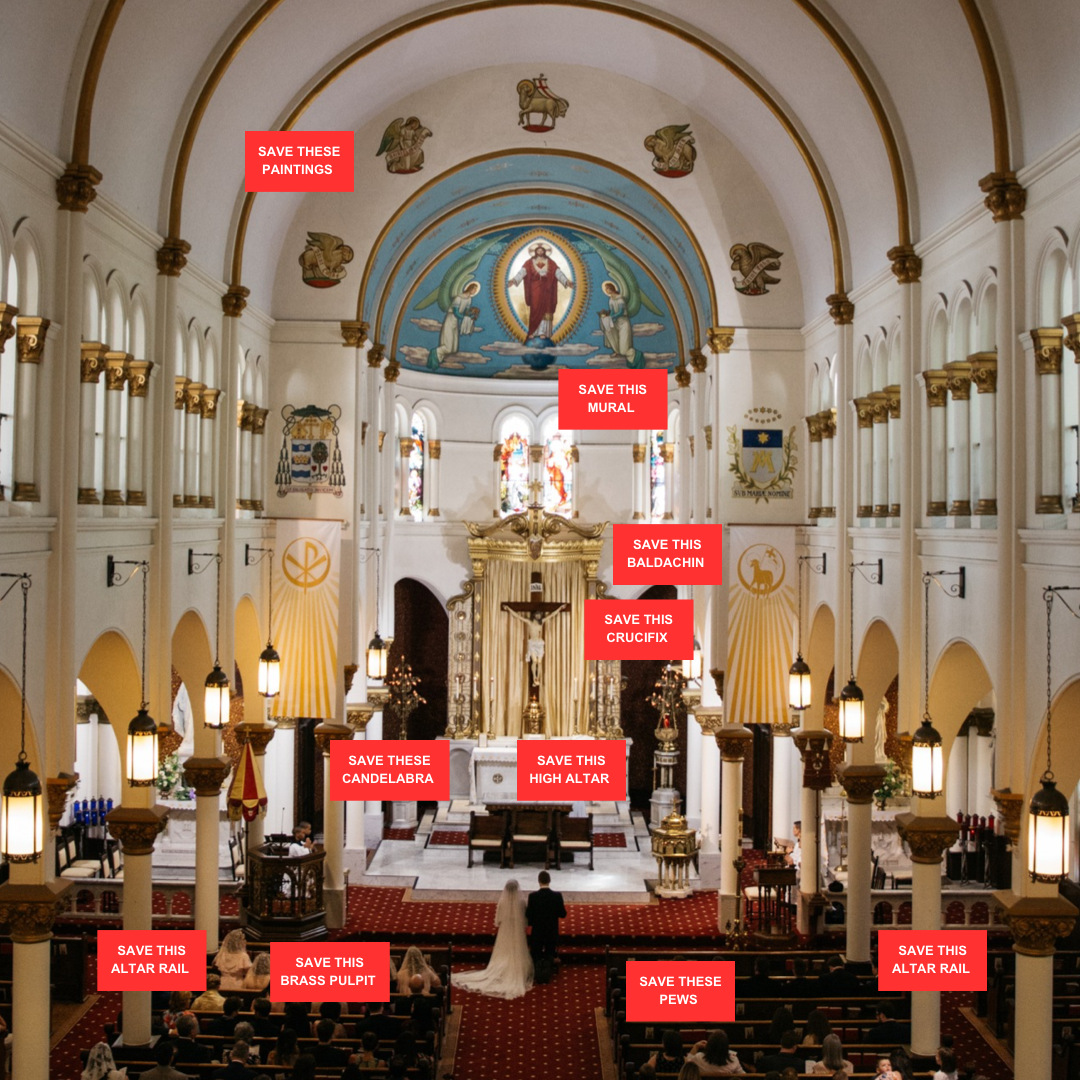
The proposed renovation would not only compromise the beauty of this beloved church but also erase the history of the generations of community members who helped build and decorate it. This church is not just a building; it's a testament to its community's faith and devotion. The art and furnishings to be removed are irreplaceable because the materials and craftsmanship that produced them no longer exist. Their loss would be devastating and irreparable. Furthermore, the Basilica is one of the oldest Catholic churches in Atlanta, one of the few buildings of its age still standing in downtown Atlanta, and a building registered in the National Register of Historic Places. Thus it has an obligation to preserve rather than radically change its look.
For those of us who have special memories in this church—conversions, Baptisms, weddings, the funerals of loved ones, or even just little quiet moments of experiencing God’s peace and consolation—the proposed dramatic overthrowing of the current look is emotionally devastating and spiritually shocking. The stability of the church is a great source of comfort in an ever-changing world, and if even this most sacred space can be changed all at once, what is safe?
Parishioners and non-parishioners, Catholics and non-Catholics, all people who respect history and love art, please join us in asking for these proposed renovations to be stopped immediately. Sign this petition to help safeguard our historic church's beautiful interior for future generations. This church was passed down to us, and we ask that maintenance and work on the church be led by people who fully appreciate its significance and intend to preserve and pass it on.
SAVE HISTORY. SAVE ART.
SIGN THE PETITION TO SAVE SACRED HEART.
The Long Petition
To The Most Reverend Gregory John Hartmayer, Most Rev. Joel M. Konzen, Most Rev. Bernard E. Shlesinger III, and Most Rev. John Nhàn Trần:
Please DELAY AND RECONSIDER the proposed renovation to the Basilica of the Sacred Heart of Jesus in Downtown Atlanta for the following FIVE REASONS.
1. The renovation process was conducted without parish involvement in the early stage, which directly contradicts the USCCB’s Guidelines outlined in Built of Living Stones.
Section 180 of Built of Living Stones: Art, Architecture, and Worship/Guidelines of the National Conference of Catholic Bishops states
- The entire parish is an integral part of the needs assessment and the development of priorities, which are the first steps of a process that will lead to a decision about building, renovating, and expending parish resources. While some decisions in the process will be made by committees, the decision and the design should never become the exclusive project of a small select group.
In “How Did We Get to This Point in the Redecoration Design Process?” Father John Howren says the current renovation plan began with a private conversation between himself and four others in about March/April of 2021. He emailed Dennis Kelly of Catholic Construction Services and later recruited at least two parishioners for their architectural and art backgrounds. This handpicked group spoke with a lighting company, four architectural firms, and two design firms and selected Rambusch Lighting Co. and Conrad Schmitt. This small, select group of handpicked parishioners and the two companies’ representatives put together an interior master plan first draft, met and selected various contractors, received cost estimates, and got the interior master plan draft liturgically and financially approved by the Archdiocese. THEN ABOUT TWO YEARS LATER, in March of 2023, these plans were presented to the parish to be discussed by appointment in small groups inside the Design Studio.
Contrary to the USCCB guideline on involving the entire parish in the first steps, this renovation did not engage the parish until after the plans and contractors were chosen. The guideline states that the entire parish's needs should inform the renovation priorities and decisions. However, this project was decided and designed for about two years by a small, select group before the parish at large even knew about it.
Section 181 of Built of Living Stones states
- When a parish is determining the need for a new church or for the renovation of an existing church, a thorough self-study and educational program is part of the needs assessment process. In that study the parish community reflects upon what it is, and what it hopes for in a new or renovated church. This is essential to enable the community to give direction to the architect and other professionals who will design the building.
This first step did not take place as a first step at all. The community was not given the opportunity to share its hopes for the renovated church until after the architects and other professionals designed the plans according to the input of a small, select group.
2. The proposed renovation, which includes the removal of significant historical and artistic elements, fails to preserve the church's artistic heritage and violates the Second Vatican Council's Constitution on the Sacred Liturgy, Sacrosanctum Concilium, The General Instruction on the Roman Missal, the Congregation of the Clergy's Circular Letter on the Care of the Church's Historical and Artistic Heritage, “Opera Artis,” and the USCCB's Guidelines, Built of Living Stones.
The proposed renovation includes removing the altars, the crucifix, the baldachin, the two Victorian candelabra, the brass pulpit detailed with images of the Sacred Heart, significant sections of the altar rails in front of the side altars, and the historic pews. It also includes painting over the 1939 paintings on the apse ceiling and triumphal arch. These changes would significantly alter the church's interior and erase many of its historical and artistic elements.
No. 123 of Sacrosanctum Concilium states
- The Church has not adopted any particular style of art as her very own; she has admitted styles from every period according to the natural talents and circumstances of peoples, and the needs of the various rites. Thus, in the course of the centuries, she has brought into being a treasury of art which must be very carefully preserved.
The General Instruction on the Roman Missal also says in no. 289 that the Church “is intent on preserving the works of art and the artistic treasures handed down from past centuries.”
The proposed renovation REMOVES and PAINTS OVER the Basilica’s artistic treasures INSTEAD OF preserving them.
“Opera Artis,” the Circular Letter on the Care of the Church's Historical and Artistic Heritage issued by the Congregation of the Clergy, included in its “reminders and decrees”
- 2. Works of art from the past are always and everywhere to be preserved so that they may lend their noble service to divine worship and their help to the people's active participation in the liturgy.
- 6. Should it become necessary to adapt works of art and the treasures of the past to the new liturgical laws, bishops are to take care that the need is genuine and that no harm comes to the work of art.
The proposed renovation does not adapt but removes and harms the works of art and treasures of the past. Where is the genuine need to do this?
Built of Living Stones Sec. 253 states that parishes, in collaboration with architects, artists, liturgical consultants, and diocesan personnel, should assess artistic works and furnishings for their value and discern works that are considered part of the sacred heritage of the Church’s art.
There is no public evidence that the current renovation process included this vital step. The list of artistic works and furnishings that are part of the Basilica’s sacred heritage would likely be similar to the list of items to be removed or painted over.
Built of Living Stones Sec. 254 states
- When it is necessary to relocate or remove artistic pieces in the interest of the liturgical reform, they can be appropriately cared for and placed in a location "befitting and worthy of the works themselves."
What is the plan for the altars, crucifix, brass pulpit, baldachin, candelabra, and altar rail portions that the proposed renovation removes?
3. The Church of the Sacred Heart, a significant part of Atlanta’s history, entered the National Register of Historic Places in 1976. The proposed renovation, which removes a significant portion of the interior architecture and design described and photographed in its nomination form to the US Department of the Interior’s National Park Service, threatens to erase its historical significance.
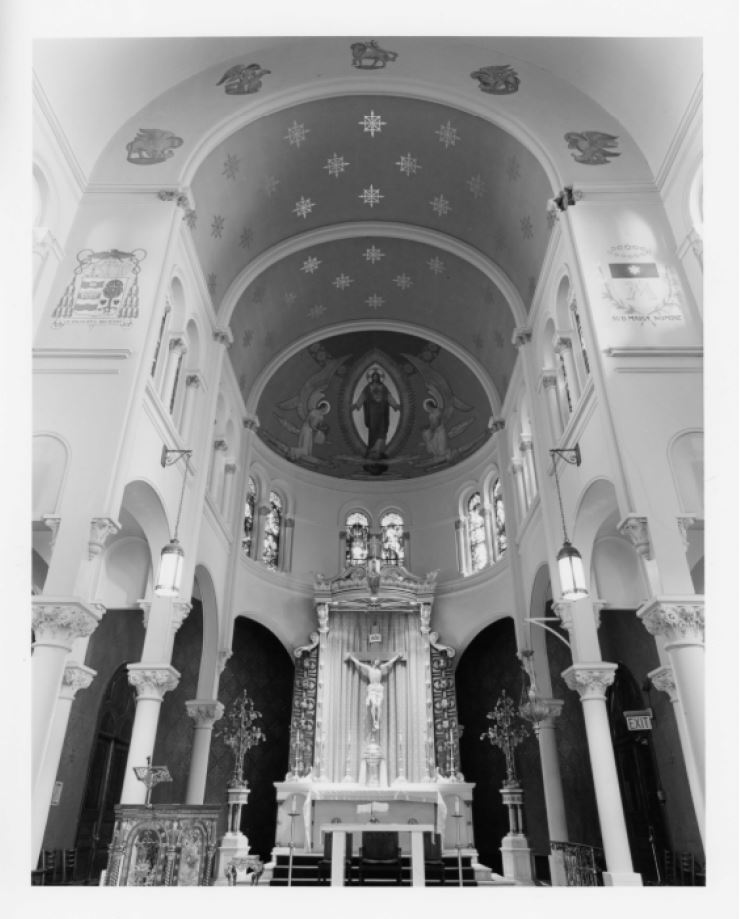
The proposed renovation would remove the altars and the crucifix and would paint over the 1939 paintings on the apse ceiling and triumphal arch, elements described in the National Register of Historic Places Inventory - Nomination Form as follows
- The nave vault terminates at a triumphal arch where there is a smooth transition to the reduced height and width of the apse. An ambulatory serves to enclose the high altar. Originally, a skylight was inserted in the roof behind what is now the altar and was to be used to throw natural sunlight onto a statue of Christ.
- The present altar and painting of the apse ceiling and triumphal arch dates from a redecoration project of 1939. On the northern side of the arch is the coat of arms of [Archbishop Paul J. Hallinan.] On the southern side of the arch is painted the escutcheon of the Society of Mary. Above these and around the curve of the arch are the symbols of the four evangelists and Christ: the bull, St. Luke; the man, St. Matthew; the lion, St. Mark; the eagle, St. John; and the lamb, Christ. Above the main altar, Christ is painted in a gold mandorla with two angels kneeling to his right and left. Clouds surround the three figures, and Christ stands on a globe of the earth. The vaulted ceiling of the apse is painted blue and stenciled with gold.
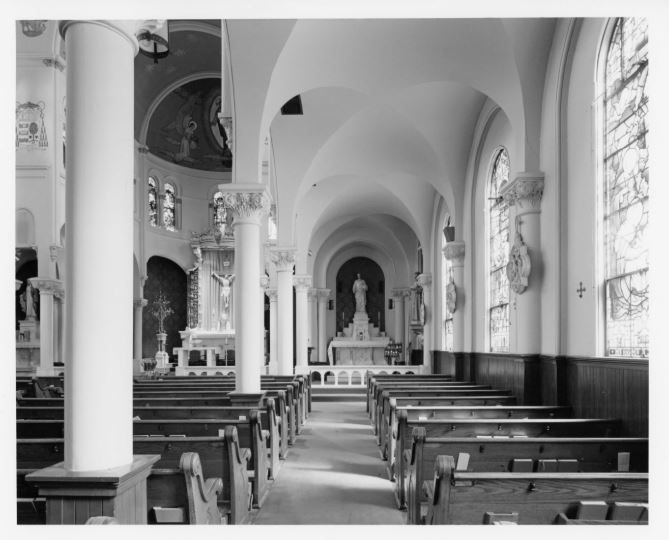
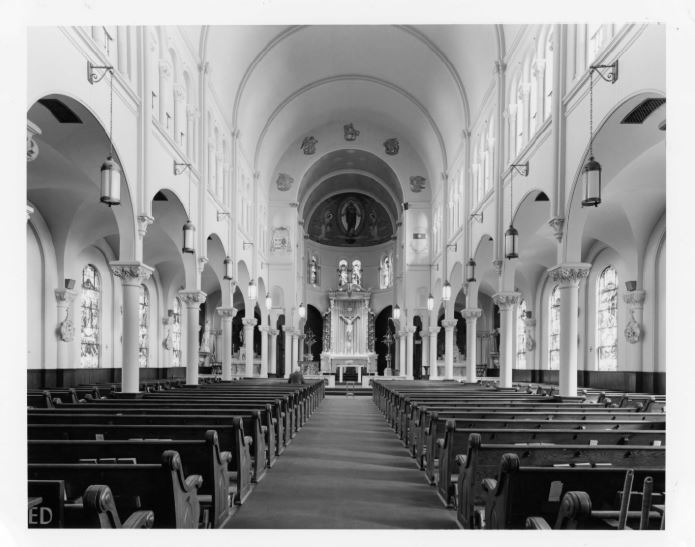
The proposed renovation would also remove the baldachin, the two Victorian candelabra, the brass pulpit detailed with images of the Sacred Heart, significant sections of the altar rails in front of the side altars, and the historic pews, all elements clearly documented in the photographs included in the National Register of Historic Places Property Photograph Form:
4. The proposed renovations might violate Canon Law, specifically Can. 1189 and Can. 1216.
Can. 1189 states
- If they are in need of repair, precious images, that is, those distinguished by age, art, or veneration, which are exhibited in churches or oratories for the reverence of the faithful are never to be restored without the written permission of the ordinary; he is to consult experts before he grants permission.
Can. 1216 states
- In the building and repair of churches, the principles and norms of the liturgy and of sacred art are to be observed, after the advice of experts has been taken into account.
There is no public evidence that the pastor or the Archdiocese of Atlanta consulted experts in sacred architecture or historic preservation. The design firms and contractors chosen for this $3.3 million project have a conflict of interest as they profit from larger-scale projects: their advice, if expert, lacks the independence to be objective.
5. The proposed plan alienates countless parishioners and visitors, disregards the Holy See’s opinion about what is appropriate for a Basilica, and does not respect the history of Sacred Heart.
Father John Howren, in his “In-Spires: From the Desk of Father John Howren” for Pentecost Sunday, wrote
- We have developed a project statement that serves as a “touchstone” for our decisions. We use this to guide our thoughts as we consider design elements, material choices for furnishings, and the like. It reads…
- Our goal is to create a welcoming environment that supports the various liturgies that occur within it, is balanced and appropriate for a Basilica, follows current liturgical guidelines, and respects the history of Sacred Heart."
However, the proposed renovations will not create a welcoming environment but will result in an environment of loss for the parishioners, other Catholics, and non-Catholics who are attached to the Basilica’s current look, a look that, according to the Basilica’s website, has not changed much since the 1960s. As the only basilica in the Archdiocese of Atlanta and a highly sought-after church for weddings, the Basilica’s church interior is one of the best known and loved in the archdiocese. Dramatic changes to its interior will cause grief.
The Basilica does not need a renovation to make it appropriate for a basilica because it was elevated to the status of a minor basilica in 2010, at which point its current appearance was deemed sufficient for the designation.
“Domus Ecclesiae: Norms for the Granting of the Title of Minor Basilica Congregation for Divine Worship and the Discipline of the Sacraments” includes in its “Conditions for Obtaining the Title of Minor Basilica”
- 8. To further the possibility of truly carrying out worthy and exemplary celebrations, the aforesaid church should be of an appropriate size and with a sufficiently large sanctuary. The various elements required for the liturgical celebration (altar, ambo [lectern], celebrant’s chair) must be placed according to the requirements of the restored liturgy. cf. GIRM, nn. 253-280.
- 9. The church may enjoy a certain renown throughout the diocese, for example, because it has been constructed and dedicated to God on the occasion of some particular historical and religious event, or because the body or significant relics of a saint are reserved in it, or because some sacred image is there venerated in a special way. The historical value or importance of the church and the worthiness of its art are also to be considered.
Under “Documents to be Produced for Granting the Title of Basilica,” “Domus Ecclesiae” includes
- 11.4. an album of photos illustrating the exterior and interior form of the church but particularly the arrangement of the sanctuary (altar, ambo [lectern], celebrant’s chair) and the other places intended for carrying out celebrations (seats for ministers and servers; baptistery or baptismal font; the place for reserving the Eucharist and places designed for the celebration of the sacrament of penance)
So the Holy See had an album of photos of Sacred Heart’s sanctuary as it looks now and deemed it liturgically, historically, and artistically worthy of being elevated to a minor basilica. The proposed renovation could create an environment “appropriate to be a basilica” by maintaining the one it has now instead of spending millions of dollars to change it.
The project statement includes “respects the history of Sacred Heart.” However, the unnecessary removal of a large number, if not the majority, of the historic art and furnishings does not show respect for this history.
In Closing
The proposed renovation would not only compromise the beauty of this beloved church but also erase the history of the generations of community members who helped build and decorate it. This church is not just a building; it is a testament to its community's faith and devotion. The art and furnishings to be removed are irreplaceable because the materials and craftsmanship that produced them no longer exist. Their loss would be devastating and irreparable. Furthermore, the Basilica is one of the oldest Catholic churches in Atlanta, one of the few buildings of its age still standing in downtown Atlanta, and a building registered in the National Register of Historic Places. Thus, we have an obligation to preserve rather than radically change its look.
For those of us who have special memories in this church—conversions, Baptisms, weddings, the funerals of loved ones, or even just little quiet moments of experiencing God’s peace and consolation—the proposed dramatic overthrowing of the current look is emotionally devastating and spiritually shocking. The stability of the church is a great source of comfort in an ever-changing world, but if even this most sacred space can be altered dramatically, with disregard to numerous directives on appropriate diligence and preservation, what is safe?
We ask that these proposed renovations be stopped immediately. Please safeguard the Basilica of the Sacred Heart of Jesus's beautiful interior for future generations. This church was passed down to us, and we ask that maintenance and work on the church be led by people who listen to the needs of the parish, fully appreciate this church’s significance, and intend to preserve and pass it on.

1,070
The Issue
UPDATE
We have received a letter from the Catholic Archdiocese of Atlanta's Director of Communications. It reads:
"June 28, 2024
To whom it may concern,
Archbishop Gregory J. Hartmayer, OFM Conv., is in receipt of your letter mailed June 7. He has reviewed your concerns and has found that all protocols have been properly followed in this project. He has approved phase I to move forward. Thank you for bringing your concerns to us."
It was signed by the Director of Communications.
Phase One A work begins July 15th.
The Short Petition
The proposed renovation would not only compromise the beauty of this beloved church but also erase the history of the generations of community members who helped build and decorate it. This church is not just a building; it's a testament to its community's faith and devotion. The art and furnishings to be removed are irreplaceable because the materials and craftsmanship that produced them no longer exist. Their loss would be devastating and irreparable. Furthermore, the Basilica is one of the oldest Catholic churches in Atlanta, one of the few buildings of its age still standing in downtown Atlanta, and a building registered in the National Register of Historic Places. Thus it has an obligation to preserve rather than radically change its look.
For those of us who have special memories in this church—conversions, Baptisms, weddings, the funerals of loved ones, or even just little quiet moments of experiencing God’s peace and consolation—the proposed dramatic overthrowing of the current look is emotionally devastating and spiritually shocking. The stability of the church is a great source of comfort in an ever-changing world, and if even this most sacred space can be changed all at once, what is safe?
Parishioners and non-parishioners, Catholics and non-Catholics, all people who respect history and love art, please join us in asking for these proposed renovations to be stopped immediately. Sign this petition to help safeguard our historic church's beautiful interior for future generations. This church was passed down to us, and we ask that maintenance and work on the church be led by people who fully appreciate its significance and intend to preserve and pass it on.
SAVE HISTORY. SAVE ART.
SIGN THE PETITION TO SAVE SACRED HEART.
The Long Petition
To The Most Reverend Gregory John Hartmayer, Most Rev. Joel M. Konzen, Most Rev. Bernard E. Shlesinger III, and Most Rev. John Nhàn Trần:
Please DELAY AND RECONSIDER the proposed renovation to the Basilica of the Sacred Heart of Jesus in Downtown Atlanta for the following FIVE REASONS.
1. The renovation process was conducted without parish involvement in the early stage, which directly contradicts the USCCB’s Guidelines outlined in Built of Living Stones.
Section 180 of Built of Living Stones: Art, Architecture, and Worship/Guidelines of the National Conference of Catholic Bishops states
- The entire parish is an integral part of the needs assessment and the development of priorities, which are the first steps of a process that will lead to a decision about building, renovating, and expending parish resources. While some decisions in the process will be made by committees, the decision and the design should never become the exclusive project of a small select group.
In “How Did We Get to This Point in the Redecoration Design Process?” Father John Howren says the current renovation plan began with a private conversation between himself and four others in about March/April of 2021. He emailed Dennis Kelly of Catholic Construction Services and later recruited at least two parishioners for their architectural and art backgrounds. This handpicked group spoke with a lighting company, four architectural firms, and two design firms and selected Rambusch Lighting Co. and Conrad Schmitt. This small, select group of handpicked parishioners and the two companies’ representatives put together an interior master plan first draft, met and selected various contractors, received cost estimates, and got the interior master plan draft liturgically and financially approved by the Archdiocese. THEN ABOUT TWO YEARS LATER, in March of 2023, these plans were presented to the parish to be discussed by appointment in small groups inside the Design Studio.
Contrary to the USCCB guideline on involving the entire parish in the first steps, this renovation did not engage the parish until after the plans and contractors were chosen. The guideline states that the entire parish's needs should inform the renovation priorities and decisions. However, this project was decided and designed for about two years by a small, select group before the parish at large even knew about it.
Section 181 of Built of Living Stones states
- When a parish is determining the need for a new church or for the renovation of an existing church, a thorough self-study and educational program is part of the needs assessment process. In that study the parish community reflects upon what it is, and what it hopes for in a new or renovated church. This is essential to enable the community to give direction to the architect and other professionals who will design the building.
This first step did not take place as a first step at all. The community was not given the opportunity to share its hopes for the renovated church until after the architects and other professionals designed the plans according to the input of a small, select group.
2. The proposed renovation, which includes the removal of significant historical and artistic elements, fails to preserve the church's artistic heritage and violates the Second Vatican Council's Constitution on the Sacred Liturgy, Sacrosanctum Concilium, The General Instruction on the Roman Missal, the Congregation of the Clergy's Circular Letter on the Care of the Church's Historical and Artistic Heritage, “Opera Artis,” and the USCCB's Guidelines, Built of Living Stones.
The proposed renovation includes removing the altars, the crucifix, the baldachin, the two Victorian candelabra, the brass pulpit detailed with images of the Sacred Heart, significant sections of the altar rails in front of the side altars, and the historic pews. It also includes painting over the 1939 paintings on the apse ceiling and triumphal arch. These changes would significantly alter the church's interior and erase many of its historical and artistic elements.
No. 123 of Sacrosanctum Concilium states
- The Church has not adopted any particular style of art as her very own; she has admitted styles from every period according to the natural talents and circumstances of peoples, and the needs of the various rites. Thus, in the course of the centuries, she has brought into being a treasury of art which must be very carefully preserved.
The General Instruction on the Roman Missal also says in no. 289 that the Church “is intent on preserving the works of art and the artistic treasures handed down from past centuries.”
The proposed renovation REMOVES and PAINTS OVER the Basilica’s artistic treasures INSTEAD OF preserving them.
“Opera Artis,” the Circular Letter on the Care of the Church's Historical and Artistic Heritage issued by the Congregation of the Clergy, included in its “reminders and decrees”
- 2. Works of art from the past are always and everywhere to be preserved so that they may lend their noble service to divine worship and their help to the people's active participation in the liturgy.
- 6. Should it become necessary to adapt works of art and the treasures of the past to the new liturgical laws, bishops are to take care that the need is genuine and that no harm comes to the work of art.
The proposed renovation does not adapt but removes and harms the works of art and treasures of the past. Where is the genuine need to do this?
Built of Living Stones Sec. 253 states that parishes, in collaboration with architects, artists, liturgical consultants, and diocesan personnel, should assess artistic works and furnishings for their value and discern works that are considered part of the sacred heritage of the Church’s art.
There is no public evidence that the current renovation process included this vital step. The list of artistic works and furnishings that are part of the Basilica’s sacred heritage would likely be similar to the list of items to be removed or painted over.
Built of Living Stones Sec. 254 states
- When it is necessary to relocate or remove artistic pieces in the interest of the liturgical reform, they can be appropriately cared for and placed in a location "befitting and worthy of the works themselves."
What is the plan for the altars, crucifix, brass pulpit, baldachin, candelabra, and altar rail portions that the proposed renovation removes?
3. The Church of the Sacred Heart, a significant part of Atlanta’s history, entered the National Register of Historic Places in 1976. The proposed renovation, which removes a significant portion of the interior architecture and design described and photographed in its nomination form to the US Department of the Interior’s National Park Service, threatens to erase its historical significance.
The proposed renovation would remove the altars and the crucifix and would paint over the 1939 paintings on the apse ceiling and triumphal arch, elements described in the National Register of Historic Places Inventory - Nomination Form as follows
- The nave vault terminates at a triumphal arch where there is a smooth transition to the reduced height and width of the apse. An ambulatory serves to enclose the high altar. Originally, a skylight was inserted in the roof behind what is now the altar and was to be used to throw natural sunlight onto a statue of Christ.
- The present altar and painting of the apse ceiling and triumphal arch dates from a redecoration project of 1939. On the northern side of the arch is the coat of arms of [Archbishop Paul J. Hallinan.] On the southern side of the arch is painted the escutcheon of the Society of Mary. Above these and around the curve of the arch are the symbols of the four evangelists and Christ: the bull, St. Luke; the man, St. Matthew; the lion, St. Mark; the eagle, St. John; and the lamb, Christ. Above the main altar, Christ is painted in a gold mandorla with two angels kneeling to his right and left. Clouds surround the three figures, and Christ stands on a globe of the earth. The vaulted ceiling of the apse is painted blue and stenciled with gold.
The proposed renovation would also remove the baldachin, the two Victorian candelabra, the brass pulpit detailed with images of the Sacred Heart, significant sections of the altar rails in front of the side altars, and the historic pews, all elements clearly documented in the photographs included in the National Register of Historic Places Property Photograph Form:
4. The proposed renovations might violate Canon Law, specifically Can. 1189 and Can. 1216.
Can. 1189 states
- If they are in need of repair, precious images, that is, those distinguished by age, art, or veneration, which are exhibited in churches or oratories for the reverence of the faithful are never to be restored without the written permission of the ordinary; he is to consult experts before he grants permission.
Can. 1216 states
- In the building and repair of churches, the principles and norms of the liturgy and of sacred art are to be observed, after the advice of experts has been taken into account.
There is no public evidence that the pastor or the Archdiocese of Atlanta consulted experts in sacred architecture or historic preservation. The design firms and contractors chosen for this $3.3 million project have a conflict of interest as they profit from larger-scale projects: their advice, if expert, lacks the independence to be objective.
5. The proposed plan alienates countless parishioners and visitors, disregards the Holy See’s opinion about what is appropriate for a Basilica, and does not respect the history of Sacred Heart.
Father John Howren, in his “In-Spires: From the Desk of Father John Howren” for Pentecost Sunday, wrote
- We have developed a project statement that serves as a “touchstone” for our decisions. We use this to guide our thoughts as we consider design elements, material choices for furnishings, and the like. It reads…
- Our goal is to create a welcoming environment that supports the various liturgies that occur within it, is balanced and appropriate for a Basilica, follows current liturgical guidelines, and respects the history of Sacred Heart."
However, the proposed renovations will not create a welcoming environment but will result in an environment of loss for the parishioners, other Catholics, and non-Catholics who are attached to the Basilica’s current look, a look that, according to the Basilica’s website, has not changed much since the 1960s. As the only basilica in the Archdiocese of Atlanta and a highly sought-after church for weddings, the Basilica’s church interior is one of the best known and loved in the archdiocese. Dramatic changes to its interior will cause grief.
The Basilica does not need a renovation to make it appropriate for a basilica because it was elevated to the status of a minor basilica in 2010, at which point its current appearance was deemed sufficient for the designation.
“Domus Ecclesiae: Norms for the Granting of the Title of Minor Basilica Congregation for Divine Worship and the Discipline of the Sacraments” includes in its “Conditions for Obtaining the Title of Minor Basilica”
- 8. To further the possibility of truly carrying out worthy and exemplary celebrations, the aforesaid church should be of an appropriate size and with a sufficiently large sanctuary. The various elements required for the liturgical celebration (altar, ambo [lectern], celebrant’s chair) must be placed according to the requirements of the restored liturgy. cf. GIRM, nn. 253-280.
- 9. The church may enjoy a certain renown throughout the diocese, for example, because it has been constructed and dedicated to God on the occasion of some particular historical and religious event, or because the body or significant relics of a saint are reserved in it, or because some sacred image is there venerated in a special way. The historical value or importance of the church and the worthiness of its art are also to be considered.
Under “Documents to be Produced for Granting the Title of Basilica,” “Domus Ecclesiae” includes
- 11.4. an album of photos illustrating the exterior and interior form of the church but particularly the arrangement of the sanctuary (altar, ambo [lectern], celebrant’s chair) and the other places intended for carrying out celebrations (seats for ministers and servers; baptistery or baptismal font; the place for reserving the Eucharist and places designed for the celebration of the sacrament of penance)
So the Holy See had an album of photos of Sacred Heart’s sanctuary as it looks now and deemed it liturgically, historically, and artistically worthy of being elevated to a minor basilica. The proposed renovation could create an environment “appropriate to be a basilica” by maintaining the one it has now instead of spending millions of dollars to change it.
The project statement includes “respects the history of Sacred Heart.” However, the unnecessary removal of a large number, if not the majority, of the historic art and furnishings does not show respect for this history.
In Closing
The proposed renovation would not only compromise the beauty of this beloved church but also erase the history of the generations of community members who helped build and decorate it. This church is not just a building; it is a testament to its community's faith and devotion. The art and furnishings to be removed are irreplaceable because the materials and craftsmanship that produced them no longer exist. Their loss would be devastating and irreparable. Furthermore, the Basilica is one of the oldest Catholic churches in Atlanta, one of the few buildings of its age still standing in downtown Atlanta, and a building registered in the National Register of Historic Places. Thus, we have an obligation to preserve rather than radically change its look.
For those of us who have special memories in this church—conversions, Baptisms, weddings, the funerals of loved ones, or even just little quiet moments of experiencing God’s peace and consolation—the proposed dramatic overthrowing of the current look is emotionally devastating and spiritually shocking. The stability of the church is a great source of comfort in an ever-changing world, but if even this most sacred space can be altered dramatically, with disregard to numerous directives on appropriate diligence and preservation, what is safe?
We ask that these proposed renovations be stopped immediately. Please safeguard the Basilica of the Sacred Heart of Jesus's beautiful interior for future generations. This church was passed down to us, and we ask that maintenance and work on the church be led by people who listen to the needs of the parish, fully appreciate this church’s significance, and intend to preserve and pass it on.
1,070
The Decision Makers
Supporter Voices
Share this petition
Petition created on May 24, 2024