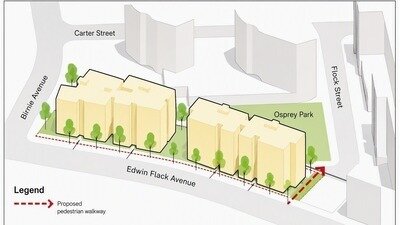

Stop the Proposed 145-Home Housing Commission Development at Sydney Olympic Park
The issue
Stop the Proposed 145-Home Housing Commission Development at Sydney Olympic Park
中文版本请见下方。
Protect our community, infrastructure, businesses and quality of life
145 homes. Around 363 residents. Four connected tower forms. One relatively small site.
We, the residents, owners and businesses of Sydney Olympic Park and the surrounding Carter Street precinct, strongly oppose the proposed development of approximately 145 social housing homes at 2A–4 Edwin Flack Avenue.
The proposal comprises two adjoining 8-storey building forms, creating a substantial four-tower appearance across the site, potentially accommodating around 363 residents.
We do not believe this is the right location, scale or timing for this development.
The proposal would place approximately 145 social housing households on a relatively small site in a precinct where transport, schools, healthcare, shopping, parking and other essential infrastructure are still developing.
The development is expected to be occupied around 2029.
The question is not simply what Sydney Olympic Park might look like under Master Plan 2050.
The question is whether the infrastructure and services required to support this development will actually be available when residents move in.
What will actually be ready in 2029?
Sydney Olympic Park is a rapidly growing precinct. Master Plan 2050 provides for substantial future growth, including new schools, community facilities, transport and other infrastructure.
We support properly planned growth.
But a long-term master plan is not the same as infrastructure actually being available when residents move in.
We are not asking for every part of Master Plan 2050 to be completed today.
We are asking a much more immediate question:
What infrastructure and services will actually be available when these 145 households move in around 2029?
Homes NSW should demonstrate that the infrastructure and services necessary to support this development will be funded, committed and capable of being operational when residents arrive.
Until that can be demonstrated, we do not believe this development should proceed.
Services and healthcare
Sydney Olympic Park is still developing the everyday services needed to support a growing residential population.
There is currently no public school within Sydney Olympic Park itself, affordable and bulk-billed primary healthcare is limited, and there is no full-service supermarket suitable for substantial weekly grocery shopping. Residents can also need to travel outside the precinct for important everyday services.
Social housing is intended to support people experiencing greater housing need. Government data cited in our formal submission indicates that approximately 38% of social housing households include at least one person with disability, while significant proportions of tenants report anxiety, financial pressure and social isolation.
This does not mean every future resident will require additional support.
It does mean that healthcare, disability, mental-health, community and other essential services need sufficient capacity and accessibility when residents move in.
These requirements must be properly considered before adding approximately 363 residents to this site.
Public transport is already under pressure
The existing public transport network is already carrying significant demand.
The 526 bus is a critical connection between Sydney Olympic Park, Newington, Rhodes and Strathfield, and capacity concerns have already been identified during peak periods.
Adding potentially another 363 residents will create additional demand for transport to work, education, healthcare, shopping and other essential services.
Sydney Metro West is currently targeted for 2032, while the Sydney Olympic Park light-rail extension does not yet have a confirmed operating date.
Future infrastructure is welcome.
But residents will be living here in 2029.
Homes NSW should demonstrate that the transport network actually available at that time will have sufficient capacity to serve the additional population.
We should not be expected to accept the development now on the assumption that future transport infrastructure will eventually catch up.
Schools and growing population pressure
Sydney Olympic Park currently has no public school within the precinct, while surrounding schools are already expanding to accommodate population growth.
Newington Public School has experienced capacity pressure, while Wentworth Point Public School has undergone a major expansion to provide additional permanent teaching spaces.
The question is not simply whether a school exists somewhere nearby.
Will there be sufficient permanent school capacity for children from these 145 households in 2029, alongside the many other developments occurring across the surrounding precinct?
That should be demonstrated before this development is approved.
Major construction, events and emergency access
The development is also expected to overlap with major construction associated with Parramatta Light Rail Stage 2.
The light-rail alignment passes through the Carter Street precinct, crosses Edwin Flack Avenue and runs along Uhrig Road.
Sydney Olympic Park is also a major events precinct, with substantial surges in traffic and pedestrian movements during concerts, sporting events and other major events.
The cumulative impact of this development alongside major construction and event activity must be properly assessed.
That includes:
construction traffic and road closures;
pedestrian diversions;
noise, dust and vibration;
event-day congestion;
parking pressure; and
emergency access and evacuation.
These are not ordinary suburban conditions.
Parking and Grazier Street
The proposal will remove existing parking capacity in a precinct where parking demand can increase dramatically during major events.
Homes NSW should demonstrate how parking demand from residents, businesses, visitors and event patrons will be accommodated.
The proposed pedestrian connection towards Grazier Street also raises concerns because it directs additional pedestrian movements towards a constrained one-way street environment with limited pedestrian infrastructure.
A development potentially accommodating 363 additional residents requires pedestrian access that is safe, accessible and properly integrated into the surrounding network.
There is a better comparison
There is an important comparison that should not be overlooked.
Homes NSW is also delivering 145 social housing homes at Kamira Avenue, Villawood - the same number proposed for Sydney Olympic Park.
But the surrounding environment is very different.
The Villawood development is close to an established town centre, with Villawood railway station, shops, schools and bus services already operating nearby.
Importantly, the Villawood project is not simply relying on a long-term plan for infrastructure to be delivered over the next 25 years. The broader town-centre renewal is already being actively delivered, with housing construction underway and supporting retail, childcare, medical, community and open-space infrastructure being progressed as part of the project.
This means the supporting infrastructure is being delivered alongside the housing, rather than being left as a future possibility with no certainty that it will be completed when residents move in.
The point is not that Sydney Olympic Park and Villawood are identical.
The point is that 145 social housing homes can be delivered in a location where essential services and transport are already established and where further supporting infrastructure is actively being delivered alongside the housing.
So the question for Sydney Olympic Park is:
Why concentrate 145 social housing households on this particular site when many of the services and infrastructure they will rely upon are still being progressively delivered, with no certainty that they will be ready when residents move in?
The issue is planning, infrastructure and location
This proposal needs to be considered in the context of the existing Sydney Olympic Park community, surrounding businesses, infrastructure constraints and the significant growth already occurring across the precinct.
The answer should not simply be that the homes can physically fit on the site.
The question is whether this is the right location, scale and timing for 145 social housing households.
We believe it is not.
Our request
We are calling on the NSW Government and Homes NSW to:
Withdraw the proposed development at 2A–4 Edwin Flack Avenue and do not proceed with this 145-home social housing project in its current location and form.
Before any proposal of this scale is considered further, Homes NSW must demonstrate:
✔ What infrastructure and services will actually be operational in 2029
✔ That healthcare, mental-health and community services will have sufficient capacity
✔ That permanent school capacity will be sufficient
✔ That public transport will have capacity for the additional population
✔ How Parramatta Light Rail construction and other major projects will affect the development
✔ How event-day traffic, parking, pedestrian safety and emergency access will be managed
✔ That the proposed Grazier Street connection is necessary and safe
✔ That appropriate long-term building management and support arrangements will be in place
Sydney Olympic Park deserves infrastructure-led growth
We are not asking for every part of Master Plan 2050 to be completed today.
We are asking for the infrastructure and services necessary to support this development to be ready when residents move in.
Housing and the infrastructure needed to support it should arrive together — not housing first and services later.
We say NO to this proposal.
Sign the petition
Stand with the residents, owners and businesses of Sydney Olympic Park and Carter Street.
Tell the NSW Government and Homes NSW:
Stop the proposed 145-home social housing development at 2A–4 Edwin Flack Avenue.
Protect our community, businesses, infrastructure, safety and quality of life.
反对悉尼奥林匹克公园拟建145套住房委员会住房项目
保护我们的社区、基础设施、企业和生活质量
145套住房、约363名居民、四个相连的塔楼体量,集中在一个相对有限的地块上。
我们是悉尼奥林匹克公园及周边Carter Street片区的居民、业主和企业经营者,我们强烈反对在2A–4 Edwin Flack Avenue拟建约145套社会住房。
该项目由两个相连的8层建筑体组成,整体呈现出四个塔楼体量的视觉效果,预计可容纳约363名居民。
我们认为,这并不是一个适合该项目的地点、规模或建设时机。
该项目将在一个相对有限的地块上集中建设约145户社会住房,而目前该区域的交通、学校、医疗、购物、停车以及其他重要基础设施仍在逐步发展。
该项目预计将在2029年前后入住。
问题并不只是2050总体规划下的悉尼奥林匹克公园未来会是什么样子。
真正的问题是:当居民入住时,支持这一规模项目所必需的基础设施和公共服务是否真正能够使用。
关键问题是:2029年什么真正能够使用?
悉尼奥林匹克公园正在快速发展。2050总体规划为未来的人口增长,以及学校、社区设施、交通和其他基础设施作出了长期规划。
我们支持合理、有规划的发展。
但是,长期总体规划并不等于居民入住时相关基础设施已经真正建成并投入使用。
我们并不是要求2050总体规划中的每一项基础设施今天就全部完成。
我们要求回答的是一个更加直接的问题:
当这145户家庭在2029年前后入住时,究竟有哪些基础设施和公共服务真正能够使用?
Homes NSW应该明确证明,支持该项目所必需的基础设施和服务,在居民入住时已经有明确的资金安排、建设承诺,并能够投入运营。
在这一点得到证明之前,我们认为该项目不应继续推进。
公共服务和医疗保障
悉尼奥林匹克公园仍处于持续发展的阶段,支持不断增长居民人口所需的日常公共服务仍在逐步完善。
目前悉尼奥林匹克公园区域内没有公立学校;价格可负担且提供批量计费服务的基层医疗资源有限;区域内也没有适合居民进行大型每周采购的全服务型大型超市。居民还需要前往片区以外获得一些重要的日常服务。
社会住房旨在帮助住房需求较为迫切的人群。我们正式反对意见中引用的政府数据显示,约38%的社会住房家庭中至少有一名残障人士,同时相当比例的住户反映存在焦虑、经济压力以及社会孤立等问题。
这并不意味着每一位未来居民都需要额外的支持。
但这意味着,在居民入住时,医疗、残障支持、心理健康、社区服务以及其他基本服务必须具备足够的容量,并且能够被居民实际、便利地使用。
在向这个地块增加约363名居民之前,这些要求必须得到充分考虑。
公共交通已经承受压力
现有公共交通网络已经承受较大的客流需求。
526路公交车是连接悉尼奥林匹克公园、Newington、Rhodes和Strathfield的重要交通线路,高峰时段已经存在运力方面的压力。
增加约363名居民,将进一步增加前往工作、教育、医疗、购物以及其他基本服务的交通需求。
目前Sydney Metro West预计于2032年投入运营,而悉尼奥林匹克公园轻轨延伸线目前仍没有确定的开通日期。
未来的基础设施当然值得欢迎。
但居民预计将在2029年前后就已经入住这里。
Homes NSW应该证明,届时实际投入使用的公共交通网络具有足够的运力,可以可靠地服务这些新增居民。
我们不应该在目前就被要求接受这个项目,同时假设未来的交通基础设施最终会赶上需求。
学校容量和人口增长压力
目前悉尼奥林匹克公园片区内没有公立学校,而周边学校已经在扩建,以应对不断增长的人口。
Newington Public School已经面临容量压力,而Wentworth Point Public School也进行了重大扩建,以增加永久性教学空间。
问题并不只是附近是否“有一所学校”。
到2029年,在周边大量其他住宅项目不断增加人口的情况下,现有学校是否拥有足够的永久性教学容量来接纳这145户家庭中的适龄儿童?
这个问题应该在项目获批之前得到明确、基于证据的回答。
大型工程、重大活动及紧急通行
预计该项目的建设及入住时间,也将与Parramatta Light Rail Stage 2的大型施工活动存在重叠。
轻轨线路将经过Carter Street片区,穿越Edwin Flack Avenue并沿Uhrig Road延伸。
悉尼奥林匹克公园同时也是重要的重大活动区域。在演唱会、体育赛事及其他大型活动期间,车辆和行人流量都会大幅增加。
该项目与大型工程及重大活动叠加产生的综合影响必须得到充分评估。
包括:
工程车辆和道路封闭;
行人绕行;
噪音、粉尘和震动;
大型活动期间的交通拥堵;
停车压力;以及
紧急车辆通行和人员疏散。
这些并不是普通住宅区所面临的日常条件。
停车和Grazier Street行人通道
该项目将减少现有停车容量,而悉尼奥林匹克公园在大型活动期间的停车需求可能大幅增加。
Homes NSW应该明确说明,居民、企业、访客以及大型活动观众所产生的停车需求将如何得到满足。
拟议通往Grazier Street的行人连接通道同样令人担忧,因为它会将更多行人引向一条受限制的单向道路,而该区域现有行人基础设施已经较为有限。
一个可能容纳约363名新增居民的开发项目,必须拥有安全、无障碍,并与周边道路和人行网络合理衔接的行人通道。
有一个值得认真考虑的比较案例
这里有一个不应被忽视的重要比较案例。
Homes NSW同样正在Villawood的Kamira Avenue建设145套社会住房——数量与悉尼奥林匹克公园拟建项目完全相同。
但两个项目周边的城市环境存在明显差异。
Villawood项目靠近一个已经成熟的城镇中心,附近已有Villawood火车站、商店、学校和公交服务。
更重要的是,Villawood项目并不是仅仅依赖一项需要在未来25年内逐步实施的长期规划。该区域更广泛的城镇中心更新目前已经在积极推进,住房建设正在进行,相关的零售、儿童托管、医疗、社区设施以及开放空间等配套设施也正在作为整体项目的一部分同步推进。
这意味着,相关配套基础设施正在与住房建设同步落实,而不是被留作一个没有明确完成时间的未来可能性,无法确定居民入住时是否能够完成。
我们的观点并不是说悉尼奥林匹克公园和Villawood完全相同。
关键在于,145套社会住房可以建设在一个基本公共服务和交通已经成熟,并且其他配套基础设施正在与住房同步落实的区域。
因此,对于悉尼奥林匹克公园,我们要问的是:
为什么要在这个特定地块集中建设145户社会住房,而居民未来所依赖的许多服务和基础设施目前仍在逐步建设之中,并且无法确定居民入住时是否能够准备就绪?
这个问题关乎规划、基础设施和选址
该项目必须结合悉尼奥林匹克公园现有社区、周边企业、基础设施限制,以及整个片区正在进行的大规模发展进行综合考虑。
问题不应该仅仅是“这个地块能不能放下145套住房”。
真正应该问的是:对于145户社会住房家庭而言,这是否是正确的地点、规模和建设时机?
我们认为不是。
我们的诉求
我们呼吁新南威尔士州政府和Homes NSW:
撤回2A–4 Edwin Flack Avenue的拟建项目,不要以目前的地点和形式推进这个145套社会住房项目。
在任何进一步考虑这一规模项目之前,Homes NSW必须明确证明:
✔ 2029年哪些基础设施和公共服务能够真正投入使用
✔ 医疗、心理健康和社区服务拥有足够的服务容量
✔ 永久性学校教学容量能够满足实际需求
✔ 公共交通拥有足够运力应对新增人口
✔ Parramatta Light Rail施工及其他大型工程将如何影响该项目
✔ 大型活动期间的交通、停车、行人安全和紧急通行将如何得到保障
✔ 拟议Grazier Street行人连接通道确有必要且安全
✔ 项目入住后将拥有适当、长期且有充足资源的楼宇管理和支持安排
悉尼奥林匹克公园需要以基础设施为先导的发展
我们不是要求2050总体规划中的每一项基础设施今天就全部完成。
我们要求的是:支持这个项目所必需的基础设施和公共服务,应当在居民入住时真正准备就绪。
住房建设应当与必要的基础设施和公共服务同步推进,而不是先建住房、再等待服务和基础设施跟上。
我们对这个项目说“不”。
请签署请愿书
请与悉尼奥林匹克公园及Carter Street的居民、业主和企业站在一起。
告诉新南威尔士州政府和Homes NSW:
停止在2A–4 Edwin Flack Avenue拟建的145套社会住房项目。
保护我们的社区、企业、基础设施、安全和生活质量。

994
The issue
Stop the Proposed 145-Home Housing Commission Development at Sydney Olympic Park
中文版本请见下方。
Protect our community, infrastructure, businesses and quality of life
145 homes. Around 363 residents. Four connected tower forms. One relatively small site.
We, the residents, owners and businesses of Sydney Olympic Park and the surrounding Carter Street precinct, strongly oppose the proposed development of approximately 145 social housing homes at 2A–4 Edwin Flack Avenue.
The proposal comprises two adjoining 8-storey building forms, creating a substantial four-tower appearance across the site, potentially accommodating around 363 residents.
We do not believe this is the right location, scale or timing for this development.
The proposal would place approximately 145 social housing households on a relatively small site in a precinct where transport, schools, healthcare, shopping, parking and other essential infrastructure are still developing.
The development is expected to be occupied around 2029.
The question is not simply what Sydney Olympic Park might look like under Master Plan 2050.
The question is whether the infrastructure and services required to support this development will actually be available when residents move in.
What will actually be ready in 2029?
Sydney Olympic Park is a rapidly growing precinct. Master Plan 2050 provides for substantial future growth, including new schools, community facilities, transport and other infrastructure.
We support properly planned growth.
But a long-term master plan is not the same as infrastructure actually being available when residents move in.
We are not asking for every part of Master Plan 2050 to be completed today.
We are asking a much more immediate question:
What infrastructure and services will actually be available when these 145 households move in around 2029?
Homes NSW should demonstrate that the infrastructure and services necessary to support this development will be funded, committed and capable of being operational when residents arrive.
Until that can be demonstrated, we do not believe this development should proceed.
Services and healthcare
Sydney Olympic Park is still developing the everyday services needed to support a growing residential population.
There is currently no public school within Sydney Olympic Park itself, affordable and bulk-billed primary healthcare is limited, and there is no full-service supermarket suitable for substantial weekly grocery shopping. Residents can also need to travel outside the precinct for important everyday services.
Social housing is intended to support people experiencing greater housing need. Government data cited in our formal submission indicates that approximately 38% of social housing households include at least one person with disability, while significant proportions of tenants report anxiety, financial pressure and social isolation.
This does not mean every future resident will require additional support.
It does mean that healthcare, disability, mental-health, community and other essential services need sufficient capacity and accessibility when residents move in.
These requirements must be properly considered before adding approximately 363 residents to this site.
Public transport is already under pressure
The existing public transport network is already carrying significant demand.
The 526 bus is a critical connection between Sydney Olympic Park, Newington, Rhodes and Strathfield, and capacity concerns have already been identified during peak periods.
Adding potentially another 363 residents will create additional demand for transport to work, education, healthcare, shopping and other essential services.
Sydney Metro West is currently targeted for 2032, while the Sydney Olympic Park light-rail extension does not yet have a confirmed operating date.
Future infrastructure is welcome.
But residents will be living here in 2029.
Homes NSW should demonstrate that the transport network actually available at that time will have sufficient capacity to serve the additional population.
We should not be expected to accept the development now on the assumption that future transport infrastructure will eventually catch up.
Schools and growing population pressure
Sydney Olympic Park currently has no public school within the precinct, while surrounding schools are already expanding to accommodate population growth.
Newington Public School has experienced capacity pressure, while Wentworth Point Public School has undergone a major expansion to provide additional permanent teaching spaces.
The question is not simply whether a school exists somewhere nearby.
Will there be sufficient permanent school capacity for children from these 145 households in 2029, alongside the many other developments occurring across the surrounding precinct?
That should be demonstrated before this development is approved.
Major construction, events and emergency access
The development is also expected to overlap with major construction associated with Parramatta Light Rail Stage 2.
The light-rail alignment passes through the Carter Street precinct, crosses Edwin Flack Avenue and runs along Uhrig Road.
Sydney Olympic Park is also a major events precinct, with substantial surges in traffic and pedestrian movements during concerts, sporting events and other major events.
The cumulative impact of this development alongside major construction and event activity must be properly assessed.
That includes:
construction traffic and road closures;
pedestrian diversions;
noise, dust and vibration;
event-day congestion;
parking pressure; and
emergency access and evacuation.
These are not ordinary suburban conditions.
Parking and Grazier Street
The proposal will remove existing parking capacity in a precinct where parking demand can increase dramatically during major events.
Homes NSW should demonstrate how parking demand from residents, businesses, visitors and event patrons will be accommodated.
The proposed pedestrian connection towards Grazier Street also raises concerns because it directs additional pedestrian movements towards a constrained one-way street environment with limited pedestrian infrastructure.
A development potentially accommodating 363 additional residents requires pedestrian access that is safe, accessible and properly integrated into the surrounding network.
There is a better comparison
There is an important comparison that should not be overlooked.
Homes NSW is also delivering 145 social housing homes at Kamira Avenue, Villawood - the same number proposed for Sydney Olympic Park.
But the surrounding environment is very different.
The Villawood development is close to an established town centre, with Villawood railway station, shops, schools and bus services already operating nearby.
Importantly, the Villawood project is not simply relying on a long-term plan for infrastructure to be delivered over the next 25 years. The broader town-centre renewal is already being actively delivered, with housing construction underway and supporting retail, childcare, medical, community and open-space infrastructure being progressed as part of the project.
This means the supporting infrastructure is being delivered alongside the housing, rather than being left as a future possibility with no certainty that it will be completed when residents move in.
The point is not that Sydney Olympic Park and Villawood are identical.
The point is that 145 social housing homes can be delivered in a location where essential services and transport are already established and where further supporting infrastructure is actively being delivered alongside the housing.
So the question for Sydney Olympic Park is:
Why concentrate 145 social housing households on this particular site when many of the services and infrastructure they will rely upon are still being progressively delivered, with no certainty that they will be ready when residents move in?
The issue is planning, infrastructure and location
This proposal needs to be considered in the context of the existing Sydney Olympic Park community, surrounding businesses, infrastructure constraints and the significant growth already occurring across the precinct.
The answer should not simply be that the homes can physically fit on the site.
The question is whether this is the right location, scale and timing for 145 social housing households.
We believe it is not.
Our request
We are calling on the NSW Government and Homes NSW to:
Withdraw the proposed development at 2A–4 Edwin Flack Avenue and do not proceed with this 145-home social housing project in its current location and form.
Before any proposal of this scale is considered further, Homes NSW must demonstrate:
✔ What infrastructure and services will actually be operational in 2029
✔ That healthcare, mental-health and community services will have sufficient capacity
✔ That permanent school capacity will be sufficient
✔ That public transport will have capacity for the additional population
✔ How Parramatta Light Rail construction and other major projects will affect the development
✔ How event-day traffic, parking, pedestrian safety and emergency access will be managed
✔ That the proposed Grazier Street connection is necessary and safe
✔ That appropriate long-term building management and support arrangements will be in place
Sydney Olympic Park deserves infrastructure-led growth
We are not asking for every part of Master Plan 2050 to be completed today.
We are asking for the infrastructure and services necessary to support this development to be ready when residents move in.
Housing and the infrastructure needed to support it should arrive together — not housing first and services later.
We say NO to this proposal.
Sign the petition
Stand with the residents, owners and businesses of Sydney Olympic Park and Carter Street.
Tell the NSW Government and Homes NSW:
Stop the proposed 145-home social housing development at 2A–4 Edwin Flack Avenue.
Protect our community, businesses, infrastructure, safety and quality of life.
反对悉尼奥林匹克公园拟建145套住房委员会住房项目
保护我们的社区、基础设施、企业和生活质量
145套住房、约363名居民、四个相连的塔楼体量,集中在一个相对有限的地块上。
我们是悉尼奥林匹克公园及周边Carter Street片区的居民、业主和企业经营者,我们强烈反对在2A–4 Edwin Flack Avenue拟建约145套社会住房。
该项目由两个相连的8层建筑体组成,整体呈现出四个塔楼体量的视觉效果,预计可容纳约363名居民。
我们认为,这并不是一个适合该项目的地点、规模或建设时机。
该项目将在一个相对有限的地块上集中建设约145户社会住房,而目前该区域的交通、学校、医疗、购物、停车以及其他重要基础设施仍在逐步发展。
该项目预计将在2029年前后入住。
问题并不只是2050总体规划下的悉尼奥林匹克公园未来会是什么样子。
真正的问题是:当居民入住时,支持这一规模项目所必需的基础设施和公共服务是否真正能够使用。
关键问题是:2029年什么真正能够使用?
悉尼奥林匹克公园正在快速发展。2050总体规划为未来的人口增长,以及学校、社区设施、交通和其他基础设施作出了长期规划。
我们支持合理、有规划的发展。
但是,长期总体规划并不等于居民入住时相关基础设施已经真正建成并投入使用。
我们并不是要求2050总体规划中的每一项基础设施今天就全部完成。
我们要求回答的是一个更加直接的问题:
当这145户家庭在2029年前后入住时,究竟有哪些基础设施和公共服务真正能够使用?
Homes NSW应该明确证明,支持该项目所必需的基础设施和服务,在居民入住时已经有明确的资金安排、建设承诺,并能够投入运营。
在这一点得到证明之前,我们认为该项目不应继续推进。
公共服务和医疗保障
悉尼奥林匹克公园仍处于持续发展的阶段,支持不断增长居民人口所需的日常公共服务仍在逐步完善。
目前悉尼奥林匹克公园区域内没有公立学校;价格可负担且提供批量计费服务的基层医疗资源有限;区域内也没有适合居民进行大型每周采购的全服务型大型超市。居民还需要前往片区以外获得一些重要的日常服务。
社会住房旨在帮助住房需求较为迫切的人群。我们正式反对意见中引用的政府数据显示,约38%的社会住房家庭中至少有一名残障人士,同时相当比例的住户反映存在焦虑、经济压力以及社会孤立等问题。
这并不意味着每一位未来居民都需要额外的支持。
但这意味着,在居民入住时,医疗、残障支持、心理健康、社区服务以及其他基本服务必须具备足够的容量,并且能够被居民实际、便利地使用。
在向这个地块增加约363名居民之前,这些要求必须得到充分考虑。
公共交通已经承受压力
现有公共交通网络已经承受较大的客流需求。
526路公交车是连接悉尼奥林匹克公园、Newington、Rhodes和Strathfield的重要交通线路,高峰时段已经存在运力方面的压力。
增加约363名居民,将进一步增加前往工作、教育、医疗、购物以及其他基本服务的交通需求。
目前Sydney Metro West预计于2032年投入运营,而悉尼奥林匹克公园轻轨延伸线目前仍没有确定的开通日期。
未来的基础设施当然值得欢迎。
但居民预计将在2029年前后就已经入住这里。
Homes NSW应该证明,届时实际投入使用的公共交通网络具有足够的运力,可以可靠地服务这些新增居民。
我们不应该在目前就被要求接受这个项目,同时假设未来的交通基础设施最终会赶上需求。
学校容量和人口增长压力
目前悉尼奥林匹克公园片区内没有公立学校,而周边学校已经在扩建,以应对不断增长的人口。
Newington Public School已经面临容量压力,而Wentworth Point Public School也进行了重大扩建,以增加永久性教学空间。
问题并不只是附近是否“有一所学校”。
到2029年,在周边大量其他住宅项目不断增加人口的情况下,现有学校是否拥有足够的永久性教学容量来接纳这145户家庭中的适龄儿童?
这个问题应该在项目获批之前得到明确、基于证据的回答。
大型工程、重大活动及紧急通行
预计该项目的建设及入住时间,也将与Parramatta Light Rail Stage 2的大型施工活动存在重叠。
轻轨线路将经过Carter Street片区,穿越Edwin Flack Avenue并沿Uhrig Road延伸。
悉尼奥林匹克公园同时也是重要的重大活动区域。在演唱会、体育赛事及其他大型活动期间,车辆和行人流量都会大幅增加。
该项目与大型工程及重大活动叠加产生的综合影响必须得到充分评估。
包括:
工程车辆和道路封闭;
行人绕行;
噪音、粉尘和震动;
大型活动期间的交通拥堵;
停车压力;以及
紧急车辆通行和人员疏散。
这些并不是普通住宅区所面临的日常条件。
停车和Grazier Street行人通道
该项目将减少现有停车容量,而悉尼奥林匹克公园在大型活动期间的停车需求可能大幅增加。
Homes NSW应该明确说明,居民、企业、访客以及大型活动观众所产生的停车需求将如何得到满足。
拟议通往Grazier Street的行人连接通道同样令人担忧,因为它会将更多行人引向一条受限制的单向道路,而该区域现有行人基础设施已经较为有限。
一个可能容纳约363名新增居民的开发项目,必须拥有安全、无障碍,并与周边道路和人行网络合理衔接的行人通道。
有一个值得认真考虑的比较案例
这里有一个不应被忽视的重要比较案例。
Homes NSW同样正在Villawood的Kamira Avenue建设145套社会住房——数量与悉尼奥林匹克公园拟建项目完全相同。
但两个项目周边的城市环境存在明显差异。
Villawood项目靠近一个已经成熟的城镇中心,附近已有Villawood火车站、商店、学校和公交服务。
更重要的是,Villawood项目并不是仅仅依赖一项需要在未来25年内逐步实施的长期规划。该区域更广泛的城镇中心更新目前已经在积极推进,住房建设正在进行,相关的零售、儿童托管、医疗、社区设施以及开放空间等配套设施也正在作为整体项目的一部分同步推进。
这意味着,相关配套基础设施正在与住房建设同步落实,而不是被留作一个没有明确完成时间的未来可能性,无法确定居民入住时是否能够完成。
我们的观点并不是说悉尼奥林匹克公园和Villawood完全相同。
关键在于,145套社会住房可以建设在一个基本公共服务和交通已经成熟,并且其他配套基础设施正在与住房同步落实的区域。
因此,对于悉尼奥林匹克公园,我们要问的是:
为什么要在这个特定地块集中建设145户社会住房,而居民未来所依赖的许多服务和基础设施目前仍在逐步建设之中,并且无法确定居民入住时是否能够准备就绪?
这个问题关乎规划、基础设施和选址
该项目必须结合悉尼奥林匹克公园现有社区、周边企业、基础设施限制,以及整个片区正在进行的大规模发展进行综合考虑。
问题不应该仅仅是“这个地块能不能放下145套住房”。
真正应该问的是:对于145户社会住房家庭而言,这是否是正确的地点、规模和建设时机?
我们认为不是。
我们的诉求
我们呼吁新南威尔士州政府和Homes NSW:
撤回2A–4 Edwin Flack Avenue的拟建项目,不要以目前的地点和形式推进这个145套社会住房项目。
在任何进一步考虑这一规模项目之前,Homes NSW必须明确证明:
✔ 2029年哪些基础设施和公共服务能够真正投入使用
✔ 医疗、心理健康和社区服务拥有足够的服务容量
✔ 永久性学校教学容量能够满足实际需求
✔ 公共交通拥有足够运力应对新增人口
✔ Parramatta Light Rail施工及其他大型工程将如何影响该项目
✔ 大型活动期间的交通、停车、行人安全和紧急通行将如何得到保障
✔ 拟议Grazier Street行人连接通道确有必要且安全
✔ 项目入住后将拥有适当、长期且有充足资源的楼宇管理和支持安排
悉尼奥林匹克公园需要以基础设施为先导的发展
我们不是要求2050总体规划中的每一项基础设施今天就全部完成。
我们要求的是:支持这个项目所必需的基础设施和公共服务,应当在居民入住时真正准备就绪。
住房建设应当与必要的基础设施和公共服务同步推进,而不是先建住房、再等待服务和基础设施跟上。
我们对这个项目说“不”。
请签署请愿书
请与悉尼奥林匹克公园及Carter Street的居民、业主和企业站在一起。
告诉新南威尔士州政府和Homes NSW:
停止在2A–4 Edwin Flack Avenue拟建的145套社会住房项目。
保护我们的社区、企业、基础设施、安全和生活质量。
The Decision Makers
Supporter voices
Petition Updates
Share this petition
Petition created on 19 August 2026