
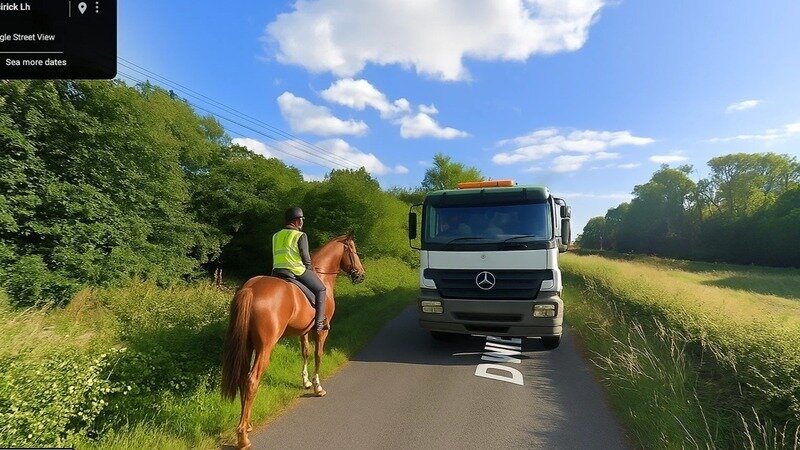
On December 3rd, Chichester District Council's planning committee will decide the fate of the Wisborough Green solar farm application (WR/25/00658/FUL)
Despite a formal rebuttal submitted to highways authorities highlighting material inaccuracies and legally significant omissions, the application appears set to proceed with a recommendation to permit. The highways assessment contains fundamental errors that put vulnerable road users – particularly equestrians – at serious risk.
West Sussex County Council Highways has issued five separate "No Objection" responses, yet continues to rely on factually incorrect vehicle movement data. The assessment claims "only two two-way HGV trips per day" – a figure that excludes 42 articulated lorries and 102 32-ton tipper trucks required for site set-up, and is based on incorrectly averaging 414 HGV movements over 24 weeks.
Most alarming is Highways' suggestion that equestrians use roadside verges to avoid HGVs – verges containing wooden stakes and ditches - because the access route, Drungewick Lane, is not wide enough. This directly contradicts Highway Code Rule 215, which requires 2 metres clearance for horses, and violates the 2022 Hierarchy of Road Users that places vulnerable users at the top of safety priorities.
With 19 horses stabled on Drungewick Lane alone, plus riders from neighbouring villages using this well-established equestrian route, the statistical minimisation of risk is not just inadequate – it's reckless. They also are happy to take the risk of Equestrians having to negotiate busy highways while Public Rights of Way are impacted by construction work!
To put the danger in perspective: the British Horse Society recorded over 3,000 equestrian-related road incidents last year, with dozens of horses killed or seriously injured and many riders hurt. A significant proportion involved vehicles passing too fast or too close — precisely the hazard created here. Drungewick Lane is already a narrow rural corridor, and the proposal introduces up to 26 heavy vehicle movements per day, on top of existing everyday traffic. Compounding this, the works require drilling beneath Public Rights of Way and resurfacing sections while they remain open to the public, forcing riders, walkers and cyclists to navigate active construction zones. These are not hypothetical risks but predictable, avoidable dangers for a route used daily by local equestrians and vulnerable road users.
The Battery Storage Blind Spot
What makes this solar application even more troubling is what is not currently in the application. Battery storage systems are increasingly recognised as essential for solar efficiency, with government plans calling for 23-27 GW of battery storage alongside solar deployment.
Without storage, solar farms are highly inefficient - generating power when it's least needed (sunny summer afternoons) and providing nothing during peak winter demand. The developer, Renewable Connections own documents acknowledge solar's inherent limitations but conveniently avoid discussing the massive battery storage facilities that will inevitably follow this approval, turning today's "temporary" solar farms into permanent industrial energy sites. Renewable Connections themselves admit: “Battery storage has a key role to play in ensuring homes and businesses can be powered by renewable energy sources, even when the sun isn’t shining or when the wind isn’t blowing.”
A further blight on the West Sussex landscape.
The Foreign Dependency Nobody Mentions
In May 2025, a shocking discovery emerged: cellular radios, described as "kill switches," were found embedded in Chinese-manufactured solar power inverters at American solar farms. These hidden devices, capable of remotely shutting down equipment, were not listed in any product documentation. Chinese firms supply around 50% of the world's solar inverters, and two companies - Huawei and Sungrow - controlled more than 50% of the global market in 2023.
The European Solar Manufacturing Council estimates that over 200GW of Europe's solar capacity - equivalent to the output of 200 nuclear power stations - relies on Chinese-manufactured inverters. The same Huawei banned from UK 5G networks due to security concerns is now welcomed into our power grid infrastructure.
Are we really surrendering control of our energy infrastructure to foreign-manufactured equipment with documented security vulnerabilities? And where is this critical national security consideration in our local planning applications?
The Grid Connection Scandal
Here's what developers aren't telling residents: even if approved, some solar farms cannot export power to the grid until 2036-2037 at the earliest. New solar farm applications across most of the UK are being given grid connection dates 15 years away, with some developers being told their projects face waits until the 2040s.
In the case of Wisborough Green, Renewable Connections ability will be restricted with significant limitations until 31st October 2037:
· Curtailment required: the export will be controlled and limited during certain periods when the grid is constrained
· Not guaranteed access: The "Non-firm" licence means that the connection can be curtailed (reduced or stopped) when transmission network capacity is insufficient
· Active Network Management (ANM) required: Special equipment must be installed both at:
o Fleet/Fleet Bramley Substation (by the network operator)
o The site (to remotely control the export levels)
The ANM system essentially allows the grid operator to automatically reduce the export when the transmission network is congested, until permanent reinforcements are completed.
So, we're being asked to sacrifice our agricultural land, endure month of construction disruption and risk life and limb on construction routes, destroy wildlife habitats and fragment ecosystems - for solar farms that cannot actually supply power to the grid for over a decade, if at all. The developers get their planning permissions and land options locked in now, but the infrastructure to use the power won't exist until our children are grown.
This is the definition of putting the cart before the horse - or rather, covering our farmland with panels that serve no purpose except landowner profit and developer speculation.
The Loss That Cannot Be Recovered
Both the Wisborough Green and South Mundham Solar (appeal meeting on 10th and 11th December) applications target agricultural land - exactly the land the National Planning Policy Framework says should be protected. Once gone for 40 years (with no guarantee of restoration), this food-producing capability is lost to a generation. Meanwhile, brownfield sites, rooftops, car parks, and industrial land remain largely untouched.
At South Mundham, residents calculated that landowners could earn £121,000 per annum (£4.8 million over 40 years) by leasing 121 acres for solar. At Wisborough Green, similar financial incentives drive this land grab. These are commercial decisions dressed up as climate action.
The developers present these schemes as temporary and benign. The reality is 40-year industrial installations using foreign technology, destroying wildlife habitats, fragmenting ecosystems, increasing flood risks, threatening ancient woodland, and turning productive farmland into energy speculation - all without proper consideration of equestrian safety, national security, or actual efficiency.
This Wisborough Green application would convert productive agricultural land into an industrial facility that:
- Cannot guarantee power to the grid
- Depends on potentially compromised foreign technology
- Endangers equestrian and pedestrian safety
- Sets a precedent for further rural industrialisation
The planning officer's recommendation to permit, despite these fundamental flaws, suggests a determination to approve at any cost – including the cost of public safety and energy security.
Chichester District Council's planning committee should refuse the Wisborough Green application. December 2025 must be remembered as the month we protected our countryside, not the month we sold it. More than 2,500 residents have now signed the petition opposing the Wisborough Green development and the issue has been covered in the National News — a clear reminder that our elected representatives are accountable to the very communities whose landscape and safety are at stake.
Once our countryside is gone, it's gone for good.
This isn't progress toward net zero – it's the destruction of our rural landscape for a system designed to fail.