

STOP THE LONG BALLOT COMMITTEE IN CANADA
The Issue
This petition seeks to address the growing discontent with the Long Ballot process in Canada that is making a mockery of our democracy.
The Longest Ballot Committee is a political movement in Canada, at one time affiliated with the Rhinoceros Party, known for flooding ballots with a large number of independent candidates in protest of the first-past-the-post (FPTP) voting system and other electoral reform related issues. Only, recent activities point to a deeper, more personal motivation for flooding the ballot in ridings where Conservative MP Pierre Poilievre is a candidate.
The recent federal election held on April 28th, saw 85 additional candidates representing independent, unknown individuals associated with the Longest Ballot Committee that were added to the ballot in the riding of Ottawa-Carleton, a riding that Pierre Poilievre has held and represented since 2004. As the result of these additional 85 candidates, the ballot was nearly a metre long. This caused several problems and raises serious questions about the intent of this group.
PHOTO SPECIMEN OF BALLOT IN OTTAWA-CARLETON
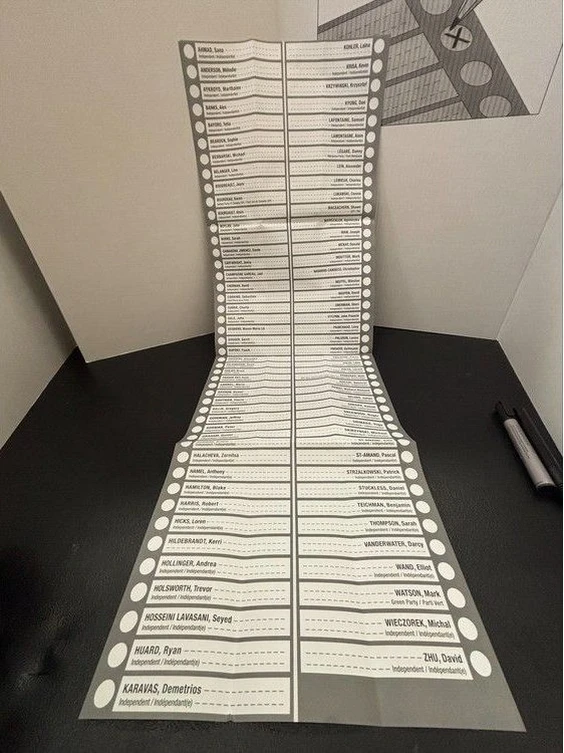
In order to show the names of all 91 candidates in the riding of Ottawa-Carleton, the ballot had two columns of names and was 97.08 centimetres or 38.22 inches long.
-- Having a large volume of names on the ballot, creates very definite accessibility issues for older people and those with disabilities such as visual deficits and motor function limitations, who are not used to seeing so many names. During the recent federal election, there were incidents where individuals with disabilities, found the process to be extremely challenging. A process that would normally take no more than 10 minutes to complete, ended up taking almost an hour. Perhaps the most serious barrier to accessibility is that Blind electors are not able to use Elections Canada's new assistive voting technology (AVTD) with long ballots.
CTV News report of incidents involving Accessibility Issues (April 27, 2025) Long ballot, lines in Carleton cause accessibility issues at polling station : https://ottawacitizen.com/news/long-ballot-lines-carleton-accessibility
Long Ballot Accessibility Report findings - Elections Canada : https://www.elections.ca/content.aspx?section=abo&dir=comp/nov2124&document=p10&lang=e
-- It is the obligation and duty of Elections Canada to ensure that electors have free access to cast their vote in a timely manner at polling stations. With 85 additional candidates on the ballot in the riding of Carleton in the recent federal election, there were long line ups outside the polling station of electors during the Advanced polling who were waiting to get inside to cast their vote. Electors were frustrated and angry in having to wait so long to vote.
-- Due to the size of the ballot, this creates very real, logistical problems for elections poll staff, in having to serve the ballot, receive and place it in the ballot box and in taking extra time to read and process each ballot. The ballot counting process that would normally wrap up before the end of a polling day, can take several hours more as the result of having to go through and check so many names for the count. During the counting process, election workers needed to stand for long periods of time because of the size of the ballot; in some cases, they were standing for hours. Explaining the long ballot to those who do not have English or French as a first language was difficult for the election workers.
MOTIVATIONS OF THE LONGEST BALLOT COMMITTEE
The leader of the Long Ballot Committee is Tomas Szuchewycz. The group states that their purpose is to raise awareness of the need for electoral reform, and yet none of their activities appear to involve any meaningful recourse with the institution that would be responsible for creating change, which is the Federal Government of Canada. The independent candidates representing the ballot protest are not required to have any knowledge of or visit the riding they are running in, pay any fee to run as a candidate or need to provide anything beyond their willingness to add their name to a ballot and to collect 100 signatures to be nominated to participate. There is no intention or expectation of winning a seat or having a voice in Parliament. There is no other form of action to support the cause of this group beyond flooding election ballots, causing disruption and has been quoted by the leader, to 'have some fun'.
In many cases, the candidates who took part in regular and by-elections had their nomination papers signed by the same electors. This indicates that voters who sign the nomination papers are not supporting the nomination of one particular candidate but the idea of having as many candidates as possible on a ballot.
Along with adding several candidates to the ballot in the riding of Carleton where Conservative MP Pierre Poilievre has been a long-time incumbent, the Long Ballot Committee were also planning to add names to the ballot in the riding where Liberal leader Mark Carney was running. The explanation from the group, was that they ran out of time in coordinating and getting names registered - An outcome that seemed rather suspicious if the aim of this group is to raise awareness about the need for electoral reform and to be avoid being seen as partisan. As it was, the result of the federal election saw Pierre Poilievre lose his long-time seat in Carleton to a newcomer, Liberal MP Bruce Fanjoy. With this result, Pierre Poilievre is now seeking to regain his MP seat in the Conservative riding of Battle River—Crowfoot. A riding easily won by Conservative MP Damien Kurek who graciously has stepped aside to allow Poilievre to run in a bi-election. The Long Ballot Committee have set their sights on this riding to once again flood the ballot with twice the number of candidates.
IN CONCLUSION
To run as a candidate in an election takes a great personal investment of time, money and organization. During this time, candidates announce their ideas and policies and campaign throughout their electoral districts (ridings), seeking as many votes as possible. It is through the process of voting that a Member of Parliament is elected for a given riding. To allow a group that has no such ambitions, obligations, affiliations or responsibilities, to be on a ballot for the purposes of a so-called protest for electoral reform that really accomplishes nothing, makes a mockery of our electoral process. It results in an incredible amount of extra time and effort for poll workers and angers and frustrates electors who are showing up to carry out their civic duty.
We the undersigned are asking the Government of Canada in association with Elections Canada, to look at this situation and make meaningful change to discontinue this activity that serves no purpose to canadians, our democracy, the electoral process or the institution of government. Thank you.

1,375
The Issue
This petition seeks to address the growing discontent with the Long Ballot process in Canada that is making a mockery of our democracy.
The Longest Ballot Committee is a political movement in Canada, at one time affiliated with the Rhinoceros Party, known for flooding ballots with a large number of independent candidates in protest of the first-past-the-post (FPTP) voting system and other electoral reform related issues. Only, recent activities point to a deeper, more personal motivation for flooding the ballot in ridings where Conservative MP Pierre Poilievre is a candidate.
The recent federal election held on April 28th, saw 85 additional candidates representing independent, unknown individuals associated with the Longest Ballot Committee that were added to the ballot in the riding of Ottawa-Carleton, a riding that Pierre Poilievre has held and represented since 2004. As the result of these additional 85 candidates, the ballot was nearly a metre long. This caused several problems and raises serious questions about the intent of this group.
PHOTO SPECIMEN OF BALLOT IN OTTAWA-CARLETON
In order to show the names of all 91 candidates in the riding of Ottawa-Carleton, the ballot had two columns of names and was 97.08 centimetres or 38.22 inches long.
-- Having a large volume of names on the ballot, creates very definite accessibility issues for older people and those with disabilities such as visual deficits and motor function limitations, who are not used to seeing so many names. During the recent federal election, there were incidents where individuals with disabilities, found the process to be extremely challenging. A process that would normally take no more than 10 minutes to complete, ended up taking almost an hour. Perhaps the most serious barrier to accessibility is that Blind electors are not able to use Elections Canada's new assistive voting technology (AVTD) with long ballots.
CTV News report of incidents involving Accessibility Issues (April 27, 2025) Long ballot, lines in Carleton cause accessibility issues at polling station : https://ottawacitizen.com/news/long-ballot-lines-carleton-accessibility
Long Ballot Accessibility Report findings - Elections Canada : https://www.elections.ca/content.aspx?section=abo&dir=comp/nov2124&document=p10&lang=e
-- It is the obligation and duty of Elections Canada to ensure that electors have free access to cast their vote in a timely manner at polling stations. With 85 additional candidates on the ballot in the riding of Carleton in the recent federal election, there were long line ups outside the polling station of electors during the Advanced polling who were waiting to get inside to cast their vote. Electors were frustrated and angry in having to wait so long to vote.
-- Due to the size of the ballot, this creates very real, logistical problems for elections poll staff, in having to serve the ballot, receive and place it in the ballot box and in taking extra time to read and process each ballot. The ballot counting process that would normally wrap up before the end of a polling day, can take several hours more as the result of having to go through and check so many names for the count. During the counting process, election workers needed to stand for long periods of time because of the size of the ballot; in some cases, they were standing for hours. Explaining the long ballot to those who do not have English or French as a first language was difficult for the election workers.
MOTIVATIONS OF THE LONGEST BALLOT COMMITTEE
The leader of the Long Ballot Committee is Tomas Szuchewycz. The group states that their purpose is to raise awareness of the need for electoral reform, and yet none of their activities appear to involve any meaningful recourse with the institution that would be responsible for creating change, which is the Federal Government of Canada. The independent candidates representing the ballot protest are not required to have any knowledge of or visit the riding they are running in, pay any fee to run as a candidate or need to provide anything beyond their willingness to add their name to a ballot and to collect 100 signatures to be nominated to participate. There is no intention or expectation of winning a seat or having a voice in Parliament. There is no other form of action to support the cause of this group beyond flooding election ballots, causing disruption and has been quoted by the leader, to 'have some fun'.
In many cases, the candidates who took part in regular and by-elections had their nomination papers signed by the same electors. This indicates that voters who sign the nomination papers are not supporting the nomination of one particular candidate but the idea of having as many candidates as possible on a ballot.
Along with adding several candidates to the ballot in the riding of Carleton where Conservative MP Pierre Poilievre has been a long-time incumbent, the Long Ballot Committee were also planning to add names to the ballot in the riding where Liberal leader Mark Carney was running. The explanation from the group, was that they ran out of time in coordinating and getting names registered - An outcome that seemed rather suspicious if the aim of this group is to raise awareness about the need for electoral reform and to be avoid being seen as partisan. As it was, the result of the federal election saw Pierre Poilievre lose his long-time seat in Carleton to a newcomer, Liberal MP Bruce Fanjoy. With this result, Pierre Poilievre is now seeking to regain his MP seat in the Conservative riding of Battle River—Crowfoot. A riding easily won by Conservative MP Damien Kurek who graciously has stepped aside to allow Poilievre to run in a bi-election. The Long Ballot Committee have set their sights on this riding to once again flood the ballot with twice the number of candidates.
IN CONCLUSION
To run as a candidate in an election takes a great personal investment of time, money and organization. During this time, candidates announce their ideas and policies and campaign throughout their electoral districts (ridings), seeking as many votes as possible. It is through the process of voting that a Member of Parliament is elected for a given riding. To allow a group that has no such ambitions, obligations, affiliations or responsibilities, to be on a ballot for the purposes of a so-called protest for electoral reform that really accomplishes nothing, makes a mockery of our electoral process. It results in an incredible amount of extra time and effort for poll workers and angers and frustrates electors who are showing up to carry out their civic duty.
We the undersigned are asking the Government of Canada in association with Elections Canada, to look at this situation and make meaningful change to discontinue this activity that serves no purpose to canadians, our democracy, the electoral process or the institution of government. Thank you.
The Decision Makers
Supporter Voices
Petition Updates
Share this petition
Petition created on May 11, 2025