

Ban feeding stations for feral cats in Waikōloa that are harming the Nēnē
The Issue
Action towards Abay Kitties
https://abaykitties.wixsite.com/abaykitties

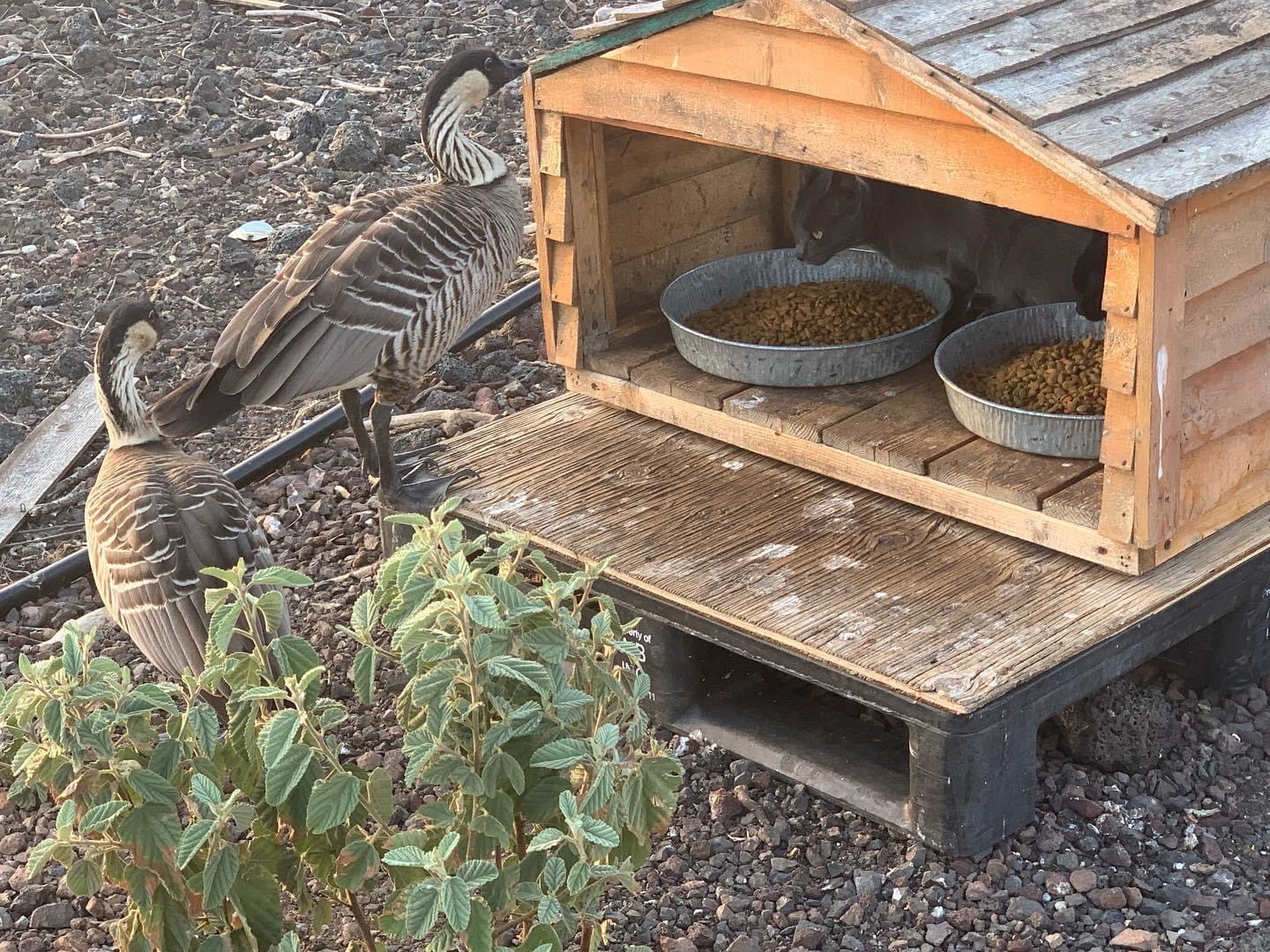
Queenʻs Market Place, Waikōloa, Hawaiʻi Island: We got an anonymous report from a concerned community member about this company Abay Kitties, who set up feeding structures to illegally feed the feral cats colonies at the Anaehoomalu Bay and The Waikōloa Resort area.

However, the Nēnē eat and drink water from these stations or the ground. In Hawaiʻi, feral cats are classified as an invasive species. The Hawaii Invasive Species Council does not recommend using “Trap-Neuter-Return” or other efforts that support the feeding or re-release of feral cats into the wild or public spaces.

We have reported this to the Department of Land and Natural Resources / Department Division of Conservation and Resources Enforcement, who said the feral cat colonies in this area have been an ongoing problem.
We ask the community to sign this petition as we advocate for protecting and conserving the Nēnē, our state bird. These birds should take precedence over the feral cats.

It is said that 25,000 Nēnē existed in Hawai`i when Captain Cook landed in 1778. Fifty years ago, the species was on the brink of extinction, utterly absent, with fewer than 30 geese in the wild statewide. Through conservation and the Endangered Species Act the Nēnē have rebounded to about 2500 statewide.
This is the reason why we are fighting so hard for this. To us, kānaka, the Nēnē are our kūpuna. They are mentioned in the Kumulipō. Like the ʻĀina, there is no separation. We are all one.

We do not have anything against cats or cat lovers. We are fighting for the right, protection, conservation, and overall existence of the Nēnē, its rightful habitat. Nēnē, the Hawaiian Goose, is the rarest in the world and are endemic to Hawaiʻi, which means they are found here and nowhere else in the world.
Here are our reasons why, as stated by the law.
Conservation Status
* Federally Listed as Threatened
* State Listed as Endangered
* State Recognized as Endemic
* NatureServe Heritage Rank G1 – Critically Imperiled
* IUCN Red List Ranking – Vulnerable
* Revised Recovery Plan for the Nēnē or Hawaiian Goose (Branta sandvicensis) – USFWS 2004
Overall Threats
Historical threats included habitat loss and degradation, hunting, and predation by rats, cats, dogs, and the small Indian mongoose. Current hazards include predation by nonnative mammals; exposure to diseases that can be transmitted by introduced nonnative animals such as feral and domestic cats (e.g., toxoplasmosis); nutritional deficiencies due to paucity of quality habitat, exposure stress at high-elevation habitats; a lack of contiguous lowland habitat; human-caused disturbance and mortality (e.g., road mortality, disturbance by hikers, aircraft strikes, collisions with wind turbines); behavioral problems related to captive propagation; and inbreeding depression.

It is unlawful to touch, feed, harass, or chase the nene, and each bird is banded.
Nēnē graze and browse on the leaves, seeds, flowers, and fruits of at least 50 native and nonnative grasses, sedges, composites, and shrubs.
The Full list of the statues is listed here.
https://dlnr.hawaii.gov/dofaw/files/2013/09/Chap124a.pdf
Feral class definition by the Hawaii Invasive species council and classifications
https://dlnr.hawaii.gov/hisc/info/invasive-species-profiles/feral-cats/
We have reports of private land companies, hotels, and Queenʻs Market Place allowing these feeding stations on their property. We ask the community to flood their emails and ask for their removal of these structures. These entities are also subject to fines. Email the HOA, and your State and County Legislators so we can find solutions to end and irradicate this problem.
Queenʻs Market Place
Owner Alexander & Baldwin
Matt Schull (S)
(808) 525-6662
Leasing Contact:
822 Bishop Street
Honolulu, HI 96813
Alexanderbaldwin.com
Matt Schull (S)
(808) 525-6662
Senator Herbert M. "Tim" Richards , III (D)
District 4
Area
North Hilo, Hamakua, Kohala, Waimea, Waikoloa, North Kona
Email: senrichards@capitol.hawaii.gov
Phone:
808-586-6760
House Districts
Representative David A. Tarnas
District 8
Area Hawi, Hala‘ula, Waimea, Makahalau, Waiki‘i, Waikoloa, Kawaihae, and Mahukona
Email: reptarnas@capitol.hawaii.gov

We need immediate action! Nēnē are precious and deserve to be protected in their natural habitat and treated with correct preservation to last a lifetime.
Mahalo for your kōkua!

541
The Issue
Action towards Abay Kitties
https://abaykitties.wixsite.com/abaykitties
Queenʻs Market Place, Waikōloa, Hawaiʻi Island: We got an anonymous report from a concerned community member about this company Abay Kitties, who set up feeding structures to illegally feed the feral cats colonies at the Anaehoomalu Bay and The Waikōloa Resort area.
However, the Nēnē eat and drink water from these stations or the ground. In Hawaiʻi, feral cats are classified as an invasive species. The Hawaii Invasive Species Council does not recommend using “Trap-Neuter-Return” or other efforts that support the feeding or re-release of feral cats into the wild or public spaces.
We have reported this to the Department of Land and Natural Resources / Department Division of Conservation and Resources Enforcement, who said the feral cat colonies in this area have been an ongoing problem.
We ask the community to sign this petition as we advocate for protecting and conserving the Nēnē, our state bird. These birds should take precedence over the feral cats.
It is said that 25,000 Nēnē existed in Hawai`i when Captain Cook landed in 1778. Fifty years ago, the species was on the brink of extinction, utterly absent, with fewer than 30 geese in the wild statewide. Through conservation and the Endangered Species Act the Nēnē have rebounded to about 2500 statewide.
This is the reason why we are fighting so hard for this. To us, kānaka, the Nēnē are our kūpuna. They are mentioned in the Kumulipō. Like the ʻĀina, there is no separation. We are all one.
We do not have anything against cats or cat lovers. We are fighting for the right, protection, conservation, and overall existence of the Nēnē, its rightful habitat. Nēnē, the Hawaiian Goose, is the rarest in the world and are endemic to Hawaiʻi, which means they are found here and nowhere else in the world.
Here are our reasons why, as stated by the law.
Conservation Status
* Federally Listed as Threatened
* State Listed as Endangered
* State Recognized as Endemic
* NatureServe Heritage Rank G1 – Critically Imperiled
* IUCN Red List Ranking – Vulnerable
* Revised Recovery Plan for the Nēnē or Hawaiian Goose (Branta sandvicensis) – USFWS 2004
Overall Threats
Historical threats included habitat loss and degradation, hunting, and predation by rats, cats, dogs, and the small Indian mongoose. Current hazards include predation by nonnative mammals; exposure to diseases that can be transmitted by introduced nonnative animals such as feral and domestic cats (e.g., toxoplasmosis); nutritional deficiencies due to paucity of quality habitat, exposure stress at high-elevation habitats; a lack of contiguous lowland habitat; human-caused disturbance and mortality (e.g., road mortality, disturbance by hikers, aircraft strikes, collisions with wind turbines); behavioral problems related to captive propagation; and inbreeding depression.
It is unlawful to touch, feed, harass, or chase the nene, and each bird is banded.
Nēnē graze and browse on the leaves, seeds, flowers, and fruits of at least 50 native and nonnative grasses, sedges, composites, and shrubs.
The Full list of the statues is listed here.
https://dlnr.hawaii.gov/dofaw/files/2013/09/Chap124a.pdf
Feral class definition by the Hawaii Invasive species council and classifications
https://dlnr.hawaii.gov/hisc/info/invasive-species-profiles/feral-cats/
We have reports of private land companies, hotels, and Queenʻs Market Place allowing these feeding stations on their property. We ask the community to flood their emails and ask for their removal of these structures. These entities are also subject to fines. Email the HOA, and your State and County Legislators so we can find solutions to end and irradicate this problem.
Queenʻs Market Place
Owner Alexander & Baldwin
Matt Schull (S)
(808) 525-6662
Leasing Contact:
822 Bishop Street
Honolulu, HI 96813
Alexanderbaldwin.com
Matt Schull (S)
(808) 525-6662
Senator Herbert M. "Tim" Richards , III (D)
District 4
Area
North Hilo, Hamakua, Kohala, Waimea, Waikoloa, North Kona
Email: senrichards@capitol.hawaii.gov
Phone:
808-586-6760
House Districts
Representative David A. Tarnas
District 8
Area Hawi, Hala‘ula, Waimea, Makahalau, Waiki‘i, Waikoloa, Kawaihae, and Mahukona
Email: reptarnas@capitol.hawaii.gov
We need immediate action! Nēnē are precious and deserve to be protected in their natural habitat and treated with correct preservation to last a lifetime.
Mahalo for your kōkua!
Supporter Voices
Petition Updates
Share this petition
Petition created on April 3, 2023