

Lobby Mayor Sadiq Khan to Refuse Planning Permission for this HIGHLY Dangerous Project
The Issue
Dear Mayor Khan
On 11 January, The Royal Borough of Kensington & Chelsea Planning Committee granted planning permission to the giant multi £billion “Project Flourish” that is the Ballymore / Sainsbury’s Kensal Canalside application (MGLA160226-4245 Ballymore / Sainsbury's Kensal Canalside application (RBKC-PP/23/06575)
I understand that this application is soon to be with you for Stage 2 approval.
I also understand that there have been many appeals to you from a variety of resident’s organisations, associations, forums, and community groups. I consider that these representations demonstrate compelling grounds for Mayoral Intervention at this stage and that there are sufficiently strong reasons for a Direction to Refuse Planning Permission.
At the very least to “call in” the application and put it through a thorough review process.
This is because the mitigations and remediations under S106 agreements so far considered (and far from being agreed) fall far short of what is needed given the site’s enormous problems.
These I outline below.
I, like thousands of others, want this site developed. URGENTLY. More quickly than this plan can ever hope to accomplish. I would like to see it developed safely, swiftly and with the provision of a much higher percentage of affordable and social homes to help satisfy the enormous local need. And there IS a completely affordable solution which I implore you to investigate (see appendix 1)
The Ballymore / Sainsbury plan seeking Stage 2 approval contravenes so many guidelines and policies.
In addition it brings absolutely unnecessary dangers to health and discomforts to life during its construction, lasting over a decade for residents in North Kensington, Brent and Westminster. It is no surprise that there will be more suffering by residents in these adjoining areas than in the more affluent parts of Kensington and Chelsea.
Many of these issues have been identified and raised by the aforementioned community groups which have written to you. Particularly the site’s enormous toxicity but also: Heritage damage: - particularly the shadowing of Kensal Green Cemetery. The lack of “affordable” or social housing: - too many expensive apartments designed to attract overseas investors. The lack of transport infrastructure: – buses, overground / underground access. The lack of services: healthcare – doctors, dentists, schools. The unnecessary transport of toxic waste through the streets of Brent: - versus the options of rail and canal. The dangers of UXOs on site: - high probability.
These issues and the policies to which they relate and often contravene have been pointed out in depth.
And sadly – and overwhelmingly – the enormous and OBVIOUS danger of housing nearly 10,000 people in an island site with only one access, AKA a cul de sac.
The consequence of RBKC granting permission for this development has lead not only to this stupidity but various other dangerous compromises. The sorts of compromises, risk taking and "trusting the builder" naivety that led to Grenfell.
The sorts of compromises that will lead to umpteen years of construction hell – not for most RBKC residents – but those of neighbouring boroughs.
• Compromise 1. There is a singular access to this site – a massive and alarmingly dangerous cul de sac.
A cul de sac destined to house nearly 10,000 people (including the St William project within this hybrid development) – a whole new city. This singular access leads to/from the already heavily congested road, Ladbroke Grove, with a singular carriageway in either direction.
In these disturbed times what happens in an emergency – a fire, a bomb, a terrorist or suicidal gunman? Or just a bad accident or medical emergency?
The dangers in case of any serious event are all too obvious.
This, above all other issues, is one which just seems to slip by the planners.
This is because, I believe, there are no absolute policy guidelines or planning laws which specifically regulate this question.
How many people at what density should be permitted to live on a site with only one access?
How many lanes should the road have onto and from which traffic flows?
If you came up with a number of nearly 10,000 people - the size of a small city – the public, quite rightly, would think you were completely bonkers.
But there are no set rules. Instead we have to assess the situation and make common sense decisions. Certainly not just take it for granted. Or accept what the developer thinks it can get away with.
Yet here we are. Nearly 10,000 people to be housed in a cul de sac. Where is the sense in that?
Traffic projections commissioned by Ballymore are patently absurd and make nonsense assumptions about modal changes, about the limited garaging on site and the removal of the petrol station but NOTHING about increased traffic due to the need for more buses, Ubers and taxis, plus deliveries from Amazon, Ocado, Temu and many other courier journeys. Never mind also from a much enlarged Sainsbury's, on-site restaurants, shops and the new "High Street”.
The singular entrance onto the already over-congested, often completely blocked, Ladbroke Grove should be planned to permit maximum traffic flow. The road’s congestion has been compounded over the last few years by constant road works, much of it caused by the crumbling under-road Victorian infrastructure from water and sewage systems to the roadway itself.
This of course will be compounded further by the huge number of HGVs and low-loaders required to build this massive project estimated at 140per day on average.
The result? Not just congestion but gridlock.
The mediations required are obvious.
The junction onto Ladbroke Grove demands flyovers, underpasses and gyratory systems (there is plenty of land on the site, and opposite, to accommodate this).
These are not inexpensive options, but are essential given that there are only two small north/south local bridges over the canal and the railway, insufficient for the amount of traffic even now.
It is not the fault of RBKC that the site is a cul de sac and that so few bridges have ever been built but this development demands considerably more transport infrastructure investment than has been offered by the developer or demanded by RBKC.
I suggest that this issue be one of, if not THE main concern, to call in the whole project for review.
How to minimise the dangers from traffic and congestion and the consequent dangers to access for security and emergency services.
As far as solving this is concerned, the only proposals mooted so far are to merely tinker with a 3 or a 4 leg option to the Ladbroke Grove junction and the introduction of traffic lights for the safety of pedestrians and cyclists. Woefully inadequate!
There should be no approval of this application until at least this problem is resolved.
None of the proposed minimal mitigations can eliminate the dangers of one access compounded by severe congestion. This danger leaves us with the potential for another almost inevitable Grenfell sized calamity, something of which RBKC (now commonly known as “The Grenfell Council”) should be extremely conscious, but apparently isn’t.
Compromise 2. The safety measures and mitigations so far agreed in regard to the dangerously toxic contamination of this particular site are pathetically weak.
Yes, Ballymore says "Lots of gasworks sites like this have been decontaminated before.
Lots of builders have done it. Trust us, we're a large experienced developer."
However, although Ballymore has previously remediated contaminated brownfield sites it has NEVER handled a major gasworks site like this one.
And, whatever their "Expert" said to the RBKC Planning Committee this IS one of the MOST contaminated gasworks sites ever.
Indeed she, Deanne Gibbs of Talon Consulting Ltd (a "geotechnical, environmental and civil engineering consultancy" company, only incorporated a couple of years ago), only deepened concern — minimised risks, sidestepped specifics, and dismissed legitimate concerns as mere “confusion”.
See: CONTAMINATION VIDEO –
https://www.youtube.com/watch?v=8I-R9u_blNU
This site's decontamination is planned to go on, patch by patch, section by section, for a minimum of 11 or 12 years. No wonder the residents of North Kensington have protested.
Over 10,000 of them living there and in neighbouring boroughs have petitioned RBKC.
The residents of North Kensington and adjacent boroughs (which include mine, Queen’s Park, Brent) are genuinely and gravely concerned at the knowledge that the decontamination of other gasworks sites in London (e.g. Southwark) has resulted in serious health hazards, illnesses and respiratory issues not to mention unbearable stenches. We should endure this for well over a decade?
Is it possible to provide greater levels of safety and mitigate the worst aspects of decontamination? Of course it is.
Here, for example, is what they are doing in China. CHINA!! Out of all the politically authoritarian and undemocratic countries in the world to have more concern about local residents than RBKC!
There are many more examples.
To do this and filter out toxic dust and gases does cost more, of course. Several £millions more. But this is a project heading to a budget of £3bn.
And this is the Royal Borough we are talking about – surely they can do better than just trust a commercial developer inexperienced in this level of contamination.
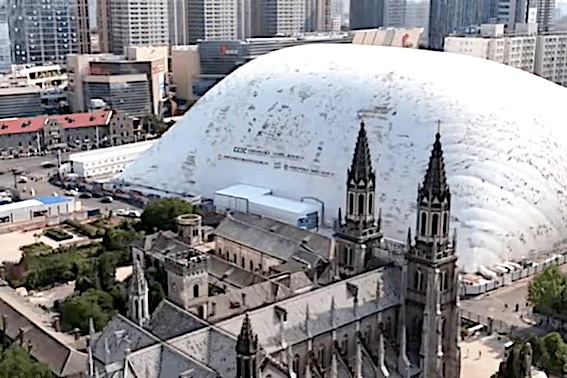
Air pressure dome in China over a construction site in Jinan
to control dust, toxins and noise pollution.
Similar solutions are available from British manufacturers.
• Compromise 3. Transporting contaminated waste out and construction materials into the site through the only access via HGVs and low-loaders when the canal and railway are available. The proposal requires an estimated 140 big truck journeys a day plus other construction worker traffic.
This they are planning to be continuing for well over a decade!
Ballymore says it "aspires" to bring in some materials by canal "if possible".
Yet there has been no sign or evidence made public that any serious investigations or costings for the development of a dedicated railway siding or of transporting at least toxic waste by canal or devising methods of transporting construction materials under some of the canal's low bridges.
These methods would, at least in the construction phase, significantly reduce the traffic impact and the massive damage to the centuries old local road and services infrastructure which, judging by the current frequency of roadworks required to keep it working, is already extremely fragile.
Bear in mind that the vast majority of this transportation impact will NOT be inflicted on RBKC but on North Kensington and the adjoining boroughs of Westminster, Brent, Hammersmith & Fulham
• Compromise 4. The lack of provision of an appropriate level of "affordable" and/or social housing.
As you well know, London, and especially RBKC, is acutely short of such. Ballymore's solution is:
a). To give the impression through its PR that there will be hundreds if not thousands of new homes provided to reduce the RBKC lengthy housing list. They have not of course explicitly said this but, for sure, that is the impression many people have got. And I suspect a majority of those who have misguidedly supported the project.
b). To reduce the normal GLA new development requirement from 35% to 20% (about 500 dwellings). But there have been so many different estimates of what the "reality" might be on completion that I am now confused. Anyway, not many.
The reason Ballymore has managed to persuade RBKC that a reduced percentage of “affordable” dwellings is necessary is largely due to the high costs of decontamination and thus the possible reduction in profit to a level they do not consider viable.
But my suggested solution obviates this cost (see appendix 1) The solution is NOT to decontaminate the site but to cap it in concrete as per the existing Sainsbury's supermarket and car park. This large building was opened in 1988 over some of the site's most contaminated ground.
A concrete raft would support low to mid-rise dwellings, of which there are a wide variety available, factory prefabricated in Germany and Sweden and possibly the UK. With quickly built and readily assembled buildings the site could be complete in 2 or 3 years instead of 10 to 12 or more.
I am NOT a planner or architect but I suspect that several thousand "affordable" homes could be built rather than Ballymore's most optimistic 500. All this in pleasant parkland with more public amenities than promised now and in a manner which is far better for the environment, for traffic, for current residents for miles around, for the potentially overshadowed Heritage site of Kensal Green Cemetery and Kensal Green itself.
(More details in Appendix 1).
I trust and really hope that you can help put a stop to this crazy, out of hand juggernaut before it is too late. I hope you will see the sense of this quicker, cheaper, less dangerous, more acceptable and eminently more attractive solution to provide homes for many more Londoners in housing need.
Kind Regards
Duncan McAusland
35 Keslake Road, Queen's Park, London NW6 6DJ
----------------------
Appendix 1.
You may not have been made aware that the Kensal Canalside site can readily be furnished with many more affordable and social homes for local people than the proposal by the developer, Ballymore.
Simply put the site should NOT be decontaminated but entirely capped in concrete. (The existing Sainsbury’s store was built on a concrete cap in 1988)
This CAN be achieved with minimal decontamination, much more quickly and with the provision of a much larger number of affordable and social homes.
- How did this issue even arise?
The developer, Ballymore, needs to build big to maximise profit.
Building big necessitates total decontamination of this grossly toxic site.
Maximising profit equals maximising density.
Density equals height.
Height means digging deep. - And on this site that requires detoxification.
• Which greatly increases the cost (never mind the dangers and discomforts for everyone around for more than a decade)
• Which greatly increases the length of time (never mind the dangers and discomforts for everyone around for more than a decade)
• Which greatly increases the amount of construction traffic (never mind the dangers and discomforts for everyone around for more than a decade)
• Which greatly increases the absolutely unnecessary risks to life and health, for example by transporting toxic waste through public streets (never mind the dangers and discomforts for everyone around for more than a decade)
Because of all these discomforts and dangers planners have to determine what safety measures and mitigations the developer should bear under S106 agreements.
Yet the more planners ask for further safety measures and mitigations the more the developer resists, makes excuses, minimises the issues (and even threatens to pull out) because of the consequent erosion of profit.
Or build even bigger to compensate!!
Why do we want to allow mega-rich developers to build an ugly high-rise new-town with over 3,000 new dwellings in the vain hope that 20% of them (500) might end up being “affordable”. You know from experience that the other 80% will end up “unaffordable” to almost anyone but dodgy overseas investors greedy to pick up any property in the Royal Borough of Kensington & Chelsea.
There are massive long term risks in having to remove, through our streets, thousands of tons of toxic waste (much of which is still to be fully assessed) over the site’s many years of construction. And that’s apart from the preposterous proposition that it is OK to access the whole of this new city through only ONE entrance/exit via the already over-congested Ladbroke Grove.
So, why not opt for a simpler, cheaper, faster, non-polluting solution which provides for a GUARANTEED greater number of even cheaper and better quality “affordable” homes.
Here is the solution:
1. Build a concrete cap over the whole site. Don’t tell me it’s not feasible – the highest toxicity on the whole site is to be found under the current Sainsbury’s supermarket. Yet, because it needs no massive foundations its own concrete cap keeps us perfectly safe. It was built in 1988 and I understand, has never had problems re contamination.
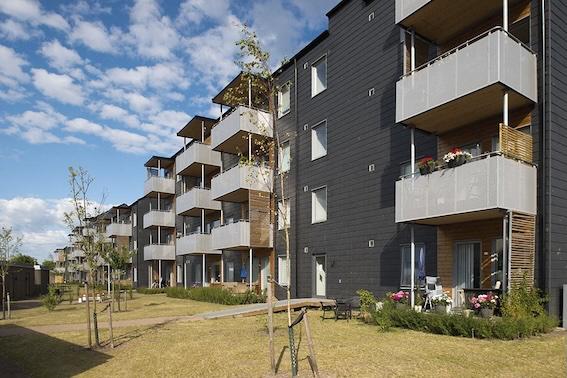
2. Build low / mid rise factory built units like these built by Swedish company BoKlok. (Please note this is NOT a sales pitch, other brands both German and British offer similar products)
BoKlok is a joint venture between two Scandinavian giants, construction specialist Skanska and furnishings giant IKEA. It supplies homes that benefit from the economies of scale offered by standardisation while offering price accessible variation across four or five models.
These homes are built primarily from wood, using a smart, industrialised and efficient process. Homes are completed off-site in a safe, dry environment using modern construction methods. This enables predictability, high quality and low costs. They are extremely well insulated and with solar panels are UK perfect for today’s low-cost “affordable” homes.
Thus, instead of the extremely optimistic 500 “affordable” new homes* proposed (but not even promised) by the developer, it would be possible to build on that same site over 1,000 new eco-friendly “very affordable” new homes for up to 4,000 people. Probably, given a good architect/planner a good deal more. All this could be achieved within 2 or 3 years. No toxic waste problems, risks and added costs. Fewer and shorter traffic issues.
I’m not an architect, I can’t be specific but SURELY this, or something very like it, is worth exploring? RBKC certainly didn’t.
Mayor Khan, this could be a shining example of how to adopt modern methods to provide social housing and create real change.
----------------------
Appendix 2
Mr Mayor,
In case you didn't know: a Ballymore case history
Ballymore's New Providence Wharf is a 559-apartment scheme, which altered the skyline east of London's Canary Wharf. However, following the 2017 Grenfell Tower fire, it emerged that New Providence Block A-E in Fairmont Avenue used the same aluminium composite material (ACM) cladding. More than 500 households would, on average, have to pay over £4,000 each after freeholder Landor Residential, part of the Ballymore group, refused to cover the cost of recladding the block.
In February 2019, Ballymore offered a 20% contribution towards recladding costs, but gave leaseholders a two-week ultimatum to foot the rest of the £2.4m bill, despite stated Ministry of Housing, Communities and Local Government policy that leaseholders should not have to be made to pay to remediate dangerous cladding systems.
Ballymore also offered loans, but threatened to cancel its 20% contribution and add a 5% interest to the loan if any resident threatened the company with legal action.
On 7 May 2021, the ACM-clad building suffered a major fire.
The blaze affected parts of the 8th, 9th and 10th floors, and resulted in two people being taken to hospital, plus the evacuation of 42 people.
Ballymore said the ACM played no part in the blaze.
However, a London Fire Brigade report about the fire revealed serious safety failings, including a broken ventilation system which meant the building acted like a "broken chimney" while escape routes filled with smoke.

2,646
The Issue
Dear Mayor Khan
On 11 January, The Royal Borough of Kensington & Chelsea Planning Committee granted planning permission to the giant multi £billion “Project Flourish” that is the Ballymore / Sainsbury’s Kensal Canalside application (MGLA160226-4245 Ballymore / Sainsbury's Kensal Canalside application (RBKC-PP/23/06575)
I understand that this application is soon to be with you for Stage 2 approval.
I also understand that there have been many appeals to you from a variety of resident’s organisations, associations, forums, and community groups. I consider that these representations demonstrate compelling grounds for Mayoral Intervention at this stage and that there are sufficiently strong reasons for a Direction to Refuse Planning Permission.
At the very least to “call in” the application and put it through a thorough review process.
This is because the mitigations and remediations under S106 agreements so far considered (and far from being agreed) fall far short of what is needed given the site’s enormous problems.
These I outline below.
I, like thousands of others, want this site developed. URGENTLY. More quickly than this plan can ever hope to accomplish. I would like to see it developed safely, swiftly and with the provision of a much higher percentage of affordable and social homes to help satisfy the enormous local need. And there IS a completely affordable solution which I implore you to investigate (see appendix 1)
The Ballymore / Sainsbury plan seeking Stage 2 approval contravenes so many guidelines and policies.
In addition it brings absolutely unnecessary dangers to health and discomforts to life during its construction, lasting over a decade for residents in North Kensington, Brent and Westminster. It is no surprise that there will be more suffering by residents in these adjoining areas than in the more affluent parts of Kensington and Chelsea.
Many of these issues have been identified and raised by the aforementioned community groups which have written to you. Particularly the site’s enormous toxicity but also: Heritage damage: - particularly the shadowing of Kensal Green Cemetery. The lack of “affordable” or social housing: - too many expensive apartments designed to attract overseas investors. The lack of transport infrastructure: – buses, overground / underground access. The lack of services: healthcare – doctors, dentists, schools. The unnecessary transport of toxic waste through the streets of Brent: - versus the options of rail and canal. The dangers of UXOs on site: - high probability.
These issues and the policies to which they relate and often contravene have been pointed out in depth.
And sadly – and overwhelmingly – the enormous and OBVIOUS danger of housing nearly 10,000 people in an island site with only one access, AKA a cul de sac.
The consequence of RBKC granting permission for this development has lead not only to this stupidity but various other dangerous compromises. The sorts of compromises, risk taking and "trusting the builder" naivety that led to Grenfell.
The sorts of compromises that will lead to umpteen years of construction hell – not for most RBKC residents – but those of neighbouring boroughs.
• Compromise 1. There is a singular access to this site – a massive and alarmingly dangerous cul de sac.
A cul de sac destined to house nearly 10,000 people (including the St William project within this hybrid development) – a whole new city. This singular access leads to/from the already heavily congested road, Ladbroke Grove, with a singular carriageway in either direction.
In these disturbed times what happens in an emergency – a fire, a bomb, a terrorist or suicidal gunman? Or just a bad accident or medical emergency?
The dangers in case of any serious event are all too obvious.
This, above all other issues, is one which just seems to slip by the planners.
This is because, I believe, there are no absolute policy guidelines or planning laws which specifically regulate this question.
How many people at what density should be permitted to live on a site with only one access?
How many lanes should the road have onto and from which traffic flows?
If you came up with a number of nearly 10,000 people - the size of a small city – the public, quite rightly, would think you were completely bonkers.
But there are no set rules. Instead we have to assess the situation and make common sense decisions. Certainly not just take it for granted. Or accept what the developer thinks it can get away with.
Yet here we are. Nearly 10,000 people to be housed in a cul de sac. Where is the sense in that?
Traffic projections commissioned by Ballymore are patently absurd and make nonsense assumptions about modal changes, about the limited garaging on site and the removal of the petrol station but NOTHING about increased traffic due to the need for more buses, Ubers and taxis, plus deliveries from Amazon, Ocado, Temu and many other courier journeys. Never mind also from a much enlarged Sainsbury's, on-site restaurants, shops and the new "High Street”.
The singular entrance onto the already over-congested, often completely blocked, Ladbroke Grove should be planned to permit maximum traffic flow. The road’s congestion has been compounded over the last few years by constant road works, much of it caused by the crumbling under-road Victorian infrastructure from water and sewage systems to the roadway itself.
This of course will be compounded further by the huge number of HGVs and low-loaders required to build this massive project estimated at 140per day on average.
The result? Not just congestion but gridlock.
The mediations required are obvious.
The junction onto Ladbroke Grove demands flyovers, underpasses and gyratory systems (there is plenty of land on the site, and opposite, to accommodate this).
These are not inexpensive options, but are essential given that there are only two small north/south local bridges over the canal and the railway, insufficient for the amount of traffic even now.
It is not the fault of RBKC that the site is a cul de sac and that so few bridges have ever been built but this development demands considerably more transport infrastructure investment than has been offered by the developer or demanded by RBKC.
I suggest that this issue be one of, if not THE main concern, to call in the whole project for review.
How to minimise the dangers from traffic and congestion and the consequent dangers to access for security and emergency services.
As far as solving this is concerned, the only proposals mooted so far are to merely tinker with a 3 or a 4 leg option to the Ladbroke Grove junction and the introduction of traffic lights for the safety of pedestrians and cyclists. Woefully inadequate!
There should be no approval of this application until at least this problem is resolved.
None of the proposed minimal mitigations can eliminate the dangers of one access compounded by severe congestion. This danger leaves us with the potential for another almost inevitable Grenfell sized calamity, something of which RBKC (now commonly known as “The Grenfell Council”) should be extremely conscious, but apparently isn’t.
Compromise 2. The safety measures and mitigations so far agreed in regard to the dangerously toxic contamination of this particular site are pathetically weak.
Yes, Ballymore says "Lots of gasworks sites like this have been decontaminated before.
Lots of builders have done it. Trust us, we're a large experienced developer."
However, although Ballymore has previously remediated contaminated brownfield sites it has NEVER handled a major gasworks site like this one.
And, whatever their "Expert" said to the RBKC Planning Committee this IS one of the MOST contaminated gasworks sites ever.
Indeed she, Deanne Gibbs of Talon Consulting Ltd (a "geotechnical, environmental and civil engineering consultancy" company, only incorporated a couple of years ago), only deepened concern — minimised risks, sidestepped specifics, and dismissed legitimate concerns as mere “confusion”.
See: CONTAMINATION VIDEO –
https://www.youtube.com/watch?v=8I-R9u_blNU
This site's decontamination is planned to go on, patch by patch, section by section, for a minimum of 11 or 12 years. No wonder the residents of North Kensington have protested.
Over 10,000 of them living there and in neighbouring boroughs have petitioned RBKC.
The residents of North Kensington and adjacent boroughs (which include mine, Queen’s Park, Brent) are genuinely and gravely concerned at the knowledge that the decontamination of other gasworks sites in London (e.g. Southwark) has resulted in serious health hazards, illnesses and respiratory issues not to mention unbearable stenches. We should endure this for well over a decade?
Is it possible to provide greater levels of safety and mitigate the worst aspects of decontamination? Of course it is.
Here, for example, is what they are doing in China. CHINA!! Out of all the politically authoritarian and undemocratic countries in the world to have more concern about local residents than RBKC!
There are many more examples.
To do this and filter out toxic dust and gases does cost more, of course. Several £millions more. But this is a project heading to a budget of £3bn.
And this is the Royal Borough we are talking about – surely they can do better than just trust a commercial developer inexperienced in this level of contamination.
Air pressure dome in China over a construction site in Jinan
to control dust, toxins and noise pollution.
Similar solutions are available from British manufacturers.
• Compromise 3. Transporting contaminated waste out and construction materials into the site through the only access via HGVs and low-loaders when the canal and railway are available. The proposal requires an estimated 140 big truck journeys a day plus other construction worker traffic.
This they are planning to be continuing for well over a decade!
Ballymore says it "aspires" to bring in some materials by canal "if possible".
Yet there has been no sign or evidence made public that any serious investigations or costings for the development of a dedicated railway siding or of transporting at least toxic waste by canal or devising methods of transporting construction materials under some of the canal's low bridges.
These methods would, at least in the construction phase, significantly reduce the traffic impact and the massive damage to the centuries old local road and services infrastructure which, judging by the current frequency of roadworks required to keep it working, is already extremely fragile.
Bear in mind that the vast majority of this transportation impact will NOT be inflicted on RBKC but on North Kensington and the adjoining boroughs of Westminster, Brent, Hammersmith & Fulham
• Compromise 4. The lack of provision of an appropriate level of "affordable" and/or social housing.
As you well know, London, and especially RBKC, is acutely short of such. Ballymore's solution is:
a). To give the impression through its PR that there will be hundreds if not thousands of new homes provided to reduce the RBKC lengthy housing list. They have not of course explicitly said this but, for sure, that is the impression many people have got. And I suspect a majority of those who have misguidedly supported the project.
b). To reduce the normal GLA new development requirement from 35% to 20% (about 500 dwellings). But there have been so many different estimates of what the "reality" might be on completion that I am now confused. Anyway, not many.
The reason Ballymore has managed to persuade RBKC that a reduced percentage of “affordable” dwellings is necessary is largely due to the high costs of decontamination and thus the possible reduction in profit to a level they do not consider viable.
But my suggested solution obviates this cost (see appendix 1) The solution is NOT to decontaminate the site but to cap it in concrete as per the existing Sainsbury's supermarket and car park. This large building was opened in 1988 over some of the site's most contaminated ground.
A concrete raft would support low to mid-rise dwellings, of which there are a wide variety available, factory prefabricated in Germany and Sweden and possibly the UK. With quickly built and readily assembled buildings the site could be complete in 2 or 3 years instead of 10 to 12 or more.
I am NOT a planner or architect but I suspect that several thousand "affordable" homes could be built rather than Ballymore's most optimistic 500. All this in pleasant parkland with more public amenities than promised now and in a manner which is far better for the environment, for traffic, for current residents for miles around, for the potentially overshadowed Heritage site of Kensal Green Cemetery and Kensal Green itself.
(More details in Appendix 1).
I trust and really hope that you can help put a stop to this crazy, out of hand juggernaut before it is too late. I hope you will see the sense of this quicker, cheaper, less dangerous, more acceptable and eminently more attractive solution to provide homes for many more Londoners in housing need.
Kind Regards
Duncan McAusland
35 Keslake Road, Queen's Park, London NW6 6DJ
----------------------
Appendix 1.
You may not have been made aware that the Kensal Canalside site can readily be furnished with many more affordable and social homes for local people than the proposal by the developer, Ballymore.
Simply put the site should NOT be decontaminated but entirely capped in concrete. (The existing Sainsbury’s store was built on a concrete cap in 1988)
This CAN be achieved with minimal decontamination, much more quickly and with the provision of a much larger number of affordable and social homes.
- How did this issue even arise?
The developer, Ballymore, needs to build big to maximise profit.
Building big necessitates total decontamination of this grossly toxic site.
Maximising profit equals maximising density.
Density equals height.
Height means digging deep. - And on this site that requires detoxification.
• Which greatly increases the cost (never mind the dangers and discomforts for everyone around for more than a decade)
• Which greatly increases the length of time (never mind the dangers and discomforts for everyone around for more than a decade)
• Which greatly increases the amount of construction traffic (never mind the dangers and discomforts for everyone around for more than a decade)
• Which greatly increases the absolutely unnecessary risks to life and health, for example by transporting toxic waste through public streets (never mind the dangers and discomforts for everyone around for more than a decade)
Because of all these discomforts and dangers planners have to determine what safety measures and mitigations the developer should bear under S106 agreements.
Yet the more planners ask for further safety measures and mitigations the more the developer resists, makes excuses, minimises the issues (and even threatens to pull out) because of the consequent erosion of profit.
Or build even bigger to compensate!!
Why do we want to allow mega-rich developers to build an ugly high-rise new-town with over 3,000 new dwellings in the vain hope that 20% of them (500) might end up being “affordable”. You know from experience that the other 80% will end up “unaffordable” to almost anyone but dodgy overseas investors greedy to pick up any property in the Royal Borough of Kensington & Chelsea.
There are massive long term risks in having to remove, through our streets, thousands of tons of toxic waste (much of which is still to be fully assessed) over the site’s many years of construction. And that’s apart from the preposterous proposition that it is OK to access the whole of this new city through only ONE entrance/exit via the already over-congested Ladbroke Grove.
So, why not opt for a simpler, cheaper, faster, non-polluting solution which provides for a GUARANTEED greater number of even cheaper and better quality “affordable” homes.
Here is the solution:
1. Build a concrete cap over the whole site. Don’t tell me it’s not feasible – the highest toxicity on the whole site is to be found under the current Sainsbury’s supermarket. Yet, because it needs no massive foundations its own concrete cap keeps us perfectly safe. It was built in 1988 and I understand, has never had problems re contamination.
2. Build low / mid rise factory built units like these built by Swedish company BoKlok. (Please note this is NOT a sales pitch, other brands both German and British offer similar products)
BoKlok is a joint venture between two Scandinavian giants, construction specialist Skanska and furnishings giant IKEA. It supplies homes that benefit from the economies of scale offered by standardisation while offering price accessible variation across four or five models.
These homes are built primarily from wood, using a smart, industrialised and efficient process. Homes are completed off-site in a safe, dry environment using modern construction methods. This enables predictability, high quality and low costs. They are extremely well insulated and with solar panels are UK perfect for today’s low-cost “affordable” homes.
Thus, instead of the extremely optimistic 500 “affordable” new homes* proposed (but not even promised) by the developer, it would be possible to build on that same site over 1,000 new eco-friendly “very affordable” new homes for up to 4,000 people. Probably, given a good architect/planner a good deal more. All this could be achieved within 2 or 3 years. No toxic waste problems, risks and added costs. Fewer and shorter traffic issues.
I’m not an architect, I can’t be specific but SURELY this, or something very like it, is worth exploring? RBKC certainly didn’t.
Mayor Khan, this could be a shining example of how to adopt modern methods to provide social housing and create real change.
----------------------
Appendix 2
Mr Mayor,
In case you didn't know: a Ballymore case history
Ballymore's New Providence Wharf is a 559-apartment scheme, which altered the skyline east of London's Canary Wharf. However, following the 2017 Grenfell Tower fire, it emerged that New Providence Block A-E in Fairmont Avenue used the same aluminium composite material (ACM) cladding. More than 500 households would, on average, have to pay over £4,000 each after freeholder Landor Residential, part of the Ballymore group, refused to cover the cost of recladding the block.
In February 2019, Ballymore offered a 20% contribution towards recladding costs, but gave leaseholders a two-week ultimatum to foot the rest of the £2.4m bill, despite stated Ministry of Housing, Communities and Local Government policy that leaseholders should not have to be made to pay to remediate dangerous cladding systems.
Ballymore also offered loans, but threatened to cancel its 20% contribution and add a 5% interest to the loan if any resident threatened the company with legal action.
On 7 May 2021, the ACM-clad building suffered a major fire.
The blaze affected parts of the 8th, 9th and 10th floors, and resulted in two people being taken to hospital, plus the evacuation of 42 people.
Ballymore said the ACM played no part in the blaze.
However, a London Fire Brigade report about the fire revealed serious safety failings, including a broken ventilation system which meant the building acted like a "broken chimney" while escape routes filled with smoke.
The Decision Makers


Supporter Voices
Petition Updates
Share this petition
Petition created on 26 October 2024