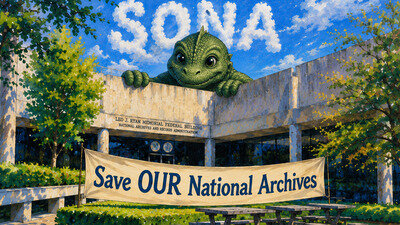

Stop the Closure of the National Archives in Chicago and San Francisco!
The Issue
SUMMARY
Keep History Alive! Save OUR National Archives regional facilities in Chicago and San Francisco!
These locations are in danger of having their historic, accessible materials sent to far-away, hard to access locations instead of being near the people who have the most interest.
The records in San Francisco and Chicago are not mundane federal government paperwork. They include historic court cases filed in federal courts on the West Coast and the Midwest, photographs and interviews with immigrants of many nationalities, and letters written by World War II homefront workers – all generated by the communities in Northern California, the Pacific region, and the Midwest. They belong near the descendants of the people documented in them. They are used by thousands of students to learn about history from primary sources.
The loss of access to these artifacts and community and genealogical history would be a terrible blow to historians, researchers, families, and students, and ultimately be detrimental to our communities and overall American History. Knowledgeable staff in Chicago and San Francisco must continue to help make these records come to life.
DETAILS
The National Archives regional facilities in Chicago and San Francisco are facing imminent closure. Sources say that records may be removed from these facilities as early as this September. This decision – without any public discussion - is a gross disservice to historians, researchers, students, genealogists, and the general public who rely heavily on access to these resources. Regional facilities of the National Archives serve as vital repositories for historical documents, providing invaluable insights into our nation's past and offering unique opportunities for education and research in the local communities that their archival holdings document. We cannot stand by as these crucial institutions are threatened with closure.
The Chicago, Illinois and San Francisco, California (located in San Bruno) regional facilities house federal records that have been deemed so valuable that they will be preserved forever and are irreplaceable and essential for local and national historical and genealogical research. They include millions of pages of records created by federal agencies and courts dating back more than a century. Examples include comprehensive case files for inmates at Alcatraz, Alien Case Files for 20th century immigrants including from the Chinese Exclusion period, Native American residential school and census records, maritime and navy records, World War II internment records for Italians and Germans, naturalization and court records, and countless other records of historical and genealogical interest.
Many of these items are best accessed in-person and cannot be easily digitized due to preservation and privacy concerns. Many items are fragile and would be damaged in any move. Closing these archives and permanently removing these records from California and Illinois would severely limit access to documents and records that are critical for understanding our history and shaping informed citizens.
Moreover, the closure is not just a local blow but a national issue. These regional archives are a part of our shared American heritage. Cutting access to these resources is akin to severing ties with our past. The closures would put irrefutable strain on the remaining regional archives being forced to accept and care for records from the closed facilities, overwhelming their capacity and reducing the quality of service due to increased demand from remote researchers. Many students learn how to do primary source research at NARA regional centers.
The mandate of the National Archives is to ensure that the American people have access to their records and history. Indeed, the 2026-2030 Strategic Plan Framework for the National Archives includes goals to “increase discoverability, availability and accessibility of records…” and to “foster meaningful community engagement…” Shuttering its regional archives violates the mission of the National Archives by restricting public access. The National Archives should increase its funding, not decrease it as its current budget proposes. Even that budget shows only negligible cost savings upon closure of these facilities. There would be added tremendous cost to move the collections of the closed facilities across the United States.
We urge the National Archives and Records Administration (NARA) and the federal government to stop the closure of the National Archives at San Francisco and the National Archives at Chicago. We demand a halt to facility closures without transparent public consultations, and an exploration of options that allow these archives to remain open and accessible.
Sign this petition to show your support for keeping our National Archives accessible and preserving our access to history! Your voice can make a difference in preserving these treasures for future generations. For more information and to learn how to help even more, visit saveournationalarchives.org.

112
The Issue
SUMMARY
Keep History Alive! Save OUR National Archives regional facilities in Chicago and San Francisco!
These locations are in danger of having their historic, accessible materials sent to far-away, hard to access locations instead of being near the people who have the most interest.
The records in San Francisco and Chicago are not mundane federal government paperwork. They include historic court cases filed in federal courts on the West Coast and the Midwest, photographs and interviews with immigrants of many nationalities, and letters written by World War II homefront workers – all generated by the communities in Northern California, the Pacific region, and the Midwest. They belong near the descendants of the people documented in them. They are used by thousands of students to learn about history from primary sources.
The loss of access to these artifacts and community and genealogical history would be a terrible blow to historians, researchers, families, and students, and ultimately be detrimental to our communities and overall American History. Knowledgeable staff in Chicago and San Francisco must continue to help make these records come to life.
DETAILS
The National Archives regional facilities in Chicago and San Francisco are facing imminent closure. Sources say that records may be removed from these facilities as early as this September. This decision – without any public discussion - is a gross disservice to historians, researchers, students, genealogists, and the general public who rely heavily on access to these resources. Regional facilities of the National Archives serve as vital repositories for historical documents, providing invaluable insights into our nation's past and offering unique opportunities for education and research in the local communities that their archival holdings document. We cannot stand by as these crucial institutions are threatened with closure.
The Chicago, Illinois and San Francisco, California (located in San Bruno) regional facilities house federal records that have been deemed so valuable that they will be preserved forever and are irreplaceable and essential for local and national historical and genealogical research. They include millions of pages of records created by federal agencies and courts dating back more than a century. Examples include comprehensive case files for inmates at Alcatraz, Alien Case Files for 20th century immigrants including from the Chinese Exclusion period, Native American residential school and census records, maritime and navy records, World War II internment records for Italians and Germans, naturalization and court records, and countless other records of historical and genealogical interest.
Many of these items are best accessed in-person and cannot be easily digitized due to preservation and privacy concerns. Many items are fragile and would be damaged in any move. Closing these archives and permanently removing these records from California and Illinois would severely limit access to documents and records that are critical for understanding our history and shaping informed citizens.
Moreover, the closure is not just a local blow but a national issue. These regional archives are a part of our shared American heritage. Cutting access to these resources is akin to severing ties with our past. The closures would put irrefutable strain on the remaining regional archives being forced to accept and care for records from the closed facilities, overwhelming their capacity and reducing the quality of service due to increased demand from remote researchers. Many students learn how to do primary source research at NARA regional centers.
The mandate of the National Archives is to ensure that the American people have access to their records and history. Indeed, the 2026-2030 Strategic Plan Framework for the National Archives includes goals to “increase discoverability, availability and accessibility of records…” and to “foster meaningful community engagement…” Shuttering its regional archives violates the mission of the National Archives by restricting public access. The National Archives should increase its funding, not decrease it as its current budget proposes. Even that budget shows only negligible cost savings upon closure of these facilities. There would be added tremendous cost to move the collections of the closed facilities across the United States.
We urge the National Archives and Records Administration (NARA) and the federal government to stop the closure of the National Archives at San Francisco and the National Archives at Chicago. We demand a halt to facility closures without transparent public consultations, and an exploration of options that allow these archives to remain open and accessible.
Sign this petition to show your support for keeping our National Archives accessible and preserving our access to history! Your voice can make a difference in preserving these treasures for future generations. For more information and to learn how to help even more, visit saveournationalarchives.org.
The Decision Makers

Supporter Voices
Petition Updates
Share this petition
Petition created on July 11, 2026