Final Update: Did this Petition Make a Difference?

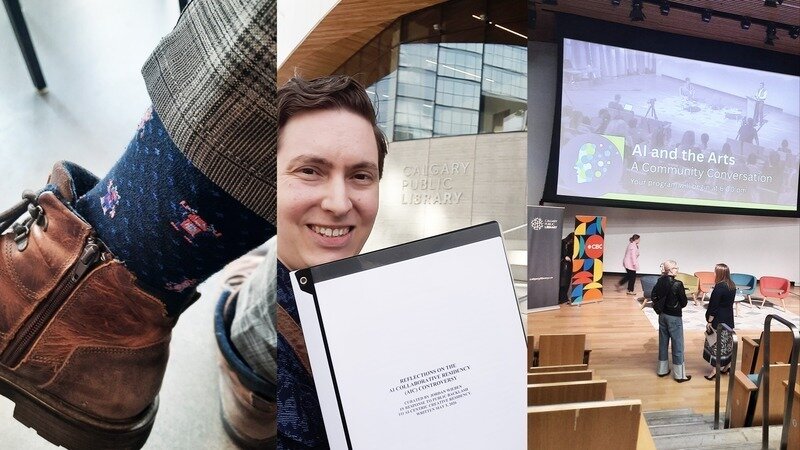
(in the image, my ironic robot socks, delivering a research document to the programming team, and the public forum about AI in the Arts)
The AI Collaborative Artist Residency at the Calgary Central Library is going ahead.
The artist representing this program is hired.
While it is dispiriting that in the face of overwhelming resistance, the Calgary Library is committed to offering this residency, before closing this petition I want to describe the events that lead to this decision and explain why I believe your voices made a difference.
I need to express my enduring gratitude for your support and the community that coalesced around protecting the most sacred aspects of being human from technological 'progress' - community, creativity, and connection. Your desire for change and trust in this petition provided a platform for myself and several other local artists to meet directly with Library leadership; this became an issue wherein I recognized that my role as a former Artist-in-Residence and as an artist who extensively researches AI-driven social harms positioned me as someone who could advocate against the adoption of AI in library spaces, and this petition was essential to help me leverage that positional authority.
More than anything I am thankful for all of your comments and messages over the last two months - I read every single one, and they became the core of my message to library staff as I curated everything into clear action items for their team. In my research, I now believe one of the most insidious effects of AI tools is the erasure of collaboration - collaboration is friction, it is difficult, but it is, above all, transformative. Through this process I was confronted by the discomfort of having civil disagreements with people I ostensibly agree with. This experience became a chance to test my own beliefs about it, to feel what arguments ring true, and to recognize the places where my convictions faltered. Charles Taylor writes in The Language Animal that “we are continuously responsive to rightness, and that is why we always recognize the relevance of a challenge that we have misspoken.”
Over the course of writing around 30,000 words - submitted to the Library as an amalgam of e-mails, essays, and formal letters to the Board - I grappled with getting to the truth of why AI should be resisted and, honestly, I conclude this process less certain than when I began... Not to say that I now believe that AI is ethical or inevitable - there is too much evidence of AI as antithetical to human wellness to be willing to submit to its unchecked deployment by tech companies. I want to invite you to hold space for complexity as I share the experience of hosting a dialogue with the Librarians and staff who are genuinely searching for a positive future, even as they lean into a technology that is causing immeasurable damage. Rather than end this petition holding onto the bitterness that resistance affected no apparent change, my hope is that we can recognize in this Residency a philosophy guided by a desire to have ethical values inform an unethical technology, and that we can respect the courage to explore the intersection of optimism and despair when it would be easier to for the Library to ignore AI altogether.
Does that mean this petition was a failure?
It has taken a long time to gather my thoughts on that point. I threw everything I had at getting this Residency paused or cancelled:
- I applied to the AI Collaborative Residency (AIC). My "portfolio" was the signatory list and comments exported from this petition and a "cover letter" describing the harms of adopting AI in the creative process and how the Calgary Public Library (CPL) could examine AI without requiring its use. The goal was to confront the hiring committee with the ethics of publicly promoting AI adoption.
- That same "cover letter" was also submitted directly to the CPL Board, including the attached signatures, comments, etc.
- Millicent Mabi, the Director of Programming and Partnerships at the CPL, invited me to meet in-person at the Central Library.
- For some reason, I was not selected for the AIC Residency :(
- On May 7, I met with two representatives of the program team. Unfortunately, Millicent was out sick that day, but I delivered a 30 page research document I compiled describing why Artificial Intelligence operates in violation to the Library's own ethics code.
- I sent a follow up letter to the Board, including the same research document, thanking them for the opportunity for dialogue and highlighting the remaining areas of concern I had about the handling of AI programming.
- A couple days later, I attended the public conference on AI in the Arts, hosted by the CPL. It was a surprise, to say the least. Half the guests were firmly against using AI at all, and only one of the four fully endorsed it.
I'm exhausted, proud, ashamed, hopeful, angry... I feel like I wasted my time, and I said so in my meeting with the programming representatives, saying that I don't know how else to explain how BAD this technology is. If the social, ethical, moral, and environmental harms are not enough to dissuade promoting this tech, I don't know what to tell you. I left that meeting feeling so discouraged that not a single person I spoke to could articulate what they hope the benefit of using AI would be. Like the ethical risks, CPL seemed happy to leave it to the resident artist to retroactively justify this program. Or not. They expressed willingness to accept that maybe this residency won't do anything. I don't want AI, after all the research I've seen I believe it is eroding the essence of being human, and, at the core of the whole debate, there is no reason to trust that the people promoting and developing AI are prioritizing anything but profit.
What gives me hope now is knowing how much this dialogue changed me, I can feel that having these debates and sifting through data for nuggets of truth has affected transformation and I trust that my shifted position was met with an equal transformation on the part of those who I engaged with. The writing I provided was meant to curate data points and facts, but it was also important to communicate the emotional impact of having AI inflicted upon the arts communities - to confront decision-makers with the hopelessness, anger, depression, and betrayal felt by artists when they see a trusted institute seemingly promote the tool of their erasure. In my meetings I witnessed regret about how this Residency was marketed and the underwhelming response to criticism; there is a recognition that simply facilitating space for AI programming is not an adequate response, and there needs to be stronger moral guidance from the CPL team. By the time it was clear that there is no stopping this Residency, it was also clear that the staff involved in its programming are intimately aware that it was a mistake. The wrong approach at the wrong moment. While this petition did not transform outcomes, I believe it transformed hearts - if only because I know how much this fights changed mine.
If speaking leads to truth, the one truth I have no answer for is this: how do we ensure AI technology is ethical if the people who care won't engage in its development?
My fear now is that the severity of the backlash to AI programming will make the CPL timid about communicating intent around AI programming more; I know they have more programs in the work, driven by public confusion about what AI is and how it will effect the future. Yes, AI is here. If there were any group of people I wish were the leaders of its development, it would be Librarians. But, having the vanguard of your public discourse about AI be a Paid. "Creative." Collaborative. Artistic. Residency. That was a big mistake.
Mostly at this stage, I am baffled by the distance between intent and execution, and I'm worried that their fear of backlash will prevent them from correcting that online. I think they now recognize how the framing of this residency was poorly handled - it is important to me, having met with CPL staff and seen the discourse at the public event, that I end this petition by extending grace as they navigate what are, yes, vital investigations of AI and, yes, deeply controversial technologies. Unlike the for-profit companies doubling down on displacing artists (looking at you, Calgary Farmer's Market!), the CPL is continuing to be a platform for emerging artists - one that I will be forever grateful for - and I really wish they were better at presenting their positive vision for these programs instead of feigning being neutral platforms for its promotion.
(I did receive a lot of push back on the assertion that CPL was "promoting" AI, to which I argued that the framing of this residency makes it look like a hearty endorsement from a public institution, which effectively legitimizes it).
The good news: while programs like the author and historian-in-residence are annual, recurring opportunities, this AI Residency is part of their 'flexible' programming slot designed to respond to prescient issues. Based on feedback at the conference, it sounds like it is unlikely to be AI-related next year. The backlash was too strong.
One of the speakers at the conference, Lucky Leggott (Calgary-based illustrator/animator), was involved in selecting the AIC Resident artist. They are firmly against incorporating AI into their process and, after hearing them speak about the selection process, I know that ethical engagement with AI technology was an essential part of selecting whoever represents this program. They haven't revealed who was selected, but I would expect to see someone inhabiting the boundary between arts and AI rather than shamelessly endorsing it, i.e. using fashion to disrupt AI surveillance technology.
If you are interested in reading the document I submitted to CPL, here it is, including two pages of MLA citations!
Research Document Describing AI Harms in Creative and Library Settings
Finally: A letter from the Board
"Hi Jordan,
Thank you so much for your follow-up email. I am pleased to hear that you had an opportunity for further discussion with Lisa and Sofia and that you found it to be a respectful and productive conversation. I spoke with both Lisa and Sofia last week and they also iterated that they appreciated the opportunity to meet you and to further discuss your concerns and programming at the Library.
I appreciate the time and attention that you have given to this topic on behalf of yourself and the artist community. These are really important conversations as we collectively continue to learn and consider the impacts that AI has for society and how we engage with it. I understand that you were also able to attend the AI and the Arts event on May 11 at the Library. I know the speakers left me with many wonderful insights to reflect on and I hope that you found it to be a valuable experience as well.
I know that you left hard copies of the attached document with both Lisa and Sofia and I will make sure to share the electronic copy with other members of our team as appropriate. I can assure you that we will review and consider this additional feedback as we think about current and future programming at the Library.
The Library will be proceeding with the Creative in Residence, AIC Artist program. The opportunities we have had to engage with individuals like yourself, as well as arts groups in the city, have enabled us to strengthen our approach to selection and development of the residency to reinforce the intent in which it was offered and to address the really good questions that have come up along the way. We are hopeful that this residency will continue to support the Arts community in asking important questions about the impacts of AI and support thoughtful exploration of how artists are grappling with it.
Thank you, again, for the time you have taken to dig into this topic and to share your (and community) feedback on this topic. It is our hope that we will continue to have opportunities for further learning and dialogue on AI, including impacts on the arts, in the future."
Thanks again for all of your support and community throughout this process! Cherish the complexity of being human, and keep resisting 'tools' that automate away the friction of existing.