

Stop mandatory medication for mental illness
Stop mandatory medication for mental illness
The Issue
"Psychosis is believed to be caused, at least in part, by overactivity of a brain chemical called dopamine, and antipsychotics are thought to work by blocking this dopamine effect."
Antipsychotics block dopamine & seratonin. This can have the side effect of inducing depression. The depression induced by antipsychotics can cause an increase in mental health symptoms such as suicidality, and the person may be much worse on the medications than off.
Still, there are many rules in Canada in place that can force a person to take antipsychotic medications, even against their will.
In Ontario, if a person refuses medication and is hospitalized for more than 30 days, then they can lose the right to choose whether they are on medication or not. A "Substitute Decision Maker" is appointed (which can be a family member or a doctor), and that person decides whether the person is on medication or not.
In hospital, behind closed doors, doctors will use physical force, security guards and nurses to physically hold down and restrain a patient to inject patients with a medicine they don't want to take, unless they comply & take the medication willingly. And this is all legal.
Outside of hospital, a "Community Treatment Order" can be issued for individuals who doctors believe should be medicated. If the patient leaves medication while the CTO is issued, the patient is immediately hospitalized and forced on medication again.
The mental health system attempts to shackle patients to the drugs, even if the patient feels they are worse with the medication than without it.
Mandatory medications have many stakeholders, and I firmly believe patient's best interest is not primary in making that decision.
Pharmaceutical companies also have a large interest in mandatory medication. In Ontario, the provincial government covers 100% of patients on ODSP program. An Invega prescription (which is a popular medication) costs $600+/month/patient. Patients on forced psychiatric medication who have no way to pay for them creates a very large funnel from the Ontario government, directly into pharmaceutical company's pockets
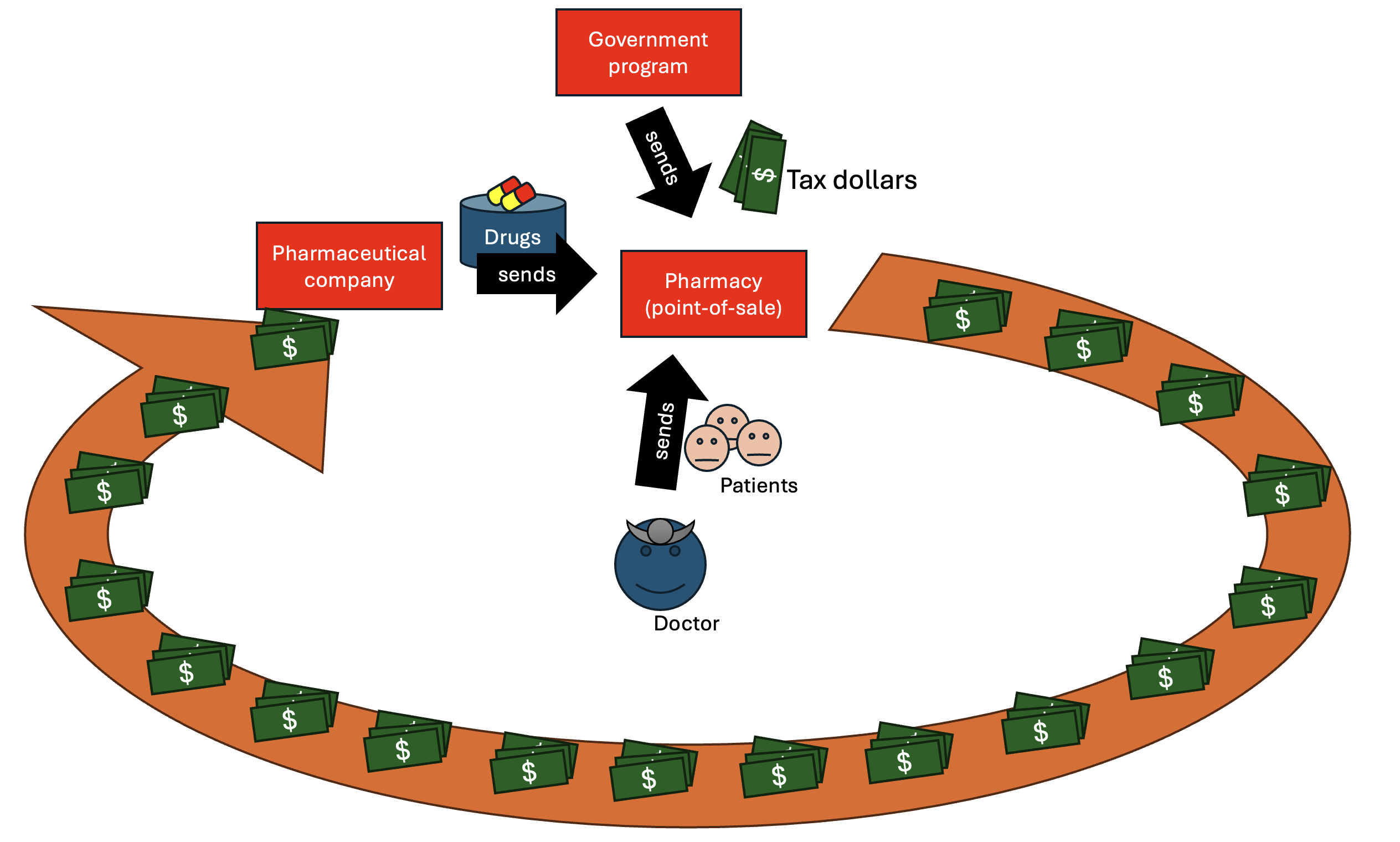
Effectively, pharmaceutical companies are exploiting the citizenship of people diagnosed with a mental illness who cannot afford them and don't want to take them. Patients chained to expensive psychiatric "medications" (that one doctor actually told me are roughly equivalent to "horse tranquilizers") frequently cannot do anything with their lives due to the chronic depression induced by the medications. These now idle and disabled citizens are being milked by the pharmaceutical industry as they are pumped full of these disabling medications that are paid for by their government. Pharmaceutical companies and doctors have been dishonest in saying that they believe that keeping patients on expensive psychiatric drugs long term is actually good for them.
Doctors will admit that there is no biological proof that antipsychotics actually have a mechanism of action that can prevent psychosis at all. Doctors cannot measure a patients' blood and find psychosis in it. Doctors cannot give a medication to a patient and find via lab measurements that the psychosis has been cured.
The only way that a doctor can make observations about a patients' apparent psychosis, is by behavioural observations, or by admission of symptom by patient.
Behavioural observations are hugely subjective. And patients can lie about absence of symptoms.
Are patients denying symptoms only to escape medication regimens? Is the only reason antipsychotics "work" is not because they biologically cure psychosis, but actually because patients consistently learn to lie to their doctors about not having symptoms, to escape the depressing effects of antipsychotic medication?
Do antipsychotic medications actually work? Or do they just teach people to lie? With a heavy-handed and forcible medical system, studies about antipsychotic medications are inherently flawed. Detection of psychotic symptoms relies heavily on honest disclosure of experience by the patient. If the patient is in fear of whom they are reporting to, they may very well lie about absence of symptom, to escape the punishment, pain, expense, and humiliation of forced medication.
The availability of forcible treatment severely erodes trust in the mental healthcare system and prevents honest disclosure of symptoms.
In my study of this subject, I have come to the conclusion that the suggestion that patients must remain permanently chained to antipsychotic medications, even when they report they are in remission, is given in bad faith.
Public Safety
While it is important to keep the people of the country safe from people breaking the law due to mental illness, it is a violation a person's rights, even if they are mentally ill, to force them to take medication that they do not want to take, that has a huge list of very negative possible side effects.
A Form 1 allows a doctor to hold a patient in hospital if they are believed to be a threat to the safety of themselves, the safety of others, or if they are demonstrating a lack of ability to care for themselves.
This petition is not disputing involuntary hospitalization or confinement of individuals with dangerous behaviour or who are unable to take care of themselves.
Instead it is about the fundamental right each person should always have to decide what goes inside their body.
On March 17 2024, MAID for solely mentally ill people was set to become available
That date was postponed until March 17 2027
MAID laws now are trying to grant mentally ill individuals (they say "advanced cases") the right to choose to die. However, many of these MAID cases may be assisted death/suicide due to depression because of medication they are forced to be on.
It just doesn't make sense that the federal government is prepared to allow solely mentally ill people the right to choose to die, while they still don't have the right to decide what goes in their bodies yet. Maybe being let off the medication would be all that is needed for the person to live a happy and healthy life.
Alternative treatment programs to medication (CBT, psychologists) are very helpful to people with mental illness. Yet the province of Ontario has an extremely small budget for psychologists, with patients being put on backlog to see one. But they can have high doses of antipsychotic medication at any time.
Dying With Dignity Canada goes as far as to say not allowing MAID for solely mentally ill is "stigmatizing, discriminatory and unconstitutional", but what about the right of mentally ill people to choose to be on medication or not?
Even pop music has addressed this concern, in the rock band Kary's song Better, with sarcastic praise of the drugs he is being put on:
Tell me that I'm happy
I'm lucky that I'm happy
That the drugs are working
That I'm alright
The artist then goes on to doubt the usefulness of the pills
These pills aren't.. right
People with mental illness are often intelligent, sensitive, law-abiding, and capable of taking care of themselves. When people meet these criteria, there should be no reason to force them onto mandatory medication regimens.
In the past, people had sections of their brain removed without consent. JFK's daughter had a lobotomy with Joseph Kennedy's consent (not her own). The operation left her significantly disabled.
Science advanced and doctors no longer recommend lobotomies for mental illness. Now it is only medication that is forced on people, and some people still find these medications disabling. Who knows what tomorrow's science will say?
Nobody can truly understand how a person feels as well as they do themselves. It is incredibly frustrating to be told my doctors that you "need" a treatment that you do not believe you do. To be forced to spend hundreds of dollars on a medicine that has a long list of possible side effects, on their orders to do so, under threat of detention in a psychiatric facility and the shame of physically forced medication if you do not comply.
In a society where merely huffing on someone can earn prison time, the treatment of the mentally ill is not up to par with the treatment that others experience. Doctors' treatment of mental health patients can border on downright criminal, with physically forcing someone to be strapped to a bed over trivial disputes in hospital (arguments with hospital staff can lead to bed-strap down (not even in prison do they use strap downs, they usually only throw a person into their cell)), humiliating forced injections by nurses and security staff that may do more harm than good.
Persons with mental illness are not necessarily incapable of making decisions that benefit themselves. Persons with mental illness should not be considered incapable of deciding whether they want to take treatment for their mental illness or not.
The forcing of medication & removal of decision making power with regards to the ability to choose to be medicated or not increases the stigma of mental illness, and may cause people who have symptoms to avoid diagnosis and seeking the help they need.
ChatGPT followup
ChatGPT gives deep knowledge of nearly any subject. Asking ChatGPT corroborates our findings above:
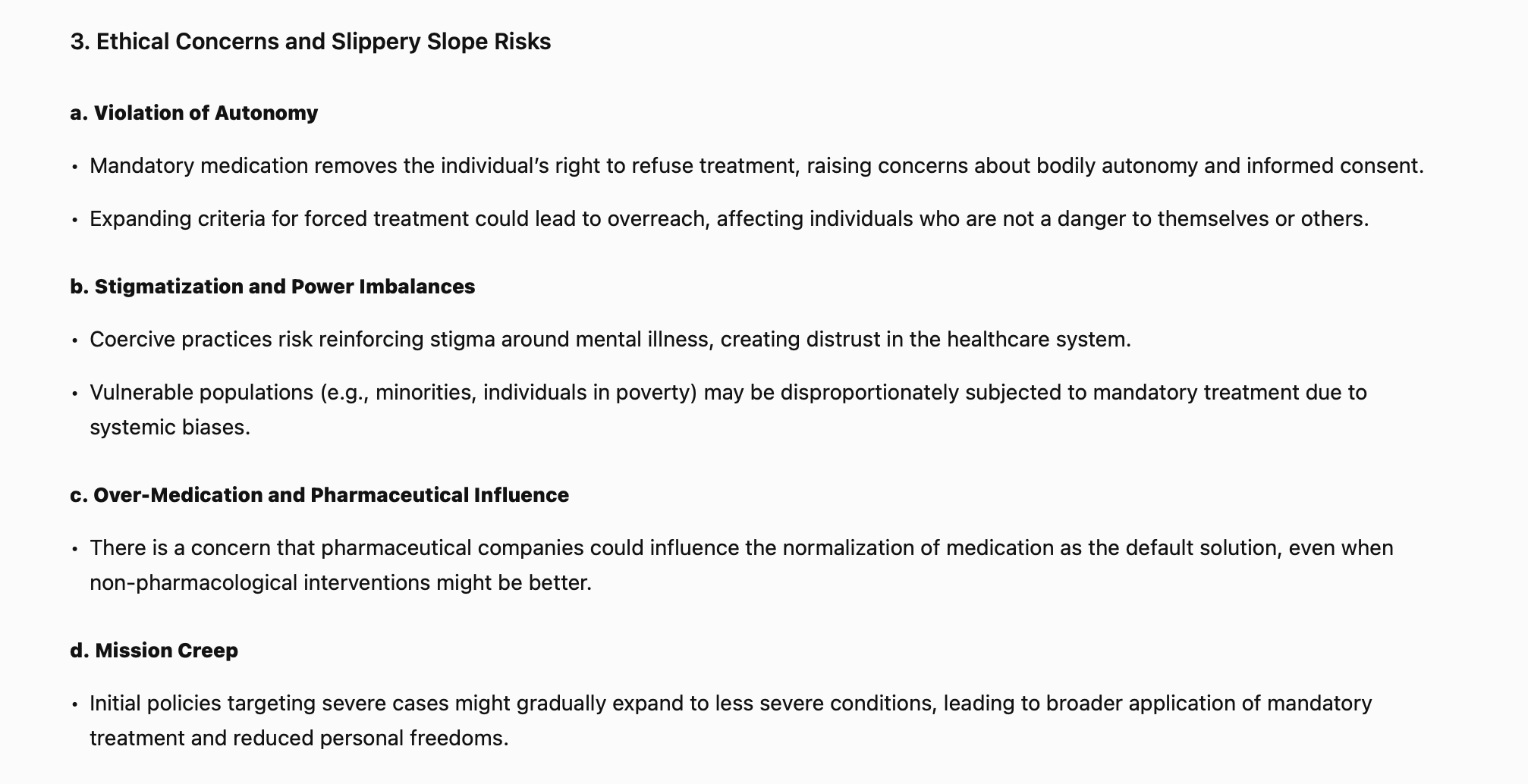
For example, if you ask ChatGPT "Is mandatory psychiatric medication a slippery slope?"
Part of ChatGPT's response is here:

1,195
The Issue
"Psychosis is believed to be caused, at least in part, by overactivity of a brain chemical called dopamine, and antipsychotics are thought to work by blocking this dopamine effect."
Antipsychotics block dopamine & seratonin. This can have the side effect of inducing depression. The depression induced by antipsychotics can cause an increase in mental health symptoms such as suicidality, and the person may be much worse on the medications than off.
Still, there are many rules in Canada in place that can force a person to take antipsychotic medications, even against their will.
In Ontario, if a person refuses medication and is hospitalized for more than 30 days, then they can lose the right to choose whether they are on medication or not. A "Substitute Decision Maker" is appointed (which can be a family member or a doctor), and that person decides whether the person is on medication or not.
In hospital, behind closed doors, doctors will use physical force, security guards and nurses to physically hold down and restrain a patient to inject patients with a medicine they don't want to take, unless they comply & take the medication willingly. And this is all legal.
Outside of hospital, a "Community Treatment Order" can be issued for individuals who doctors believe should be medicated. If the patient leaves medication while the CTO is issued, the patient is immediately hospitalized and forced on medication again.
The mental health system attempts to shackle patients to the drugs, even if the patient feels they are worse with the medication than without it.
Mandatory medications have many stakeholders, and I firmly believe patient's best interest is not primary in making that decision.
Pharmaceutical companies also have a large interest in mandatory medication. In Ontario, the provincial government covers 100% of patients on ODSP program. An Invega prescription (which is a popular medication) costs $600+/month/patient. Patients on forced psychiatric medication who have no way to pay for them creates a very large funnel from the Ontario government, directly into pharmaceutical company's pockets
Effectively, pharmaceutical companies are exploiting the citizenship of people diagnosed with a mental illness who cannot afford them and don't want to take them. Patients chained to expensive psychiatric "medications" (that one doctor actually told me are roughly equivalent to "horse tranquilizers") frequently cannot do anything with their lives due to the chronic depression induced by the medications. These now idle and disabled citizens are being milked by the pharmaceutical industry as they are pumped full of these disabling medications that are paid for by their government. Pharmaceutical companies and doctors have been dishonest in saying that they believe that keeping patients on expensive psychiatric drugs long term is actually good for them.
Doctors will admit that there is no biological proof that antipsychotics actually have a mechanism of action that can prevent psychosis at all. Doctors cannot measure a patients' blood and find psychosis in it. Doctors cannot give a medication to a patient and find via lab measurements that the psychosis has been cured.
The only way that a doctor can make observations about a patients' apparent psychosis, is by behavioural observations, or by admission of symptom by patient.
Behavioural observations are hugely subjective. And patients can lie about absence of symptoms.
Are patients denying symptoms only to escape medication regimens? Is the only reason antipsychotics "work" is not because they biologically cure psychosis, but actually because patients consistently learn to lie to their doctors about not having symptoms, to escape the depressing effects of antipsychotic medication?
Do antipsychotic medications actually work? Or do they just teach people to lie? With a heavy-handed and forcible medical system, studies about antipsychotic medications are inherently flawed. Detection of psychotic symptoms relies heavily on honest disclosure of experience by the patient. If the patient is in fear of whom they are reporting to, they may very well lie about absence of symptom, to escape the punishment, pain, expense, and humiliation of forced medication.
The availability of forcible treatment severely erodes trust in the mental healthcare system and prevents honest disclosure of symptoms.
In my study of this subject, I have come to the conclusion that the suggestion that patients must remain permanently chained to antipsychotic medications, even when they report they are in remission, is given in bad faith.
Public Safety
While it is important to keep the people of the country safe from people breaking the law due to mental illness, it is a violation a person's rights, even if they are mentally ill, to force them to take medication that they do not want to take, that has a huge list of very negative possible side effects.
A Form 1 allows a doctor to hold a patient in hospital if they are believed to be a threat to the safety of themselves, the safety of others, or if they are demonstrating a lack of ability to care for themselves.
This petition is not disputing involuntary hospitalization or confinement of individuals with dangerous behaviour or who are unable to take care of themselves.
Instead it is about the fundamental right each person should always have to decide what goes inside their body.
On March 17 2024, MAID for solely mentally ill people was set to become available
That date was postponed until March 17 2027
MAID laws now are trying to grant mentally ill individuals (they say "advanced cases") the right to choose to die. However, many of these MAID cases may be assisted death/suicide due to depression because of medication they are forced to be on.
It just doesn't make sense that the federal government is prepared to allow solely mentally ill people the right to choose to die, while they still don't have the right to decide what goes in their bodies yet. Maybe being let off the medication would be all that is needed for the person to live a happy and healthy life.
Alternative treatment programs to medication (CBT, psychologists) are very helpful to people with mental illness. Yet the province of Ontario has an extremely small budget for psychologists, with patients being put on backlog to see one. But they can have high doses of antipsychotic medication at any time.
Dying With Dignity Canada goes as far as to say not allowing MAID for solely mentally ill is "stigmatizing, discriminatory and unconstitutional", but what about the right of mentally ill people to choose to be on medication or not?
Even pop music has addressed this concern, in the rock band Kary's song Better, with sarcastic praise of the drugs he is being put on:
Tell me that I'm happy
I'm lucky that I'm happy
That the drugs are working
That I'm alright
The artist then goes on to doubt the usefulness of the pills
These pills aren't.. right
People with mental illness are often intelligent, sensitive, law-abiding, and capable of taking care of themselves. When people meet these criteria, there should be no reason to force them onto mandatory medication regimens.
In the past, people had sections of their brain removed without consent. JFK's daughter had a lobotomy with Joseph Kennedy's consent (not her own). The operation left her significantly disabled.
Science advanced and doctors no longer recommend lobotomies for mental illness. Now it is only medication that is forced on people, and some people still find these medications disabling. Who knows what tomorrow's science will say?
Nobody can truly understand how a person feels as well as they do themselves. It is incredibly frustrating to be told my doctors that you "need" a treatment that you do not believe you do. To be forced to spend hundreds of dollars on a medicine that has a long list of possible side effects, on their orders to do so, under threat of detention in a psychiatric facility and the shame of physically forced medication if you do not comply.
In a society where merely huffing on someone can earn prison time, the treatment of the mentally ill is not up to par with the treatment that others experience. Doctors' treatment of mental health patients can border on downright criminal, with physically forcing someone to be strapped to a bed over trivial disputes in hospital (arguments with hospital staff can lead to bed-strap down (not even in prison do they use strap downs, they usually only throw a person into their cell)), humiliating forced injections by nurses and security staff that may do more harm than good.
Persons with mental illness are not necessarily incapable of making decisions that benefit themselves. Persons with mental illness should not be considered incapable of deciding whether they want to take treatment for their mental illness or not.
The forcing of medication & removal of decision making power with regards to the ability to choose to be medicated or not increases the stigma of mental illness, and may cause people who have symptoms to avoid diagnosis and seeking the help they need.
ChatGPT followup
ChatGPT gives deep knowledge of nearly any subject. Asking ChatGPT corroborates our findings above:
For example, if you ask ChatGPT "Is mandatory psychiatric medication a slippery slope?"
Part of ChatGPT's response is here:
1,195
The Decision Makers

Supporter Voices
Petition Updates
Share this petition
Petition created on December 23, 2022