Stop Developer-Led Abuse: From Highgate to the Fens

Stop Developer-Led Abuse: From Highgate to the Fens
The Issue
Stop Developer-Led Abuse and Restore Public Trust in Planning
This campaign started in Highgate. It now spans Norfolk. It reveals a national failure in planning, regulation, and environmental protection
This campaign exposes systemic failures and
Environmental harm at linked sites:
• Highgate (Haringey)
• Tamar Nurseries, (Norfolk)
· Whitewebbs Park
· Sheffield
· Plymouth City Council
Throughout my life, I have cherished the intricate web of life that sustains us all. Our well-being — and the future of our communities — is unmistakably intertwined with the health of our natural environments.
Biodiversity, ecology, and wild spaces deserve our care — not our exploitation. We must prioritise regeneration and protection over the heedless pursuit of profit. That’s why I began this campaign: to defend the cherished trees and green spaces of the Highgate Conservation Area from overdevelopment.
This is not about opposing development—it’s about protecting the integrity, ecology, and accountability of our national planning system.
But what began as a local call for protection has now revealed a national pattern of loss, omission, and failure.
🌿 Protect Nature. Stop Developer Abuse. Restore Public Trust. This campaign began with the loss of a single tree — but it speaks to a much deeper crisis. Across the country, from Highgate to rural Norfolk, developers are destroying protected land, felling trees without permission, and bypassing planning laws. Rewilded areas and green spaces are being lost while councils and regulators look the other way.
- We’re calling for: Real accountability for illegal development
- Stronger protection for nature and rewilded land
- National reform to restore trust in planning and enforcement
- This isn’t just about one place — it’s about fairness, biodiversity, and the future of our communities.
Please sign and share. Let’s stand together for nature, for justice, and for the land we all depend on.
Degrade it. Reclassify it. Develop it. That’s the playbook
From urban green lungs like Shepherds Close to rewilded floodplains in Norfolk, we witness the systematic unravelling of local environmental protection. Drainage boards dominated by landowners, retrospective planning abuses, biodiversity laws ignored, and regulators deferring responsibility are how nature is lost, quietly and legally.
Whitewebbs Park is just one of many green spaces now under threat.
A 500-year-old oak tree, ancient woodlands, and vital habitats are being quietly destroyed while those in power look the other way.
From Highgate to Norfolk to Whitewebbs, this campaign stands for every place being lost to unchecked developer abuse.
We are not just fighting for land — we are fighting for life itself.
Please stand with us to protect what cannot be replaced.
What’s happening in Highgate and Norfolk is happening everywhere.
Across the UK, people are watching their green spaces disappear as developers exploit loopholes, override protections, and silence communities.
This isn’t mismanagement — it’s a systemic failure.
Planning laws are being bypassed. Oversight is collapsing. And people are telling the same story in town, field after field.
One felled tree. Zero accountability. Sign the petition to stop the abuse of our green spaces.
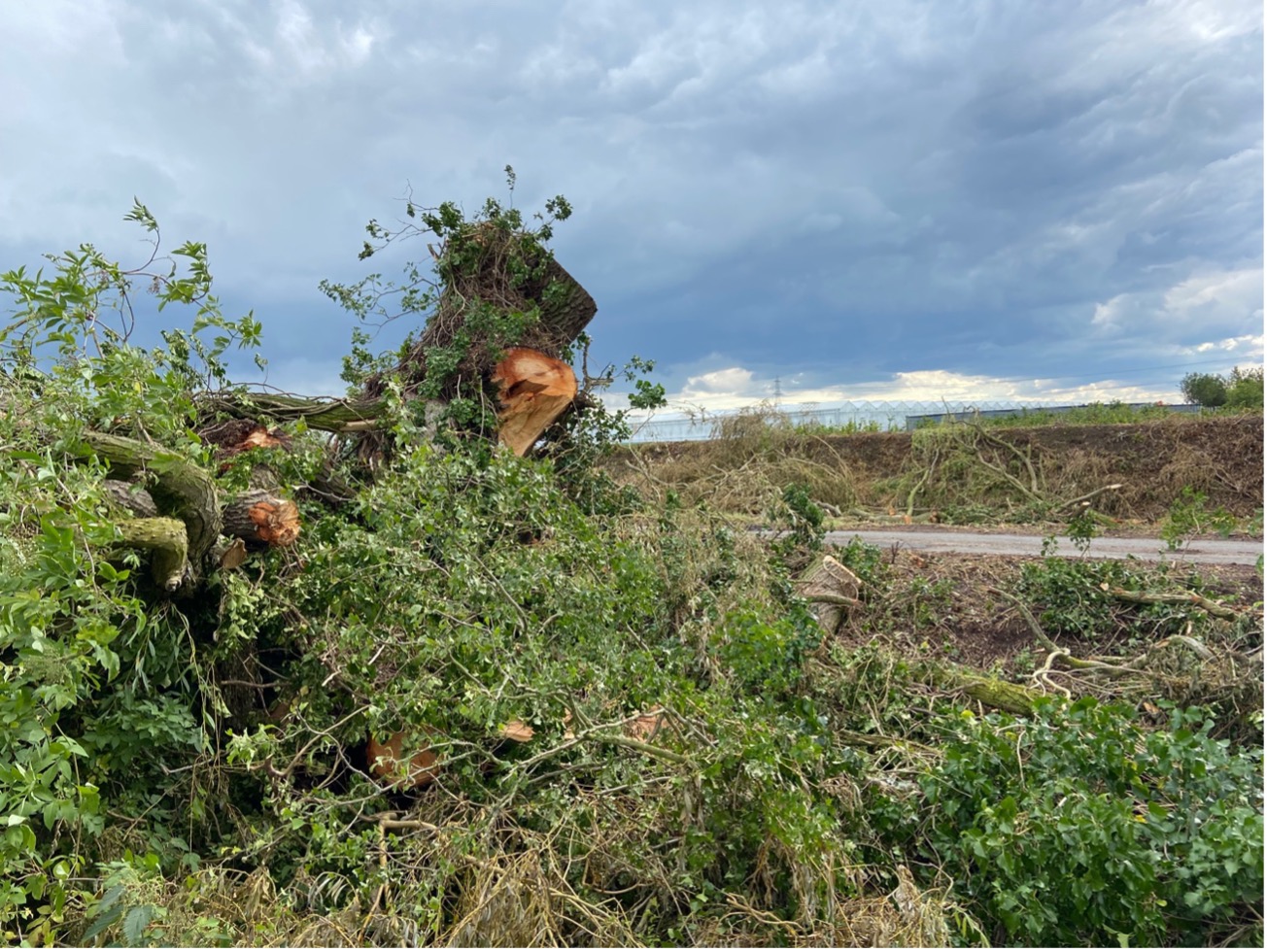
You can’t build a house “with the forest” if you cut the forest down first.
Shepherds Close: A Green Corridor Under Siege
For over four decades, Shepherds Close N6 has faced relentless pressure from speculative developers. Each application chips away at a cherished green corridor — a vital ecological buffer and community refuge in the heart of Highgate.
Despite repeated community-led rejections, developers persist — submitting near-identical proposals, exploiting loopholes, and draining public resources. But it’s not just the paperwork that’s repeating. On the ground, the site has been strategically degraded:
- Trees felled
- Vegetation cleared
- Wildlife displaced
This is a well-worn tactic: degrade the land, discredit its value, then redevelop. What was once a thriving green oasis is now being reframed as “infill” — an attempt to justify its reclassification as brownfield.
The strategy is simple: degrade it, rebrand it, then build on it.
Haringey Council must not only reject the current proposal but prevent this pattern of ecological erasure from becoming precedent.
This Is Not Brownfield — It’s Essential Garden Land
This is essential garden land — not vacant or derelict space. It forms part of the Highgate Conservation Area, providing a crucial link in the ecological network between homes, hedgerows, and neighbouring green spaces.
Developers may try to downplay it, but under planning policy, garden land is not brownfield. The land remains ecologically active, historically valued, and community-defended.
A Green Asset Under Siege
The community is now working to designate this land as a Local Green Space — a recognition of what it truly is: a shared, living space with value far beyond its development potential.
We call on Haringey Council to:
- Recognise this land’s environmental and community value
- Support its Local Green Space designation
- Prevent it from being reclassified or built over
We also call for a local byelaw to:
- Permanently protect the site as part of Highgate’s ecological network
- Stop the cycle of repeated speculative applications
- Preserve its role as a wildlife corridor, green buffer, and climate asset
Other councils have used byelaws to protect village greens, ancient hedgerows, and nature reserves.
It’s time for Haringey to do the same.This land isn’t “leftover” — it’s living. And the law should reflect that.
In another open case in Highgate, a protected tree subject to an enforcement notice was lost without accountability. The tree, located on land owned by the Wellcome Trust, collapsed and damaged neighbouring property. No investigation or enforcement action was taken despite its protected status, prior enforcement history, and institutional ownership. The Council dismissed the incident as a civil matter, and the injured parties were left without apology, reparation, or public explanation
What We're Asking from the Wellcome Trust One of the trees lost in this campaign — a mature, protected tree at the edge of several green garden spaces in Highgate — stood on land owned by the Wellcome Trust.
We are calling on the Wellcome Trust to take responsibility for the loss of a protected tree that stood on their land in Highgate. The tree was subject to an enforcement notice, fell without intervention, and damaged neighbouring properties. Despite its significance and history, no action was taken to prevent the loss — and no explanation has ever been offered.
We are asking the Wellcome Trust to:
- Acknowledge the loss and their failure to manage the tree responsibly
- Apologise to the neighbours affected by the damage and inaction
- Explain why no action was taken despite the enforcement notice and clear grounds for follow-up
- Commit to protecting nature and upholding environmental safeguards on their land moving forward
As a major institution with a public mission rooted in science, ethics, and global health, the Wellcome Trust should be setting an example — not avoiding scrutiny. Institutions must be held to the same standards as private developers.
Silence cannot be the final word. Attempts to seek dialogue with the Wellcome Trust have been met with a wall of silence. Who can we trust if we can’t trust those who claim to protect science, health, and the future?
It wasn’t just that the tree fell — it was allowed to fall.
Planning Has Become a Tool for Developers — Not Communities
Residents have fought every application. But they are now exhausted, sidelined, and ignored. The planning system, as it stands, rewards persistence from developers — and attrition from the public.
What was once a green refuge is being strategically stripped, rebranded as opportunity, and placed in the crosshairs of speculative development.
The House of the Lost Forest
The latest proposal has been branded a “self-build family home” — but this is a speculative land grab wrapped in soft language. The strategy is familiar: cut down the trees, degrade the land, rebrand it as underused, and build.
They’ve named it “The House of the Lost Forest” — a title that unintentionally tells the truth.
First the trees fall. Then the applications arrive.
What was once a green corridor is reframed as “infill” — and built over.
You don’t honour a forest by destroying it.
This isn’t self-build — it’s self-serving.
And the community sees through it.
Planning Inspectorate Most Recent Planning Application London N6
The National Mirror – Tamar Nurseries, Norfolk
In rural Norfolk, the pattern repeats — but in a floodplain.
A mature willow tree was unlawfully felled during nesting season and omitted from all planning documents. The individuals involved began removing the entire tree but were interrupted midway — leaving it partially felled.
To this day, no one has come forward to explain who authorised the action, issue an apology, or formally acknowledge what occurred. Instead, the act was informally justified as a ‘favour’ — despite being unlawful and ecologically damaging. The incident, now under police investigation, involved a mature willow tree with clear environmental and hydrological significance that was never declared in the planning application.
This wasn’t a favour — it was an unauthorised act in a legally protected area, targeting a mature tree with clear ecological and hydrological value. To excuse it as a favour is not only misleading but deeply disturbing. It felt like a violation — followed by the expectation of gratitude.
The silence and evasion that followed speak volumes — this is not just a failure of process but a serious breach of public trust and environmental duty. The police are now investigating (Crime Ref: 36/46190/24).
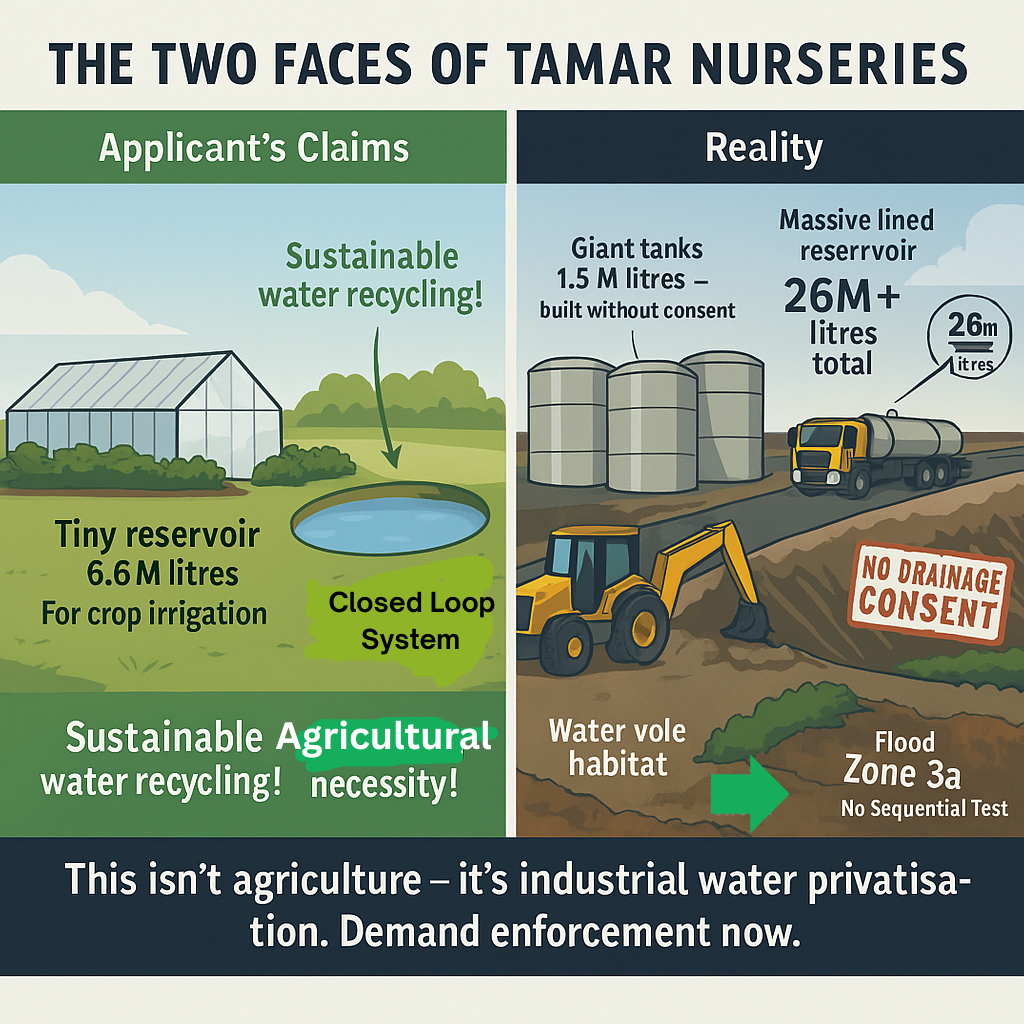
The developer has installed three large tanks, storing over 6 million litres of water — without disclosing them in the planning process.
The site sits in Flood Zone 3a, yet no Drainage Impact Assessment, abstraction licence, or SuDS plan has been provided.
The Internal Drainage Board made up of landowners, issued hidden consents without public transparency.
No biodiversity survey. No enforcement. No accountability.
This case has exposed the failure of the planning system to uphold environmental protection or public trust.
What's Happening Now
Tamar Nurseries — recently acquired by The Fountain Group (a commercial group with interests in food logistics, agriculture, and housing development), a company known for turning former nurseries into housing — is applying for a new 6.6 million litre reservoir in a sensitive floodplain (Flood Zone 3a), next to rewilded land and protected wildlife habitat.
Corporate Takeover and Timeline of Events
On 23 May 2024, directors linked to The Fountain Group took over Tamar Nurseries Ltd — a company with known interests in development and land conversion.
Just six weeks later, on 2 July 2024, a mature willow tree within a legally protected drainage buffer was illegally felled during nesting season — without consent and without declaration in any planning documents.
This act is now the subject of a police investigation (Crime Ref: 36/46190/24).
The proximity of these events raises serious concerns about intent, accountability, and a culture of planning evasion following the company’s acquisition.
This is not just about a tank. It is about the piecemeal industrialisation of green space under the cover of horticulture — while planning rules, biodiversity laws, and local voices are ignored.
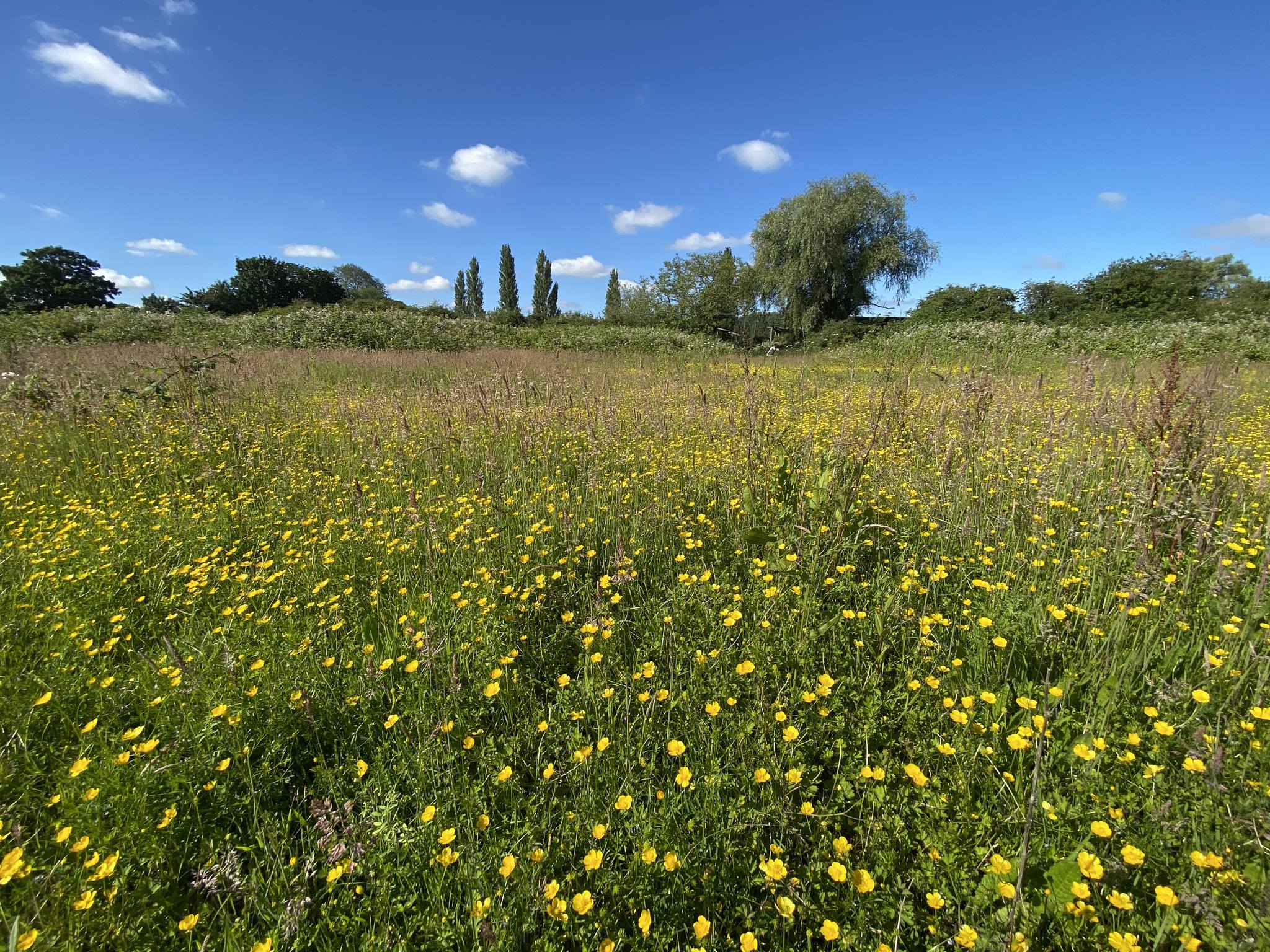
This is the rewilded land now at risk — a restored meadows teeming with life.
A Living Landscape
This isn’t just open land — it’s a vital, rewilded habitat. The meadow supports wildflowers, pollinators, and nesting birds like skylarks, yellowhammers, and reed buntings. Barn owls hunt here at dusk. Bats feed overhead. Hedgehogs, butterflies, and dragonflies thrive in this restored ecosystem. These species — many on the Red and Amber lists — depend on spaces like this to survive. Once lost, they don’t come back
This Isn’t Just About Plants — It’s a Developer-Backed Land Grab
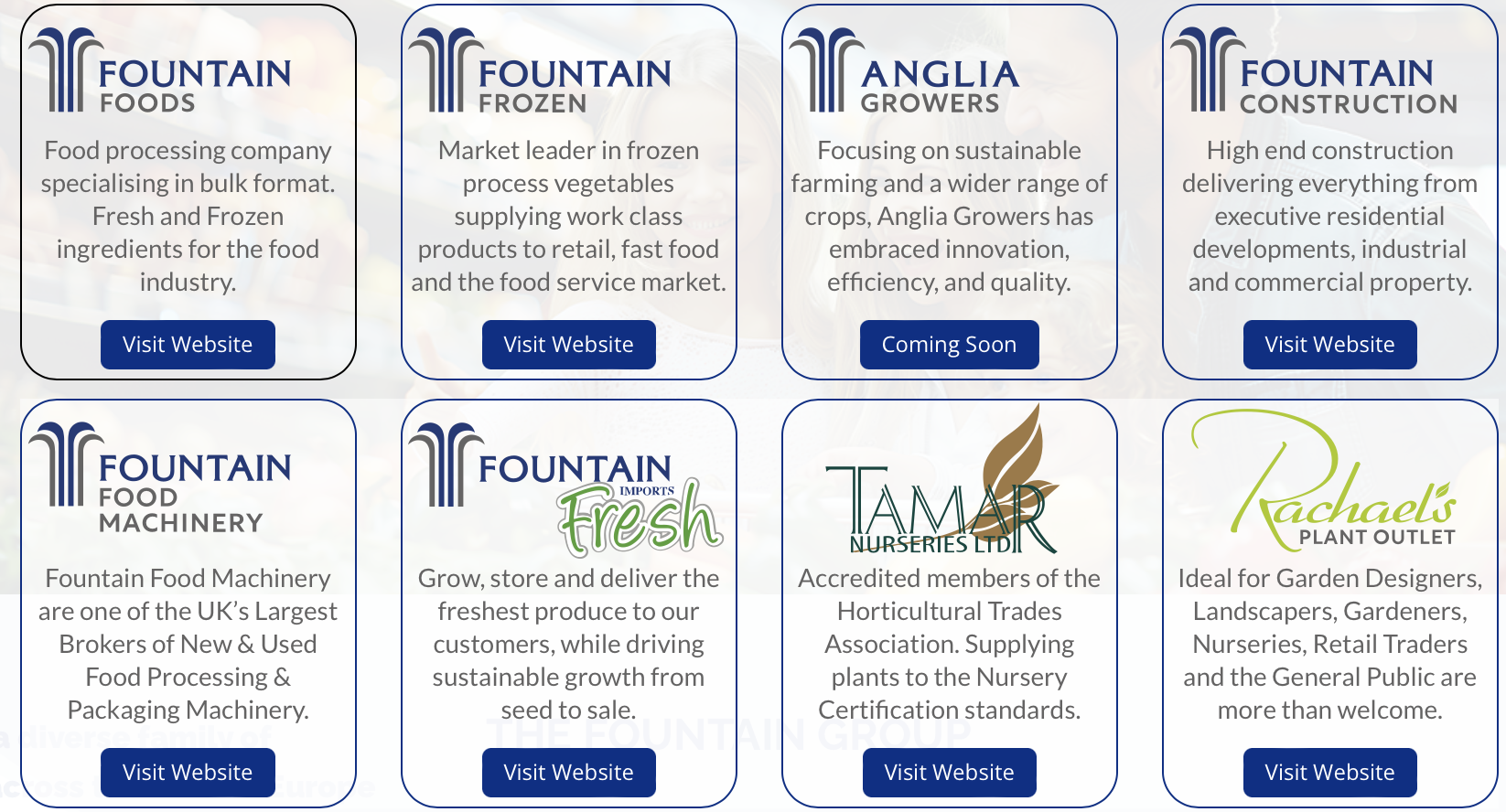
Tamar Nurseries Ltd, the company applying for a 6.6 million litre water reservoir and linked to the unlawful felling of a mature willow tree, is not just a local nursery. It is part of The Fountain Group, a corporate network involved in executive residential development, commercial construction, food logistics, and agricultural machinery.
This includes:
Fountain Construction – High-end residential and commercial development.
Anglia Growers & Food Machinery – Agricultural expansion and industrial-scale food processing.
Tamar Nurseries Ltd – Now revealed as part of a broader development group.
The group claims to store up to 20 million litres of water across the site — far beyond what’s been declared in planning applications. This infrastructure raises real fears that the land is being prepared for future development, not just irrigation.
Meanwhile, a tree was felled unlawfully, drainage works were carried out without consent, and biodiversity surveys were ignored.
We must act now to stop this pattern of developer-led abuse, retrospective planning, and regulatory evasion — and restore public trust in the planning system.
This raises serious questions:
- Is the proposed 6.6 million litre reservoir truly intended for nursery irrigation, or is it infrastructure for distribution logistics?
- Why was a mature willow tree illegally felled and left out of all planning documents?
- Why has this group been allowed to expand its infrastructure — tanks, underground pipes, drainage works — without transparent planning oversight?
Clarification
This campaign refers to “The Fountain Group” in the context of housing, water infrastructure, and planning developments associated with Tamar Nurseries Ltd.
We wish to clarify that Fountain Fresh Imports Ltd. and its Managing Director, Jack Hanson, are not involved in the Tamar Nurseries planning application.
An image that may have implied otherwise was included in error and has now been removed to prevent confusion. We regret any misunderstanding and appreciate the opportunity to clarify.
Concealed Corporate Control
Company records confirm that Fountain Foods Ltd — controlled by directors James and Kenneth Lawrence of The Factory, New Road, Upwell — shares its registered address and leadership with both Tamar Nurseries Ltd and Tamar Holdings 2024 Ltd. This confirms a coordinated corporate structure not declared in the current planning application. The failure to disclose this shared control and infrastructure strengthens the case for material misrepresentation and supports the call for enforcement, reclassification, and potential referral under planning and fraud legislation.
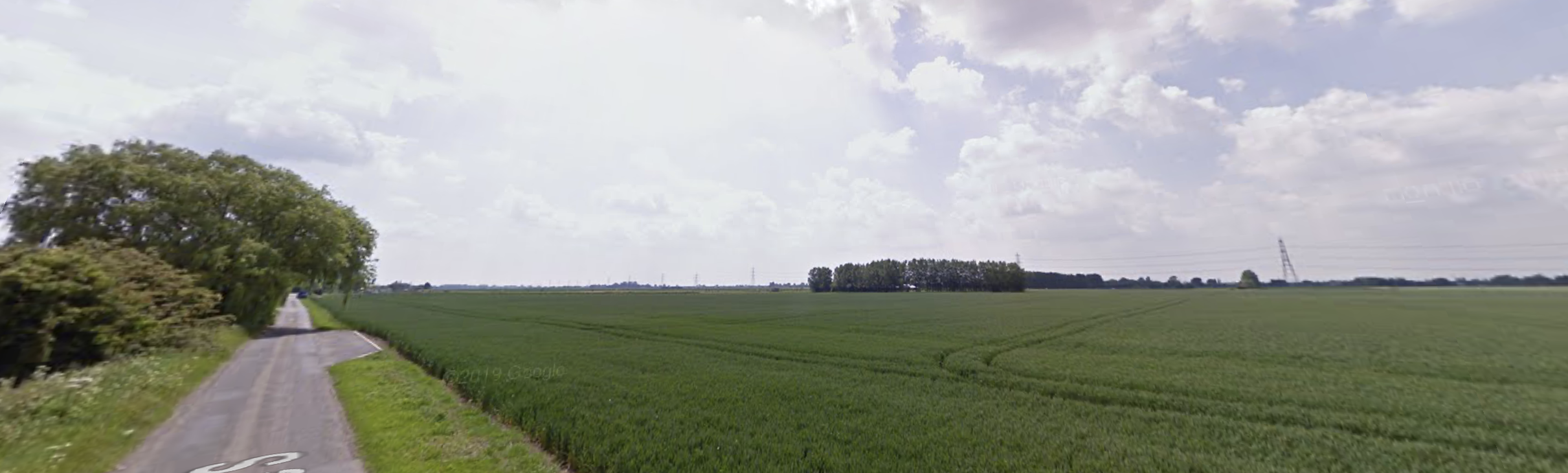
“Is this really about plants — or paving the way for future housing or commercial use?”
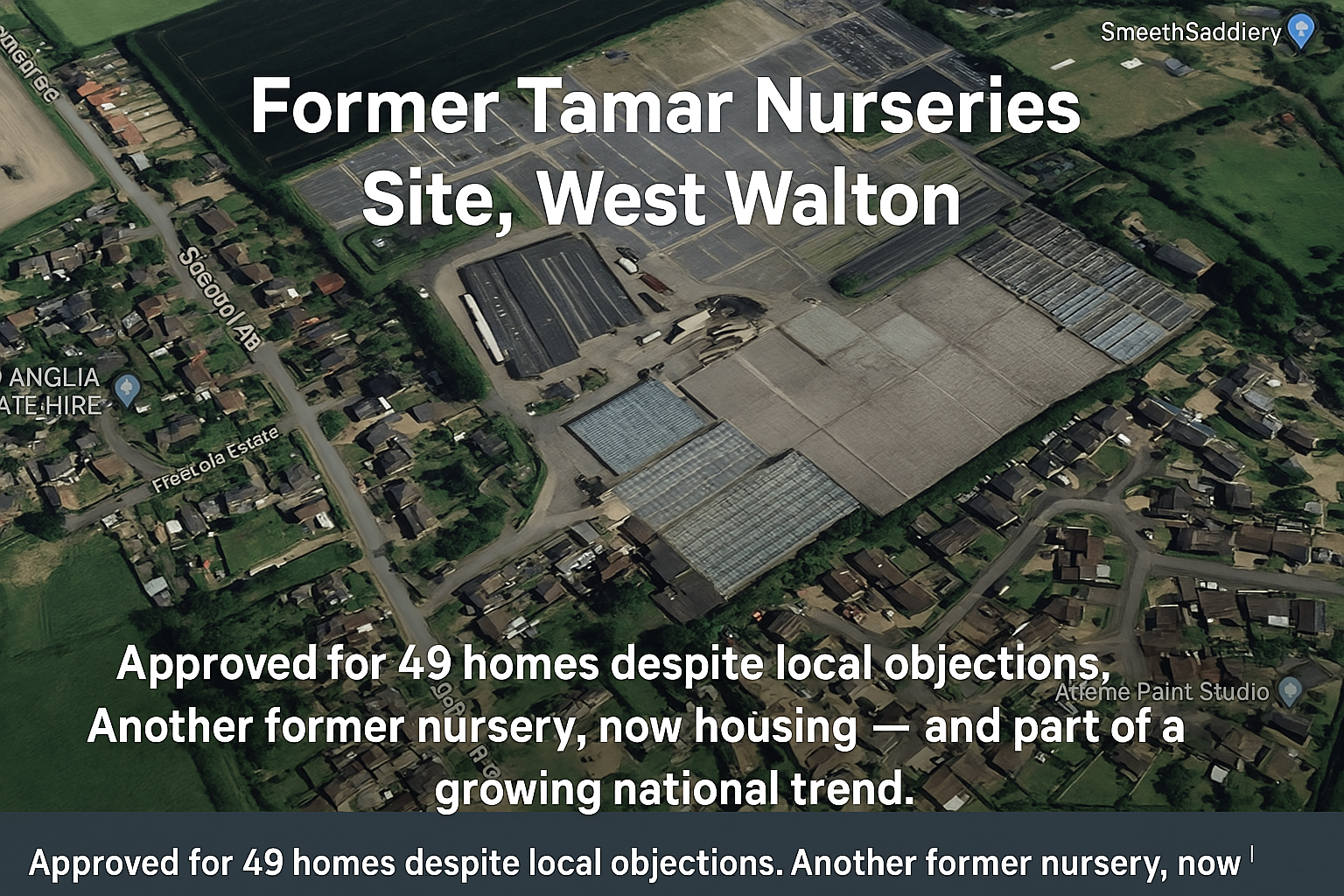
This Is Not About Plants — It’s a Logistics Operation in DisguiseNew evidence confirms that the vast infrastructure being installed at Tamar Nurseries — including three industrial tanks and a proposed 6.6 million litre reservoir — is not required for traditional nursery irrigation. The volume of stored water, the size of the infrastructure, and the lack of declared need all point to something else: a commercial logistics and storage operation, not horticulture.
The site is now part of the Fountain Group — a company with a track record of acquiring greenfield land and converting it into housing estates, food distribution hubs, and commercial storage units.
What’s happening here is not a plant nursery expansion — it’s a quiet transformation of agricultural land into an industrial water depot concealed behind the language of irrigation.
If declared truthfully, this change of use would have triggered:
- A full commercial planning application
- A drainage and flood risk assessment
- environmental impact assessment
- Reassessment of CIL liability and business rates
None of this has occurred.
Instead, the application has omitted key infrastructure, misrepresented the scale of water usage, and bypassed the necessary scrutiny for development in a flood-prone, ecologically sensitive landscape.
We are calling for the site to be reclassified, enforcement action to be taken, and the planning application to be refused until full independent assessments are carried out.
The group’s website shows their development interests go far beyond horticulture, including high-end construction projects. That makes it even more urgent to scrutinise their planning application and ask:
Are we witnessing the quiet repurposing of agricultural land for future industrial development under the guise of nursery expansion — and if so, who is holding them accountable?
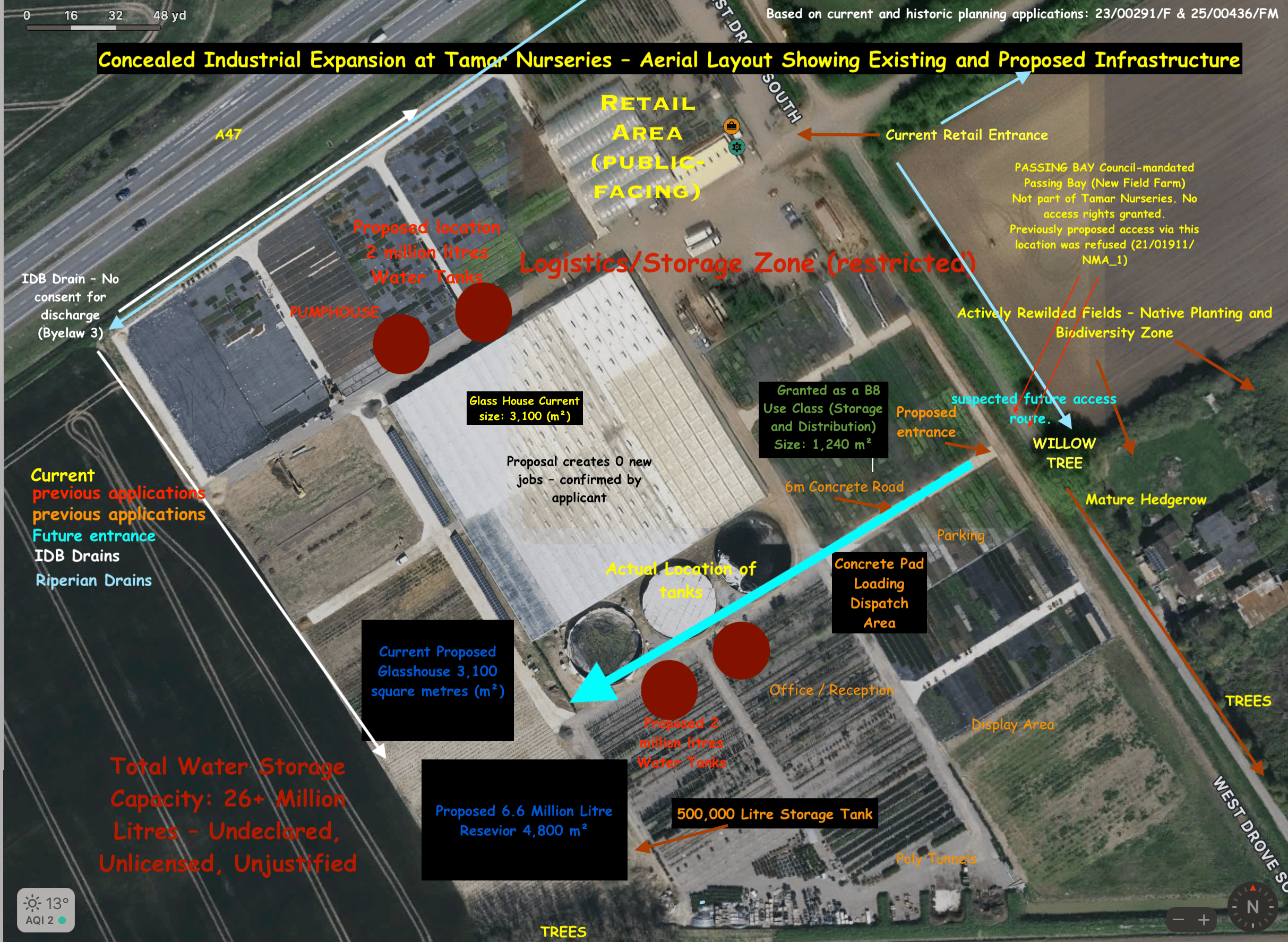
This Aerial image shows what the planning documents don’t: massive tanks, a proposed 6.6M-litre reservoir, a felled tree now aligned with a new gravel access road, and no irrigation infrastructure in sight. This isn’t horticulture — it’s hidden industrial development.
This is no longer a small horticultural unit—it is a commercial site owned by a major food infrastructure group with a clear trajectory toward industrial-scale development. This raises urgent questions about transparency, environmental oversight, and the true long-term intentions for the land.
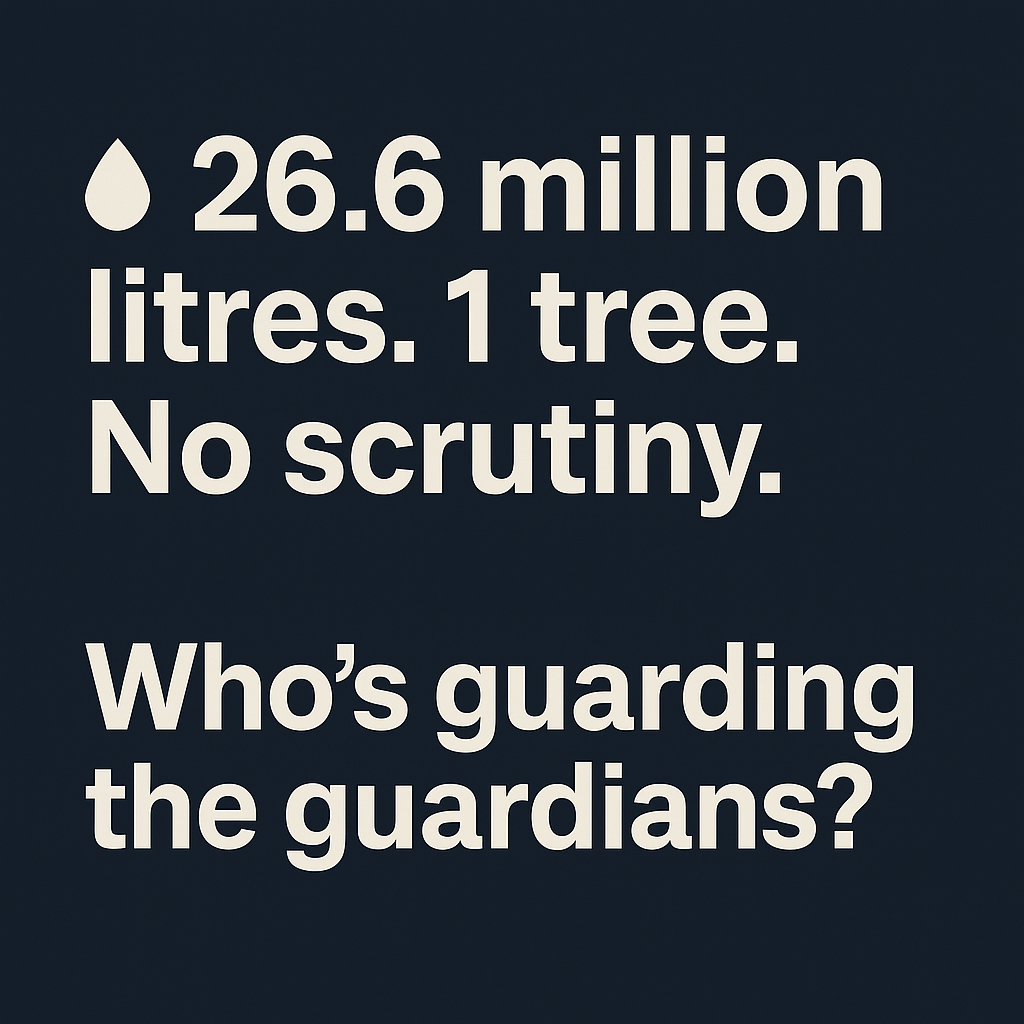
When green spaces are destroyed without consent, when biodiversity surveys are bypassed, and when unauthorised works in protected zones are ignored — we have to ask: Who Is Upholding Environmental Law?
The Environment Act 2021 was created to safeguard nature, enforce biodiversity net gain, and hold public bodies accountable. But in this case:
A mature willow tree was illegally felled in a protected drainage buffer during nesting season. In the same period, a 50-year-old rewilded hedgerow was destroyed without consent — a likely breach of the Hedgerows Regulations 1997, which protect important, long-established boundary habitats. While a Biodiversity Net Gain (BNG) report has been submitted, it fails to account for habitat partially destroyed — including the unlawful felling of a mature willow and the partial removal of a 50+-year-old hedgerow on rewilded land directly affected by the development. Ignoring these losses undermines the credibility of any claimed ‘net gain’ and contradicts the intent of the Environment Act 2021.
Drainage infrastructure has been installed without consent or public scrutiny. Shockingly, a councillor publicly defended the unlawful felling — while the police investigation is still ongoing. If elected officials and planning authorities fail to enforce even the most basic environmental protections, who is left to defend the law — and nature itself?
Tamar Nurseries’ production manager confirmed each tank holds 2 million litres. With three tanks on site, that’s a minimum of 6 million litres of undeclared, unlicensed, and unassessed water infrastructure.
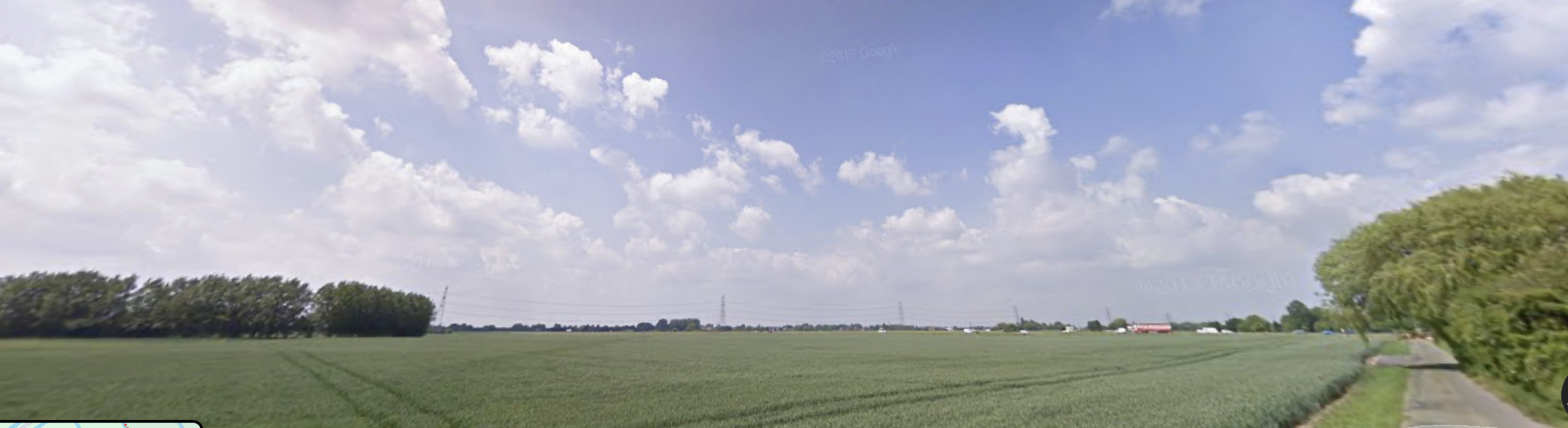
Live Application Under Scrutiny: Tamar Nurseries Ltd—now part of The Fountain Group—is seeking approval for a 6.6 million-litre reservoir under Planning Application 25/00436/FM (submitted to King's Lynn and West Norfolk Borough Council).
This application does not mention the 3 existing tanks already on site, despite their confirmed capacity of at least 6 million litres.
Please look at this One-page briefing to get an understanding of what is going on.
Here is the live Fountain Group Planning Application
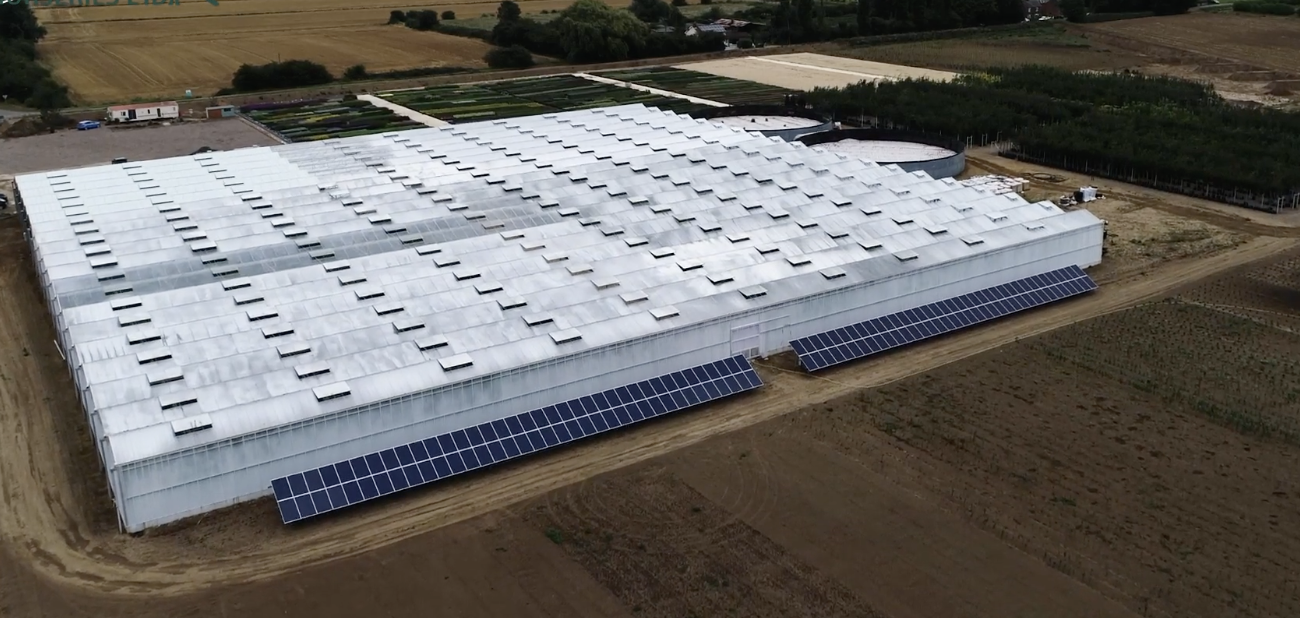
Elsewhere, Tamar has claimed the site stores up to 20 million litres, further underscoring the discrepancy between public claims and what’s been declared to planners.
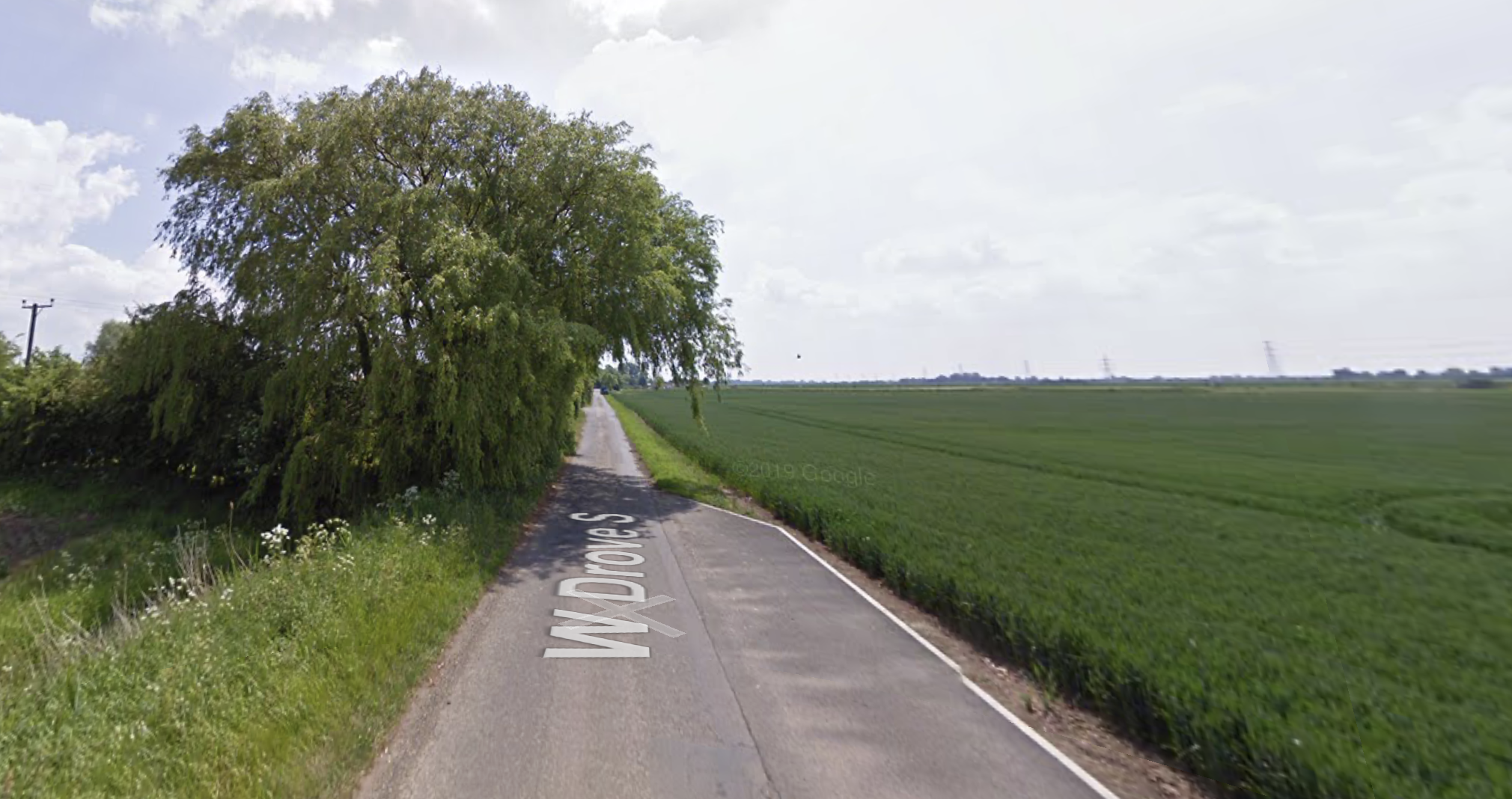
What This Reveals
Governance Failure and Public Interest
This case is not just about the unlawful felling of a mature willow tree — it reveals a much wider problem. Despite clear breaches of environmental, planning, and criminal law, no enforcement action was taken until the landowner initiated formal complaints, police involvement, and public objections.
Authorities tasked with protecting nature — including the local planning department and the Forestry Commission — either failed to act or misclassified serious ecological harm. Evidence of unauthorised development, corporate concealment, planning misrepresentation, and ecological loss has been repeatedly ignored or downplayed.
This is a governance failure — where the law exists, but is not enforced. And when those entrusted with protecting our countryside stay silent, nature is left undefended.
This case now stands as a test of public trust in the planning system, in environmental protection, and in basic accountability. It raises critical questions:
- Why are developers able to proceed without consequence when laws are broken?
- Why are local residents and land stewards forced to do the job of regulators?
- What happens to our landscapes and ecosystems when enforcement bodies fail?
- We are calling not only for enforcement in this case, but for national reform.
- This is about protecting all of us from the erosion of our green spaces, and ensuring that nature and community are no longer sidelined by commercial gain.
These two sites — one urban, one rural — show that planning protections are breaking down across the country:
Retrospective applications are being used to normalise unauthorised development.
Drainage consents are issued in secret by quasi-public boards with no democratic oversight.
Biodiversity laws are bypassed through omission, under-resourcing, and evasion.
Communities are ignored, silenced, or outpaced by developers exploiting every gap in the system.
What the Developer Says Publicly vs. What’s in the Application
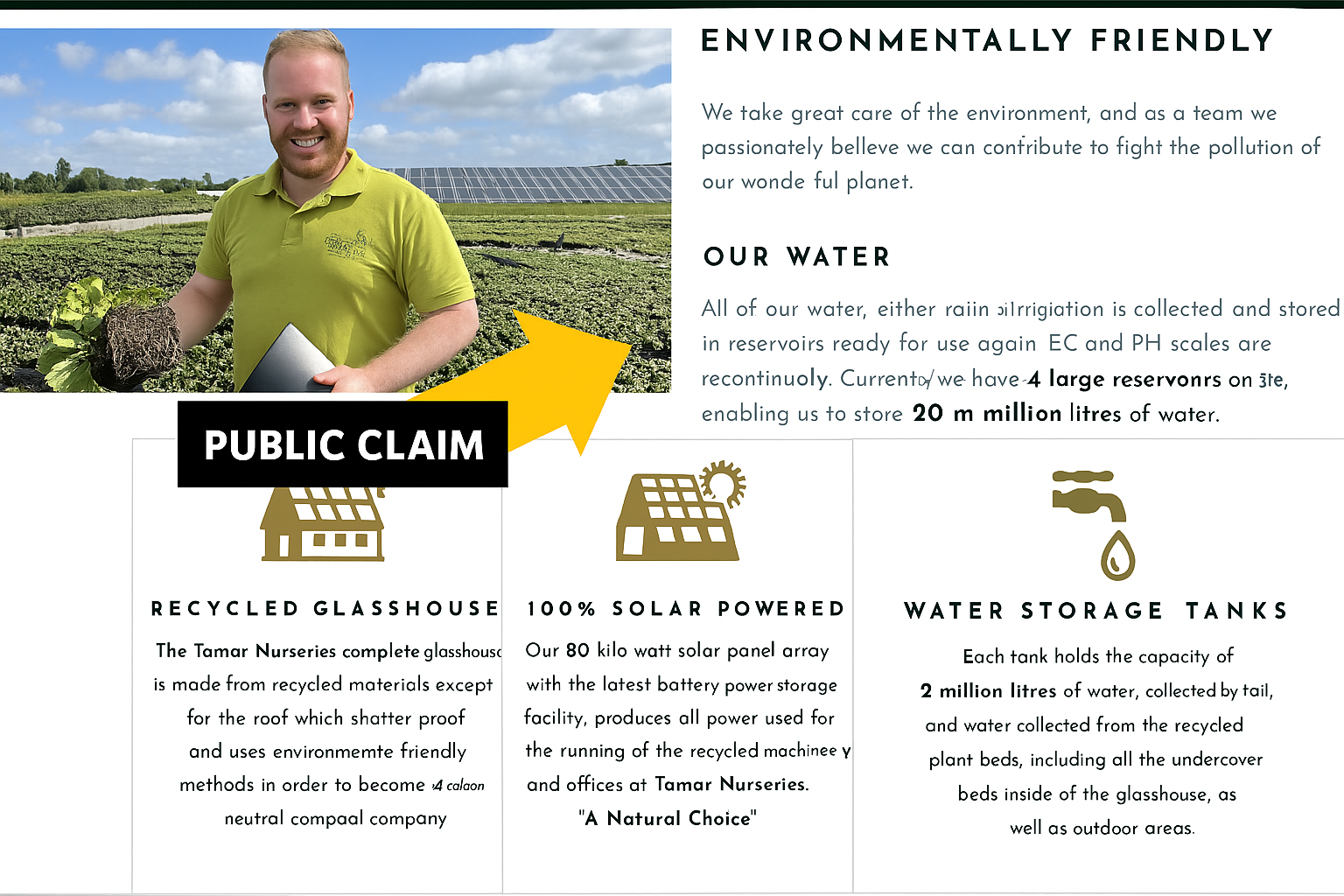
Tamar Nurseries’ own website (screenshot below) boasts that:
“We have 4 large reservoirs on site, enabling us to store 20 million litres of water.”
“Each tank holds 2 million litres of water.”
Yet in their planning application, they claim they’re proposing just one 6.6 million litre reservoir — with no mention of the others already in place.
They also fail to explain:
How this volume of water is sourced (there’s no abstraction licence),
How flood risk is managed (there’s no Drainage Impact Assessment),
How does this affect neighbouring land or the environment (there’s no ecological survey)?
This is a clear example of misleading omissions — saying one thing publicly and another (or nothing) when it counts.
This is why we need urgent reform. The system is broken if developers can hide the scale of their infrastructure and sidestep environmental checks.
A Deeper Duty — The Rights of Nature
Across both sites — urban and rural — the damage is physical, ecological, spiritual, and communal.
In Highgate, 19 mature trees were felled at Shepherds Close without planning permission, stripping a cherished green corridor of its canopy and silencing birdsong that had echoed for decades. These trees were not “obstacles” — they were anchors of a living landscape, cooling the air, sheltering wildlife, and offering quiet sanctuary in the city. Their destruction was not just premature — it was premeditated.
In Norfolk, the mature willow tree that was unlawfully felled stood not only as a habitat but as a guardian of the water and the wild. It was removed without consent, during nesting season, from a legally protected riparian buffer — an act now under active police investigation. Its loss is not just environmental — it is a violation of nature’s rights, and of our shared duty to protect the more-than-human world.
Natural law recognises that some truths precede legislation: that the Earth has inherent rights to flourish, and that communities have a duty of care to future generations. What has happened here — through omission, silence, and evasion — is a quiet form of ecocide. It matters not just legally, but morally, spiritually, and communally.
In this sense, I do not speak only for myself. I speak for the willows, the oaks, the hedgerows and owls, bats and skylarks, and the future that depends on justice for the living world. I call on those in power to act with the integrity this moment demands — not just to enforce policy, but to honour life.
Let’s hold them — and the planning system — accountable.
What We’re Demanding
We call on the Secretary of State for Levelling Up, Housing & Communities to:
Support the creation of a local bylaw to protect Highgate Conservation Area from repeated speculative planning applications.
Launch a national investigation into planning enforcement failures — especially concerning flood zones and undeclared infrastructure.
Introduce public oversight and transparency for Internal Drainage Board consent.
Mandate enforceable biodiversity net gain and proper ecological surveys for all planning applications.
Protect the rights of residents and rewilders who are defending land and nature.
We are calling for:
- A full independent investigation into Tamar Nurseries’ planning and environmental breaches.
- Immediate enforcement action and planning refusal for unlawful infrastructure.
- Review and reform of Drainage Boards and retrospective planning policies.
- Stronger legal protections for rewilded land and community environmental stewardship.
- National-level intervention where local governance has failed
A Governance Crisis: Cllr Julian Kirk and Drainage Board Power
We call for urgent scrutiny of public officials who condone or enable environmental harm.
Cllr Julian Kirk publicly defended the unlawful felling of a mature willow tree — an act currently under police investigation (Crime Ref: 36/46190/24). A local farmer, Cllr Kirk currently sits on King’s Lynn & West Norfolk Borough Council, the authority responsible for determining the Tamar Nurseries planning application. He previously served on the King’s Lynn Internal Drainage Board (IDB), which retrospectively issued consents for unauthorised drainage works on the same site.
This overlap of roles and public statements raises serious concerns about governance, transparency, and potential conflicts of interest in the decision-making process
In March 2025, Cllr Kirk resigned from Norfolk County Council and defected to Reform UK, triggering a by-election in Marshland North. His resignation speech included accusations of “totally undemocratic” decision-making — even as he faces questions about his own role in planning and environmental governance.
These overlapping roles and public endorsements raise legitimate concerns about bias, political influence, and a lack of impartial oversight.
We must call this what it is: ecocide — the systematic erosion of nature for short-term profit, enabled by silence and loopholes.
From Highgate to Norfolk — Our Planning System Is Broken
Why does this matter nationally?
This case exposes how, in post-Brexit Britain, vital environmental protections and public safeguards have quietly been dismantled. Before Brexit, EU regulations required proper environmental impact assessments, transparent planning consultation, and strong biodiversity protections. Now, those checks have been weakened or removed — and corporate developers are exploiting that vacuum. What happened at Tamar Nurseries is not an isolated mistake; it’s part of a growing trend of planning by stealth, where private interests act first and seek permission later. Without EU oversight and with fragmented UK enforcement, who is protecting our countryside, biodiversity, and democratic rights? If this goes unchallenged, more rewilded land, mature trees, and rural habitats will be lost — not just in Norfolk, but across the country.
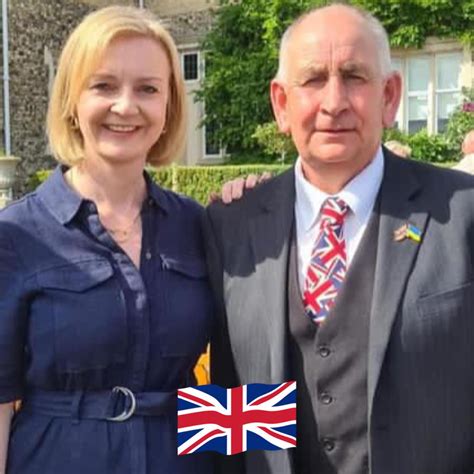
Drainage Boards: Hidden Power, No Oversight
The King’s Lynn IDB — a body with the power to approve drainage works and infrastructure in flood zones — is made up largely of appointed landowners and agricultural representatives, many with ties to commercial development.
Its decisions, including consent near protected rewilded buffers and failure to enforce against unauthorised infrastructure, are made without public consultation or ecological review.
This lack of transparency exposes a deeper problem: quasi-public bodies enabling environmental harm behind closed doors. It’s time these institutions were brought into the light and made democratically accountable.
A full list of Board Members is available publicly here https://www.wlma.org.uk/uploads/KLIDB_Appointed_Board_Members.pdf
Yet these decisions — like allowing drainage modifications near a protected rewilded buffer or not enforcing against unauthorised pipes and tanks — are made without public scrutiny, consultation, or ecological oversight.
This lack of transparency highlights a broader governance failure: drainage authorities, operating quasi-independently, can greenlight environmental harm without democratic input. It’s time these bodies were brought into the light.
Our Vision
We want a planning system that:
Respects ecological integrity over speculative development
Closes loopholes that allow piecemeal destruction of our green spaces
Holds councils and drainage boards accountable to the public
Protects those who care for and restore nature
And upholds the law — not just when it’s convenient
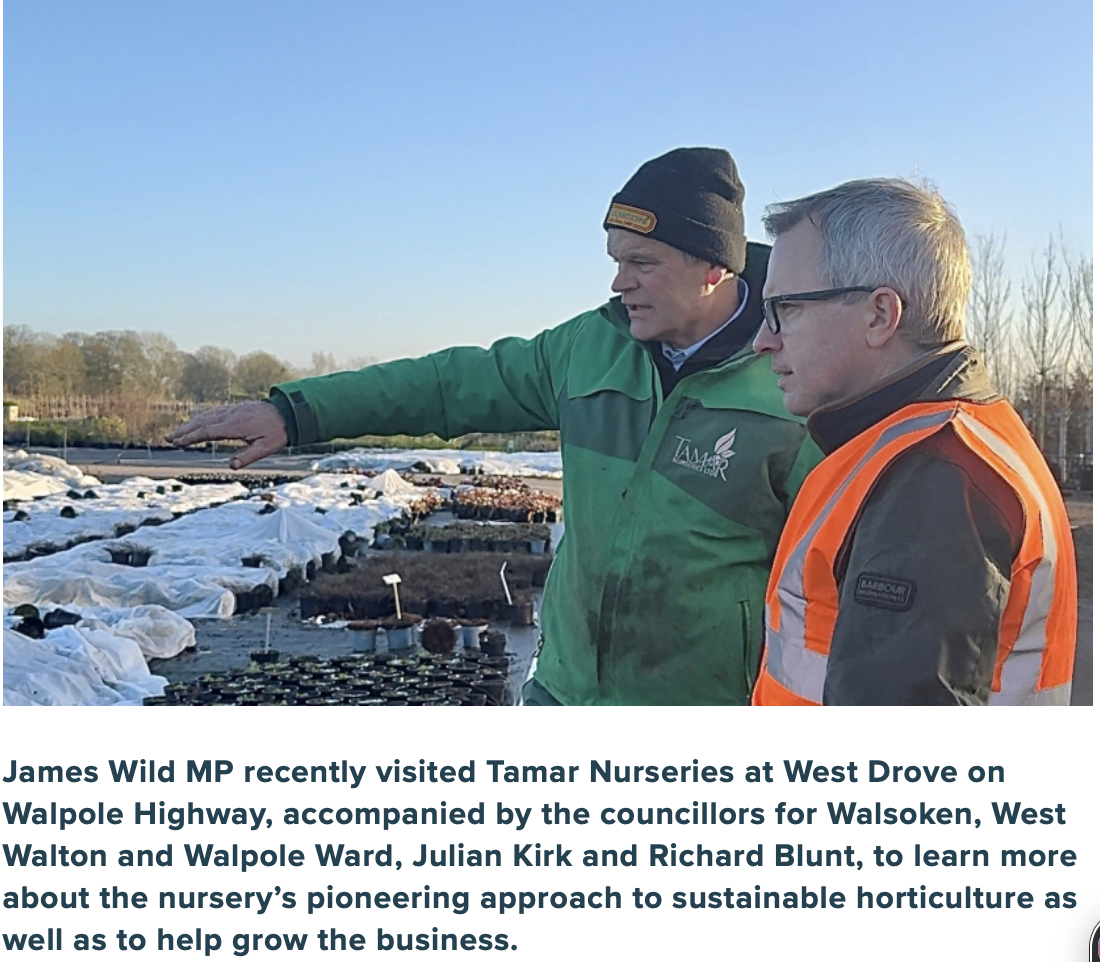
This site now falls under MP James Wild’s constituency — he has a duty to act.
Why This Matters?
Political Praise — But Where’s the Oversight?
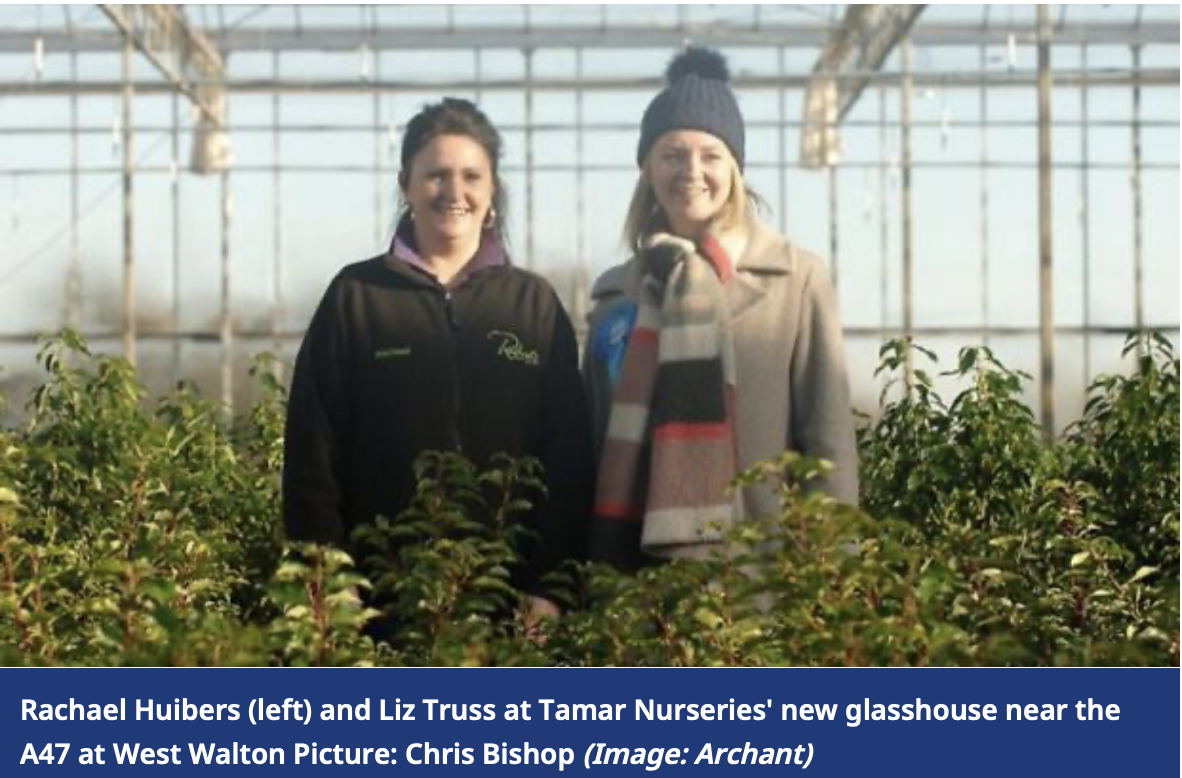
Tamar Nurseries and the Fountain Group have been praised by multiple MPs and councillors — including visits from James Wild MP, Cllr Julian Kirk, and former trade minister Liz Truss.
Articles show political leaders touring the site, praising its innovation and water storage — yet omitting the police-investigated tree felling, undeclared tanks, and missing flood and biodiversity assessments. When developers enjoy high-level access but face no enforcement over breaches of environmental law, the public is right to ask: Who is this system really serving?
This campaign began with the destruction of a beloved green space in Highgate North London, where 19 mature trees were felled despite years of community resistance — with no planning permission in site, but it has revealed a far more profound and more disturbing issue.
What started as a local fight to protect trees and biodiversity has exposed a national pattern of planning failure, environmental erosion, and democratic breakdown.
From Highgate to the Fens, our green spaces are being lost to development and a system that no longer protects them. Planning laws are being bypassed. Ecological harm is going unpunished. Drainage consents are issued without scrutiny.
This is a microcosm moment — one that shows how trust in our planning system is being eroded and why urgent reform is needed to restore accountability, protect nature, and defend the public’s right to shape the places we live in.
This petition combines photographic evidence, corporate links, planning documents, and regulatory failures to reveal a national issue hiding behind local cases. Now, we need action. We have the receipts. Now, we need reform — not just for one tree or one village, but for a planning system that serves the public, not private profit
If we don’t act now, we risk losing not just trees and green corridors — but the protections meant to keep them safe.
Please sign and share. Help us protect what remains.
Media Praise vs Environmental Reality
While Tamar Nurseries and the Fountain Group have received glowing praise from public figures like James Wild MP, Julian Kirk, and Liz Truss, these endorsements fail to acknowledge the serious environmental and planning breaches now under investigation
James Wild MP visits Tamar Nurseries – EDP24
Liz Truss praises Fountain Fresh and Tamar Nurseries – Wisbech Standard
Fountain Group Built 49 Homes on Former Tamar Nurseries — Is This the Real Agenda?
https://www.edp24.co.uk/news/24440543.plans-49-new-homes-west-walton-near-
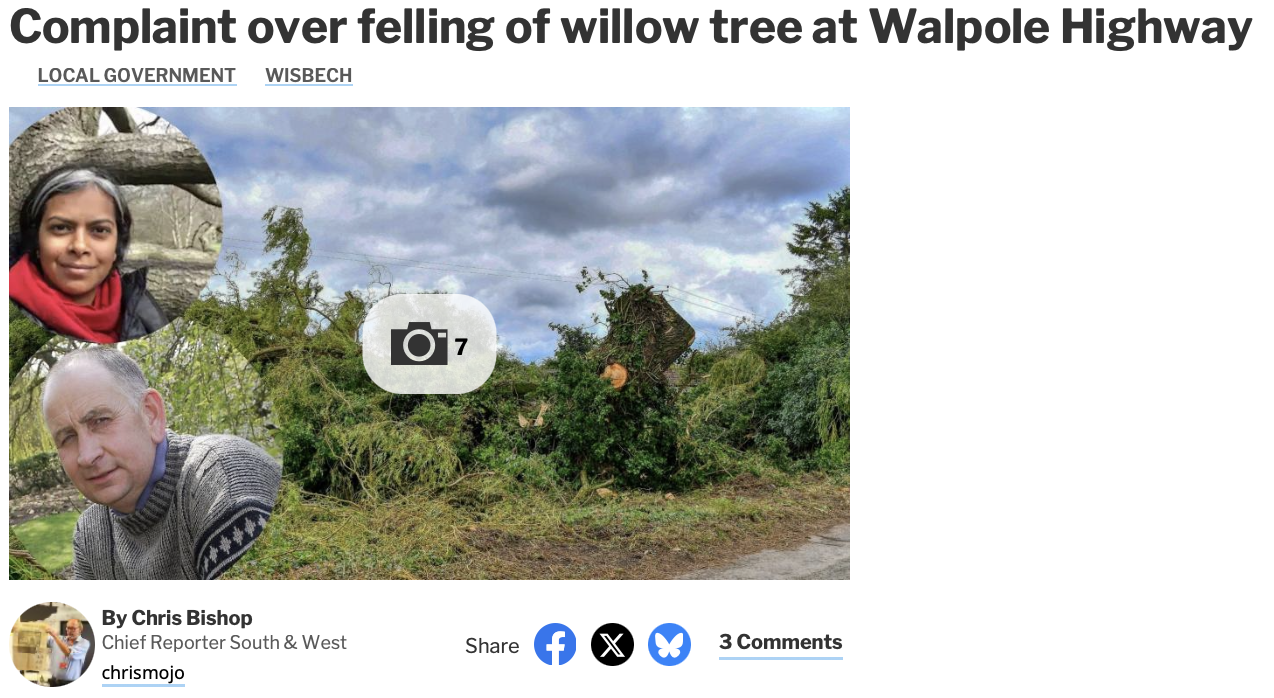
Public trust in environmental governance is undermined when elected officials make unverified public statements about unlawful acts — especially while a police investigation is underway. Cllr Julian Kirk’s public endorsement of the willow tree’s felling (currently under investigation) raises legitimate questions about bias and procedural integrity. A formal complaint has been submitted under the Councillors’ Code of Conduct.
We are calling for independent scrutiny of this case — and broader reform to ensure that environmental protections are upheld impartially, without political interference or misinformation.
This is not a personal dispute; the issues affect the broader public through environmental damage, greenwashing, unauthorised development in a floodplain and protected conservation areas, taxation and levy avoidance (Community Infrastructure Levy and business rates), and the misuse of dormant companies to evade scrutiny. It shows a breakdown of governance and potential corruption or negligence within the planning enforcement process.

1,211
The Issue
Stop Developer-Led Abuse and Restore Public Trust in Planning
This campaign started in Highgate. It now spans Norfolk. It reveals a national failure in planning, regulation, and environmental protection
This campaign exposes systemic failures and
Environmental harm at linked sites:
• Highgate (Haringey)
• Tamar Nurseries, (Norfolk)
· Whitewebbs Park
· Sheffield
· Plymouth City Council
Throughout my life, I have cherished the intricate web of life that sustains us all. Our well-being — and the future of our communities — is unmistakably intertwined with the health of our natural environments.
Biodiversity, ecology, and wild spaces deserve our care — not our exploitation. We must prioritise regeneration and protection over the heedless pursuit of profit. That’s why I began this campaign: to defend the cherished trees and green spaces of the Highgate Conservation Area from overdevelopment.
This is not about opposing development—it’s about protecting the integrity, ecology, and accountability of our national planning system.
But what began as a local call for protection has now revealed a national pattern of loss, omission, and failure.
🌿 Protect Nature. Stop Developer Abuse. Restore Public Trust. This campaign began with the loss of a single tree — but it speaks to a much deeper crisis. Across the country, from Highgate to rural Norfolk, developers are destroying protected land, felling trees without permission, and bypassing planning laws. Rewilded areas and green spaces are being lost while councils and regulators look the other way.
- We’re calling for: Real accountability for illegal development
- Stronger protection for nature and rewilded land
- National reform to restore trust in planning and enforcement
- This isn’t just about one place — it’s about fairness, biodiversity, and the future of our communities.
Please sign and share. Let’s stand together for nature, for justice, and for the land we all depend on.
Degrade it. Reclassify it. Develop it. That’s the playbook
From urban green lungs like Shepherds Close to rewilded floodplains in Norfolk, we witness the systematic unravelling of local environmental protection. Drainage boards dominated by landowners, retrospective planning abuses, biodiversity laws ignored, and regulators deferring responsibility are how nature is lost, quietly and legally.
Whitewebbs Park is just one of many green spaces now under threat.
A 500-year-old oak tree, ancient woodlands, and vital habitats are being quietly destroyed while those in power look the other way.
From Highgate to Norfolk to Whitewebbs, this campaign stands for every place being lost to unchecked developer abuse.
We are not just fighting for land — we are fighting for life itself.
Please stand with us to protect what cannot be replaced.
What’s happening in Highgate and Norfolk is happening everywhere.
Across the UK, people are watching their green spaces disappear as developers exploit loopholes, override protections, and silence communities.
This isn’t mismanagement — it’s a systemic failure.
Planning laws are being bypassed. Oversight is collapsing. And people are telling the same story in town, field after field.
One felled tree. Zero accountability. Sign the petition to stop the abuse of our green spaces.
You can’t build a house “with the forest” if you cut the forest down first.
Shepherds Close: A Green Corridor Under Siege
For over four decades, Shepherds Close N6 has faced relentless pressure from speculative developers. Each application chips away at a cherished green corridor — a vital ecological buffer and community refuge in the heart of Highgate.
Despite repeated community-led rejections, developers persist — submitting near-identical proposals, exploiting loopholes, and draining public resources. But it’s not just the paperwork that’s repeating. On the ground, the site has been strategically degraded:
- Trees felled
- Vegetation cleared
- Wildlife displaced
This is a well-worn tactic: degrade the land, discredit its value, then redevelop. What was once a thriving green oasis is now being reframed as “infill” — an attempt to justify its reclassification as brownfield.
The strategy is simple: degrade it, rebrand it, then build on it.
Haringey Council must not only reject the current proposal but prevent this pattern of ecological erasure from becoming precedent.
This Is Not Brownfield — It’s Essential Garden Land
This is essential garden land — not vacant or derelict space. It forms part of the Highgate Conservation Area, providing a crucial link in the ecological network between homes, hedgerows, and neighbouring green spaces.
Developers may try to downplay it, but under planning policy, garden land is not brownfield. The land remains ecologically active, historically valued, and community-defended.
A Green Asset Under Siege
The community is now working to designate this land as a Local Green Space — a recognition of what it truly is: a shared, living space with value far beyond its development potential.
We call on Haringey Council to:
- Recognise this land’s environmental and community value
- Support its Local Green Space designation
- Prevent it from being reclassified or built over
We also call for a local byelaw to:
- Permanently protect the site as part of Highgate’s ecological network
- Stop the cycle of repeated speculative applications
- Preserve its role as a wildlife corridor, green buffer, and climate asset
Other councils have used byelaws to protect village greens, ancient hedgerows, and nature reserves.
It’s time for Haringey to do the same.This land isn’t “leftover” — it’s living. And the law should reflect that.
In another open case in Highgate, a protected tree subject to an enforcement notice was lost without accountability. The tree, located on land owned by the Wellcome Trust, collapsed and damaged neighbouring property. No investigation or enforcement action was taken despite its protected status, prior enforcement history, and institutional ownership. The Council dismissed the incident as a civil matter, and the injured parties were left without apology, reparation, or public explanation
What We're Asking from the Wellcome Trust One of the trees lost in this campaign — a mature, protected tree at the edge of several green garden spaces in Highgate — stood on land owned by the Wellcome Trust.
We are calling on the Wellcome Trust to take responsibility for the loss of a protected tree that stood on their land in Highgate. The tree was subject to an enforcement notice, fell without intervention, and damaged neighbouring properties. Despite its significance and history, no action was taken to prevent the loss — and no explanation has ever been offered.
We are asking the Wellcome Trust to:
- Acknowledge the loss and their failure to manage the tree responsibly
- Apologise to the neighbours affected by the damage and inaction
- Explain why no action was taken despite the enforcement notice and clear grounds for follow-up
- Commit to protecting nature and upholding environmental safeguards on their land moving forward
As a major institution with a public mission rooted in science, ethics, and global health, the Wellcome Trust should be setting an example — not avoiding scrutiny. Institutions must be held to the same standards as private developers.
Silence cannot be the final word. Attempts to seek dialogue with the Wellcome Trust have been met with a wall of silence. Who can we trust if we can’t trust those who claim to protect science, health, and the future?
It wasn’t just that the tree fell — it was allowed to fall.
Planning Has Become a Tool for Developers — Not Communities
Residents have fought every application. But they are now exhausted, sidelined, and ignored. The planning system, as it stands, rewards persistence from developers — and attrition from the public.
What was once a green refuge is being strategically stripped, rebranded as opportunity, and placed in the crosshairs of speculative development.
The House of the Lost Forest
The latest proposal has been branded a “self-build family home” — but this is a speculative land grab wrapped in soft language. The strategy is familiar: cut down the trees, degrade the land, rebrand it as underused, and build.
They’ve named it “The House of the Lost Forest” — a title that unintentionally tells the truth.
First the trees fall. Then the applications arrive.
What was once a green corridor is reframed as “infill” — and built over.
You don’t honour a forest by destroying it.
This isn’t self-build — it’s self-serving.
And the community sees through it.
Planning Inspectorate Most Recent Planning Application London N6
The National Mirror – Tamar Nurseries, Norfolk
In rural Norfolk, the pattern repeats — but in a floodplain.
A mature willow tree was unlawfully felled during nesting season and omitted from all planning documents. The individuals involved began removing the entire tree but were interrupted midway — leaving it partially felled.
To this day, no one has come forward to explain who authorised the action, issue an apology, or formally acknowledge what occurred. Instead, the act was informally justified as a ‘favour’ — despite being unlawful and ecologically damaging. The incident, now under police investigation, involved a mature willow tree with clear environmental and hydrological significance that was never declared in the planning application.
This wasn’t a favour — it was an unauthorised act in a legally protected area, targeting a mature tree with clear ecological and hydrological value. To excuse it as a favour is not only misleading but deeply disturbing. It felt like a violation — followed by the expectation of gratitude.
The silence and evasion that followed speak volumes — this is not just a failure of process but a serious breach of public trust and environmental duty. The police are now investigating (Crime Ref: 36/46190/24).
The developer has installed three large tanks, storing over 6 million litres of water — without disclosing them in the planning process.
The site sits in Flood Zone 3a, yet no Drainage Impact Assessment, abstraction licence, or SuDS plan has been provided.
The Internal Drainage Board made up of landowners, issued hidden consents without public transparency.
No biodiversity survey. No enforcement. No accountability.
This case has exposed the failure of the planning system to uphold environmental protection or public trust.
What's Happening Now
Tamar Nurseries — recently acquired by The Fountain Group (a commercial group with interests in food logistics, agriculture, and housing development), a company known for turning former nurseries into housing — is applying for a new 6.6 million litre reservoir in a sensitive floodplain (Flood Zone 3a), next to rewilded land and protected wildlife habitat.
Corporate Takeover and Timeline of Events
On 23 May 2024, directors linked to The Fountain Group took over Tamar Nurseries Ltd — a company with known interests in development and land conversion.
Just six weeks later, on 2 July 2024, a mature willow tree within a legally protected drainage buffer was illegally felled during nesting season — without consent and without declaration in any planning documents.
This act is now the subject of a police investigation (Crime Ref: 36/46190/24).
The proximity of these events raises serious concerns about intent, accountability, and a culture of planning evasion following the company’s acquisition.
This is not just about a tank. It is about the piecemeal industrialisation of green space under the cover of horticulture — while planning rules, biodiversity laws, and local voices are ignored.
This is the rewilded land now at risk — a restored meadows teeming with life.
A Living Landscape
This isn’t just open land — it’s a vital, rewilded habitat. The meadow supports wildflowers, pollinators, and nesting birds like skylarks, yellowhammers, and reed buntings. Barn owls hunt here at dusk. Bats feed overhead. Hedgehogs, butterflies, and dragonflies thrive in this restored ecosystem. These species — many on the Red and Amber lists — depend on spaces like this to survive. Once lost, they don’t come back
This Isn’t Just About Plants — It’s a Developer-Backed Land Grab
Tamar Nurseries Ltd, the company applying for a 6.6 million litre water reservoir and linked to the unlawful felling of a mature willow tree, is not just a local nursery. It is part of The Fountain Group, a corporate network involved in executive residential development, commercial construction, food logistics, and agricultural machinery.
This includes:
Fountain Construction – High-end residential and commercial development.
Anglia Growers & Food Machinery – Agricultural expansion and industrial-scale food processing.
Tamar Nurseries Ltd – Now revealed as part of a broader development group.
The group claims to store up to 20 million litres of water across the site — far beyond what’s been declared in planning applications. This infrastructure raises real fears that the land is being prepared for future development, not just irrigation.
Meanwhile, a tree was felled unlawfully, drainage works were carried out without consent, and biodiversity surveys were ignored.
We must act now to stop this pattern of developer-led abuse, retrospective planning, and regulatory evasion — and restore public trust in the planning system.
This raises serious questions:
- Is the proposed 6.6 million litre reservoir truly intended for nursery irrigation, or is it infrastructure for distribution logistics?
- Why was a mature willow tree illegally felled and left out of all planning documents?
- Why has this group been allowed to expand its infrastructure — tanks, underground pipes, drainage works — without transparent planning oversight?
Clarification
This campaign refers to “The Fountain Group” in the context of housing, water infrastructure, and planning developments associated with Tamar Nurseries Ltd.
We wish to clarify that Fountain Fresh Imports Ltd. and its Managing Director, Jack Hanson, are not involved in the Tamar Nurseries planning application.
An image that may have implied otherwise was included in error and has now been removed to prevent confusion. We regret any misunderstanding and appreciate the opportunity to clarify.
Concealed Corporate Control
Company records confirm that Fountain Foods Ltd — controlled by directors James and Kenneth Lawrence of The Factory, New Road, Upwell — shares its registered address and leadership with both Tamar Nurseries Ltd and Tamar Holdings 2024 Ltd. This confirms a coordinated corporate structure not declared in the current planning application. The failure to disclose this shared control and infrastructure strengthens the case for material misrepresentation and supports the call for enforcement, reclassification, and potential referral under planning and fraud legislation.
“Is this really about plants — or paving the way for future housing or commercial use?”
This Is Not About Plants — It’s a Logistics Operation in DisguiseNew evidence confirms that the vast infrastructure being installed at Tamar Nurseries — including three industrial tanks and a proposed 6.6 million litre reservoir — is not required for traditional nursery irrigation. The volume of stored water, the size of the infrastructure, and the lack of declared need all point to something else: a commercial logistics and storage operation, not horticulture.
The site is now part of the Fountain Group — a company with a track record of acquiring greenfield land and converting it into housing estates, food distribution hubs, and commercial storage units.
What’s happening here is not a plant nursery expansion — it’s a quiet transformation of agricultural land into an industrial water depot concealed behind the language of irrigation.
If declared truthfully, this change of use would have triggered:
- A full commercial planning application
- A drainage and flood risk assessment
- environmental impact assessment
- Reassessment of CIL liability and business rates
None of this has occurred.
Instead, the application has omitted key infrastructure, misrepresented the scale of water usage, and bypassed the necessary scrutiny for development in a flood-prone, ecologically sensitive landscape.
We are calling for the site to be reclassified, enforcement action to be taken, and the planning application to be refused until full independent assessments are carried out.
The group’s website shows their development interests go far beyond horticulture, including high-end construction projects. That makes it even more urgent to scrutinise their planning application and ask:
Are we witnessing the quiet repurposing of agricultural land for future industrial development under the guise of nursery expansion — and if so, who is holding them accountable?
This Aerial image shows what the planning documents don’t: massive tanks, a proposed 6.6M-litre reservoir, a felled tree now aligned with a new gravel access road, and no irrigation infrastructure in sight. This isn’t horticulture — it’s hidden industrial development.
This is no longer a small horticultural unit—it is a commercial site owned by a major food infrastructure group with a clear trajectory toward industrial-scale development. This raises urgent questions about transparency, environmental oversight, and the true long-term intentions for the land.
When green spaces are destroyed without consent, when biodiversity surveys are bypassed, and when unauthorised works in protected zones are ignored — we have to ask: Who Is Upholding Environmental Law?
The Environment Act 2021 was created to safeguard nature, enforce biodiversity net gain, and hold public bodies accountable. But in this case:
A mature willow tree was illegally felled in a protected drainage buffer during nesting season. In the same period, a 50-year-old rewilded hedgerow was destroyed without consent — a likely breach of the Hedgerows Regulations 1997, which protect important, long-established boundary habitats. While a Biodiversity Net Gain (BNG) report has been submitted, it fails to account for habitat partially destroyed — including the unlawful felling of a mature willow and the partial removal of a 50+-year-old hedgerow on rewilded land directly affected by the development. Ignoring these losses undermines the credibility of any claimed ‘net gain’ and contradicts the intent of the Environment Act 2021.
Drainage infrastructure has been installed without consent or public scrutiny. Shockingly, a councillor publicly defended the unlawful felling — while the police investigation is still ongoing. If elected officials and planning authorities fail to enforce even the most basic environmental protections, who is left to defend the law — and nature itself?
Tamar Nurseries’ production manager confirmed each tank holds 2 million litres. With three tanks on site, that’s a minimum of 6 million litres of undeclared, unlicensed, and unassessed water infrastructure.
Live Application Under Scrutiny: Tamar Nurseries Ltd—now part of The Fountain Group—is seeking approval for a 6.6 million-litre reservoir under Planning Application 25/00436/FM (submitted to King's Lynn and West Norfolk Borough Council).
This application does not mention the 3 existing tanks already on site, despite their confirmed capacity of at least 6 million litres.
Please look at this One-page briefing to get an understanding of what is going on.
Here is the live Fountain Group Planning Application
Elsewhere, Tamar has claimed the site stores up to 20 million litres, further underscoring the discrepancy between public claims and what’s been declared to planners.
What This Reveals
Governance Failure and Public Interest
This case is not just about the unlawful felling of a mature willow tree — it reveals a much wider problem. Despite clear breaches of environmental, planning, and criminal law, no enforcement action was taken until the landowner initiated formal complaints, police involvement, and public objections.
Authorities tasked with protecting nature — including the local planning department and the Forestry Commission — either failed to act or misclassified serious ecological harm. Evidence of unauthorised development, corporate concealment, planning misrepresentation, and ecological loss has been repeatedly ignored or downplayed.
This is a governance failure — where the law exists, but is not enforced. And when those entrusted with protecting our countryside stay silent, nature is left undefended.
This case now stands as a test of public trust in the planning system, in environmental protection, and in basic accountability. It raises critical questions:
- Why are developers able to proceed without consequence when laws are broken?
- Why are local residents and land stewards forced to do the job of regulators?
- What happens to our landscapes and ecosystems when enforcement bodies fail?
- We are calling not only for enforcement in this case, but for national reform.
- This is about protecting all of us from the erosion of our green spaces, and ensuring that nature and community are no longer sidelined by commercial gain.
These two sites — one urban, one rural — show that planning protections are breaking down across the country:
Retrospective applications are being used to normalise unauthorised development.
Drainage consents are issued in secret by quasi-public boards with no democratic oversight.
Biodiversity laws are bypassed through omission, under-resourcing, and evasion.
Communities are ignored, silenced, or outpaced by developers exploiting every gap in the system.
What the Developer Says Publicly vs. What’s in the Application
Tamar Nurseries’ own website (screenshot below) boasts that:
“We have 4 large reservoirs on site, enabling us to store 20 million litres of water.”
“Each tank holds 2 million litres of water.”
Yet in their planning application, they claim they’re proposing just one 6.6 million litre reservoir — with no mention of the others already in place.
They also fail to explain:
How this volume of water is sourced (there’s no abstraction licence),
How flood risk is managed (there’s no Drainage Impact Assessment),
How does this affect neighbouring land or the environment (there’s no ecological survey)?
This is a clear example of misleading omissions — saying one thing publicly and another (or nothing) when it counts.
This is why we need urgent reform. The system is broken if developers can hide the scale of their infrastructure and sidestep environmental checks.
A Deeper Duty — The Rights of Nature
Across both sites — urban and rural — the damage is physical, ecological, spiritual, and communal.
In Highgate, 19 mature trees were felled at Shepherds Close without planning permission, stripping a cherished green corridor of its canopy and silencing birdsong that had echoed for decades. These trees were not “obstacles” — they were anchors of a living landscape, cooling the air, sheltering wildlife, and offering quiet sanctuary in the city. Their destruction was not just premature — it was premeditated.
In Norfolk, the mature willow tree that was unlawfully felled stood not only as a habitat but as a guardian of the water and the wild. It was removed without consent, during nesting season, from a legally protected riparian buffer — an act now under active police investigation. Its loss is not just environmental — it is a violation of nature’s rights, and of our shared duty to protect the more-than-human world.
Natural law recognises that some truths precede legislation: that the Earth has inherent rights to flourish, and that communities have a duty of care to future generations. What has happened here — through omission, silence, and evasion — is a quiet form of ecocide. It matters not just legally, but morally, spiritually, and communally.
In this sense, I do not speak only for myself. I speak for the willows, the oaks, the hedgerows and owls, bats and skylarks, and the future that depends on justice for the living world. I call on those in power to act with the integrity this moment demands — not just to enforce policy, but to honour life.
Let’s hold them — and the planning system — accountable.
What We’re Demanding
We call on the Secretary of State for Levelling Up, Housing & Communities to:
Support the creation of a local bylaw to protect Highgate Conservation Area from repeated speculative planning applications.
Launch a national investigation into planning enforcement failures — especially concerning flood zones and undeclared infrastructure.
Introduce public oversight and transparency for Internal Drainage Board consent.
Mandate enforceable biodiversity net gain and proper ecological surveys for all planning applications.
Protect the rights of residents and rewilders who are defending land and nature.
We are calling for:
- A full independent investigation into Tamar Nurseries’ planning and environmental breaches.
- Immediate enforcement action and planning refusal for unlawful infrastructure.
- Review and reform of Drainage Boards and retrospective planning policies.
- Stronger legal protections for rewilded land and community environmental stewardship.
- National-level intervention where local governance has failed
A Governance Crisis: Cllr Julian Kirk and Drainage Board Power
We call for urgent scrutiny of public officials who condone or enable environmental harm.
Cllr Julian Kirk publicly defended the unlawful felling of a mature willow tree — an act currently under police investigation (Crime Ref: 36/46190/24). A local farmer, Cllr Kirk currently sits on King’s Lynn & West Norfolk Borough Council, the authority responsible for determining the Tamar Nurseries planning application. He previously served on the King’s Lynn Internal Drainage Board (IDB), which retrospectively issued consents for unauthorised drainage works on the same site.
This overlap of roles and public statements raises serious concerns about governance, transparency, and potential conflicts of interest in the decision-making process
In March 2025, Cllr Kirk resigned from Norfolk County Council and defected to Reform UK, triggering a by-election in Marshland North. His resignation speech included accusations of “totally undemocratic” decision-making — even as he faces questions about his own role in planning and environmental governance.
These overlapping roles and public endorsements raise legitimate concerns about bias, political influence, and a lack of impartial oversight.
We must call this what it is: ecocide — the systematic erosion of nature for short-term profit, enabled by silence and loopholes.
From Highgate to Norfolk — Our Planning System Is Broken
Why does this matter nationally?
This case exposes how, in post-Brexit Britain, vital environmental protections and public safeguards have quietly been dismantled. Before Brexit, EU regulations required proper environmental impact assessments, transparent planning consultation, and strong biodiversity protections. Now, those checks have been weakened or removed — and corporate developers are exploiting that vacuum. What happened at Tamar Nurseries is not an isolated mistake; it’s part of a growing trend of planning by stealth, where private interests act first and seek permission later. Without EU oversight and with fragmented UK enforcement, who is protecting our countryside, biodiversity, and democratic rights? If this goes unchallenged, more rewilded land, mature trees, and rural habitats will be lost — not just in Norfolk, but across the country.
Drainage Boards: Hidden Power, No Oversight
The King’s Lynn IDB — a body with the power to approve drainage works and infrastructure in flood zones — is made up largely of appointed landowners and agricultural representatives, many with ties to commercial development.
Its decisions, including consent near protected rewilded buffers and failure to enforce against unauthorised infrastructure, are made without public consultation or ecological review.
This lack of transparency exposes a deeper problem: quasi-public bodies enabling environmental harm behind closed doors. It’s time these institutions were brought into the light and made democratically accountable.
A full list of Board Members is available publicly here https://www.wlma.org.uk/uploads/KLIDB_Appointed_Board_Members.pdf
Yet these decisions — like allowing drainage modifications near a protected rewilded buffer or not enforcing against unauthorised pipes and tanks — are made without public scrutiny, consultation, or ecological oversight.
This lack of transparency highlights a broader governance failure: drainage authorities, operating quasi-independently, can greenlight environmental harm without democratic input. It’s time these bodies were brought into the light.
Our Vision
We want a planning system that:
Respects ecological integrity over speculative development
Closes loopholes that allow piecemeal destruction of our green spaces
Holds councils and drainage boards accountable to the public
Protects those who care for and restore nature
And upholds the law — not just when it’s convenient
This site now falls under MP James Wild’s constituency — he has a duty to act.
Why This Matters?
Political Praise — But Where’s the Oversight?
Tamar Nurseries and the Fountain Group have been praised by multiple MPs and councillors — including visits from James Wild MP, Cllr Julian Kirk, and former trade minister Liz Truss.
Articles show political leaders touring the site, praising its innovation and water storage — yet omitting the police-investigated tree felling, undeclared tanks, and missing flood and biodiversity assessments. When developers enjoy high-level access but face no enforcement over breaches of environmental law, the public is right to ask: Who is this system really serving?
This campaign began with the destruction of a beloved green space in Highgate North London, where 19 mature trees were felled despite years of community resistance — with no planning permission in site, but it has revealed a far more profound and more disturbing issue.
What started as a local fight to protect trees and biodiversity has exposed a national pattern of planning failure, environmental erosion, and democratic breakdown.
From Highgate to the Fens, our green spaces are being lost to development and a system that no longer protects them. Planning laws are being bypassed. Ecological harm is going unpunished. Drainage consents are issued without scrutiny.
This is a microcosm moment — one that shows how trust in our planning system is being eroded and why urgent reform is needed to restore accountability, protect nature, and defend the public’s right to shape the places we live in.
This petition combines photographic evidence, corporate links, planning documents, and regulatory failures to reveal a national issue hiding behind local cases. Now, we need action. We have the receipts. Now, we need reform — not just for one tree or one village, but for a planning system that serves the public, not private profit
If we don’t act now, we risk losing not just trees and green corridors — but the protections meant to keep them safe.
Please sign and share. Help us protect what remains.
Media Praise vs Environmental Reality
While Tamar Nurseries and the Fountain Group have received glowing praise from public figures like James Wild MP, Julian Kirk, and Liz Truss, these endorsements fail to acknowledge the serious environmental and planning breaches now under investigation
James Wild MP visits Tamar Nurseries – EDP24
Liz Truss praises Fountain Fresh and Tamar Nurseries – Wisbech Standard
Fountain Group Built 49 Homes on Former Tamar Nurseries — Is This the Real Agenda?
https://www.edp24.co.uk/news/24440543.plans-49-new-homes-west-walton-near-
Public trust in environmental governance is undermined when elected officials make unverified public statements about unlawful acts — especially while a police investigation is underway. Cllr Julian Kirk’s public endorsement of the willow tree’s felling (currently under investigation) raises legitimate questions about bias and procedural integrity. A formal complaint has been submitted under the Councillors’ Code of Conduct.
We are calling for independent scrutiny of this case — and broader reform to ensure that environmental protections are upheld impartially, without political interference or misinformation.
This is not a personal dispute; the issues affect the broader public through environmental damage, greenwashing, unauthorised development in a floodplain and protected conservation areas, taxation and levy avoidance (Community Infrastructure Levy and business rates), and the misuse of dormant companies to evade scrutiny. It shows a breakdown of governance and potential corruption or negligence within the planning enforcement process.
1,211


Supporter Voices
Share this petition
Petition created on 29 November 2024