
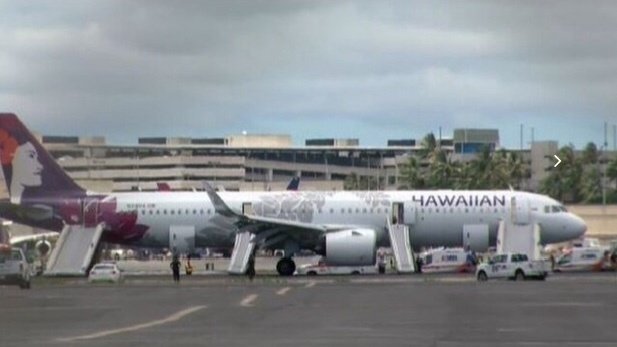
Photo: Hawaii News Now.
Another serious fume event occurred yesterday, very similar to the British Airways evacuation in Valencia on 5th August 2019.
Jon Snook, chief operations officer at Hawaiian, said the five adults and two children taken to hospitals were suffering from “smoke-related symptoms.” Their injuries did not appear to be severe.
That is rather a presumptuous observation from Mr. Snook because 1. He is not medically qualified and 2. He cannot possibly rule out long-term health issues from inhaling poisonous fumes onboard that aircraft.
It is similar to all statements from the Airline Industry, the HSE, the UK Government and the Commission on Toxicity (COT) to DENY that the fumes and smoke from engine oil and hydraulic fluids are harmful to health. Statements such as “Levels observed in the flights that formed part of the study were comparable to those typically experienced in domestic settings.” (Cranfield Study)
or from the CAA -
‘From what is currently known about the concentrations of potentially toxic chemicals in contaminated air, long-term toxic effects would not be expected, but this remains an area of scientific uncertainty.’
The science is available to anyone who can be bothered to look for it.
A study released yesterday by the New England Journal of Medicine (22 August 2019) explains the long-term health effects and deaths from pollution. Being trapped inside an aircraft is an even worse situation - particularly during a fume event. It is important to note that particulate matter from harmful chemicals is released into aircraft even during ‘normal operations’.
https://www.nejm.org/doi/10.1056/NEJMoa1817364
‘There is no 'safe' level of exposure, scientists said, suggesting current air quality guidelines don't protect public health.
Scientists found when levels of pollution spike, so do the number of deaths, including those from heart failure, asthma and lung diseases..
Tiny particles, called particulate matter (PM) can be inhaled deep into the lungs where they irritate the lining and enter the bloodstream.’ - Bearnairdine Beaumont - Aerotoxic Team.
More Evidence:
http://www.iasa.com.au/folders/Safety_Issues/Cabin_Safety/aopis.html
From George Bates - Boeing Engineer - 2007:
‘Bottom line is I think we are looking for a tombstone before anyone with any horsepower is going to take interest’.

How much more evidence do they need?
How many more studies are needed until this constant poisoning of passengers and airline crew is stopped?