Are School Image Policies Publication-Centred or Child-Centred?

Over the past few months, reflecting on my own experience with my child's school's image policies, I've come to realise this issue raises broader questions than image consent alone. It has led me to ask what principles should guide school image policies.
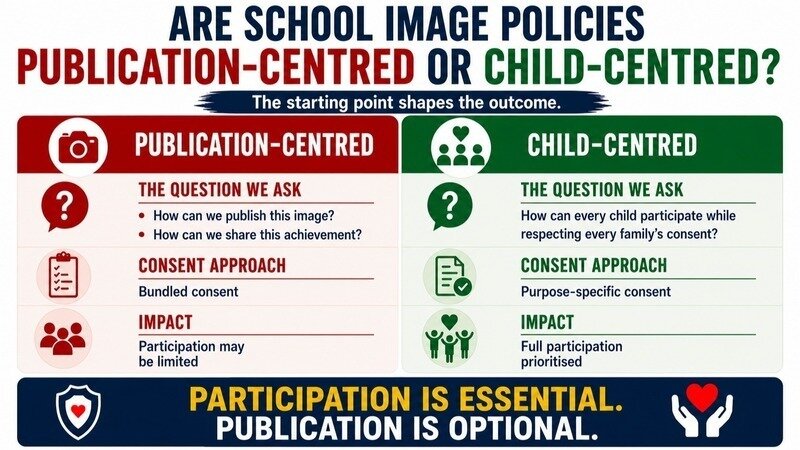
What is the guiding principle behind school image policies?
Should policies be designed around image publication?
Or should they be designed around children's participation, inclusion and wellbeing?
I believe the starting point matters because it shapes the outcome.
If policies begin with image publication, the question is:
"How can we publish this image?"
"How can we share this achievement?"
If they begin with the child, the question is:
"How can we celebrate this achievement while ensuring every child participates and every family's consent decisions are respected?"
Those aren't the same question, and they can lead to very different outcomes.
If image publication drives policy, children's participation may be adapted to suit publication. If participation, inclusion and wellbeing drive policy, image publication is adapted to suit the child.
For example, using a publication-centred approach, if a dance performance or group photo is intended for public sharing, a child without the relevant image consent may be asked not to appear in the recording or photograph so the image can be shared publicly. In a child-centred approach, every child participates in the activity. The school then determines whether the image should be shared publicly, shared through another channel, or not shared at all, in accordance with each family's consent decisions.
That distinction has become even more relevant in light of new guidance released today.
Today, Australia's eSafety Commissioner released new guidance highlighting the increased risks of sharing school images in the age of AI. The guidance encourages schools to think carefully about why images are shared, how they are shared, and the risks involved.
Importantly, the guidance doesn't suggest schools should stop celebrating students. Rather, it encourages thoughtful decision-making about image sharing while protecting students from emerging risks.
Perhaps the time has come to rethink not just how schools seek consent, but what their image policies are designed to achieve.
Good policy shouldn't force a choice between privacy and participation.
Participation is essential.
Publication is optional.
Further reading:
New guidance published today (28 July 2026)
Australia's eSafety Commissioner: Sharing school imagery in the age of AI – risks, deepfakes and how to protect students and staff