A view from the shore...

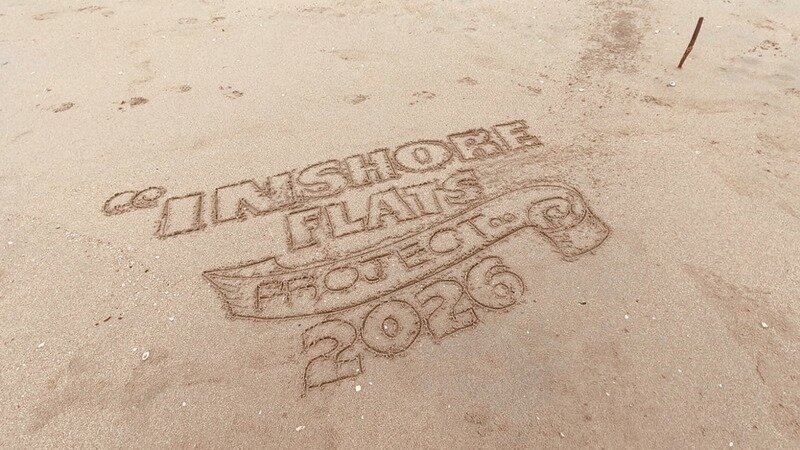
Sharing two things with you, our supporters.
The first is a photo of our name, etched in the sand, by some of our supporters at Lucinda, QLD. Lucinda is one of the places where the tunnel nets have been trialled.
The second is a piece of writing by another supporter. It's an account of what it might be like to witness a tunnel net in operation from the town beach in Bowen, QLD. Bowen is another place where tunnel nets have been trialled.
Enjoy, and from all of us at The Inshore Flats Project, a big thank you for your support.
Tunnel Vision: A View from the Shore, by Steven Burley
I imagine myself a visitor watching from the shoreline as the crew arrive, fanning out in three dorys. The beach is wide and the water a rich graded-blue, glinting in the sun. It is full tide on the sand flats out of Bowen. Sometimes I see a turtle. A while back a friend saw a dugong. There are always rays and fish cruising the shallows, dining on crustaceans buried in the sand. It is fun to walk the shoreline as the tide drains, seeing the channels and rivulets exposed. Thousands of crabs then parade, safe for the moment from the Trevally, Permit and rays.
The men are working now, one dory dragging a net left, the other dragging a net right. Two dories moving in opposite directions, spooling it out from the centre. Blue floats tie it to the surface while weights drop to anchor it to the sand. Every now and then the boats pause to drive a post in, fixing it in position. To my left the net goes on and on. It is the same on my right.
I like to go for a swim along the beach at home in NSW. For me, anything more than 1 km is too long in the water and so I swim 500m out to my favourite pine tree and 500m back. Good exercise but not too tiring. These blokes are putting their nets further. About 800 m to the right and 800 m to the left. A long swim. They carry on, bringing the final section right up to the beach, hammering in posts all of the way.
The workers in the central dory have not been idle. At the centre of the wings is a gap and beyond it a smaller enclosure, perhaps 100 m wide. A holding pen made of the same net fixed with more posts. Nothing gets out of there.
I realise what is happening. This is gravity-fed trawling of the beach. As the tide drains, everything swimming in it follows the water down, from sharks to rays to turtles to baitfish to juvenile fish to full-size adults. As if to confirm this, I see that in the lowermost point of the holding pen is a metal grate and a final, small pen. Perhaps a killing zone, I wonder.
It is now mid tide and the wing-nets have funnelled everything into the holding pen. Skittish schools of fish anxiously traipse back and forth. A turtle bumps the netting. Imagining myself to be a fish, I feel a sense of panic as the water drains further leaving less and less room to swim, more and more bodies to bump. Predator and prey alike.
Another hour and the final dregs of the tide are almost done. The sand flats are all but exposed. The killing zone is full of fish. Everything is caught.
A worker stands with a large scoop and piles the fish into a basin in the central dory. It must be hard work. Hand over hand he picks it up and dumps the catch down. Men on board sort them out.
I see some by-catch thrown back in, some floating belly-up soon after, some perhaps reviving and swimming away. The problem is that the by-catch is food for someone.
At home, the pelicans and cormorants would be waiting for a free feed. But in these tropical waters I have no doubt that the sharks will be quickly onto this caper too.
Now back in the holding pen, the metal gate has kept some creatures from entering the killing zone. It is designed to keep turtles, big rays, dugong and other such things out. I wonder how a fisherman will handle a big ray, or shepherd the many large turtles over the net-wings. Or how will the crew manage the dugong, the one my friend saw here, if it is trapped and needs to be released?
No doubt there are answers to some of these questions, but what does it mean in the long-run, for the local beach?
More than 50 species were caught during the tunnel net trials. They have swum in these waters for centuries. They form part of an ecosystem. In a World Heritage Area. A single gravity-trawl can catch over 6,000 fish, weighing over 2 tonnes, from a single beach. Unsurprisingly, 97% of the catch were either by-catch or low commercial value fish.
Without banging on about facts and figures, one wonders how it can possibly be worthwhile. One of the best places in Australia for recreational fishing, with the millions of dollar value accompanying it, will be scraped and sorted for paltry returns. The high volume harvesting of GTs, golden trevally, permit and more, at each tunnel net site, will decimate the flats.
And all for what? How many tides of gravity trawling can a sand flat sustain before the fish are gone?