Stand Against Racial Hate,Ethnic Persecution and Protect Indigenous Afar Rights in Eritrea
Stand Against Racial Hate,Ethnic Persecution and Protect Indigenous Afar Rights in Eritrea
The Issue
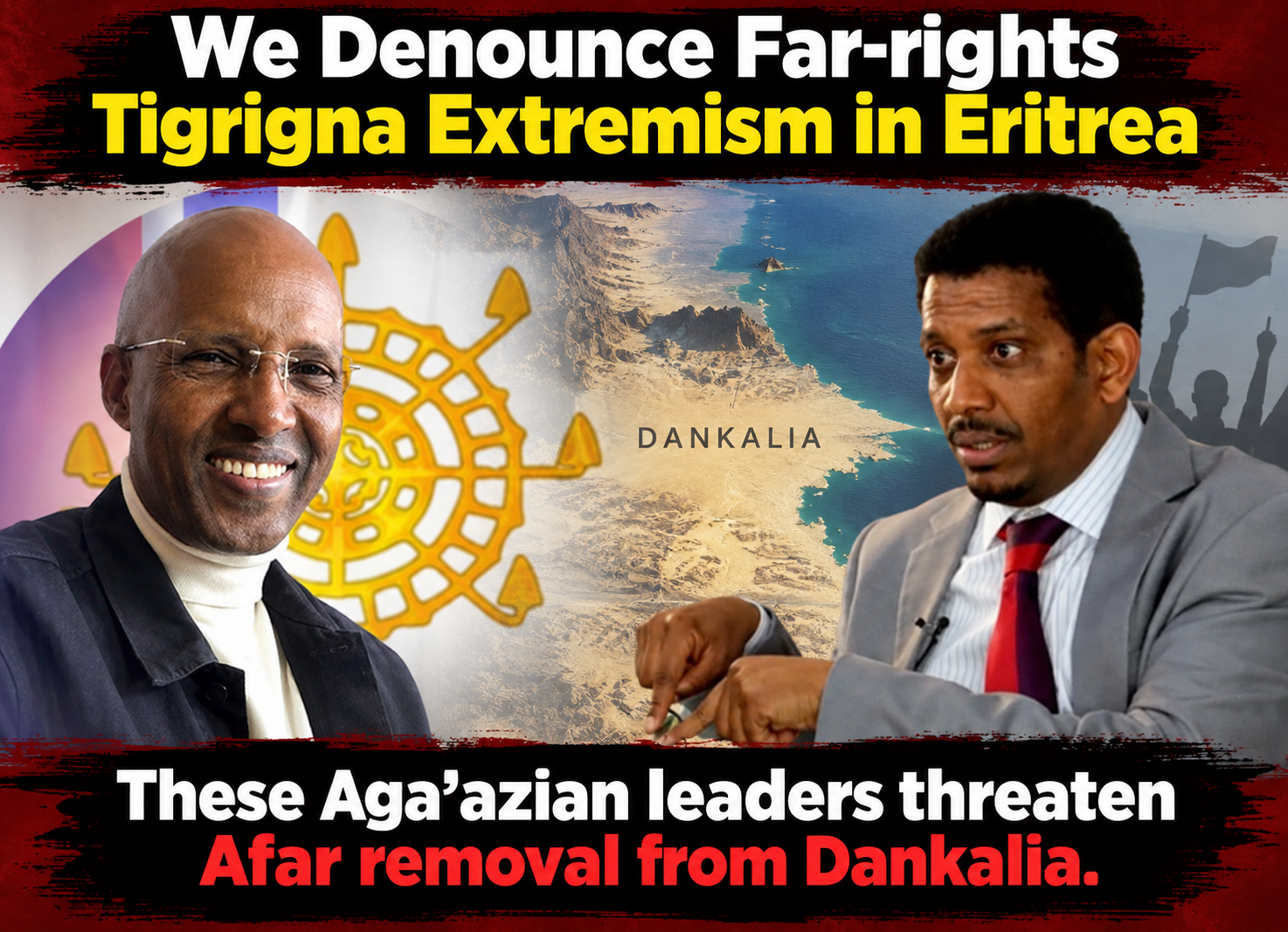
The indigenous Afar nation in Eritrea is facing a dangerous dual threat: systematic state-led ethnic persecution on the ground, and a rising wave of far-right extremist hate speech advocating for their ethnic expulsion.
Recently, Dr. Habtom Mehari Ghebrezghiabher, director of the Israel-based far-right Tigrinya nationalist movement Agaiazian Media and Education Centre (AMEC), published statements claiming that the ethnic Afar are "not indigenous to Eritrea" and calling for them to be "expelled back to where they came from." He further claimed that only the Tigrinya have the right to self-determination and that no other tribal or clan group possesses such a right. See article here https://habtomghebrezghiabher.substack.com/p/the-afar-tribal-clans-are-not-indigenous
This follows earlier dehumanizing statements by Aga'azian founder Tesfazion Gebre Selassie (Eyob Medhanie), who referred to the Afar as a "starving, cholera-affected minority" that should be imprisoned, explicitly denying their humanity and claiming Afar homelands as exclusively Tigrinya territory. See clip here https://youtu.be/tt-qQCJVWTM?si=xugmasNS8dZSqz98
Words Precede Atrocity Crimes
As UN Secretary-General António Guterres warned:
"The Holocaust didn’t start with the gas chambers. The genocides in Rwanda and Cambodia didn’t start with mass killings. They started with discrimination & hate speech."
The Afar people are long-established indigenous pastoralists whose presence in the Horn of Africa spans millennia, supported by extensive archaeological findings—such as the one-million-year-old Homo cranium from Buya in the Danakil Depression—and historical treaties with colonial powers. Indigenous rights experts recognize the Afar, Saho, Kunama, and Nara as indigenous peoples of Eritrea.
Yet, since 1991, the Eritrean government has systematically targeted the Afar through mass murder of leadership, destruction of customary law, economic blockades on traditional fishing and trade, and the confiscation of ancestral lands in Dankalia, Assab, and strategic Red Sea coastlines. Independent United Nations investigations have concluded that these acts amount to crimes against humanity and ethnic persecution.
What We Are Demanding
We call on the international human rights community, the Eritrean diaspora, and all democratic forces to act immediately:
Denounce Diaspora Extremism: We urge all Eritrean democratic opposition groups, civil society, and diaspora leaders to explicitly condemn the far-right Aga'azian movement and reject any ideology advocating for the expulsion or disenfranchisement of indigenous non-Tigrinya populations.
International Action & Accountability: We request that the UN Human Rights Council and UN Special Rapporteurs increase monitoring and investigations into ongoing state-sponsored crimes against humanity targeting the Afar in Eritrea.
Constitutional Guarantees: We demand that any future democratic transition in Eritrea guarantee internal self-determination, land rights, and constitutional protections for the Afar, Saho, Kunama, Nara, and all indigenous communities.
Sign and Share This Petition Today
By signing, you stand against ethnic hatred, protect indigenous rights, and demand a free, democratic, and inclusive future for all peoples of Eritrea.
Initiated by: Ahmed Y. Mohamed
President, Eritrean Afar National Congress
Ottawa, Canada
Reference & Full Statement Document
For detailed context, archaeological references, UN reports, and historical treaty citations, read the full official release statement:
Responding to Racial Hatred and Incitement of Violence Against the Afar Nation in Eritrea
Ottawa, Canada
September 18, 2026
Dr. Habtom Mehari Ghebrezghiabher, director of the Agaiazian Media and Education Centre (AMEC)—an Israel-based, far-right Tigrinya nationalist movement—recently published an article claiming that the ethnic Afar are "not indigenous to Eritrea" and calling for them to be "expelled back to where they came from." He further asserted that "only the Tigrinya—the highly homogeneous and overwhelming majority—constitute an indigenous nation and have the right to self-determination. No other tribal or clan group has such a right."
Threatening an entire ethnic group with forced removal from their ancestral homeland is extreme rhetoric that must not be taken lightly. This statement is particularly alarming because it originates from a group positioning itself within the Eritrean opposition against President Isaias Afwerki’s regime, which the far-right Aga'azian movement claims to oppose from the diaspora.
This is not an isolated incident. In 2017, the UK-based founder of the Aga'azian movement, Tesfazion Gebre Selassie (also known as Eyob Medhanie), escalated this hate speech even further. In a recorded video statement, he characterized the Afar as a "starving, cholera-affected minority" that should be imprisoned, reiterating the extremist claim that Afar territories are exclusively Tigrinya land and dehumanizing the Afar people by asserting that his group does not consider them human.
Tragically, the indigenous Afar in Eritrea are already enduring the very displacement and subjugation advocated by these far-right extremists. Since Eritrea gained independence in 1991, the state has systematically and violently targeted the Afar population on an ethnic basis. These abuses include the mass murder of Afar leadership, the destruction of traditional customary laws and social structures, and severe economic embargoes targeting traditional Afar livelihoods such as fishing, pastoralism, and regional trade. These ongoing oppressions have systematically forced large numbers of the Afar population to flee their traditional territories.
Furthermore, the state has instituted discriminatory land policies designed to dispossess the Afar of their strategically critical resources—including potash-rich regions, the Red Sea coastline, fishing grounds, and the Port of Assab—by declaring all land and resources in Dankalia (the traditional Afar homeland) to be state-owned property. This systemic dispossession continues to fuel an ongoing exodus of Afar refugees into neighboring Djibouti, Yemen, and Ethiopia.
These actions have not gone unnoticed internationally. Independent United Nations investigations, including reports by UN Special Rapporteurs on the situation of human rights in Eritrea, have concluded that the Eritrean government has committed crimes against humanity and systematic ethnic persecution against the Afar people.
Warning to the World: Protection Against Genocide and Racial Hatred of the Afar in Eritrea
"The Holocaust didn’t start with the gas chambers. The genocides in Rwanda and Cambodia didn’t start with mass killings. They started with discrimination & hate speech. Let’s pay tribute to genocide victims by fighting for prevention through equality – in our words & actions." — António Guterres, UN Secretary-General
The deep-rooted preexistence and indigeneity of the Afar people in the Horn of Africa are backed by both modern international human rights frameworks and extensive archaeological evidence. Fossil discoveries in the Danakil (Afar) Depression—such as the one-million-year-old Homo cranium found in Buya, Eritrea, which exhibits traits of both Homo erectus and Homo sapiens—attest to an ancient, continuous human presence in the traditional Afar homelands. Historically, the Afar operated as independent sultanates with a documented presence spanning millennia. They maintained their sovereignty by fiercely resisting external foreign incursions and Abyssinian highland intrusions into their territories as early as the 1500s, as well as resisting 19th-century European colonial powers, with whom they negotiated 19 separate international agreements and treaties. In international law, international legal experts and UN Special Rapporteurs recognize the Afar as long-established, distinct indigenous pastoralist communities who maintain an unbroken, ancestral connection to their land and traditional maritime territories.
In contrast to extremist claims asserting exclusive dominion, indigenous rights experts and international organizations like the International Work Group for Indigenous Affairs (IWGIA) recognize four primary indigenous groups in Eritrea: the Afar, the Saho, the Kunama, and the Nara (historically referenced as Baria). Historical analysis demonstrates that Tigrinya-speaking groups are relatively recent arrivals to the Eritrean highlands, having migrated northward from the highlands of Tigray into present-day Eritrea. Despite this historical record, far-right extremist rhetoric continues to deny Afar indigeneity, echoing the state-sponsored marginalization and violent dispossession that the UN Special Rapporteur on the situation of human rights in Eritrea has warned constitutes severe human rights violations and systematic ethnic persecution.
A Call to Action for the Eritrean Diaspora and Democratic Forces
The Eritrean government's deliberate policies and systematic use of violence have severely weakened the Afar nation, creating a vulnerable environment where far-right extremist groups like the Aga'azian feel emboldened to advocate for ethnic cleansing and total displacement. It is precisely because of this state-inflicted vulnerability that protecting indigenous minorities must be elevated to an urgent priority—not only under the current autocratic regime but as a foundational pillar for the future democratization of Eritrea.
We urgently call upon the broader international human rights mechanism, the Eritrean diaspora, and all democratic opposition forces to unequivocally denounce these vile extremist groups and distance themselves from ideologies that threaten Eritrea’s multicultural and diverse composition. Silence in the face of ethnic hatred only fuels the machinery of division and violence. Democratic actors must stand firmly in defense of the internal self-determination of their fellow Afar citizens, advocating for robust constitutional protections that secure Afar identity, culture, ancestral lands, and territorial rights in a post-regime, democratic Eritrea.
Ahmed Y. Mohamed, President, Eritrean Afar National Congress
References and Source Links
1. United Nations Secretary-General António Guterres — Genocide Prevention and Hate Speech. In his 2019 message for the International Day of Commemoration and Dignity of the Victims of the Crime of Genocide, Guterres stated that the Holocaust and the genocides in Rwanda, Srebrenica and Cambodia were preceded by “discrimination, hate speech, incitement to violence and the dehumanization of ‘the other’.” (United Nations) UN Secretary-General — International Day of Commemoration of Victims of Genocide
2. International Work Group for Indigenous Affairs (IWGIA), The Indigenous World 2026: Eritrea. IWGIA identifies at least four Indigenous Peoples in Eritrea: the Afar, Kunama, Saho and Nara, and states that these peoples have inhabited their traditional territories for approximately 2,000 years. (IWGIA) IWGIA — The Indigenous World 2026: Eritrea
3. UN Special Rapporteur on the Situation of Human Rights in Eritrea, Mohamed Abdelsalam Babiker, A/HRC/53/20 (2023). The report contains a dedicated section on the “Situation of the Afar Indigenous communities” and identifies the Afar as Indigenous to Eritrea. It discusses discrimination, arbitrary arrests, disappearances, violence, persecution and interference with traditional Afar livelihoods.
OHCHR — UN Special Rapporteur country documentation on Eritrea
4. Abbate, Ernesto, et al. (1998), “A One-Million-Year-Old Homo Cranium from the Danakil (Afar) Depression of Eritrea,” Nature, 393, 458–460. Researchers discovered a well-preserved Homo cranium in the Northern Danakil (Afar) Depression of Eritrea, dated to approximately one million years ago. The specimen displayed a combination of characteristics associated with Homo erectus and Homo sapiens. This establishes the extraordinary prehistoric importance of the Danakil landscape, although the fossil itself should not be characterized as ethnically Afar. (Nature)Nature — A One-Million-Year-Old Homo Cranium from the Danakil (Afar) Depression of Eritrea
PubMed — Abbate et al., 1998
5. Assab Agreement, 15 November 1869. The surviving agreement records Hassan ben Ahmad and Ibrahim ben Ahmad as “Sultans of Assab” and documents their agreement with Giuseppe Sapeto concerning territory around Assab. Whatever interpretation is given to the colonial transaction itself, the document is direct nineteenth-century evidence that European expansion at Assab encountered pre-existing local political authorities rather than an uninhabited territory. (Wikisource)
Primary text — 1869 Agreement concerning the Bay of Assab
6. United Nations — “Hate Speech and Real Harm.” The UN emphasizes that the Holocaust did not begin with gas chambers but with hate speech against a minority, illustrating the relationship between dehumanization, discriminatory propaganda and subsequent atrocity crimes. (United Nations)
United Nations — Hate Speech and Real Harm
7. United Nations — “The Shocking Link Between Hate Speech and Genocide.” This UN resource discusses hate speech and dehumanization as potential precursors to atrocity crimes and examines historical examples including the Holocaust, Rwanda and Srebrenica. (United Nations)
United Nations — The Shocking Link Between Hate Speech and Genocide
67
The Issue
The indigenous Afar nation in Eritrea is facing a dangerous dual threat: systematic state-led ethnic persecution on the ground, and a rising wave of far-right extremist hate speech advocating for their ethnic expulsion.
Recently, Dr. Habtom Mehari Ghebrezghiabher, director of the Israel-based far-right Tigrinya nationalist movement Agaiazian Media and Education Centre (AMEC), published statements claiming that the ethnic Afar are "not indigenous to Eritrea" and calling for them to be "expelled back to where they came from." He further claimed that only the Tigrinya have the right to self-determination and that no other tribal or clan group possesses such a right. See article here https://habtomghebrezghiabher.substack.com/p/the-afar-tribal-clans-are-not-indigenous
This follows earlier dehumanizing statements by Aga'azian founder Tesfazion Gebre Selassie (Eyob Medhanie), who referred to the Afar as a "starving, cholera-affected minority" that should be imprisoned, explicitly denying their humanity and claiming Afar homelands as exclusively Tigrinya territory. See clip here https://youtu.be/tt-qQCJVWTM?si=xugmasNS8dZSqz98
Words Precede Atrocity Crimes
As UN Secretary-General António Guterres warned:
"The Holocaust didn’t start with the gas chambers. The genocides in Rwanda and Cambodia didn’t start with mass killings. They started with discrimination & hate speech."
The Afar people are long-established indigenous pastoralists whose presence in the Horn of Africa spans millennia, supported by extensive archaeological findings—such as the one-million-year-old Homo cranium from Buya in the Danakil Depression—and historical treaties with colonial powers. Indigenous rights experts recognize the Afar, Saho, Kunama, and Nara as indigenous peoples of Eritrea.
Yet, since 1991, the Eritrean government has systematically targeted the Afar through mass murder of leadership, destruction of customary law, economic blockades on traditional fishing and trade, and the confiscation of ancestral lands in Dankalia, Assab, and strategic Red Sea coastlines. Independent United Nations investigations have concluded that these acts amount to crimes against humanity and ethnic persecution.
What We Are Demanding
We call on the international human rights community, the Eritrean diaspora, and all democratic forces to act immediately:
Denounce Diaspora Extremism: We urge all Eritrean democratic opposition groups, civil society, and diaspora leaders to explicitly condemn the far-right Aga'azian movement and reject any ideology advocating for the expulsion or disenfranchisement of indigenous non-Tigrinya populations.
International Action & Accountability: We request that the UN Human Rights Council and UN Special Rapporteurs increase monitoring and investigations into ongoing state-sponsored crimes against humanity targeting the Afar in Eritrea.
Constitutional Guarantees: We demand that any future democratic transition in Eritrea guarantee internal self-determination, land rights, and constitutional protections for the Afar, Saho, Kunama, Nara, and all indigenous communities.
Sign and Share This Petition Today
By signing, you stand against ethnic hatred, protect indigenous rights, and demand a free, democratic, and inclusive future for all peoples of Eritrea.
Initiated by: Ahmed Y. Mohamed
President, Eritrean Afar National Congress
Ottawa, Canada
Reference & Full Statement Document
For detailed context, archaeological references, UN reports, and historical treaty citations, read the full official release statement:
Responding to Racial Hatred and Incitement of Violence Against the Afar Nation in Eritrea
Ottawa, Canada
September 18, 2026
Dr. Habtom Mehari Ghebrezghiabher, director of the Agaiazian Media and Education Centre (AMEC)—an Israel-based, far-right Tigrinya nationalist movement—recently published an article claiming that the ethnic Afar are "not indigenous to Eritrea" and calling for them to be "expelled back to where they came from." He further asserted that "only the Tigrinya—the highly homogeneous and overwhelming majority—constitute an indigenous nation and have the right to self-determination. No other tribal or clan group has such a right."
Threatening an entire ethnic group with forced removal from their ancestral homeland is extreme rhetoric that must not be taken lightly. This statement is particularly alarming because it originates from a group positioning itself within the Eritrean opposition against President Isaias Afwerki’s regime, which the far-right Aga'azian movement claims to oppose from the diaspora.
This is not an isolated incident. In 2017, the UK-based founder of the Aga'azian movement, Tesfazion Gebre Selassie (also known as Eyob Medhanie), escalated this hate speech even further. In a recorded video statement, he characterized the Afar as a "starving, cholera-affected minority" that should be imprisoned, reiterating the extremist claim that Afar territories are exclusively Tigrinya land and dehumanizing the Afar people by asserting that his group does not consider them human.
Tragically, the indigenous Afar in Eritrea are already enduring the very displacement and subjugation advocated by these far-right extremists. Since Eritrea gained independence in 1991, the state has systematically and violently targeted the Afar population on an ethnic basis. These abuses include the mass murder of Afar leadership, the destruction of traditional customary laws and social structures, and severe economic embargoes targeting traditional Afar livelihoods such as fishing, pastoralism, and regional trade. These ongoing oppressions have systematically forced large numbers of the Afar population to flee their traditional territories.
Furthermore, the state has instituted discriminatory land policies designed to dispossess the Afar of their strategically critical resources—including potash-rich regions, the Red Sea coastline, fishing grounds, and the Port of Assab—by declaring all land and resources in Dankalia (the traditional Afar homeland) to be state-owned property. This systemic dispossession continues to fuel an ongoing exodus of Afar refugees into neighboring Djibouti, Yemen, and Ethiopia.
These actions have not gone unnoticed internationally. Independent United Nations investigations, including reports by UN Special Rapporteurs on the situation of human rights in Eritrea, have concluded that the Eritrean government has committed crimes against humanity and systematic ethnic persecution against the Afar people.
Warning to the World: Protection Against Genocide and Racial Hatred of the Afar in Eritrea
"The Holocaust didn’t start with the gas chambers. The genocides in Rwanda and Cambodia didn’t start with mass killings. They started with discrimination & hate speech. Let’s pay tribute to genocide victims by fighting for prevention through equality – in our words & actions." — António Guterres, UN Secretary-General
The deep-rooted preexistence and indigeneity of the Afar people in the Horn of Africa are backed by both modern international human rights frameworks and extensive archaeological evidence. Fossil discoveries in the Danakil (Afar) Depression—such as the one-million-year-old Homo cranium found in Buya, Eritrea, which exhibits traits of both Homo erectus and Homo sapiens—attest to an ancient, continuous human presence in the traditional Afar homelands. Historically, the Afar operated as independent sultanates with a documented presence spanning millennia. They maintained their sovereignty by fiercely resisting external foreign incursions and Abyssinian highland intrusions into their territories as early as the 1500s, as well as resisting 19th-century European colonial powers, with whom they negotiated 19 separate international agreements and treaties. In international law, international legal experts and UN Special Rapporteurs recognize the Afar as long-established, distinct indigenous pastoralist communities who maintain an unbroken, ancestral connection to their land and traditional maritime territories.
In contrast to extremist claims asserting exclusive dominion, indigenous rights experts and international organizations like the International Work Group for Indigenous Affairs (IWGIA) recognize four primary indigenous groups in Eritrea: the Afar, the Saho, the Kunama, and the Nara (historically referenced as Baria). Historical analysis demonstrates that Tigrinya-speaking groups are relatively recent arrivals to the Eritrean highlands, having migrated northward from the highlands of Tigray into present-day Eritrea. Despite this historical record, far-right extremist rhetoric continues to deny Afar indigeneity, echoing the state-sponsored marginalization and violent dispossession that the UN Special Rapporteur on the situation of human rights in Eritrea has warned constitutes severe human rights violations and systematic ethnic persecution.
A Call to Action for the Eritrean Diaspora and Democratic Forces
The Eritrean government's deliberate policies and systematic use of violence have severely weakened the Afar nation, creating a vulnerable environment where far-right extremist groups like the Aga'azian feel emboldened to advocate for ethnic cleansing and total displacement. It is precisely because of this state-inflicted vulnerability that protecting indigenous minorities must be elevated to an urgent priority—not only under the current autocratic regime but as a foundational pillar for the future democratization of Eritrea.
We urgently call upon the broader international human rights mechanism, the Eritrean diaspora, and all democratic opposition forces to unequivocally denounce these vile extremist groups and distance themselves from ideologies that threaten Eritrea’s multicultural and diverse composition. Silence in the face of ethnic hatred only fuels the machinery of division and violence. Democratic actors must stand firmly in defense of the internal self-determination of their fellow Afar citizens, advocating for robust constitutional protections that secure Afar identity, culture, ancestral lands, and territorial rights in a post-regime, democratic Eritrea.
Ahmed Y. Mohamed, President, Eritrean Afar National Congress
References and Source Links
1. United Nations Secretary-General António Guterres — Genocide Prevention and Hate Speech. In his 2019 message for the International Day of Commemoration and Dignity of the Victims of the Crime of Genocide, Guterres stated that the Holocaust and the genocides in Rwanda, Srebrenica and Cambodia were preceded by “discrimination, hate speech, incitement to violence and the dehumanization of ‘the other’.” (United Nations) UN Secretary-General — International Day of Commemoration of Victims of Genocide
2. International Work Group for Indigenous Affairs (IWGIA), The Indigenous World 2026: Eritrea. IWGIA identifies at least four Indigenous Peoples in Eritrea: the Afar, Kunama, Saho and Nara, and states that these peoples have inhabited their traditional territories for approximately 2,000 years. (IWGIA) IWGIA — The Indigenous World 2026: Eritrea
3. UN Special Rapporteur on the Situation of Human Rights in Eritrea, Mohamed Abdelsalam Babiker, A/HRC/53/20 (2023). The report contains a dedicated section on the “Situation of the Afar Indigenous communities” and identifies the Afar as Indigenous to Eritrea. It discusses discrimination, arbitrary arrests, disappearances, violence, persecution and interference with traditional Afar livelihoods.
OHCHR — UN Special Rapporteur country documentation on Eritrea
4. Abbate, Ernesto, et al. (1998), “A One-Million-Year-Old Homo Cranium from the Danakil (Afar) Depression of Eritrea,” Nature, 393, 458–460. Researchers discovered a well-preserved Homo cranium in the Northern Danakil (Afar) Depression of Eritrea, dated to approximately one million years ago. The specimen displayed a combination of characteristics associated with Homo erectus and Homo sapiens. This establishes the extraordinary prehistoric importance of the Danakil landscape, although the fossil itself should not be characterized as ethnically Afar. (Nature)Nature — A One-Million-Year-Old Homo Cranium from the Danakil (Afar) Depression of Eritrea
PubMed — Abbate et al., 1998
5. Assab Agreement, 15 November 1869. The surviving agreement records Hassan ben Ahmad and Ibrahim ben Ahmad as “Sultans of Assab” and documents their agreement with Giuseppe Sapeto concerning territory around Assab. Whatever interpretation is given to the colonial transaction itself, the document is direct nineteenth-century evidence that European expansion at Assab encountered pre-existing local political authorities rather than an uninhabited territory. (Wikisource)
Primary text — 1869 Agreement concerning the Bay of Assab
6. United Nations — “Hate Speech and Real Harm.” The UN emphasizes that the Holocaust did not begin with gas chambers but with hate speech against a minority, illustrating the relationship between dehumanization, discriminatory propaganda and subsequent atrocity crimes. (United Nations)
United Nations — Hate Speech and Real Harm
7. United Nations — “The Shocking Link Between Hate Speech and Genocide.” This UN resource discusses hate speech and dehumanization as potential precursors to atrocity crimes and examines historical examples including the Holocaust, Rwanda and Srebrenica. (United Nations)
United Nations — The Shocking Link Between Hate Speech and Genocide
The Decision Makers


Petition Updates
Share this petition
Petition created on September 19, 2026