High court has postponed the Criminal Medical Negligence trial. To find a Medical Assessor.

Court to consider appointing medical assessor for trial against surgeon Peter Beale
22 January 2024 - 14:15
Phathu Luvhengo
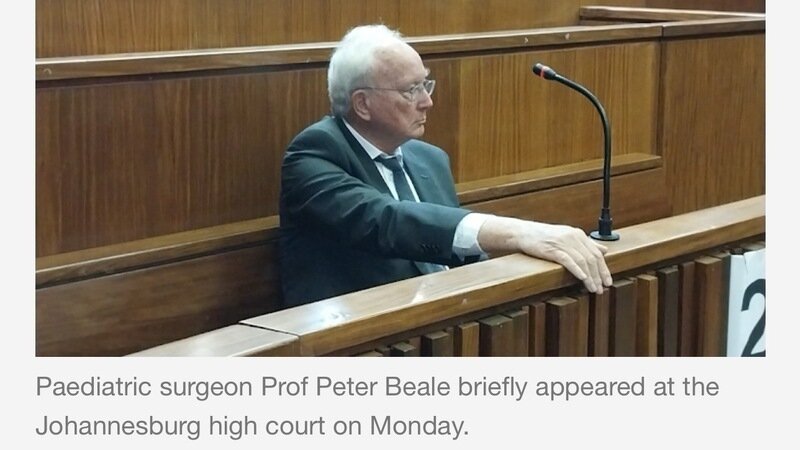
Paediatric surgeon Prof Peter Beale briefly appeared at the Johannesburg high court on Monday.
The Johannesburg high court has postponed the fraud and murder trial against paediatric surgeon Prof Peter Beale to Wednesday.
This is to allow the court to possibly appoint a medical assessor who will sit with the judge during the proceedings.
Beale, whose co-accused, anaesthetist Dr Abdulhay Munshi, was shot dead in September 2020, made a brief appearance in the Johannesburg high court on Monday.
The court heard it was in the interests of justice for the judge to consider sitting with an assessor.
Though no decision has been taken yet , the assessor, who could be a paediatric surgeon, would advise the judge on the medical aspects of the case during the trial.
Beale has been accused of three counts of murder and two counts of fraud.
TimesLIVE previously reported that despite the media having previously named the victims, the court ordered the names be withheld as requested by their families.
According to the indictment, Beale is accused of “unlawfully and intentionally” causing the death of a three-year-old boy in March 2012, a 21-month-old girl in July 2016 and a 10-year-old boy in October 2019 after he had operated on the children.
The fraud charges pertain to the pathology results he had given to the parents of the three-year-old boy and the 10-year-old boy in which, according to the indictment, he allegedly misrepresented facts with the intention to defraud.
In 2019, the Sunday Times reported families were blaming Beale for the children's deaths.
One Johannesburg family blamed Beale and claimed to the publication his actions and those of Munshi caused the agonising and traumatic death of their 10-year-old son.
TimesLIVE
WHAT ROLES, RESPONSIBILITIES AND IDEAL SKILLS SHOULD A MEDICAL ASSESSOR HAVE?
First, the assessor will almost invariably be required to prepare at an early stage by reading the expert opinions and the relevant medical literature in preparation for trial. This means the assessor should understand the facts that are being contended and more importantly, the technical issues that may have to be decided by the judge.
The assessor will often be asked to sit in for the trial, at least when technical evidence is being given. His second responsibility, therefore, is to be there for the judge to consult, either during the trial proper or before the trial. He can help the judge to understand the technical issues, to understand the effect and meaning of technical evidence, especially when the experts are being examined. He can also advise the judge as to the proper technical inferences to be drawn from proved facts, the shortcomings of an expert’s opinion, or the extent of the difference between apparently contradictory conclusions. One important way in which he can be actively involved is by suggesting questions for the judge to pose to an expert witness with a view to testing that witness’s view, to making plain his meaning or even to simply obtain an articulated basis for his opinion. It may even be possible for an assessor to directly pose questions to a witness.
Third, when the judge is preparing for the trial, the assessor may be required to act as his consultant or tutor. The assessor could be called upon to help the judge understand the technical issues and evidence, or to give the judge a general introduction to the field of study and to provide the “medical and scientific background and context which expert opinions may often assume without spelling out in detail”.
Fourth, the assessor might act as a court officer in the sense that he might be expected to assist the judge or the assistant registrar at pre-trial conferences, or preside at the meetings of experts. This could be done to help the lawyers or the experts reach agreement on certain issues, or to refine the issues being disputed.
Finally, after the trial, the assessor may be called to advise the judge based on the evidence that emerges. This could either take the form of informal oral advice or, in certain cases, a written opinion at some point in time.
The skills and qualities that a medical assessor should have?
First, it would be helpful for the medical assessor to be a bit of a lawyer. If he understands some rudimentary legal concepts, such as the burden of proof, and the elements of the tort of negligence, he can then understand the context in which the dispute arose, and he can frame the questions and his advice, and perhaps direct the parties’ experts in a way that suits the substance of the legal analysis. If he understands his role (as opposed to the role of experts), he will also be more aware of what he may say and what he may not.
Second, the assessor should be able to think like a researcher. He should be able to identify the flaws, limitations or shortcomings in the experts’ medical opinions, and he should be able to test their strength by formulating the appropriate questions. He should also be able to explain how the conclusion is affected if certain premises are changed. It would be an added bonus if the assessor can think on his feet as the evidence develops organically in court. The “right” questions to ask depend on the evidence that is being given in court, and it would be helpful for evidence to be clarified as it is given.
Third, the assessor should also be like a teacher. He should be able to educate the judge appropriately on the area in which he is an expert and which is required for the judge to dispose of the matter at hand. Ideally, he should also be able to highlight matters that are easy to misunderstand or often misunderstood, or even better, identify and correct any specific misunderstandings that the judge may have of the technical concepts. He should also be able to clearly articulate the basis for his opinion.