SMART Didn’t Study River Users in Healdsburg—Now It Wants to Skip Environmental Review

SMART Didn’t Study River Users in Healdsburg—Now It Wants to Skip Environmental Review
The Issue
SMART’s own Board discussion confirms the problem.
At its March 18, 2026 meeting, a Board member acknowledged that the Healdsburg Extension required new environmental analysis because rail operations today differ from what was assumed in the 2006 Environmental Impact Report—and then asked whether, if SMART relies on a new CEQA exemption (Senate Bill 71), that would prevent the public from challenging those differences.
General Counsel replied that “the intent is there…given if it’s in our right of way.”
This exchange shows that SMART knows the 2006 environmental report does not reflect current conditions, knows its newer analysis could be challenged, and is considering using exemptions to avoid that scrutiny rather than fix the gaps.
Under the California Environmental Quality Act (CEQA), that is backwards: agencies must fully study and disclose impacts before approval—not rely on outdated analysis and then seek to shield it from review.
The Background
On December 17, 2025, SMART’s Board approved its final environmental review despite two critical flaws:
- It repeatedly relied on conclusions from the 2006 EIR—even though that study never analyzed the Healdsburg extension.
- It failed to meaningfully analyze a known and obvious reality: people use the river under the bridge.
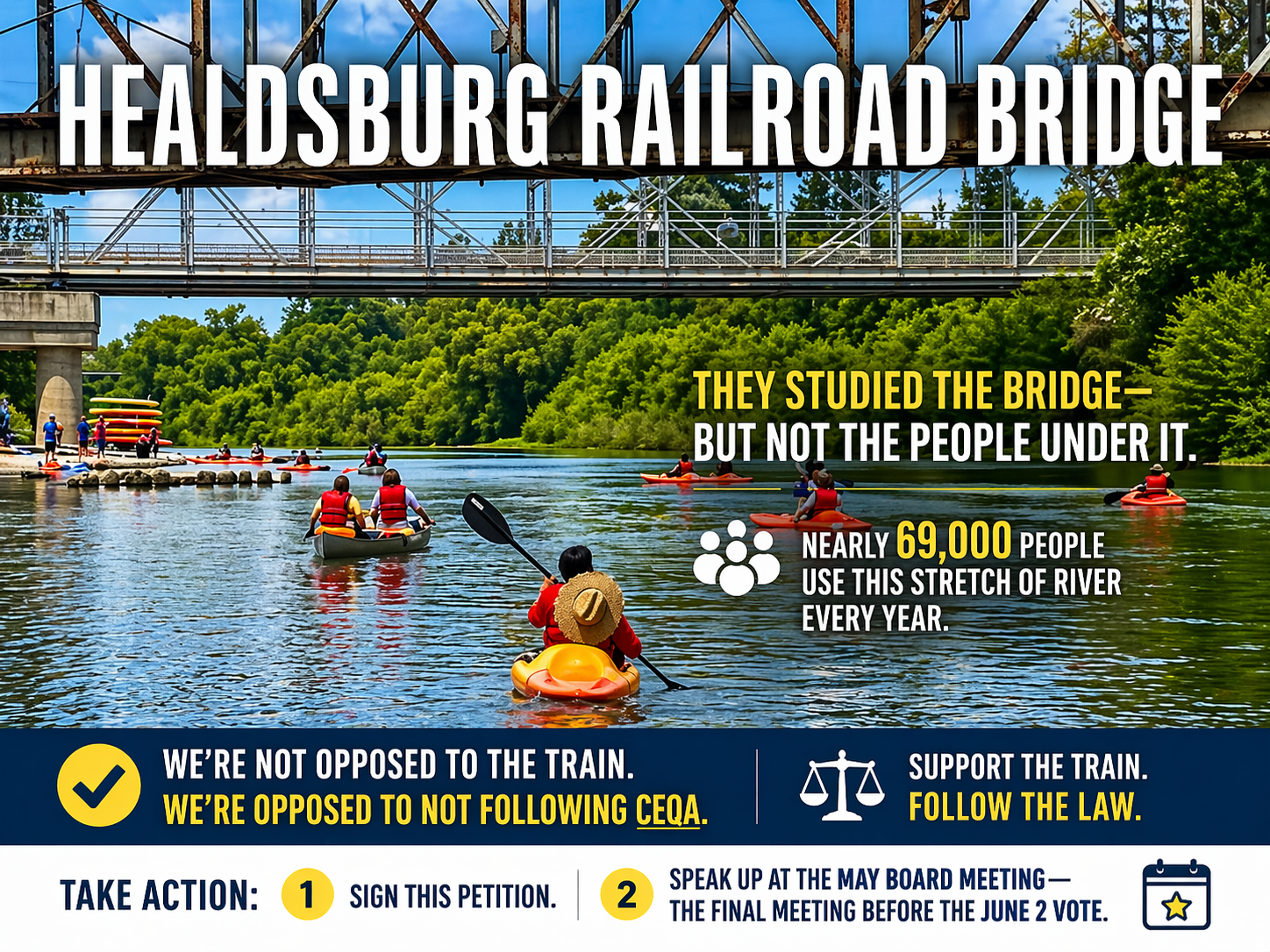
River use here is not hypothetical. River’s Edge Kayak and Canoe alone launches about 4,000 people each summer, all of whom pass beneath the bridge. Sonoma County Regional Parks reports roughly 65,000 visitors to Veterans Memorial Beach during peak season. Together, that’s nearly 69,000 people using this stretch of river every year.
The Core Problem
The California Environmental Quality Act (CEQA) requires agencies to study real-world conditions before approving a project. That includes how people actually use the environment.
But SMART never meaningfully analyzed the kayakers, swimmers, paddleboarders, anglers, and families who rely on this stretch of the Russian River.
That omission matters. It means:
- Decision-makers were not given a full picture
- The public could not meaningfully participate
- Claims of “no new or more severe impacts” are unsupported
Courts have made clear that this kind of informational gap violates CEQA’s core purpose: to inform decision-makers and the public, reduce harm, and prevent avoidable damage before it happens.
SMART Knows That The River Is Not In Its Right-Of-Way
SMART’s right-of-way is limited to the tracks and bridge structure. The Russian River itself—including the heavily used stretch between the bridge and Veterans Memorial Beach—is a public waterway.
The bridge may be SMART’s—but the river is public, and that’s where the impacts happen.
Impacts to this area must be analyzed as impacts to public use—not minimized as impacts confined to railroad property.
SMART is relying on a study that never looked at this location
SMART claims impacts are “less than significant” based on the 2006 EIR.
But that study:
Did not include the Healdsburg extension
Did not analyze river use at this bridge
Did not evaluate construction impacts in this location
You can’t claim impacts are insignificant in Healdsburg based on a study that never looked at Healdsburg.
Bottom Line
SMART’s own Board discussion confirms what the record already shows:
conditions today are different, impacts are being newly analyzed, and those impacts could be challenged.
Instead of addressing those differences with a full and honest environmental review, SMART is attempting to rely on outdated analysis and pursue exemptions to avoid scrutiny.
If the people using the river were not studied, then the impacts to the river were not studied—and CEQA requires a complete review before this project can move forward.
We’re not opposed to the train—we’re opposed to cutting corners.If this project moves forward, it must follow the California Environmental Quality Act and fully study its real impacts.
Take action now:
Step 1: Sign this petition to demand a full CEQA review that actually studies impacts to river users before construction begins.
Step 2: Show up and speak at the May 20, 2026 SMART Board meeting—the last meeting before the June 2 vote. Your voice matters.

195
The Issue
SMART’s own Board discussion confirms the problem.
At its March 18, 2026 meeting, a Board member acknowledged that the Healdsburg Extension required new environmental analysis because rail operations today differ from what was assumed in the 2006 Environmental Impact Report—and then asked whether, if SMART relies on a new CEQA exemption (Senate Bill 71), that would prevent the public from challenging those differences.
General Counsel replied that “the intent is there…given if it’s in our right of way.”
This exchange shows that SMART knows the 2006 environmental report does not reflect current conditions, knows its newer analysis could be challenged, and is considering using exemptions to avoid that scrutiny rather than fix the gaps.
Under the California Environmental Quality Act (CEQA), that is backwards: agencies must fully study and disclose impacts before approval—not rely on outdated analysis and then seek to shield it from review.
The Background
On December 17, 2025, SMART’s Board approved its final environmental review despite two critical flaws:
- It repeatedly relied on conclusions from the 2006 EIR—even though that study never analyzed the Healdsburg extension.
- It failed to meaningfully analyze a known and obvious reality: people use the river under the bridge.
River use here is not hypothetical. River’s Edge Kayak and Canoe alone launches about 4,000 people each summer, all of whom pass beneath the bridge. Sonoma County Regional Parks reports roughly 65,000 visitors to Veterans Memorial Beach during peak season. Together, that’s nearly 69,000 people using this stretch of river every year.
The Core Problem
The California Environmental Quality Act (CEQA) requires agencies to study real-world conditions before approving a project. That includes how people actually use the environment.
But SMART never meaningfully analyzed the kayakers, swimmers, paddleboarders, anglers, and families who rely on this stretch of the Russian River.
That omission matters. It means:
- Decision-makers were not given a full picture
- The public could not meaningfully participate
- Claims of “no new or more severe impacts” are unsupported
Courts have made clear that this kind of informational gap violates CEQA’s core purpose: to inform decision-makers and the public, reduce harm, and prevent avoidable damage before it happens.
SMART Knows That The River Is Not In Its Right-Of-Way
SMART’s right-of-way is limited to the tracks and bridge structure. The Russian River itself—including the heavily used stretch between the bridge and Veterans Memorial Beach—is a public waterway.
The bridge may be SMART’s—but the river is public, and that’s where the impacts happen.
Impacts to this area must be analyzed as impacts to public use—not minimized as impacts confined to railroad property.
SMART is relying on a study that never looked at this location
SMART claims impacts are “less than significant” based on the 2006 EIR.
But that study:
Did not include the Healdsburg extension
Did not analyze river use at this bridge
Did not evaluate construction impacts in this location
You can’t claim impacts are insignificant in Healdsburg based on a study that never looked at Healdsburg.
Bottom Line
SMART’s own Board discussion confirms what the record already shows:
conditions today are different, impacts are being newly analyzed, and those impacts could be challenged.
Instead of addressing those differences with a full and honest environmental review, SMART is attempting to rely on outdated analysis and pursue exemptions to avoid scrutiny.
If the people using the river were not studied, then the impacts to the river were not studied—and CEQA requires a complete review before this project can move forward.
We’re not opposed to the train—we’re opposed to cutting corners.If this project moves forward, it must follow the California Environmental Quality Act and fully study its real impacts.
Take action now:
Step 1: Sign this petition to demand a full CEQA review that actually studies impacts to river users before construction begins.
Step 2: Show up and speak at the May 20, 2026 SMART Board meeting—the last meeting before the June 2 vote. Your voice matters.
195
Supporter Voices
Petition Updates
Share this petition
Petition created on April 20, 2026