Heat pollution and local issues with national importance

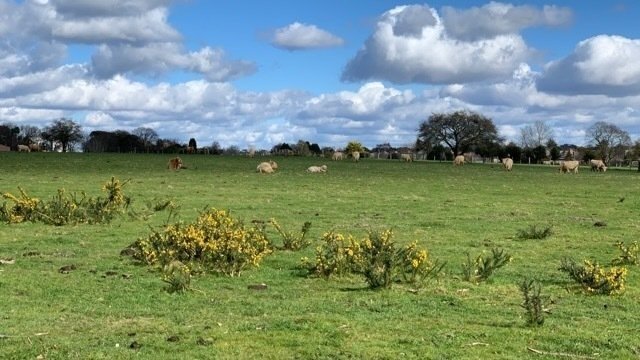
I recently found a very interesting article about urban green spaces. A new hospital on what would be the remnants of Highmoor Farm will not only create traffic, noise and light pollution but heat pollution too.
https://www.nhm.ac.uk/discover/why-we-need-green-spaces-in-cities.html
‘Green spaces in cities mitigate the effects of pollution and can reduce a phenomenon known as the urban heat island effect, which refers to heat trapped in built-up areas.
The urban heat island effect appears in towns and cities as a result of human activity. The heat generated by people, transport, shops and industry is trapped in the narrow roads and concrete structures, unable to escape to the atmosphere. This can bring the temperature in urban areas up 3-4°C higher than the surrounding countryside, and with that comes a vicious cycle.
Increased temperatures in summer leads to an increased demand for cooling. This expands our energy consumption, which in turn intensifies fossil fuel consumption, increasing pollutants in the air and harmful smog on our streets.
Hotter pavements also damage the water cycle. In summer, surface temperatures can be a staggering 50°C hotter than the surrounding air, and that heat is transferred to the rainwater that drains into our sewers, which in turn raises water temperatures as it is released into streams, rivers and lakes. This can be destructive to aquatic ecosystems, as changes in water temperature can be stressful or even fatal for marine life.’
This was written by Callum Mair for the Natural History Museum.
Nuffield Health purports to be interested in looking after an ageing population but it’s my belief that leaving the Farm as it is, would do far more for this section of the population than developing one of the last remaining green spaces in the area. Their pursuit of this development suggests that they are happy to benefit financially from an ageing population but perhaps don’t have the best interests of local people at heart, many of which will be part of that population. We help to resolve national issues by acting locally; no development is without a knock-on effect. It will only add to the list of terrible planning decisions of all time, if it goes through. So stopping this is in everyone’s interest.
After all, the impacts of this proposed development are not a matter of opinion, but of fact.
It is not an opinion that more commuters means more pollution on many affected roads and less desirable routes for cyclists. This creates a vicious circle.
It is not an opinion that the HSA application for Highmoor Farm was, less than a year ago, rejected because it would not help to protect Talbot Heath.
It is not an opinion that school children and nearby residents will suffer the adverse affects of the increased traffic and noise. To the point where, compensation ‘may’ be given to a few local residents (which they would have to apply for) from a year after the new roads opened, under the Land Compensation Act.
Please continue to share. You have done so much already and many, many thanks for helping in the effort to save the Farm. Let’s get to 6,000 signatures (5,630 at last count!)