
End of Season Update:
Artificial Does Not Mean Disposable
The Martin Dunham Reservoir remains drained, its future uncertain, and its fate stalled in state bureaucracy. Only one of its release valves still functions, and if it fails, downstream communities could face real risk. This update explains what must happen next: flood mapping, structural assessment, and responsible restoration. Read the full update, share it widely, and help us keep the pressure on New York State to protect our reservoir before it is lost for good.
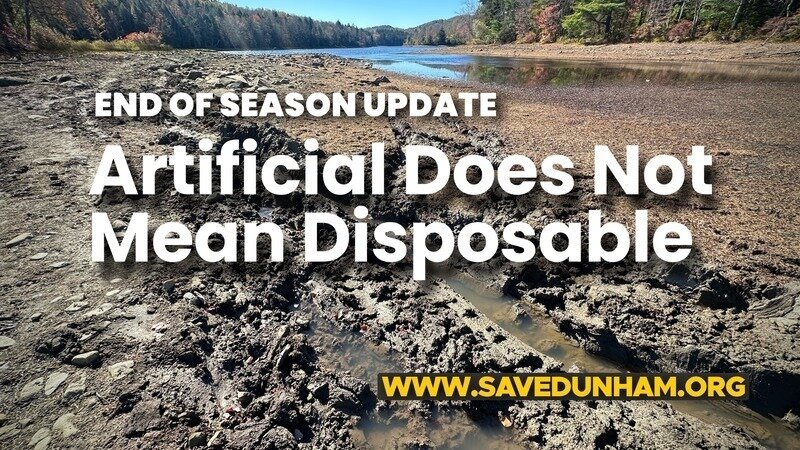
It has been a while since I last posted a formal update, and as the summer fades into fall and winter, I want to share where things stand in the effort to save Martin Dunham Reservoir. I wish I had more encouraging news. My most recent conversation with New York State Parks made it clear that little has changed in terms of forward movement. Aside from some minor cosmetic maintenance, the reservoir continues to be drained to a shadow of what it once was. Sections that once reflected the sky are now exposed mudflats, marked by tire tracks, deep ruts, and erosion. What was once a beloved landscape of water and forest has been reduced to an unsightly and disheartening scene for both residents and visitors.
It certainly feels as though Dunham has been abandoned. New York State manages 5,400 active dams across the state. On paper, Martin Dunham is just one cell in that spreadsheet, a data point in a long list of aging infrastructure waiting for a decision. But for those of us who walk its trails, fish its waters, or grew up beside it, the Dunham is more than an entry in a database. It is part of our shared environmental and cultural heritage.
This process will not move quickly. Bureaucratic systems rarely do. As we enter the winter months, updates may become less frequent, but that does not mean momentum has stopped. The community effort remains strong, and advocacy continues behind the scenes. Every signature, every letter, and every shared story helps keep this issue visible.
At present, the reservoir will remain drained until a decision is made or the damaged valves can be replaced. Currently, only one of the reservoir’s valves is operational, and it has been left open. There are concerns that if it were closed, it might not reopen, which would be critical in a post-tropical storm or hurricane event. The reservoir’s drawdown has left sections exposed to erosion and created long-term uncertainty for the surrounding watershed.
What “Artificial” Really Means
Recently, I have noticed that New York State Parks has begun referring to Martin Dunham Reservoir as an “artificial lake.” I have also seen this language echoed in social media comments, suggesting that an artificial body of water is not worth saving when other “natural” resources need protection. Let me be clear: artificial does not mean unworthy.
Almost every lake in the New York State Parks system has been shaped or modified by human intervention. From the impoundments at Moreau Lake to the historic dams at Minnewaska, the Finger Lakes canal linkages, and the many reservoirs that supply drinking water to entire regions, human hands have shaped nearly every “natural” feature we now protect. If we apply the logic that “artificial equals disposable,” we erase the very landscapes we have spent a century preserving.
By strategically referring to Martin Dunham Reservoir as “artificial,” New York State Parks places it outside the agency’s stated mission of natural resource protection. The word becomes a bureaucratic tool, distancing the reservoir from the values that justify state stewardship. Once reclassified this way, a resource no longer falls within the system’s conservation mandate, creating a pathway for decommissioning and neglect under the appearance of policy consistency.
This shift in language is not simply semantic. It determines whether a place is protected or abandoned. It reframes a living ecosystem as a technical problem to be erased, rather than a landscape to be repaired.
The value of Dunham lies not only in its ecological role but in its history, its place in the lives of those who depend on it, and its potential as a sustainable, restored ecosystem. To discard it simply because it is human-made is to forget that stewardship often means caring for what we have altered. The same ethic that drives us to restore wetlands or remove invasive species should compel us to restore the Dunham, to make it whole again, not erase it.
The Missing Data: Flood Mapping and Risk Assessment
One of the most pressing issues that remains unanswered is the lack of downstream flood modeling. Before any decision is made about the dam’s future, whether removal, modification, or repair, New York State must provide a comprehensive hydrologic risk assessment. That means more than surface-level inspection reports.
We need floodplain mapping that models high-water scenarios under different rainfall intensities and dam breach conditions. We need soil stability testing, sediment transport analysis, and inflow-outflow modeling to understand what lies beneath the drained basin. We need a transparent accounting of how the removal or failure of the dam would affect homes, roads, and habitats downstream. Without that data, there can be no informed decision, only speculation.
Pressing the state for this information is not obstructionism. It is responsibility. Communities deserve to know the real risks before irreversible actions are taken.
Engineering Alternatives Worth Considering
There are also realistic short-term measures that could stabilize the dam while long-term decisions are made. One proven technique is the use of impervious blankets, flexible, layered membranes or clay-based liners placed over sections of the dam face to limit seepage and reduce erosion. These systems can extend the lifespan of aging dams by controlling water infiltration without complete reconstruction.
Additional drainage systems can also be installed to safely manage internal pressure within the embankment. These include toe drains at the dam’s base to collect and redirect seepage, chimney drains that relieve hydraulic pressure vertically through the core, and relief wells that maintain equilibrium between upstream and downstream water levels. Each of these measures is standard practice in dam rehabilitation projects across the country and could buy valuable time for a thoughtful, data-driven plan to emerge. It is not a choice between full removal or neglect. There are sound, intermediate solutions available.
Since this petition began and the Save Dunham Committee formed, the effort has seen support from elected officials across party lines. That speaks volumes. It underscores that this cause transcends politics. It is about community, place, and the right of the public to have a say in the future of its own lands.
I also want to recognize the dedicated volunteers and advocates of the Save Dunham Committee, who continue to give their time, energy, and even their own funds to keep this effort moving forward. Their commitment has carried this cause through another season and kept hope alive for everyone who loves this place.
Ansel Adams once said, “It is horrifying that we have to fight our own government to save the environment.” His words still ring true. The Martin Dunham Reservoir is public land. It belongs to the people of New York. That means you have a voice in what happens to it. Saving Dunham is not just about preserving one body of water. It is about setting a precedent for how we protect the next one.
If we allow bureaucratic neglect and spreadsheet logic to define our relationship with the land, then every park, forest, and shoreline could one day be written off the same way.
Keep Speaking for Dunham
When I started this petition, it was out of a belief that one voice could start a conversation. Thousands of voices later, that conversation has become a movement. It has reminded our elected officials, our community, and New York State Parks that Martin Dunham Reservoir is not forgotten and not disposable.
But this is the point where awareness must become persistence. The state’s inaction will not last forever, and when a decision is finally made, our collective voices must still be at the table. I ask you, whether you signed last year or just found this cause today, to keep showing up. Share this petition again. Write to your representatives. Talk about the Dunham when you are on the trails, at work, or at your kitchen table.
Every mention, every post, every conversation helps keep the reservoir visible in the eyes of those who would rather see it quietly fade away.
The Martin Dunham Reservoir belongs to all of us, and its story is not over. Help me make sure that when the state finally acts, it does so with the will of the people behind it.
Add your voice. Share the petition. Help us save Dunham.
Disclaimer
The statements and opinions expressed by www.savedunham.org are offered in the spirit of public advocacy and community engagement. They are based on publicly available information, personal observation, and good-faith interpretation of state and local records.
The statements published on www.savedunham.org reflect the views of private citizens and are not made by engineers, contractors, or agents of any government agency. Nothing contained on this site should be construed as technical, engineering, or legal advice.
All official decisions, assessments, and risk determinations regarding Martin Dunham Reservoir and its associated structures remain under the authority of the New York State Office of Parks, Recreation and Historic Preservation and the New York State Department of Environmental Conservation.
The www.savedunham.org assumes no liability for the actions or decisions of any individual or agency in response to the information shared herein.