
The Save Dunham petition has surpassed 2,500 signatures!
Please keep sharing and remain engaged.
Below is the full exchange between myself and New York State Parks regarding the proposed removal of the Martin Dunham Dam in Grafton Lakes State Park. I’ve included a TL;DR, a plain-language summary, and the complete emails so you can see the full context, including discussion of the flood mapping used in the state’s current feasibility study. You can see my original request for clarification in the updates at www.savedunham.org
+++
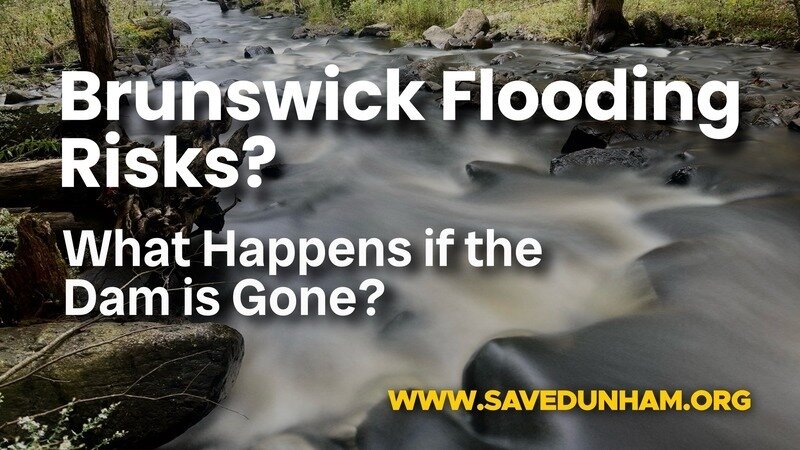
The Martin Dunham Reservoir holds a significant volume of stormwater from the steep, fast-draining Quacken Kill watershed. In heavy rain or tropical storm events, the dam slows and retains runoff that would otherwise surge downstream toward communities like Brunswick, Poestenkill, and Troy. If the dam is removed and replaced with a shallow wetland, that stormwater storage would be lost, and peak flows could arrive downstream faster and in greater volume.
I believe that every community downstream of the dam should be asking now: What will happen during the next major storm if the reservoir is gone?
TL;DR:
I asked NYS Parks if they had modeled how flooding would change after removing the Martin Dunham Dam. Their reply only covered flood scenarios for the existing dam, not post-removal conditions. This matters because removing the dam would eliminate a major stormwater buffer for the steep Quacken Kill watershed. Without that buffer, heavy rains could reach downstream communities like Brunswick faster and in greater volume. Residents of Brunswick, and other downstream areas, should be asking now what the flood risk will be if the dam is removed, and if the state will provide those projections before making a decision.
Background & Context
Earlier this month, I wrote to NYS Parks Commissioner Pro Tempore Randy Simons asking for clarification on whether downstream flood risks had been assessed for the proposed removal of the Martin Dunham Dam in Grafton Lakes State Park. My concern was that the Stantec feasibility study only includes “catastrophic failure” flood maps for the current dam, and does not model what would happen to downstream flows if the dam were removed and replaced with an engineered wetland.
The State’s Reply
Public Affairs Coordinator Jim Levulis, replying on behalf of Commissioner Simons, explained that the inundation maps in the study model three extreme-event scenarios, Sunny Day Failure, Half Probable Maximum Flood without dam failure, and Half Probable Maximum Flood with dam failure. These scenarios use existing dam and reservoir conditions and are designed to map maximum flood extents from those hypothetical events. Levulis notes that further studies and public review will occur, but does not commit to modeling post-removal hydrology or disclosing such results before a decision is made.
My Reply
In my response, I thanked them for the information but pointed out that their maps do not represent post-removal conditions. Removing the dam would change peak flow timing, reduce floodwater storage, and could increase both the speed and depth of downstream flooding. A shallow wetland does not provide the same flood attenuation as a reservoir.
I requested that the state conduct updated hydrologic and hydraulic modeling for the “no-dam” alternative before making any final decision. This should include storm routing for a range of events (10-, 25-, 50-, 100-year floods, and PMF), mapping depth and velocity at key points, seasonal and debris sensitivity analysis, and a comparison of current vs. no-dam flood stages at critical sites like schools, bridges, and residential neighborhoods.
For public comment to be meaningful, these results must be available during the review period, not afterward.
+++
New York State Parks, Recreation and Historic Preservation response to my inquiry about downstream flood mapping:
Mr. John Bulmer,
On behalf of New York State Parks, Recreation and Historic Preservation Commissioner Pro Tempore Randy Simons, thank you for your letter regarding the Martin Dunham Dam and Reservoir and your overall interest in New York's natural environment.
Concerning your statement about hydraulic modeling, in the early stages of planning and design, inundation mapping is only provided to convey risk associated with the existing dam under extreme scenarios. These scenarios include:
*Sunny Day Failure: A hypothetical dam failure occurring without any preceding storm event. This scenario assumes the sudden release of the reservoir's full volume, producing a flood wave that travels downstream. It represents a worst-case condition for structural failure.
*½ Probable Maximum Flood (PMF) Without Dam Failure: This scenario assumes extreme rainfall without any structural failure of the dam. The extreme rainfall produces a corresponding flood event, known as the Probable Maximum Flood.
*½ PMF With Dam Failure: This scenario combines the impacts of the PMF with a concurrent dam failure, simulating the compounded effects of extreme rainfall and structural failure. It provides insight into the most severe flood conditions that could occur.
To generate these maps, hydraulic modeling was performed to simulate flood waves and map impacts for each scenario. The modeling used flow information from previous studies to trace flood extents along downstream land features. These maps don't represent a single point in time, but instead show the maximum area touched by water as the flood wave moves downstream from the dam. This approach ensures that all potentially affected areas are identified for risk mitigation and response planning, even though the actual depth and duration of flooding will vary throughout the mapped area.
As outlined in Section 3.4 of the feasibility study (pages 21-24), the three identified alternatives for the Martin Dunham Dam are subject to a combination of federal, state and local regulations aimed to protect human health and the environment. These involve numerous permits and regulatory processes, including further study and assessments. The regulating agencies have established criteria for the required level of study as well as opportunities for public review and comment.
Further updates regarding the Martin Dunham Dam and Reservoir will be shared publicly, including on the Grafton Lakes State Park website and Facebook pages, as well as communications to elected officials, interested stakeholders and the media.
Further information on the Martin Dunham Dam and Reservoir is available on the Grafton Lakes State Park website: https://parks.ny.gov/parks/graftonlakes Public input is being accepted via email at dunham@parks.ny.gov.
Jim Levulis
Public Affairs & Community Engagement Coordinator
NYS Office of Parks, Recreation and Historic Preservation
Saratoga-Capital Region
19 Roosevelt Dr., Saratoga Springs, NY 12866
James.Levulis@parks.ny.gov
+++
My response
Mr. Levulis and Commissioner Pro Tempore Randy Simons,
Thank you for your response to my earlier inquiry. While I appreciate the information provided, it does not address my primary concern: how downstream flooding would change under a dam-removal and constructed-wetland scenario.
The inundation extents shown in the “Updated Sunny Day” and “Full PMF” scenarios were developed for the existing dam and reservoir configuration, including current storage capacity, outlet works, and breach assumptions. These results do not represent post-removal conditions. Once the dam is removed, the hydraulics of the system will change. Peak flow timing, attenuation, channel slope, and roughness will differ significantly. A shallow constructed wetland will not provide the same flood attenuation as the current impoundment, which may alter both the magnitude and the pattern of downstream flooding.
Under New York State practice, and to satisfy SEQRA’s requirement to fully evaluate all reasonable alternatives with potential public safety implications, a removal alternative should be assessed using updated hydrologic and hydraulic modeling that reflects post-removal conditions. At a minimum, this should include:
Development of a no-dam terrain model, incorporating proposed wetland grading.
- Routing of design storm events (10-, 25-, 50-, 100-year, and PMF) using accepted tools such as HEC-HMS and HEC-RAS, with the dam absent.
- Production of inundation mapping for each event showing depth, velocity, and arrival time at key downstream locations.
- Sensitivity analysis for seasonal variation, rain-on-snow conditions, debris blockage at culverts and bridges, and backwater from the Hudson River.
- Comparative analysis of current vs. no-dam peak flows and stages at critical cross-sections, including schools, bridges, and residential areas, to quantify changes in risk.
Without this no-dam scenario modeling, the public and decision-makers do not have the information necessary to evaluate the downstream flood impacts of the removal and wetland conversion proposal. The current inundation map is informative for existing conditions, but it is not a valid proxy for post-removal flood risk.
This information gap leaves downstream communities unable to assess whether removal would increase their vulnerability to flooding. For the public comment period to be meaningful, the results of this updated modeling must be available before the close of that process and before any final decision is made.
I request that updated modeling for the no-dam alternative be developed and made available as part of the review process so that all potential impacts can be fully and transparently assessed, especially for downstream communities such as Brunswick.
Thank you,
John Bulmer
Organizer, Save Dunham Petition
www.savedunham.org
The information presented above is based on publicly available documents, the official feasibility study, and direct correspondence with the New York State Office of Parks, Recreation and Historic Preservation. Statements regarding potential downstream flooding and stormwater retention capacity are provided for public awareness and discussion. They reflect reasonable interpretations of hydrologic principles and the contents of the cited documents, and are not definitive predictions of future events. Readers are encouraged to review the source materials and participate in the public comment process to form their own conclusions.