
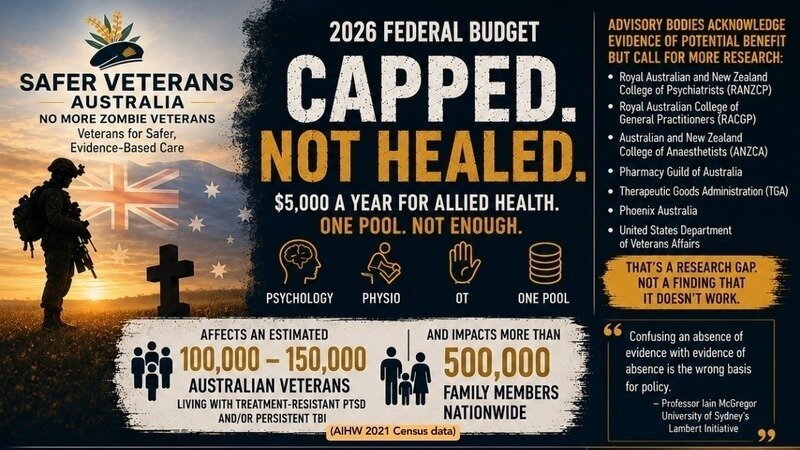
The 2026 Federal Budget just capped veteran allied health at $5,000 a year.
Psychology. Physio. OT. One pool. For veterans living with complex PTSD and TBI.
According to official estimates, this directly affects an estimated 100,000 to 150,000 Australian veterans living with treatment-resistant PTSD and/or persistent TBI, and impacts more than 500,000 family members nationwide.
Here’s what the budget doesn’t answer:
What do we do for veterans whose minds and bodies are not responding to conventional treatment?
Every human being has an endocannabinoid system (ECS). It regulates sleep, stress, fear, mood, inflammation, and recovery. It plays a direct role in how the brain processes trauma. Veterans living with chronic PTSD and TBI often show measurable disruption to their ECS.
This is not fringe science. It is human biology.
The advisory bodies DVA relies on, all of whom acknowledge evidence of potential benefit while calling for more research, include:
▪ Royal Australian and New Zealand College of Psychiatrists (RANZCP)
Australian Centre for Cannabinoid Clinical and Research Excellence (ACRE)
▪ Royal Australian College of General Practitioners (RACGP)
▪ Australian and New Zealand College of Anaesthetists (ANZCA)
▪ Pharmacy Guild of Australia
▪ Therapeutic Goods Administration (TGA)
▪ Phoenix Australia
▪ United States Department of Veterans Affairs
That is a research gap, not a finding that it does not work.
Australia’s leading cannabinoid scientist, Professor Iain McGregor from the University of Sydney’s Lambert Initiative, has warned that confusing an absence of evidence with evidence of absence is the wrong basis for policy.
Yet many of these same systems continue supporting psychiatric medication pathways the Royal Commission identified as contributing to polypharmacy, deterioration, and in some cases suicidal ideation.
The evidence bar is not being applied equally.
DVA now funds MDMA-assisted psychotherapy for treatment-resistant PTSD, an emerging treatment where long-term risks are still being studied, using exactly the kind of supervised access model we have been asking for.
For five years, No More Zombie Veterans and Safer Veterans Australia have submitted peer-reviewed research, real-world veteran outcomes, and international program data to DVA, Ministers, and the Royal Commission.
The Royal Commission’s 2024 final report called for medicinal cannabis research to be prioritised and barriers to access to be addressed.
DVA has not responded.
One veteran spent 17 years cycling through conventional treatment and psychiatric hospitalisations costing DVA an estimated $100,000 per year.
After transitioning to supervised medicinal cannabis treatment:
• zero psychiatric hospitalisations for more than a decade
• improved stability
• improved quality of life
• potential savings to DVA exceeding $1,000,000
That is not an argument against conventional care.
It is an argument for having more options for veterans who are not responding to standard pathways.
Policy should follow biology.
Veterans deserve modern trauma science.
👉 Safer Veterans Australia
#NoMoreZombieVeterans #SaferVeterans #VeteransBudget #ECS #RoyalCommission