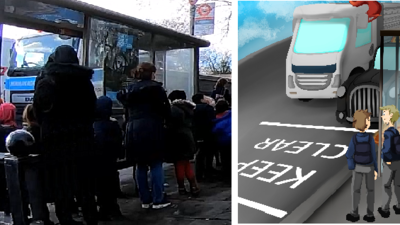

Reduce children’s exposure to diesel vehicle exhaust at roadside bus shelters.
The Issue
When I think about protecting the public from air pollution, I start with the fragile developing lungs of a baby in the womb, a newborn, an infant, a toddler or young child.
Their greatest exposure to air pollution is arguably 8am till 10am, when morning traffic is heavily congested and millions of children are travelling to nursery and school, often accompanied by pregnant mum and a younger sibling in a buggy.
You might have heard of Ella Kissi-Debrah ‘s story. A young Londoner who died from asthma-related breathing problems in 2013. In an expert report for Ella’s family; “her serious form of asthma and her death in February 2013 are linked directly to the illegal levels of pollution from diesel traffic thundering daily down London’s South Circular Road near her home.”
We know that damage to the lungs in early age is irreversible and that children and infants draw between two and four times more pollutants into their lungs, compared to adults in the same environment. There is a significant impact for children’s health when they regularly breathe high concentrations of diesel vehicle exhaust. The UK has one of the highest rates of asthma in the world.
As Londoners, we are advised to stay away from the kerb on busy roads and walk on the building side of the pavement. This is good advice as there is a significant reduction in pollution levels for every additional metre of space between our children’s lungs and the vehicles exhaust.
However, for those of us using buses, we are directed to wait at bus shelters located at the kerb of very busy roads.
Every school day, children wait at roadside bus shelters for 6-12 minutes next to congested idling traffic. That’s an hour a week, a day and a half per year that children breathe high concentrations of diesel exhaust. This is simply to get to school by bus!
Our solution is simple- let’s take a well-known road symbol and use it for a different but related purpose. London drivers already know not to stop and idle where there are Keep Clear road markings at the junction to side streets. We should make drivers aware that they are approaching an area where children gather and wait by the roadside. Surely, this is as important as making drivers aware that they are approaching a side road?
Drivers do not intentionally stop and idle their vehicles engines next to children. They are watching the road ahead and often do not notice the baby in a buggy or young child at a bus shelter until they are already stationary and idling next to them.
A suitable area on the road in front of bus shelters is already marked out containing the words ‘bus stop’. Vehicles stop and idle on the words bus stop. There is sufficient space in this marked area for Keep Clear road markings. It’s a small change that could make a huge difference.
I believe this is a simple low cost way to significantly reduce pollution exposure for millions of people who use the bus network every day. Observing Keep Clear signs makes little difference to drivers or their journey time, but this could make a huge difference to children’s health.
How to help:
· Sign the petition!
· Share the petition on social media and with neighbours
· Tweet your support- Join me @LittleNinjaUK using #NO2idling
Thanks for your support to reduce children’s exposure to harmful diesel exhaust.
LittleNinjaUK

346
The Issue
When I think about protecting the public from air pollution, I start with the fragile developing lungs of a baby in the womb, a newborn, an infant, a toddler or young child.
Their greatest exposure to air pollution is arguably 8am till 10am, when morning traffic is heavily congested and millions of children are travelling to nursery and school, often accompanied by pregnant mum and a younger sibling in a buggy.
You might have heard of Ella Kissi-Debrah ‘s story. A young Londoner who died from asthma-related breathing problems in 2013. In an expert report for Ella’s family; “her serious form of asthma and her death in February 2013 are linked directly to the illegal levels of pollution from diesel traffic thundering daily down London’s South Circular Road near her home.”
We know that damage to the lungs in early age is irreversible and that children and infants draw between two and four times more pollutants into their lungs, compared to adults in the same environment. There is a significant impact for children’s health when they regularly breathe high concentrations of diesel vehicle exhaust. The UK has one of the highest rates of asthma in the world.
As Londoners, we are advised to stay away from the kerb on busy roads and walk on the building side of the pavement. This is good advice as there is a significant reduction in pollution levels for every additional metre of space between our children’s lungs and the vehicles exhaust.
However, for those of us using buses, we are directed to wait at bus shelters located at the kerb of very busy roads.
Every school day, children wait at roadside bus shelters for 6-12 minutes next to congested idling traffic. That’s an hour a week, a day and a half per year that children breathe high concentrations of diesel exhaust. This is simply to get to school by bus!
Our solution is simple- let’s take a well-known road symbol and use it for a different but related purpose. London drivers already know not to stop and idle where there are Keep Clear road markings at the junction to side streets. We should make drivers aware that they are approaching an area where children gather and wait by the roadside. Surely, this is as important as making drivers aware that they are approaching a side road?
Drivers do not intentionally stop and idle their vehicles engines next to children. They are watching the road ahead and often do not notice the baby in a buggy or young child at a bus shelter until they are already stationary and idling next to them.
A suitable area on the road in front of bus shelters is already marked out containing the words ‘bus stop’. Vehicles stop and idle on the words bus stop. There is sufficient space in this marked area for Keep Clear road markings. It’s a small change that could make a huge difference.
I believe this is a simple low cost way to significantly reduce pollution exposure for millions of people who use the bus network every day. Observing Keep Clear signs makes little difference to drivers or their journey time, but this could make a huge difference to children’s health.
How to help:
· Sign the petition!
· Share the petition on social media and with neighbours
· Tweet your support- Join me @LittleNinjaUK using #NO2idling
Thanks for your support to reduce children’s exposure to harmful diesel exhaust.
LittleNinjaUK
The Decision Makers

Petition Updates
Share this petition
Petition created on 2 August 2018