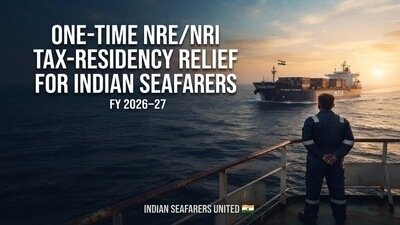

Request for One-Time NRE/NRI Tax-Residency Relief for Indian Seafarers — FY 2026–27
The Issue
Executive Summary
Indian merchant seafarers are currently facing exceptional employment and crew-rotation disruptions arising from the heightened maritime-security situation in the Persian Gulf, Strait of Hormuz and surrounding regions.
These circumstances can prevent otherwise eligible and willing seafarers from completing the normal period required to maintain their intended non-resident tax status — through no fault of their own.
We therefore respectfully request the Government of India to consider a one-time, proportionate tax-residency relief for Indian seafarers for FY 2026–27, so that genuine seafarers are not placed at an unintended tax disadvantage because they complied with official safety advisories and deployment restrictions.
One possible approach would be to consider 120 days as a temporary qualifying benchmark, or such other period or equivalent tax-residency/RNOR mechanism as the Government considers appropriate.
⸻
To
Hon’ble Union Minister for Finance, Government of India
Ministry of Finance
Central Board of Direct Taxes (CBDT)
Also Requested to Take Up This Matter
Directorate General of Shipping / DGMA
Ministry of Ports, Shipping and Waterways Maritime Union of India (MUI)
National Union of Seafarers of India (NUSI)
Other recognised Indian maritime unions, seafarer organisations and welfare bodies
⸻
The Request
We, the undersigned Indian seafarers, maritime professionals and supporters, respectfully request the Government of India to consider a one-time special tax-residency relief for FY 2026–27 for genuine Indian seafarers whose employment, joining, sign-off or vessel deployment has been directly affected by the prevailing maritime-security situation.
The proposed relief could include:
1. A temporary reduction of the applicable qualifying period, with 120 days considered as a reasonable benchmark;
OR
2. Any other proportionate reduction or day-count adjustment that the Government considers appropriate;
OR
3. An equivalent special tax-residency/RNOR mechanism that protects genuinely affected seafarers from unintended tax consequences arising from circumstances beyond their control.
The objective is simple:
A seafarer should not suffer an unintended tax-residency disadvantage merely because extraordinary maritime-security circumstances prevented him or her from completing the normal qualifying period.
⸻
Why This Relief Is Necessary
1. Exceptional Maritime-Security Circumstances
The security situation in and around the Strait of Hormuz, Persian Gulf and adjacent waters has created extraordinary uncertainty for international shipping and for Indian merchant seafarers.
The Directorate General of Shipping has issued multiple advisories addressing these circumstances.
In particular, DGS Circular No. 01 of 2026 dated 14 January 2026 advised RPSL companies and shipping companies not to deploy or send Indian seafarers to Iran until further orders.
Subsequent DGS advisories, including DGS Circular No. 10 of 2026 dated 6 March 2026, addressed the heightened security risks affecting the Persian Gulf, Strait of Hormuz and adjacent waters.
These are not ordinary employment disruptions. They arise from an officially recognised maritime-security environment in which deployment and voyage decisions may be affected by safety considerations.
2. Employment and Crew-Change Opportunities Are Not Controlled by Seafarers
A merchant seafarer cannot independently decide:
* when a vessel will be available for joining;
* which route the vessel will take;
* whether a vessel will enter or transit a high-risk area;
* whether a shipowner will suspend deployment;
* whether a crew change will take place;
* whether a contract will be delayed, cancelled or postponed; or
* whether a vessel will be rerouted because of security concerns.
A seafarer may therefore remain fully available and willing to work while being unable to obtain the required number of qualifying days outside India.
3. Safety Compliance Should Not Create an Unintended Tax Penalty
Indian seafarers should not be placed in a situation where they effectively face a choice between:
complying with official safety and deployment advisorie and protecting their intended tax-residency position.
National maritime-safety policies and tax-residency provisions should operate consistently during extraordinary circumstances.
If the Government considers it necessary to restrict or discourage deployment in high-risk areas for the protection of Indian seafarers, those same seafarers should not subsequently suffer an unintended tax disadvantage because the resulting employment disruption prevented them from completing the normal qualifying period.
⸻
A Temporary and Proportionate Solution
This petition does not seek a permanent amendment to India’s tax-residency framework.
It does not seek an indiscriminate tax exemption for all seafarers.
It does not seek preferential treatment unrelated to the extraordinary circumstances currently affecting maritime employment.
The request is specifically for a one-time, temporary and proportionate relief for FY 2026–27, targeted at genuine seafarers affected by extraordinary maritime-security-related employment disruption.
The Government may determine the most appropriate legal mechanism.
A 120-day qualifying benchmark is suggested only as one practical option. The final period, eligibility criteria and implementation mechanism may be determined by the Ministry of Finance/CBDT after consultation with the maritime authorities and recognised seafarer organisations.
⸻
Why Seafarers Need Special Consideration
The employment structure of merchant seafarers is fundamentally different from that of most land-based workers.
A seafarer’s ability to accumulate qualifying days outside India depends on factors including:
* vessel availability;
* shipowner/operator deployment decisions;
* international voyage schedules;
* port restrictions;
* crew-change arrangements;
* geopolitical developments;
* maritime-security advisories; and
* safe and lawful access to trading routes.
A seafarer cannot simply choose to accumulate additional qualifying days outside India when there is no vessel or when deployment to a particular route has been restricted for safety reasons.
Therefore, extraordinary disruption to maritime employment can have a direct and disproportionate effect on tax residency.
⸻
A Fairness-Based Request
The purpose of this petition is not to ask for special treatment merely because the signatories are seafarers.
It is to request temporary protection from an unintended consequence created by circumstances beyond the seafarer’s control.
Where Government safety advisories influence whether Indian seafarers can be deployed to certain regions or voyages, the resulting reduction in employment opportunities should be considered when determining whether those seafarers should receive temporary tax-residency relief.
A proportionate one-time measure would provide fairness while preserving the Government’s authority to determine the appropriate tax framework.
⸻
Request to Maritime Unions
We respectfully request the Maritime Union of India (MUI), National Union of Seafarers of India (NUSI) and other recognised Indian maritime unions and seafarer organisations to:
* review this issue;
* assess the number of potentially affected Indian seafarers;
* obtain representations and supporting data from the maritime community;
* consult with DG Shipping/DGMA and the Ministry of Ports, Shipping and Waterways; and
* formally take up the matter with the Ministry of Finance and CBDT.
A coordinated representation from India’s recognised maritime organisations would help ensure that the operational realities faced by merchant seafarers are properly considered at the policy level.
⸻
Our Specific Request to the Government
We respectfully request the Government of India to consider:
A ONE-TIME SPECIAL TAX-RESIDENCY RELIEF FOR GENUINELY AFFECTED INDIAN SEAFARERS FOR FY 2026–27.
This may be implemented through:
Option 1: A temporary qualifying benchmark of approximately 120 days;
OR
Option 2: Another reasonable reduction or day-count adjustment determined by the Government;
OR
Option 3: An equivalent special tax-residency/RNOR mechanism that achieves the same objective.
The final mechanism, eligibility conditions and documentation requirements may be determined by the Government after consultation with the relevant maritime authorities and recognised seafarer organisations.
⸻
This Is About Fairness, Not a Permanent Tax Concession
Indian seafarers serve on vessels that keep international trade and India’s maritime economy moving.
When extraordinary security circumstances restrict their ability to join vessels or complete normal contracts, they should not be placed at an unintended disadvantage solely because they followed safety requirements and remained available for lawful employment.
A temporary and proportionate FY 2026–27 relief would recognise these exceptional circumstances without creating a permanent change to India’s tax system.
⸻
Call to Action
To the Government of India
We respectfully request the Ministry of Finance and CBDT to examine this issue urgently and consider an appropriate one-time tax-residency relief mechanism for FY 2026–27.
To DG Shipping/DGMA and the Ministry of Ports, Shipping and Waterways
We request your support in formally representing the employment and deployment difficulties faced by Indian seafarers during the present maritime-security situation.
To MUI, NUSI and Other Maritime Organisations
We request you to review this representation and, if considered appropriate, formally take up the matter with the Ministry of Finance and CBDT on behalf of affected Indian seafarers.
To Fellow Seafarers and Supporters
Please sign this petition, share it with fellow seafarers and maritime professionals, and help bring this issue to the attention of the appropriate authorities and recognised maritime organisations.
A unified and evidence-based representation can help ensure that extraordinary circumstances are given fair consideration.
Temporary. Proportionate. Fair.
No permanent change. No blanket exemption.
Just fair consideration for Indian seafarers affected by circumstances beyond their control.

1,864
The Issue
Executive Summary
Indian merchant seafarers are currently facing exceptional employment and crew-rotation disruptions arising from the heightened maritime-security situation in the Persian Gulf, Strait of Hormuz and surrounding regions.
These circumstances can prevent otherwise eligible and willing seafarers from completing the normal period required to maintain their intended non-resident tax status — through no fault of their own.
We therefore respectfully request the Government of India to consider a one-time, proportionate tax-residency relief for Indian seafarers for FY 2026–27, so that genuine seafarers are not placed at an unintended tax disadvantage because they complied with official safety advisories and deployment restrictions.
One possible approach would be to consider 120 days as a temporary qualifying benchmark, or such other period or equivalent tax-residency/RNOR mechanism as the Government considers appropriate.
⸻
To
Hon’ble Union Minister for Finance, Government of India
Ministry of Finance
Central Board of Direct Taxes (CBDT)
Also Requested to Take Up This Matter
Directorate General of Shipping / DGMA
Ministry of Ports, Shipping and Waterways Maritime Union of India (MUI)
National Union of Seafarers of India (NUSI)
Other recognised Indian maritime unions, seafarer organisations and welfare bodies
⸻
The Request
We, the undersigned Indian seafarers, maritime professionals and supporters, respectfully request the Government of India to consider a one-time special tax-residency relief for FY 2026–27 for genuine Indian seafarers whose employment, joining, sign-off or vessel deployment has been directly affected by the prevailing maritime-security situation.
The proposed relief could include:
1. A temporary reduction of the applicable qualifying period, with 120 days considered as a reasonable benchmark;
OR
2. Any other proportionate reduction or day-count adjustment that the Government considers appropriate;
OR
3. An equivalent special tax-residency/RNOR mechanism that protects genuinely affected seafarers from unintended tax consequences arising from circumstances beyond their control.
The objective is simple:
A seafarer should not suffer an unintended tax-residency disadvantage merely because extraordinary maritime-security circumstances prevented him or her from completing the normal qualifying period.
⸻
Why This Relief Is Necessary
1. Exceptional Maritime-Security Circumstances
The security situation in and around the Strait of Hormuz, Persian Gulf and adjacent waters has created extraordinary uncertainty for international shipping and for Indian merchant seafarers.
The Directorate General of Shipping has issued multiple advisories addressing these circumstances.
In particular, DGS Circular No. 01 of 2026 dated 14 January 2026 advised RPSL companies and shipping companies not to deploy or send Indian seafarers to Iran until further orders.
Subsequent DGS advisories, including DGS Circular No. 10 of 2026 dated 6 March 2026, addressed the heightened security risks affecting the Persian Gulf, Strait of Hormuz and adjacent waters.
These are not ordinary employment disruptions. They arise from an officially recognised maritime-security environment in which deployment and voyage decisions may be affected by safety considerations.
2. Employment and Crew-Change Opportunities Are Not Controlled by Seafarers
A merchant seafarer cannot independently decide:
* when a vessel will be available for joining;
* which route the vessel will take;
* whether a vessel will enter or transit a high-risk area;
* whether a shipowner will suspend deployment;
* whether a crew change will take place;
* whether a contract will be delayed, cancelled or postponed; or
* whether a vessel will be rerouted because of security concerns.
A seafarer may therefore remain fully available and willing to work while being unable to obtain the required number of qualifying days outside India.
3. Safety Compliance Should Not Create an Unintended Tax Penalty
Indian seafarers should not be placed in a situation where they effectively face a choice between:
complying with official safety and deployment advisorie and protecting their intended tax-residency position.
National maritime-safety policies and tax-residency provisions should operate consistently during extraordinary circumstances.
If the Government considers it necessary to restrict or discourage deployment in high-risk areas for the protection of Indian seafarers, those same seafarers should not subsequently suffer an unintended tax disadvantage because the resulting employment disruption prevented them from completing the normal qualifying period.
⸻
A Temporary and Proportionate Solution
This petition does not seek a permanent amendment to India’s tax-residency framework.
It does not seek an indiscriminate tax exemption for all seafarers.
It does not seek preferential treatment unrelated to the extraordinary circumstances currently affecting maritime employment.
The request is specifically for a one-time, temporary and proportionate relief for FY 2026–27, targeted at genuine seafarers affected by extraordinary maritime-security-related employment disruption.
The Government may determine the most appropriate legal mechanism.
A 120-day qualifying benchmark is suggested only as one practical option. The final period, eligibility criteria and implementation mechanism may be determined by the Ministry of Finance/CBDT after consultation with the maritime authorities and recognised seafarer organisations.
⸻
Why Seafarers Need Special Consideration
The employment structure of merchant seafarers is fundamentally different from that of most land-based workers.
A seafarer’s ability to accumulate qualifying days outside India depends on factors including:
* vessel availability;
* shipowner/operator deployment decisions;
* international voyage schedules;
* port restrictions;
* crew-change arrangements;
* geopolitical developments;
* maritime-security advisories; and
* safe and lawful access to trading routes.
A seafarer cannot simply choose to accumulate additional qualifying days outside India when there is no vessel or when deployment to a particular route has been restricted for safety reasons.
Therefore, extraordinary disruption to maritime employment can have a direct and disproportionate effect on tax residency.
⸻
A Fairness-Based Request
The purpose of this petition is not to ask for special treatment merely because the signatories are seafarers.
It is to request temporary protection from an unintended consequence created by circumstances beyond the seafarer’s control.
Where Government safety advisories influence whether Indian seafarers can be deployed to certain regions or voyages, the resulting reduction in employment opportunities should be considered when determining whether those seafarers should receive temporary tax-residency relief.
A proportionate one-time measure would provide fairness while preserving the Government’s authority to determine the appropriate tax framework.
⸻
Request to Maritime Unions
We respectfully request the Maritime Union of India (MUI), National Union of Seafarers of India (NUSI) and other recognised Indian maritime unions and seafarer organisations to:
* review this issue;
* assess the number of potentially affected Indian seafarers;
* obtain representations and supporting data from the maritime community;
* consult with DG Shipping/DGMA and the Ministry of Ports, Shipping and Waterways; and
* formally take up the matter with the Ministry of Finance and CBDT.
A coordinated representation from India’s recognised maritime organisations would help ensure that the operational realities faced by merchant seafarers are properly considered at the policy level.
⸻
Our Specific Request to the Government
We respectfully request the Government of India to consider:
A ONE-TIME SPECIAL TAX-RESIDENCY RELIEF FOR GENUINELY AFFECTED INDIAN SEAFARERS FOR FY 2026–27.
This may be implemented through:
Option 1: A temporary qualifying benchmark of approximately 120 days;
OR
Option 2: Another reasonable reduction or day-count adjustment determined by the Government;
OR
Option 3: An equivalent special tax-residency/RNOR mechanism that achieves the same objective.
The final mechanism, eligibility conditions and documentation requirements may be determined by the Government after consultation with the relevant maritime authorities and recognised seafarer organisations.
⸻
This Is About Fairness, Not a Permanent Tax Concession
Indian seafarers serve on vessels that keep international trade and India’s maritime economy moving.
When extraordinary security circumstances restrict their ability to join vessels or complete normal contracts, they should not be placed at an unintended disadvantage solely because they followed safety requirements and remained available for lawful employment.
A temporary and proportionate FY 2026–27 relief would recognise these exceptional circumstances without creating a permanent change to India’s tax system.
⸻
Call to Action
To the Government of India
We respectfully request the Ministry of Finance and CBDT to examine this issue urgently and consider an appropriate one-time tax-residency relief mechanism for FY 2026–27.
To DG Shipping/DGMA and the Ministry of Ports, Shipping and Waterways
We request your support in formally representing the employment and deployment difficulties faced by Indian seafarers during the present maritime-security situation.
To MUI, NUSI and Other Maritime Organisations
We request you to review this representation and, if considered appropriate, formally take up the matter with the Ministry of Finance and CBDT on behalf of affected Indian seafarers.
To Fellow Seafarers and Supporters
Please sign this petition, share it with fellow seafarers and maritime professionals, and help bring this issue to the attention of the appropriate authorities and recognised maritime organisations.
A unified and evidence-based representation can help ensure that extraordinary circumstances are given fair consideration.
Temporary. Proportionate. Fair.
No permanent change. No blanket exemption.
Just fair consideration for Indian seafarers affected by circumstances beyond their control.
The Decision Makers
Supporter Voices
Petition Updates
Share this petition
Petition created on 14 September 2026