Reopen Mingus Mill: Restore a Working Historic Mill and Support Local Economy

Reopen Mingus Mill: Restore a Working Historic Mill and Support Local Economy
The Issue
To: Great Smoky Mountains National Park Leadership, National Park Service, and Community Stakeholders
Why This Matters
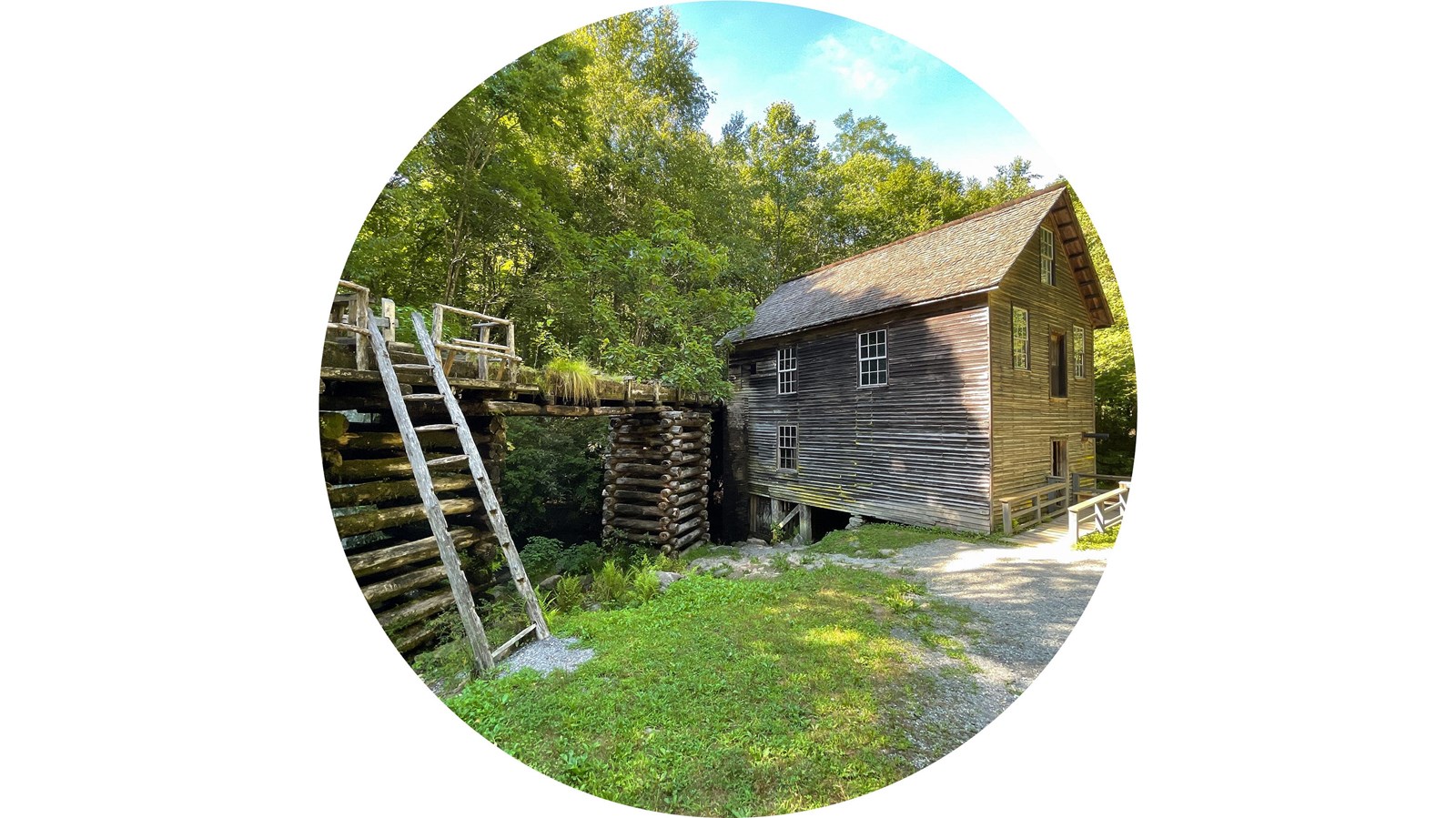
Mingus Mill, built in 1886, is one of only two working grist mills in Great Smoky Mountains National Park. It is not just a static museum: it is usually a living, functioning mill that also shows visitors the process of turning corn into meal, exactly as it was done more than a century ago.
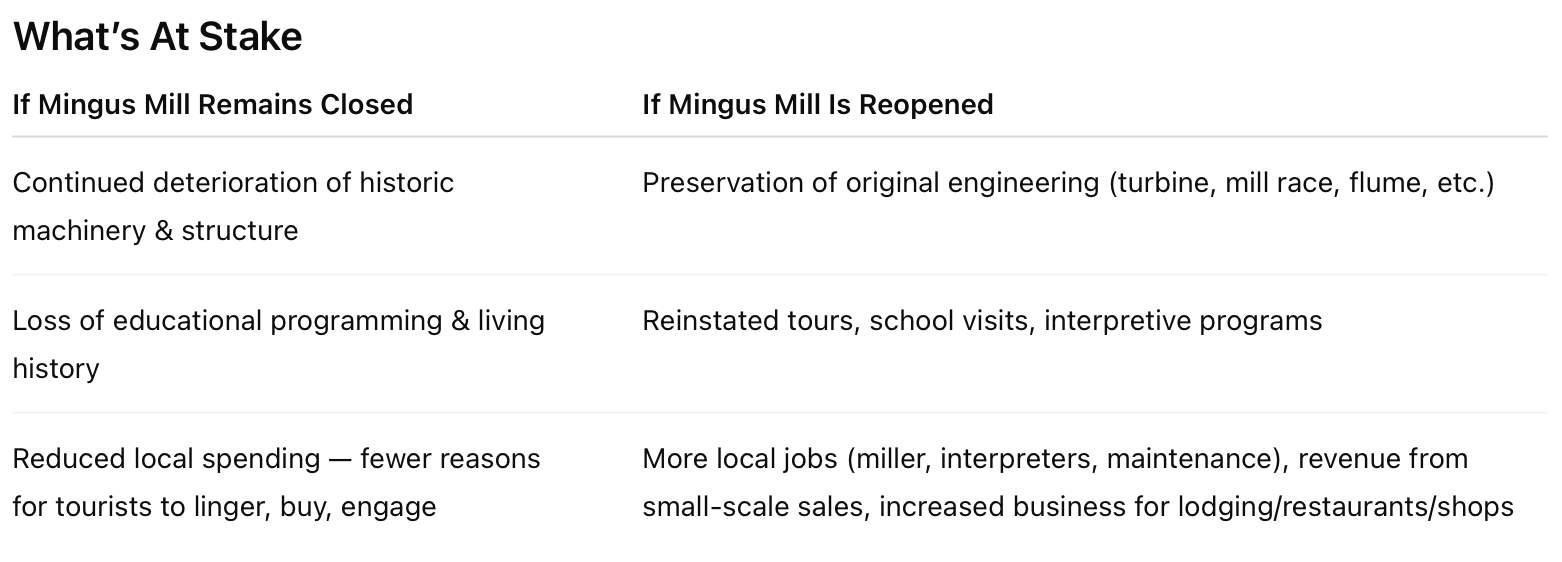
When Mingus Mill is open, it employs skilled millers, educates thousands of visitors every season, draws tourism dollars into Swain County and the surrounding region, and produces meal that visitors can purchase and take home. It used to serve 200+ local families in its operational days.

Closed Since 2023
The National Park Service website and visitor pages currently list the mill as “temporarily closed for preservation and rehabilitation work.” What they do not say is that the interior has been closed since 2023 with no published timeline, no progress updates, and no reopening date. According to internal sources I spoke with, there isn't any ongoing work to make the repairs needed and no internal push to reopen the mill.
Visitors still show up expecting to tour a working mill only to leave disappointed and local businesses lose the revenue those extended visits bring. Millions of visitors come to the Great Smoky Mountains National Park; heritage sites like Mingus Mill increase visitor time spent in and around gateway communities. Swain County, NC and the Cherokee area are heavily reliant on tourism and historic/cultural sites to support lodging, restaurants, small businesses, artisans. The longer Mingus Mill remains closed inside (for rehab, etc.), the more economic opportunity is lost.
Lack of Transparency
Calling a multi-year closure “temporary” with no published repair status, cost estimate, or target reopening date leaves the public in the dark. Visitors arrive expecting to tour a working mill and leave disappointed — hurting both trust in the park’s communications and the local economy that depends on that foot traffic.
Our Request
We call on the National Park Service to:
- Publish a public report on the mill’s current condition, needed repairs, and cost estimates.
- Set and share a clear reopening timeline with milestones and public updates.
- Engage Community & Cultural partners to ensure respectful, beneficial, and collaborative restoration efforts, namely for The Eastern Band of Cherokee Indians, Swain County, Friends of the Smokies, and local businesses, in planning, fundraising, and interpretive programming.
- Recommit to keeping Mingus Mill operational as a working mill and cornerstone of local heritage.
Join Us If You Believe . . .
- That living history matters — that you can learn more by seeing, touching, hearing a working mill rather than just reading signs.
- That this is a chance to preserve rare engineering heritage (a turbine-powered grist mill from 1886) that cannot be replaced once lost.
- That reopening this mill will put people back to work, restore a part of the local economy, help small businesses, and strengthen community identity.
WHAT ELSE CAN WE DO?
Write , call, and get active on social media!
Here are people with power to reopen the mill and a draft letter you can copy and send:
- Superintendent — Great Smoky Mountains National Park
Name / role: Cassius Cash, Superintendent (listed as park superintendent in official notices).
Why contact: Superintendent is the park’s top official for operational/repair/rehab decisions at the park level. Send detailed, local-impact letters here first.
Mail: Great Smoky Mountains National Park, 107 Park Headquarters Road, Gatlinburg, TN 37738. Phone: (865) 436-1200 (park HQ main line) Email: cassius_cash@nps.gov - Oconaluftee Visitor Center / Mountain Farm Museum (local contact near Mingus Mill)
Why contact: Local visitor center staff and the Oconaluftee office are on the ground near Mingus Mill (useful for local-level pressure and to gather local impact statements).
Phone: Oconaluftee Visitor Center — (828) 497-1900.
Address: Mountain Farm Museum / Oconaluftee Visitor Center, 150 US Hwy 441 N, Cherokee, NC 28719 - NPS — Southeast Regional Director (oversight above park level)
Name / role: Darrell Echols, Acting Regional Director, NPS Southeast Region (Region 2 — covers NC/TN).
Why contact: Regional office oversees park superintendents and bigger funding/repairs/prioritization decisions. If the park-level response is unsatisfactory, escalate here.
Mail/Office: 100 Alabama Street SW, 1924 Building, Atlanta, GA 30303.
Phone: 404-507-5600 (Region office main) - U.S. Department of the Interior — Secretary (policy / major funding escalation)
Name / role: Doug Burgum, Secretary of the Interior (current DOI Secretary).
Why contact: DOI receives escalations about major park maintenance funding and federal policy that could influence repair priorities. Use only if local/regional routes don’t resolve it.
Mail: U.S. Department of the Interior, 1849 C Street NW, Washington, DC 20240.
Phone: (202) 208-3100. DOI contact form is available on the DOI site. - Friends of the Smokies (nonprofit park partner)
Why contact: This nonprofit raises funds for park projects and restoration. If repairs need funding or public support, Friends of the Smokies can advocate and, potentially, fundraise. Ask them whether they can prioritize Mingus Mill or help with a capital campaign.
Mail: Friends of the Smokies, 3099 Winfield Dunn Parkway, Kodak, TN 37764 - Eastern Band of Cherokee Indians (local sovereign neighbor / stakeholder)
Why contact: Mingus Mill sits at the Cherokee-side entrance area (Oconaluftee). Tribal leadership can be an influential local partner and advocate to the NPS for cultural/economic reasons. They may also have shared concerns about access and local economy effects.
Main phone / tribal offices: Eastern Band of Cherokee Indians — (828) 497-7000.
Chief’s office / mailing: 88 Council House Loop, Cherokee, NC 28719 (or PO Box 455) - Local Congressional offices (constituency pressure)
- U.S. House — Rep. Chuck Edwards (NC-11) (represents western NC districts including areas near the park). Washington DC phone: (202) 224-3121 (use Congress switchboard) and see district office contacts on his site.
- U.S. Senators (North Carolina): Sen. Ted Budd and Sen. Thom Tillis — both represent NC in the Senate and can press DOI/NPS on prioritization and federal support. DC phones: Sen. Budd (202) 224-3154; Sen. Tillis (202) 224-6342. Office locations and local phone numbers are on their websites.
- U.S. Senators (Tennessee): Because the park spans TN as well, consider also contacting Sen. Marsha Blackburn and Sen. Bill Hagerty. DC phones: Blackburn (202) 224-3344; Hagerty (202) 224-4944.
Dear [Recipient Name or Title],
I am writing to urge you to prioritize the repair and reopening of Mingus Mill in Great Smoky Mountains National Park.
Mingus Mill is one of only two working grist mills in the entire park, and it has been closed since 2023. This closure not only limits public access to an irreplaceable piece of history — it also removes an important economic driver for Swain County and surrounding communities.
When Mingus Mill is open, it:
- Employs skilled millers and interpretive staff who share Appalachian history with thousands of visitors
- Draws tourism dollars that support local businesses, lodging, restaurants, and tax revenue
- Encourages longer visitor stays, increasing overall spending in the region
- Serves as a living educational resource for school groups and travelers from around the world
- Every month this site remains closed is a month of lost wages, lost economic activity, and lost opportunities to inspire visitors.
I respectfully urge you to:
- Publish a status report on the mill’s condition and repair needs
- Set and share a clear timeline for repairs and reopening
- Engage community and cultural partners — including the Eastern Band of Cherokee Indians, Swain County, Friends of the Smokies, and local businesses — to ensure restoration efforts are respectful, collaborative, and beneficial
- Recommit to keeping Mingus Mill operational as a working mill and cornerstone of Smokies history
Mingus Mill is more than a building — it is a bridge between past and present, and a powerful contributor to the park’s economic and educational mission. Please take action to put mill workers back to work, strengthen our local economy, and protect this important heritage site for future generations.
Thank you for your service and stewardship of the Great Smoky Mountains National Park.
Sincerely,
[Your Name]
[City, State]
[Optional: Phone / Email]
*Written and researched with the help of AI

21
The Issue
To: Great Smoky Mountains National Park Leadership, National Park Service, and Community Stakeholders
Why This Matters
Mingus Mill, built in 1886, is one of only two working grist mills in Great Smoky Mountains National Park. It is not just a static museum: it is usually a living, functioning mill that also shows visitors the process of turning corn into meal, exactly as it was done more than a century ago.
When Mingus Mill is open, it employs skilled millers, educates thousands of visitors every season, draws tourism dollars into Swain County and the surrounding region, and produces meal that visitors can purchase and take home. It used to serve 200+ local families in its operational days.
Closed Since 2023
The National Park Service website and visitor pages currently list the mill as “temporarily closed for preservation and rehabilitation work.” What they do not say is that the interior has been closed since 2023 with no published timeline, no progress updates, and no reopening date. According to internal sources I spoke with, there isn't any ongoing work to make the repairs needed and no internal push to reopen the mill.
Visitors still show up expecting to tour a working mill only to leave disappointed and local businesses lose the revenue those extended visits bring. Millions of visitors come to the Great Smoky Mountains National Park; heritage sites like Mingus Mill increase visitor time spent in and around gateway communities. Swain County, NC and the Cherokee area are heavily reliant on tourism and historic/cultural sites to support lodging, restaurants, small businesses, artisans. The longer Mingus Mill remains closed inside (for rehab, etc.), the more economic opportunity is lost.
Lack of Transparency
Calling a multi-year closure “temporary” with no published repair status, cost estimate, or target reopening date leaves the public in the dark. Visitors arrive expecting to tour a working mill and leave disappointed — hurting both trust in the park’s communications and the local economy that depends on that foot traffic.
Our Request
We call on the National Park Service to:
- Publish a public report on the mill’s current condition, needed repairs, and cost estimates.
- Set and share a clear reopening timeline with milestones and public updates.
- Engage Community & Cultural partners to ensure respectful, beneficial, and collaborative restoration efforts, namely for The Eastern Band of Cherokee Indians, Swain County, Friends of the Smokies, and local businesses, in planning, fundraising, and interpretive programming.
- Recommit to keeping Mingus Mill operational as a working mill and cornerstone of local heritage.
Join Us If You Believe . . .
- That living history matters — that you can learn more by seeing, touching, hearing a working mill rather than just reading signs.
- That this is a chance to preserve rare engineering heritage (a turbine-powered grist mill from 1886) that cannot be replaced once lost.
- That reopening this mill will put people back to work, restore a part of the local economy, help small businesses, and strengthen community identity.
WHAT ELSE CAN WE DO?
Write , call, and get active on social media!
Here are people with power to reopen the mill and a draft letter you can copy and send:
- Superintendent — Great Smoky Mountains National Park
Name / role: Cassius Cash, Superintendent (listed as park superintendent in official notices).
Why contact: Superintendent is the park’s top official for operational/repair/rehab decisions at the park level. Send detailed, local-impact letters here first.
Mail: Great Smoky Mountains National Park, 107 Park Headquarters Road, Gatlinburg, TN 37738. Phone: (865) 436-1200 (park HQ main line) Email: cassius_cash@nps.gov - Oconaluftee Visitor Center / Mountain Farm Museum (local contact near Mingus Mill)
Why contact: Local visitor center staff and the Oconaluftee office are on the ground near Mingus Mill (useful for local-level pressure and to gather local impact statements).
Phone: Oconaluftee Visitor Center — (828) 497-1900.
Address: Mountain Farm Museum / Oconaluftee Visitor Center, 150 US Hwy 441 N, Cherokee, NC 28719 - NPS — Southeast Regional Director (oversight above park level)
Name / role: Darrell Echols, Acting Regional Director, NPS Southeast Region (Region 2 — covers NC/TN).
Why contact: Regional office oversees park superintendents and bigger funding/repairs/prioritization decisions. If the park-level response is unsatisfactory, escalate here.
Mail/Office: 100 Alabama Street SW, 1924 Building, Atlanta, GA 30303.
Phone: 404-507-5600 (Region office main) - U.S. Department of the Interior — Secretary (policy / major funding escalation)
Name / role: Doug Burgum, Secretary of the Interior (current DOI Secretary).
Why contact: DOI receives escalations about major park maintenance funding and federal policy that could influence repair priorities. Use only if local/regional routes don’t resolve it.
Mail: U.S. Department of the Interior, 1849 C Street NW, Washington, DC 20240.
Phone: (202) 208-3100. DOI contact form is available on the DOI site. - Friends of the Smokies (nonprofit park partner)
Why contact: This nonprofit raises funds for park projects and restoration. If repairs need funding or public support, Friends of the Smokies can advocate and, potentially, fundraise. Ask them whether they can prioritize Mingus Mill or help with a capital campaign.
Mail: Friends of the Smokies, 3099 Winfield Dunn Parkway, Kodak, TN 37764 - Eastern Band of Cherokee Indians (local sovereign neighbor / stakeholder)
Why contact: Mingus Mill sits at the Cherokee-side entrance area (Oconaluftee). Tribal leadership can be an influential local partner and advocate to the NPS for cultural/economic reasons. They may also have shared concerns about access and local economy effects.
Main phone / tribal offices: Eastern Band of Cherokee Indians — (828) 497-7000.
Chief’s office / mailing: 88 Council House Loop, Cherokee, NC 28719 (or PO Box 455) - Local Congressional offices (constituency pressure)
- U.S. House — Rep. Chuck Edwards (NC-11) (represents western NC districts including areas near the park). Washington DC phone: (202) 224-3121 (use Congress switchboard) and see district office contacts on his site.
- U.S. Senators (North Carolina): Sen. Ted Budd and Sen. Thom Tillis — both represent NC in the Senate and can press DOI/NPS on prioritization and federal support. DC phones: Sen. Budd (202) 224-3154; Sen. Tillis (202) 224-6342. Office locations and local phone numbers are on their websites.
- U.S. Senators (Tennessee): Because the park spans TN as well, consider also contacting Sen. Marsha Blackburn and Sen. Bill Hagerty. DC phones: Blackburn (202) 224-3344; Hagerty (202) 224-4944.
Dear [Recipient Name or Title],
I am writing to urge you to prioritize the repair and reopening of Mingus Mill in Great Smoky Mountains National Park.
Mingus Mill is one of only two working grist mills in the entire park, and it has been closed since 2023. This closure not only limits public access to an irreplaceable piece of history — it also removes an important economic driver for Swain County and surrounding communities.
When Mingus Mill is open, it:
- Employs skilled millers and interpretive staff who share Appalachian history with thousands of visitors
- Draws tourism dollars that support local businesses, lodging, restaurants, and tax revenue
- Encourages longer visitor stays, increasing overall spending in the region
- Serves as a living educational resource for school groups and travelers from around the world
- Every month this site remains closed is a month of lost wages, lost economic activity, and lost opportunities to inspire visitors.
I respectfully urge you to:
- Publish a status report on the mill’s condition and repair needs
- Set and share a clear timeline for repairs and reopening
- Engage community and cultural partners — including the Eastern Band of Cherokee Indians, Swain County, Friends of the Smokies, and local businesses — to ensure restoration efforts are respectful, collaborative, and beneficial
- Recommit to keeping Mingus Mill operational as a working mill and cornerstone of Smokies history
Mingus Mill is more than a building — it is a bridge between past and present, and a powerful contributor to the park’s economic and educational mission. Please take action to put mill workers back to work, strengthen our local economy, and protect this important heritage site for future generations.
Thank you for your service and stewardship of the Great Smoky Mountains National Park.
Sincerely,
[Your Name]
[City, State]
[Optional: Phone / Email]
*Written and researched with the help of AI
21
The Decision Makers


Supporter Voices
Petition Updates
Share this petition
Petition created on September 18, 2025