

Recognise children as victims of domestic violence in Australia
The issue
My daughter was murdered in 2022 with her 23-month-old baby lying underneath her. She was stabbed 78 times in front of her son, and there was ZERO crime for what he saw or the trauma he experienced. By the law, he was not a victim and no punishment was given for his trauma and experience
When domestic and family violence takes place in a home, children are not mere bystanders. They hear the arguments through the walls of their bedrooms, witness the aftermath of injuries and destruction, and often find themselves trying to protect a parent during moments of terror. For these children, each day brings a harrowing uncertainty about when the violence might erupt again. Yet, despite the clear evidence of their suffering, Australia's criminal law continues to predominantly view them as witnesses to these traumatic events rather than victims.
This persistent legal oversight does a profound disservice to the countless children who endure the psychological and emotional scars of living in a violent home. Recognising children as victims rather than witnesses can open doors to more comprehensive support services tailored specifically to their needs. It can ensure they receive immediate psychological assistance, safe spaces, and protective measures to shield them from ongoing harm.
International studies have repeatedly shown the debilitating long-term effects domestic violence has on children, such as increased risk of depression, anxiety, and difficulty in forming healthy relationships later in life. Moreover, in acknowledging children as victims, we reinforce the commitment of Australian society to fully confront the impacts of domestic violence and support all who suffer its devastating consequences.
We call on Australian governments to:
1. Introduce a specific, nationally consistent criminal offence of committing domestic and family violence where a child is present, sees, hears or is exposed to it.
2. Make a child's presence a mandatory aggravating factor in sentencing in every state and territory.
3. Legally recognise these children as victims, through the crime perpetrated against them, with full access to victim support, trauma-informed counselling and compensation schemes.
4. Ensure children are automatically included in protection orders where they live with violence.
Children cannot vote, lobby or speak up for themselves. They need us to do it for them. Please sign and share.
By signing this petition, you are not only demanding legislative change but also showing solidarity with vulnerable children who need our protection and support. Join us in making this vital change and ensuring that every child living in a violent environment in Australia gets the recognition and help they truly deserve.
Why This Matters
4 in 10 Australians were exposed to domestic violence as children. The Australian Child Maltreatment Study (2023) found exposure to domestic violence (39.6%) is the most common form of child maltreatment in Australia. The six most common combinations of
maltreatment all include it, affecting one-third of the population. Children in homes where violence happens are not bystanders. They hear it, see the injuries and damage afterwards, try to protect a parent, and live in fear of the next time. Yet Australian criminal law still largely treats them as witnesses rather than victims.
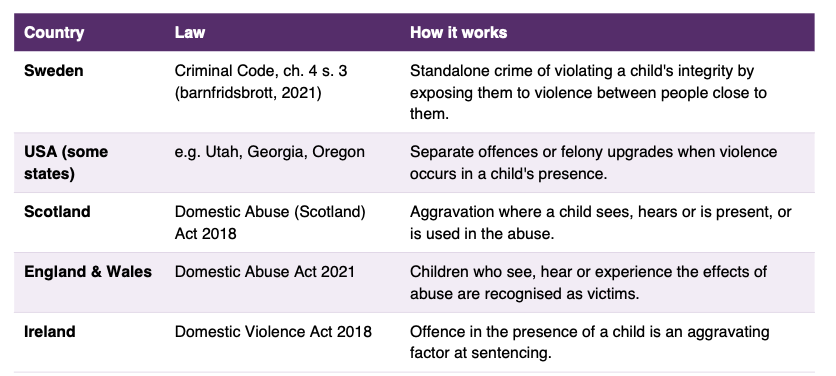
How Countries Respond
Countries generally use one or more of three approaches:
• Standalone offence: exposing a child to violence is a separate crime, and the child is a victim in
their own right.
• Aggravating factor: the original offence attracts a harsher sentence if a child is present.
• Civil and child protection recognition: exposure is defined as abuse or family violence,
affecting protection orders, parenting orders and child protection responses, but is not a separate
criminal charge.
Countries With Laws

2,560
The issue
My daughter was murdered in 2022 with her 23-month-old baby lying underneath her. She was stabbed 78 times in front of her son, and there was ZERO crime for what he saw or the trauma he experienced. By the law, he was not a victim and no punishment was given for his trauma and experience
When domestic and family violence takes place in a home, children are not mere bystanders. They hear the arguments through the walls of their bedrooms, witness the aftermath of injuries and destruction, and often find themselves trying to protect a parent during moments of terror. For these children, each day brings a harrowing uncertainty about when the violence might erupt again. Yet, despite the clear evidence of their suffering, Australia's criminal law continues to predominantly view them as witnesses to these traumatic events rather than victims.
This persistent legal oversight does a profound disservice to the countless children who endure the psychological and emotional scars of living in a violent home. Recognising children as victims rather than witnesses can open doors to more comprehensive support services tailored specifically to their needs. It can ensure they receive immediate psychological assistance, safe spaces, and protective measures to shield them from ongoing harm.
International studies have repeatedly shown the debilitating long-term effects domestic violence has on children, such as increased risk of depression, anxiety, and difficulty in forming healthy relationships later in life. Moreover, in acknowledging children as victims, we reinforce the commitment of Australian society to fully confront the impacts of domestic violence and support all who suffer its devastating consequences.
We call on Australian governments to:
1. Introduce a specific, nationally consistent criminal offence of committing domestic and family violence where a child is present, sees, hears or is exposed to it.
2. Make a child's presence a mandatory aggravating factor in sentencing in every state and territory.
3. Legally recognise these children as victims, through the crime perpetrated against them, with full access to victim support, trauma-informed counselling and compensation schemes.
4. Ensure children are automatically included in protection orders where they live with violence.
Children cannot vote, lobby or speak up for themselves. They need us to do it for them. Please sign and share.
By signing this petition, you are not only demanding legislative change but also showing solidarity with vulnerable children who need our protection and support. Join us in making this vital change and ensuring that every child living in a violent environment in Australia gets the recognition and help they truly deserve.
Why This Matters
4 in 10 Australians were exposed to domestic violence as children. The Australian Child Maltreatment Study (2023) found exposure to domestic violence (39.6%) is the most common form of child maltreatment in Australia. The six most common combinations of
maltreatment all include it, affecting one-third of the population. Children in homes where violence happens are not bystanders. They hear it, see the injuries and damage afterwards, try to protect a parent, and live in fear of the next time. Yet Australian criminal law still largely treats them as witnesses rather than victims.
How Countries Respond
Countries generally use one or more of three approaches:
• Standalone offence: exposing a child to violence is a separate crime, and the child is a victim in
their own right.
• Aggravating factor: the original offence attracts a harsher sentence if a child is present.
• Civil and child protection recognition: exposure is defined as abuse or family violence,
affecting protection orders, parenting orders and child protection responses, but is not a separate
criminal charge.
Countries With Laws
The Decision Makers

Supporter voices
Petition Updates
Share this petition
Petition created on 22 September 2026