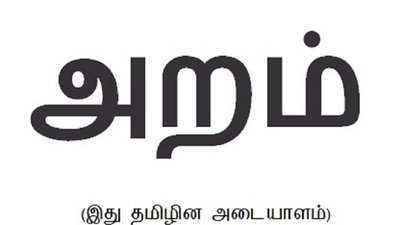

Include the Word – “ARRAM” (அறம்) in English Dictionaries of the World
The Issue
Include the Word – “ARRAM” (அறம்) in English Dictionaries of the World
(Petition to all English Dictionaries and Microsoft Office Dictionary)
Word – “ARRAM” (mass noun) Phonetics: British English - /”ARRAM”/, American English - /”ARRAM”/
Meaning: Nature's Truth, Nature's Natural Discipline and Justice, Ethical value, Dharmic proposition and disposition, Reality of nature, Natural behavior, Nature’s action and reaction, being with Natural Justice
Pronunciation: https://soundcloud.com/search?q=“ARRAM”%20pronunciation
Introduction
Words are the expressing empowerment of the humanity. Most words signify an object or event or any other thing independently. There are some words which signify a concept and some a philosophy. “ARRAM” is a Tamil word that means not just a concept but a holistic philosophy of Tamils and Tamil traditions. “ARRAM” the word, means the realism of Nature’s Truth not influenced by any Human invented Binaries, like, Good or Bad, Beautiful and Ugly etc.
Historicity
The first Tamil Sangam (Tamil Academic Expert Assemblies) took place in Thenmadurai in the estimated period between 9600 BCE to 5200 BCE (Duration - 4440 years), the second Tamil Sangam in Kapatapuram in the period between 5400 BCE to 1750 BCE (Duration - 3700 years) and the third Tamil Sangam in 600 BCE to 300 BCE (Duration - 1850 years). “ARRAM” remained one of the core themes for all the Tamil Sangams.
Purpose
There is no single word that embodies true comprehensive meaning of the word “ARRAM” in English and its required for enriching the meaning and aura of the word in English and other languages.
The purpose of inclusion of this word in the world dictionaries is to propagate the philosophy the word “ARRAM” and the meaning it conveys, which would influence larger understanding of natural morality for humanity and humaneness.
The whole of Tamil literature embodies the concept of “ARRAM” in all of its genres. If we introduce “ARRAM”, to those who are unfamiliar, they would explore more into its meaning, to understand, use, create and interpret their own values, ethics and morale from this unique perspective.
The contextual interpretation and meaning of the word “ARRAM” are the following as enumerated by various literary works and common usages.
“ARRAM” in Tamil, according to some elders, comes from the Tamil word "Aru" which means to cut or remove. In this context removing the bad elements influenced by human fallacies, in thought and action is the way to keep "“ARRAM”" alive.
“ARRAM" in the traditions is a set of discipline principles which have to be adhered to, in order to avoid negative and undesirable consequences. The principles of "ARRAM” have been enumerated for several levels, but notably in the literature, as "ARRAM” for individuals, “ARRAM” for the family, “ARRAM” for the community and “ARRAM” for the country and its polity.
Discipline is about following the principle of right thing (righteous) in the right way in every endeavour. Discipline, Honesty and Sincerity are considered to be the outcome of “ARRAM” consciousness.
Ethics is another meaning or interpretation attributed to “ARRAM” by many writers and philosophers. “ARRAM” is also interpreted as the righteousness. Righteousness means what are morally Right, Genuine and Justifiable.
“ARRAM” is interpreted as Dharma by some. The word Dharma has its roots in Sanskrit, which means literally as "decree or custom". The meaning and interpretation of this word, Dharma, is the eternal and inherent nature of reality, regarded in Hinduism as a cosmic law underlying right behaviour and social order. In Buddhism, it’s interpreted as the nature of reality regarded as a universal truth taught by Buddha. It also means in simple terms as an aspect of truth or reality.
“ARRAM” in its aura encompasses every moral philosophy and principle in its interpretation. The interpretation of moral philosophy can be done using nine general principles, namely, Cultural Relativism (i.e., different cultures and subgroups have different ways of living and behaving that should be considered and respected), Utilitarian (i.e., what action result in the most happiness for the most people?), Absolute Moral Rules (i.e., always follow a moral rule such as being honest regardless of the circumstances or consequences), Rights (e.g., life, liberty, and the pursuit of happiness as well as perhaps a right to food, housing, education, and a living wage), Virtue (e.g., honesty, compassion, integrity, loyalty), Justice (i.e., what is fair?), Social contract (i.e., informal and formal rules for getting along such as first come, first serve), Common good (i.e., what is in the best interest of the community?) and Egoism (i.e., self interest can often lead to ethical behaviour such as altruism in the service of narcissism).
Further when we discuss on what is the right thing to do, we would have ethical or moral dilemma. The various theories of the concept of justice provide the approaches towards the right thing to do. Like the Utilitarianism by Jeremy Bentham and the categorical imperative by Immanuel Kant. After considering all the approaches to justice, Alasdair Macintyre, a Scottish moral and political philosopher characterises the humans as "storytelling beings" who live their lives with narrative quests. “ARRAM” is expressed throughout tens of centuries through all genres of literatures, epics and the socio, economical and political life styles of Tamils all over the world seamlessly.
There are several English words having Tamil origin and continue to be used as English word in all parts of the word. For example, Anaconda (from the word aanai kondraan meaning elephant killer), Alvar (from the word allwar meaning sink, be absorbed), Anicut (from the word anaikattu meaning dam structure), Betel (from the word Vettrilai meanin a plant leaf), Candy (from the word kantu meaning candy), Cash (from the word kasu, meaning coin money), Catamaran (from the word kattumaram meaning tied woods, Cheroot (from the word suru meaning roll), Coir (from the word kayiru meaning rope), Coolie / Cooly (from the word cooli meaning labour or hire), Corundum (from the word kurundam / kuruvindham meaning ruby), Cot (from the word kattil meaning bedstead), Cowrie (from the word kotu meaning shell), Culvert (from the word culvetru meaning stone inscription), Curry (from the word kari meaning curry), Ginger (from the word injiver meaning ginger root), Godown (from the word kidangu meaning store room), Jaggery (from the word chakkarai meaning sugar), Kabaddi (from the word kai pidi meaning hold hands), Mango (from the word maangaai meaning unripe mango), Mongoose (from the word mangus meaning snake killing ichncumon), Moringa (from the word murungai meaning drumstick), Mulligatawny (from the word milagu thanneer meaning pepper water), Mung Bean (from the word mungu meaning sink / soak), Pagoda (from the word pagavadi meaning house belonging to a deity), Pariah / Pariahdom (from the word paaiyer meaning drummer), Patchouli (from the word pachchai ilai meaning green leaf), Pandal (from the word pandal meaning calophyllum inophyllum), Poppadam (from the word pappadama meaning thin crisp flat bread), Sambal (from the word sambal meaning chilli based sauce), Teak (from the word thekku meaning a type of wood) and Vetiver (from the word vettiver meaning a trophical Indian Grass (Vetiveria zizanioides). The above etymologies are from Oxford English Dictionary, American Heritage Dictionary, Online Etymology Dictionary and Merriam-Webster Collegiate Dictionary.
My previous individual request submissions have not been given attention. Hence a joint request would be effective. Please sign in and endorse this petition and also spread this message.
If you wish to submit this word to the OED and Merriam Webster dictionaries use the links below.
https://www.merriam-webster.com/help/faq-addword
http://nws.merriam-webster.com/opendictionary/guide.php
https://public.oed.com/contribute-to-the-oed/submission-form/
https://global.oup.com/academic/category/dictionaries-and reference/oedsubform/?cc=us&lang=en&
Evidences & References
There are millions of evidences available in the Internet itself on the epistemic and ontological background of this word. Few are provided here for quick reference.
https://en.wikipedia.org/wiki/Legal_system_of_ancient_Tamil_country
https://en.wikipedia.org/wiki/Sangam_literature
http://www.acharya.gen.in:8080/tamil/kural/kural_ref.php
https://aruniyan.wordpress.com/2015/06/13/tamil-word-aram/
References from Books and Websites
https://www.google.com/search?source=hp&ei=oo41XJqCHovIvgTI1JqYAw&q=righteous
+meaning&btnK=GoogleSearch&oq=righte&gs_l=psyab.3.0.0i20i263l2j0l8.645408.647731..650037...1.0..0.252.1449.0j3j4......0....1..gws-wiz.....0..0i131.xtyLhJqMOUs
https://en.wikipedia.org/wiki/Justice:_What%27s_the_Right_Thing_to_Do%3F
https://en.wikipedia.org/wiki/Alasdair_MacIntyre
http://self.gutenberg.org/articles/list_of_english_words_of_tamil_origin

Petition Closed
The Issue
Include the Word – “ARRAM” (அறம்) in English Dictionaries of the World
(Petition to all English Dictionaries and Microsoft Office Dictionary)
Word – “ARRAM” (mass noun) Phonetics: British English - /”ARRAM”/, American English - /”ARRAM”/
Meaning: Nature's Truth, Nature's Natural Discipline and Justice, Ethical value, Dharmic proposition and disposition, Reality of nature, Natural behavior, Nature’s action and reaction, being with Natural Justice
Pronunciation: https://soundcloud.com/search?q=“ARRAM”%20pronunciation
Introduction
Words are the expressing empowerment of the humanity. Most words signify an object or event or any other thing independently. There are some words which signify a concept and some a philosophy. “ARRAM” is a Tamil word that means not just a concept but a holistic philosophy of Tamils and Tamil traditions. “ARRAM” the word, means the realism of Nature’s Truth not influenced by any Human invented Binaries, like, Good or Bad, Beautiful and Ugly etc.
Historicity
The first Tamil Sangam (Tamil Academic Expert Assemblies) took place in Thenmadurai in the estimated period between 9600 BCE to 5200 BCE (Duration - 4440 years), the second Tamil Sangam in Kapatapuram in the period between 5400 BCE to 1750 BCE (Duration - 3700 years) and the third Tamil Sangam in 600 BCE to 300 BCE (Duration - 1850 years). “ARRAM” remained one of the core themes for all the Tamil Sangams.
Purpose
There is no single word that embodies true comprehensive meaning of the word “ARRAM” in English and its required for enriching the meaning and aura of the word in English and other languages.
The purpose of inclusion of this word in the world dictionaries is to propagate the philosophy the word “ARRAM” and the meaning it conveys, which would influence larger understanding of natural morality for humanity and humaneness.
The whole of Tamil literature embodies the concept of “ARRAM” in all of its genres. If we introduce “ARRAM”, to those who are unfamiliar, they would explore more into its meaning, to understand, use, create and interpret their own values, ethics and morale from this unique perspective.
The contextual interpretation and meaning of the word “ARRAM” are the following as enumerated by various literary works and common usages.
“ARRAM” in Tamil, according to some elders, comes from the Tamil word "Aru" which means to cut or remove. In this context removing the bad elements influenced by human fallacies, in thought and action is the way to keep "“ARRAM”" alive.
“ARRAM" in the traditions is a set of discipline principles which have to be adhered to, in order to avoid negative and undesirable consequences. The principles of "ARRAM” have been enumerated for several levels, but notably in the literature, as "ARRAM” for individuals, “ARRAM” for the family, “ARRAM” for the community and “ARRAM” for the country and its polity.
Discipline is about following the principle of right thing (righteous) in the right way in every endeavour. Discipline, Honesty and Sincerity are considered to be the outcome of “ARRAM” consciousness.
Ethics is another meaning or interpretation attributed to “ARRAM” by many writers and philosophers. “ARRAM” is also interpreted as the righteousness. Righteousness means what are morally Right, Genuine and Justifiable.
“ARRAM” is interpreted as Dharma by some. The word Dharma has its roots in Sanskrit, which means literally as "decree or custom". The meaning and interpretation of this word, Dharma, is the eternal and inherent nature of reality, regarded in Hinduism as a cosmic law underlying right behaviour and social order. In Buddhism, it’s interpreted as the nature of reality regarded as a universal truth taught by Buddha. It also means in simple terms as an aspect of truth or reality.
“ARRAM” in its aura encompasses every moral philosophy and principle in its interpretation. The interpretation of moral philosophy can be done using nine general principles, namely, Cultural Relativism (i.e., different cultures and subgroups have different ways of living and behaving that should be considered and respected), Utilitarian (i.e., what action result in the most happiness for the most people?), Absolute Moral Rules (i.e., always follow a moral rule such as being honest regardless of the circumstances or consequences), Rights (e.g., life, liberty, and the pursuit of happiness as well as perhaps a right to food, housing, education, and a living wage), Virtue (e.g., honesty, compassion, integrity, loyalty), Justice (i.e., what is fair?), Social contract (i.e., informal and formal rules for getting along such as first come, first serve), Common good (i.e., what is in the best interest of the community?) and Egoism (i.e., self interest can often lead to ethical behaviour such as altruism in the service of narcissism).
Further when we discuss on what is the right thing to do, we would have ethical or moral dilemma. The various theories of the concept of justice provide the approaches towards the right thing to do. Like the Utilitarianism by Jeremy Bentham and the categorical imperative by Immanuel Kant. After considering all the approaches to justice, Alasdair Macintyre, a Scottish moral and political philosopher characterises the humans as "storytelling beings" who live their lives with narrative quests. “ARRAM” is expressed throughout tens of centuries through all genres of literatures, epics and the socio, economical and political life styles of Tamils all over the world seamlessly.
There are several English words having Tamil origin and continue to be used as English word in all parts of the word. For example, Anaconda (from the word aanai kondraan meaning elephant killer), Alvar (from the word allwar meaning sink, be absorbed), Anicut (from the word anaikattu meaning dam structure), Betel (from the word Vettrilai meanin a plant leaf), Candy (from the word kantu meaning candy), Cash (from the word kasu, meaning coin money), Catamaran (from the word kattumaram meaning tied woods, Cheroot (from the word suru meaning roll), Coir (from the word kayiru meaning rope), Coolie / Cooly (from the word cooli meaning labour or hire), Corundum (from the word kurundam / kuruvindham meaning ruby), Cot (from the word kattil meaning bedstead), Cowrie (from the word kotu meaning shell), Culvert (from the word culvetru meaning stone inscription), Curry (from the word kari meaning curry), Ginger (from the word injiver meaning ginger root), Godown (from the word kidangu meaning store room), Jaggery (from the word chakkarai meaning sugar), Kabaddi (from the word kai pidi meaning hold hands), Mango (from the word maangaai meaning unripe mango), Mongoose (from the word mangus meaning snake killing ichncumon), Moringa (from the word murungai meaning drumstick), Mulligatawny (from the word milagu thanneer meaning pepper water), Mung Bean (from the word mungu meaning sink / soak), Pagoda (from the word pagavadi meaning house belonging to a deity), Pariah / Pariahdom (from the word paaiyer meaning drummer), Patchouli (from the word pachchai ilai meaning green leaf), Pandal (from the word pandal meaning calophyllum inophyllum), Poppadam (from the word pappadama meaning thin crisp flat bread), Sambal (from the word sambal meaning chilli based sauce), Teak (from the word thekku meaning a type of wood) and Vetiver (from the word vettiver meaning a trophical Indian Grass (Vetiveria zizanioides). The above etymologies are from Oxford English Dictionary, American Heritage Dictionary, Online Etymology Dictionary and Merriam-Webster Collegiate Dictionary.
My previous individual request submissions have not been given attention. Hence a joint request would be effective. Please sign in and endorse this petition and also spread this message.
If you wish to submit this word to the OED and Merriam Webster dictionaries use the links below.
https://www.merriam-webster.com/help/faq-addword
http://nws.merriam-webster.com/opendictionary/guide.php
https://public.oed.com/contribute-to-the-oed/submission-form/
https://global.oup.com/academic/category/dictionaries-and reference/oedsubform/?cc=us&lang=en&
Evidences & References
There are millions of evidences available in the Internet itself on the epistemic and ontological background of this word. Few are provided here for quick reference.
https://en.wikipedia.org/wiki/Legal_system_of_ancient_Tamil_country
https://en.wikipedia.org/wiki/Sangam_literature
http://www.acharya.gen.in:8080/tamil/kural/kural_ref.php
https://aruniyan.wordpress.com/2015/06/13/tamil-word-aram/
References from Books and Websites
https://www.google.com/search?source=hp&ei=oo41XJqCHovIvgTI1JqYAw&q=righteous
+meaning&btnK=GoogleSearch&oq=righte&gs_l=psyab.3.0.0i20i263l2j0l8.645408.647731..650037...1.0..0.252.1449.0j3j4......0....1..gws-wiz.....0..0i131.xtyLhJqMOUs
https://en.wikipedia.org/wiki/Justice:_What%27s_the_Right_Thing_to_Do%3F
https://en.wikipedia.org/wiki/Alasdair_MacIntyre
http://self.gutenberg.org/articles/list_of_english_words_of_tamil_origin
The Decision Makers

Petition Updates
Share this petition
Petition created on 23 January 2019