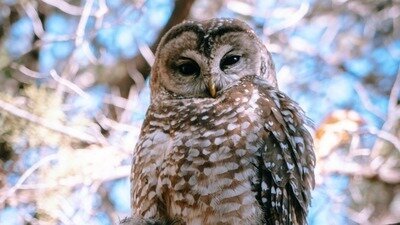

Protect Spotted Owls and Old-Growth Forests From the USFWS Logging Scheme
The Issue
In September 2024, the U.S. Fish and Wildlife Service released a plan to shoot 450,000 barred owls over 30 years, at a projected cost of up to $1.35 billion. The stated purpose was to help the threatened northern spotted owl, which shares old-growth forests across California, Oregon, and Washington with its more adaptable cousin.
But a second USFWS rulemaking published in July 2026 reveals what is actually at stake. That rule strips the word "harm" from the Endangered Species Act, eliminating the habitat protections that have shielded wildlife for 50 years. Together, the two rules work as a coordinated opening: shooting barred owls is designed to trigger incidental take permits allowing timber companies to displace and harm spotted owls, while the ESA habitat rollback removes the legal backstop that would otherwise stop them. Kill the owls, count it as an offset, cut the trees.
The shooting plan covers 24 million acres across three states, including 17 national forests and 14 National Park Service units. Yosemite, Crater Lake, and Olympic National Parks are all within the shooting range. Attorneys for Animal Wellness Action, which filed suit in U.S. District Court in Portland, described the plan as "a shot in the dark, with potential adverse impacts on spotted owls and other species that the USFWS fails to meaningfully evaluate."
The labeling of barred owls as "invasive" is also false. They are native North American birds, protected under the Migratory Bird Treaty Act of 1918, whose range has expanded like hundreds of other species adapting to human-altered landscapes.
The broader context makes the logging motive plain. H.R. 1, passed in 2025, already mandates more than a 60 percent increase in logging on federal public lands. The USFWS is providing the regulatory machinery to make that possible. The ESA harm rescission takes effect in September 2026. Once it does, the habitat protections that anchored the law since 1973 stop existing.
Sign this petition to demand Congress block the ESA harm rescission and defund the barred owl kill plan before the old-growth forests both owl species depend on are gone.

528
The Issue
In September 2024, the U.S. Fish and Wildlife Service released a plan to shoot 450,000 barred owls over 30 years, at a projected cost of up to $1.35 billion. The stated purpose was to help the threatened northern spotted owl, which shares old-growth forests across California, Oregon, and Washington with its more adaptable cousin.
But a second USFWS rulemaking published in July 2026 reveals what is actually at stake. That rule strips the word "harm" from the Endangered Species Act, eliminating the habitat protections that have shielded wildlife for 50 years. Together, the two rules work as a coordinated opening: shooting barred owls is designed to trigger incidental take permits allowing timber companies to displace and harm spotted owls, while the ESA habitat rollback removes the legal backstop that would otherwise stop them. Kill the owls, count it as an offset, cut the trees.
The shooting plan covers 24 million acres across three states, including 17 national forests and 14 National Park Service units. Yosemite, Crater Lake, and Olympic National Parks are all within the shooting range. Attorneys for Animal Wellness Action, which filed suit in U.S. District Court in Portland, described the plan as "a shot in the dark, with potential adverse impacts on spotted owls and other species that the USFWS fails to meaningfully evaluate."
The labeling of barred owls as "invasive" is also false. They are native North American birds, protected under the Migratory Bird Treaty Act of 1918, whose range has expanded like hundreds of other species adapting to human-altered landscapes.
The broader context makes the logging motive plain. H.R. 1, passed in 2025, already mandates more than a 60 percent increase in logging on federal public lands. The USFWS is providing the regulatory machinery to make that possible. The ESA harm rescission takes effect in September 2026. Once it does, the habitat protections that anchored the law since 1973 stop existing.
Sign this petition to demand Congress block the ESA harm rescission and defund the barred owl kill plan before the old-growth forests both owl species depend on are gone.


Supporter Voices
Petition Updates
Share this petition
Petition created on August 3, 2026