
Protect Our Drinking Water: Stop Kerber’s Farm Expansion on Froehlich Farm Nature Preserve
Protect Our Drinking Water: Stop Kerber’s Farm Expansion on Froehlich Farm Nature Preserve
The Issue
We demand that Suffolk County immediately stop all further progress on the School at Kerber’s Farm Inc., also known as the Kerber’s Educational Farm project, at Froehlich Farm Nature Preserve in Huntington, New York, and open a full public investigation.
Froehlich Farm was already saved by taxpayers in 1991 through the Drinking Water Protection Program. It was not purchased to promote a private business, expand a commercial brand, create a new farming enterprise, or solve parking problems for a business across the street. It was preserved to protect highly permeable glacial deposits, deep recharge to the Magothy aquifer, wildlife habitat, open space, passive recreation, and natural-history education. Article XII of the Suffolk County Charter requires these protected lands to remain in their natural state as a nature preserve. Any change to that protected purpose requires proper legal authority and public referendum.
The public deserves answers about why Suffolk County is relying on a later site survey that appears to contradict the Nature Preserve Handbook and the Charter protections that governed this land when it was acquired. A later site survey cannot rewrite the legal purpose of land purchased with drinking-water protection tax dollars. The Nature Preserve Handbook and County Charter are not suggestions; they are the rules that protect this land for the public.
Do not be fooled by Kerber’s Farm’s claim that it “saved” the Kerber’s Farm property from condo development. That claim is misleading. The property is only 1.9 acres and is zoned for single-family residential use. It could not simply be turned into condominiums without major zoning changes, approvals, environmental review, and public scrutiny. Any special treatment to legalize, expand, or support a private commercial operation in that residential neighborhood would raise serious spot-zoning and land-use concerns.
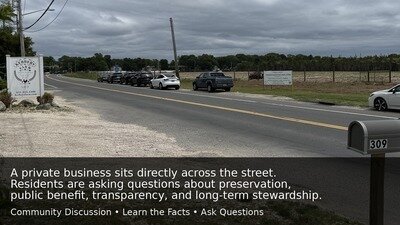
That narrative distracts from the real issue: Froehlich Farm Nature Preserve was already saved by the public more than 30 years ago with drinking-water protection tax dollars. Kerber’s Farm is not saving public land. It is using a preservation story to justify access to taxpayer-protected preserve land across the street.
This is not preservation. It is an attempt to turn protected public land into a support system for a private business under the guise of education.
Do not be fooled by the claim that Kerber’s is “bringing farming history back” to Froehlich Farm. Farming had been dormant for decades because the land was preserved to protect groundwater, open space, wildlife habitat, and Long Island’s sole-source aquifer. Natural-history education is not farming. Natural-history education means observing and learning from ecosystems in their natural state. Farming is the opposite: it requires clearing, tilling, irrigation, fencing, cultivation, traffic, parking, and potential pesticide use. Turning a nature preserve into cultivated fields and a parking lot directly contradicts the purpose of a preserve.
The damage has already begun. Land has already been cleared. Suffolk County must stop before more harm is done.
Suffolk County’s SEQRA review and Agricultural District approval also raise serious concerns. The 1.9-acre Kerber’s parcel is in a residential neighborhood and appears heavily developed with a café/restaurant, dwellings, driveways, parking, barns, and animal structures. Only a limited portion appears capable of cultivation.
Under Agriculture & Markets Law § 303-b, land must be predominantly viable agricultural land to qualify for Agricultural District inclusion. Suffolk County must explain how more than half of this parcel is actually used for, or suitable for, agricultural production. Restaurant sales, prepared foods, retail markups, classes, agritourism, and branding should not count as qualifying agricultural sales.
The County’s SEQRA review appears inadequate. Suffolk County reportedly treated zoning conflicts, traffic, parking, noise, animals, wastewater, school use, and neighborhood impacts as “no or small impact,” despite obvious concerns in a residential neighborhood. Suffolk County must disclose its evidence, including site visits, soil review, farmed acreage, qualifying sales verification, and environmental analysis.
The proposed parking lot and bus turnaround, approximately 0.65 to 0.67 acres, create serious risks from gasoline, oil, stormwater runoff, traffic, and contamination. Organic farming is not impact-free; it can still contribute nitrates and other pollutants to groundwater. Frequent field trips and public programming also raise concerns about overuse, traffic safety, noise, habitat disruption, and cumulative impacts. Suffolk County cannot label these impacts “small” or “routine” and move forward without taking the required hard look.
This proposal is especially troubling because the type of farming education Kerber’s claims to offer already exists at Froehlich Farm. In 2004, Assemblyman James Conte secured a $7,500 state grant for Friends of Huntington Farmland to create an organic farming and gardening program within Froehlich Farm. That program already has organic farming areas, nature trails, classrooms, bathrooms, and parking at Breezy Park. It can support sustainable farming education without clearing 20 more acres, building a new parking lot, or adding new infrastructure across from Kerber’s private business.
Suffolk County must explain why it is duplicating an existing stewardship program while putting more pressure on protected aquifer land. The Nature Preserve Handbook limits cultivation and support facilities on preserve land. If the existing Friends of Huntington Farmland program has already reached or exhausted the permitted level of cultivation or support infrastructure, then no additional cultivation, clearing, parking, fencing, or new infrastructure should be allowed.
Protected preserve land should not be cleared again to duplicate a purpose that is already being served. If Kerber’s educational goals could be met through collaboration with Friends of Huntington Farmland, the existing Froehlich program, or a low-impact walking trail connection, why is Suffolk County choosing the more destructive option?
This project raises serious questions that Suffolk County must answer publicly before any further work is allowed. Why have other entities reportedly been denied expanded use of this protected land, including public-safety needs such as the Cold Spring Harbor Fire Department? Why was WPW Growers restricted from selling pies from an existing support building on Froehlich Farm Nature Preserve? Why weren’t other farms, schools, or lawful nonprofit organizations in the area given the same opportunity to apply for or use this land?
And why is Kerber’s, a private business with unresolved Town compliance issues, now being granted access to taxpayer-protected preserve land under the banner of education?
Suffolk County must explain the selection process, the legal standard applied, whether this opportunity was publicly offered, why Kerber’s was selected, and why protected preserve land is being used in a way that appears to support one private business across the street.
Farming schools are not unique in Huntington. Lawful organizations already provide agricultural education and stewardship, including Friends of Huntington Farmland at Froehlich Farm, ELIJA Farm, and Manor Farm. Suffolk County does not need to sacrifice protected aquifer land to create something that already exists legally elsewhere.
We want answers. Suffolk County must stop the project, disclose all records, explain the legal authority for this license, reopen environmental review, hold a public hearing, and prove why land bought to protect our drinking water is being used in a way that appears to benefit a private business.
Kerber’s Farm is not saving Froehlich Farm. The public already saved it. Our preserved land should not be used to promote a noncompliant private business, and our drinking water should not be put at risk in the name of teaching children about sustainability.

504
The Issue
We demand that Suffolk County immediately stop all further progress on the School at Kerber’s Farm Inc., also known as the Kerber’s Educational Farm project, at Froehlich Farm Nature Preserve in Huntington, New York, and open a full public investigation.
Froehlich Farm was already saved by taxpayers in 1991 through the Drinking Water Protection Program. It was not purchased to promote a private business, expand a commercial brand, create a new farming enterprise, or solve parking problems for a business across the street. It was preserved to protect highly permeable glacial deposits, deep recharge to the Magothy aquifer, wildlife habitat, open space, passive recreation, and natural-history education. Article XII of the Suffolk County Charter requires these protected lands to remain in their natural state as a nature preserve. Any change to that protected purpose requires proper legal authority and public referendum.
The public deserves answers about why Suffolk County is relying on a later site survey that appears to contradict the Nature Preserve Handbook and the Charter protections that governed this land when it was acquired. A later site survey cannot rewrite the legal purpose of land purchased with drinking-water protection tax dollars. The Nature Preserve Handbook and County Charter are not suggestions; they are the rules that protect this land for the public.
Do not be fooled by Kerber’s Farm’s claim that it “saved” the Kerber’s Farm property from condo development. That claim is misleading. The property is only 1.9 acres and is zoned for single-family residential use. It could not simply be turned into condominiums without major zoning changes, approvals, environmental review, and public scrutiny. Any special treatment to legalize, expand, or support a private commercial operation in that residential neighborhood would raise serious spot-zoning and land-use concerns.
That narrative distracts from the real issue: Froehlich Farm Nature Preserve was already saved by the public more than 30 years ago with drinking-water protection tax dollars. Kerber’s Farm is not saving public land. It is using a preservation story to justify access to taxpayer-protected preserve land across the street.
This is not preservation. It is an attempt to turn protected public land into a support system for a private business under the guise of education.
Do not be fooled by the claim that Kerber’s is “bringing farming history back” to Froehlich Farm. Farming had been dormant for decades because the land was preserved to protect groundwater, open space, wildlife habitat, and Long Island’s sole-source aquifer. Natural-history education is not farming. Natural-history education means observing and learning from ecosystems in their natural state. Farming is the opposite: it requires clearing, tilling, irrigation, fencing, cultivation, traffic, parking, and potential pesticide use. Turning a nature preserve into cultivated fields and a parking lot directly contradicts the purpose of a preserve.
The damage has already begun. Land has already been cleared. Suffolk County must stop before more harm is done.
Suffolk County’s SEQRA review and Agricultural District approval also raise serious concerns. The 1.9-acre Kerber’s parcel is in a residential neighborhood and appears heavily developed with a café/restaurant, dwellings, driveways, parking, barns, and animal structures. Only a limited portion appears capable of cultivation.
Under Agriculture & Markets Law § 303-b, land must be predominantly viable agricultural land to qualify for Agricultural District inclusion. Suffolk County must explain how more than half of this parcel is actually used for, or suitable for, agricultural production. Restaurant sales, prepared foods, retail markups, classes, agritourism, and branding should not count as qualifying agricultural sales.
The County’s SEQRA review appears inadequate. Suffolk County reportedly treated zoning conflicts, traffic, parking, noise, animals, wastewater, school use, and neighborhood impacts as “no or small impact,” despite obvious concerns in a residential neighborhood. Suffolk County must disclose its evidence, including site visits, soil review, farmed acreage, qualifying sales verification, and environmental analysis.
The proposed parking lot and bus turnaround, approximately 0.65 to 0.67 acres, create serious risks from gasoline, oil, stormwater runoff, traffic, and contamination. Organic farming is not impact-free; it can still contribute nitrates and other pollutants to groundwater. Frequent field trips and public programming also raise concerns about overuse, traffic safety, noise, habitat disruption, and cumulative impacts. Suffolk County cannot label these impacts “small” or “routine” and move forward without taking the required hard look.
This proposal is especially troubling because the type of farming education Kerber’s claims to offer already exists at Froehlich Farm. In 2004, Assemblyman James Conte secured a $7,500 state grant for Friends of Huntington Farmland to create an organic farming and gardening program within Froehlich Farm. That program already has organic farming areas, nature trails, classrooms, bathrooms, and parking at Breezy Park. It can support sustainable farming education without clearing 20 more acres, building a new parking lot, or adding new infrastructure across from Kerber’s private business.
Suffolk County must explain why it is duplicating an existing stewardship program while putting more pressure on protected aquifer land. The Nature Preserve Handbook limits cultivation and support facilities on preserve land. If the existing Friends of Huntington Farmland program has already reached or exhausted the permitted level of cultivation or support infrastructure, then no additional cultivation, clearing, parking, fencing, or new infrastructure should be allowed.
Protected preserve land should not be cleared again to duplicate a purpose that is already being served. If Kerber’s educational goals could be met through collaboration with Friends of Huntington Farmland, the existing Froehlich program, or a low-impact walking trail connection, why is Suffolk County choosing the more destructive option?
This project raises serious questions that Suffolk County must answer publicly before any further work is allowed. Why have other entities reportedly been denied expanded use of this protected land, including public-safety needs such as the Cold Spring Harbor Fire Department? Why was WPW Growers restricted from selling pies from an existing support building on Froehlich Farm Nature Preserve? Why weren’t other farms, schools, or lawful nonprofit organizations in the area given the same opportunity to apply for or use this land?
And why is Kerber’s, a private business with unresolved Town compliance issues, now being granted access to taxpayer-protected preserve land under the banner of education?
Suffolk County must explain the selection process, the legal standard applied, whether this opportunity was publicly offered, why Kerber’s was selected, and why protected preserve land is being used in a way that appears to support one private business across the street.
Farming schools are not unique in Huntington. Lawful organizations already provide agricultural education and stewardship, including Friends of Huntington Farmland at Froehlich Farm, ELIJA Farm, and Manor Farm. Suffolk County does not need to sacrifice protected aquifer land to create something that already exists legally elsewhere.
We want answers. Suffolk County must stop the project, disclose all records, explain the legal authority for this license, reopen environmental review, hold a public hearing, and prove why land bought to protect our drinking water is being used in a way that appears to benefit a private business.
Kerber’s Farm is not saving Froehlich Farm. The public already saved it. Our preserved land should not be used to promote a noncompliant private business, and our drinking water should not be put at risk in the name of teaching children about sustainability.
504
The Decision Makers


Supporter Voices
Petition Updates
Share this petition
Petition created on May 30, 2026