Protect Kaziranga’s ecological safeguards
The Issue
Growing up in Assam, Kaziranga has always been more than just a national park to me; it is a sanctuary for incredible biodiversity and an emblem of natural heritage. Renowned for its population of one-horned rhinoceroses and wild elephants, Kaziranga is constituted of unique ecosystems that include forests, wetlands, and a network of rivers. Together with the surrounding eco-sensitive zone (ESZ), it forms a crucial corridor for many species to thrive and move freely.
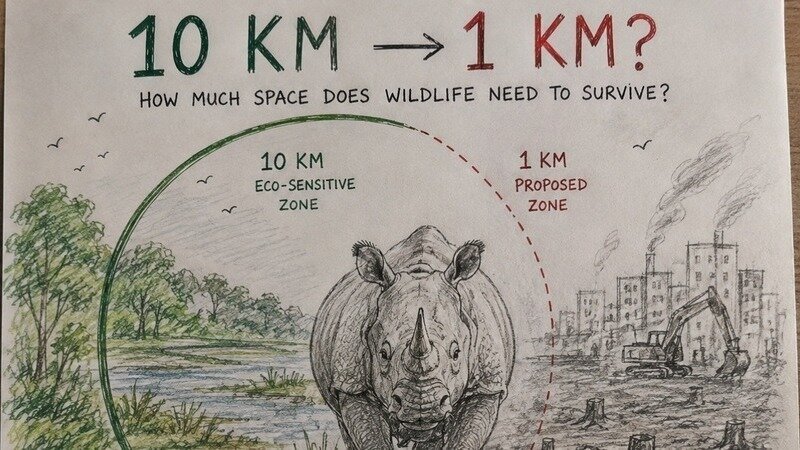
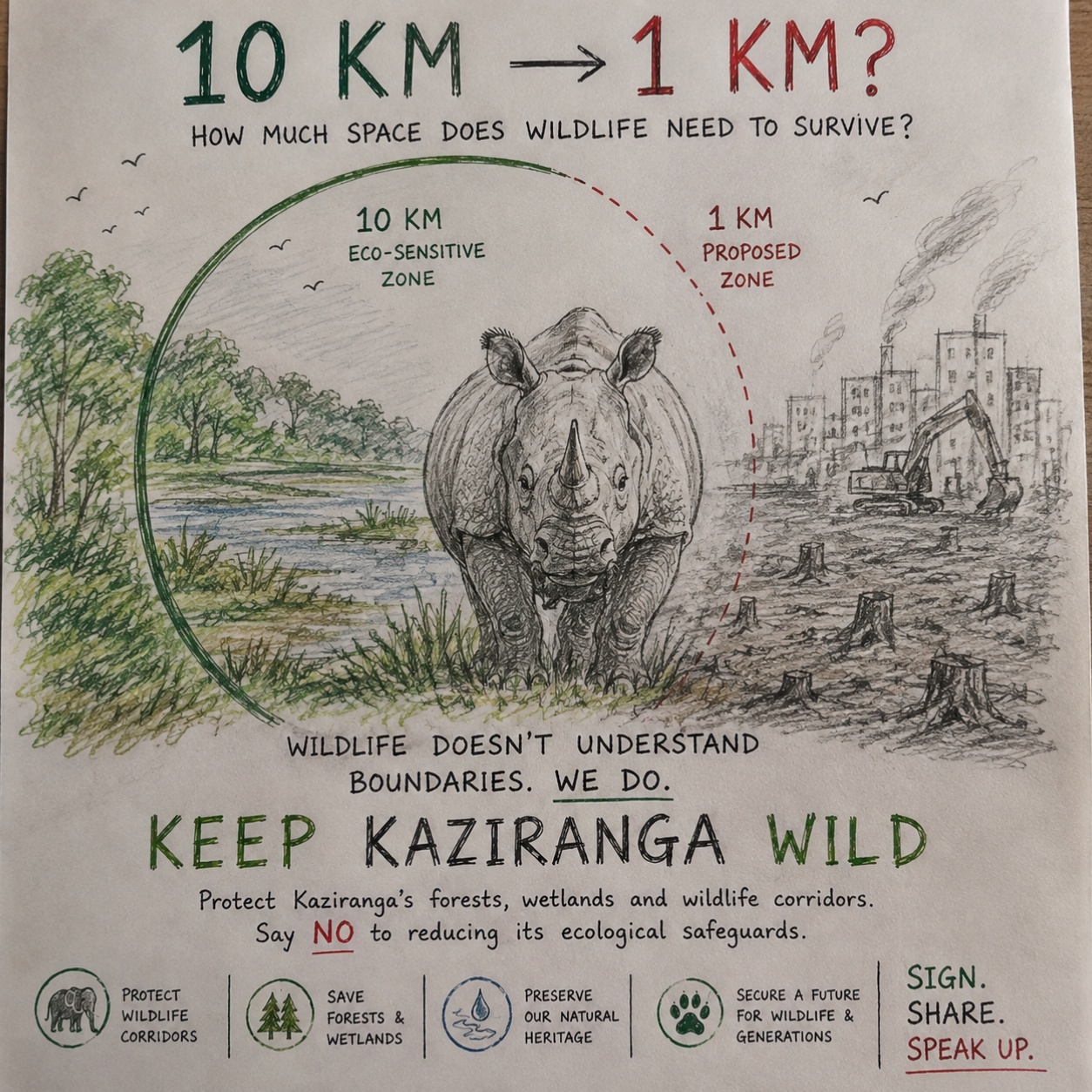
Recently, the Government of Assam announced plans to reduce the Eco-Sensitive Zone (ESZ) around Kaziranga National Park from the current 10 kilometers to just 1 kilometer. This decision could have devastating consequences for the wildlife, including elephants and rhinos, that do not adhere to man-made boundaries and depend on these sprawling landscapes to live and migrate. According to various environmental studies, when ESZs are constricted, particularly around biodiversity hotspots, it invariably leads to human-wildlife conflict, habitat fragmentation, and loss of biodiversity.
The current ESZ is a result of years of diligent work by conservationists, scientists, and local communities who understand that safeguarding these buffer zones is integral to preserving the park’s ecological identity. A reduction to 1 km not only neglects this collective wisdom but also threatens the survival of innumerable species that depend on the park's ecosystem.
Moreover, wildlife conservation is not merely an environmental issue but a cultural and economic one as well. Kaziranga attracts millions of tourists each year, prominently boosting local economies. It is a source of pride, identity, and livelihood for the residents of Assam. A diminished ESZ could deter tourists, thus impacting livelihoods tied to eco-tourism and conservation efforts.
By calling on the Government of Assam and the central government of India to halt this reduction unless based on thorough scientific evaluation, we seek to ensure that decisions affecting Kaziranga's future are grounded in robust ecological science, balancing the needs of both people and wildlife.
Please join us in this fight to keep Kaziranga wild. Sign and share this petition to make sure that the voices advocating for robust environmental protection are heard and acted upon. Protecting Kaziranga's ecological integrity is a responsibility we all share—one that preserves our natural legacy for generations to come.

40
The Issue
Growing up in Assam, Kaziranga has always been more than just a national park to me; it is a sanctuary for incredible biodiversity and an emblem of natural heritage. Renowned for its population of one-horned rhinoceroses and wild elephants, Kaziranga is constituted of unique ecosystems that include forests, wetlands, and a network of rivers. Together with the surrounding eco-sensitive zone (ESZ), it forms a crucial corridor for many species to thrive and move freely.
Recently, the Government of Assam announced plans to reduce the Eco-Sensitive Zone (ESZ) around Kaziranga National Park from the current 10 kilometers to just 1 kilometer. This decision could have devastating consequences for the wildlife, including elephants and rhinos, that do not adhere to man-made boundaries and depend on these sprawling landscapes to live and migrate. According to various environmental studies, when ESZs are constricted, particularly around biodiversity hotspots, it invariably leads to human-wildlife conflict, habitat fragmentation, and loss of biodiversity.
The current ESZ is a result of years of diligent work by conservationists, scientists, and local communities who understand that safeguarding these buffer zones is integral to preserving the park’s ecological identity. A reduction to 1 km not only neglects this collective wisdom but also threatens the survival of innumerable species that depend on the park's ecosystem.
Moreover, wildlife conservation is not merely an environmental issue but a cultural and economic one as well. Kaziranga attracts millions of tourists each year, prominently boosting local economies. It is a source of pride, identity, and livelihood for the residents of Assam. A diminished ESZ could deter tourists, thus impacting livelihoods tied to eco-tourism and conservation efforts.
By calling on the Government of Assam and the central government of India to halt this reduction unless based on thorough scientific evaluation, we seek to ensure that decisions affecting Kaziranga's future are grounded in robust ecological science, balancing the needs of both people and wildlife.
Please join us in this fight to keep Kaziranga wild. Sign and share this petition to make sure that the voices advocating for robust environmental protection are heard and acted upon. Protecting Kaziranga's ecological integrity is a responsibility we all share—one that preserves our natural legacy for generations to come.
The Decision Makers

Petition Updates
Share this petition
Petition created on 13 August 2026