
Protect IUP Co-op Park from Timbering!
Protect IUP Co-op Park from Timbering!
The Issue
Please SIGN OUR PETITION to Protect the Co-op park
Our petition asks for the following:
- An immediate halt to the ALL work in Co-op Park (marking trees, timbering).
- Employ forest ecology experts to evaluate the proposed plan.
- Allow the Co-op park to remain untouched as a natural area for student enjoyment.
- Use of the park exclusively for purposes which support the mission of The Student Cooperative:
"The Student Cooperative Association at Indiana University of Pennsylvania is a non-profit organization owned and operated by a community of activity-fee paying members that provides facilities, activities and services to enhance the social, cultural, recreational, and learning experience for the university community." (https://www.coop.iup.edu/wp-content/uploads/2019/09/Mission-Statement.pdf
THE BACKGROUND INFORMATION:
“A mere three miles from the IUP campus and downtown Indiana, the Co-op Park is 281 acres of beautiful woodlands and fields. There are 10 miles of hiking and walking trails that connect the Co-op Park with the Whites Woods Nature Center” (WWNC). (https://www.coop.iup.ed/campus-recreation/lodge/
Services listed for the park on the website are:
College Lodge Road Entrance: College Lodge Rental; Sledding & Tubing; Disc Golf Course; 2 ½ mile Fitness Par Course; 5K Course; Hiking / Walking Trails
Fulton Run Road Entrance: Two Softball Fields; Fishing Pond; Archery Range; Walking Areas
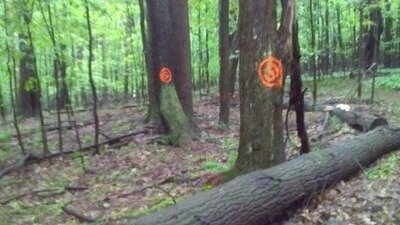
Unfortunately, the Co-op Board and Co-op Executive Director and CEO Lou Garzarelli, have approved a ‘land management plan’ which has resulted in a huge proportion of the largest trees along the trails in the IUP Co-op Park, adjoining WWNC, to be marked for timbering.
The linked article details what we have learned: https://thehawkeyeonlinenews.wordpress.com/2026/05/27/logging-whites-woods-sister-forest/
In response to enquiries by the community, Mr. Garzarelli (in a letter co-signed by Co-op Board Chair, Dr. Joshua Castle), attempted to justify the tree removal, and refused to release the plan for public scrutiny, as follows:
“For the Co-op Park, the trees identified for removal are ones that are either in distress or that prevent safe use of the trails and the park property. Removal of invasive plant species is part of the land management plan, which was vetted for more than nine months by the Student Co-op leadership.
“Because this contract is between a private entity, the Student Co-op, it would not be appropriate to share details about this plan or its selection in public. The Student Co-Op is governed by its Board of Directors, which administers the Student Activity Fee, and sets out policy for the Association.”
Contrary to their assertions, that “the trees identified for removal are ones that are either in distress or that prevent safe use of the trails and the park property,” a walk through the marked trees suggests otherwise. Many of them are the largest trees in the park and are neither compromised nor a threat to safety.
In fact, what has been shared about the plan is remarkably similar to a plan that was proposed, and rejected for the adjoining White’s Woods Nature Center by the same company, Millstone. Some key responses to that plan by forestry experts are:
- “…while the proposed strategies may be well-intentioned, for many reasons, it will not produce a positive outcome.” -- Mike Wolf, Forester, Appalachian Forest Consultants (letter dated July 2, 2020).
- “…the combination of opening the canopy to allow sunlight penetration to the forest floor … will unquestionably create conditions that are ideal for invasive plant colonization and proliferation, and are detrimental to forest regeneration and sustainability. Once this takes place it will require constant, expensive, and intensive intervention to restore.” – Jeffery Larkin, Thomas Simmons, and Michael Tyree, IUP Faculty (letter dated April 30, 2020).
- “…It will look like a bomb went off. This park will literally never be the same. There will be a lot of tears.” -- Tom Kane, Johnson Brothers Lumber, (The Hawkeye, May 22, 2020).
Our petition objects to the proposed wide-spread timbering for the following reasons:
-
Removing the canopy will cause invasive plants to multiply exponentially, requiring considerably more maintenance with removal at least every six months
-
It appears that there is an intention to create an open park – more like the Oak Grove – which will require frequent mowing, again much more maintenance;
- Trails will become hotter and therefore much less usable in the summer months;
- The removal of large trees will require considerable equipment and result in extensive damage to surrounding trees – for every timbered tree, six or more additional trees are lost due to disruption of the area;
- Impact on the environment (air quality, carbon emissions, water table, etc.) is likely to be very damaging;
- Ultimately, such a plan is likely to destroy the forest, at considerable financial and environmental cost, and for no good reason

380
The Issue
Please SIGN OUR PETITION to Protect the Co-op park
Our petition asks for the following:
- An immediate halt to the ALL work in Co-op Park (marking trees, timbering).
- Employ forest ecology experts to evaluate the proposed plan.
- Allow the Co-op park to remain untouched as a natural area for student enjoyment.
- Use of the park exclusively for purposes which support the mission of The Student Cooperative:
"The Student Cooperative Association at Indiana University of Pennsylvania is a non-profit organization owned and operated by a community of activity-fee paying members that provides facilities, activities and services to enhance the social, cultural, recreational, and learning experience for the university community." (https://www.coop.iup.edu/wp-content/uploads/2019/09/Mission-Statement.pdf
THE BACKGROUND INFORMATION:
“A mere three miles from the IUP campus and downtown Indiana, the Co-op Park is 281 acres of beautiful woodlands and fields. There are 10 miles of hiking and walking trails that connect the Co-op Park with the Whites Woods Nature Center” (WWNC). (https://www.coop.iup.ed/campus-recreation/lodge/
Services listed for the park on the website are:
College Lodge Road Entrance: College Lodge Rental; Sledding & Tubing; Disc Golf Course; 2 ½ mile Fitness Par Course; 5K Course; Hiking / Walking Trails
Fulton Run Road Entrance: Two Softball Fields; Fishing Pond; Archery Range; Walking Areas
Unfortunately, the Co-op Board and Co-op Executive Director and CEO Lou Garzarelli, have approved a ‘land management plan’ which has resulted in a huge proportion of the largest trees along the trails in the IUP Co-op Park, adjoining WWNC, to be marked for timbering.
The linked article details what we have learned: https://thehawkeyeonlinenews.wordpress.com/2026/05/27/logging-whites-woods-sister-forest/
In response to enquiries by the community, Mr. Garzarelli (in a letter co-signed by Co-op Board Chair, Dr. Joshua Castle), attempted to justify the tree removal, and refused to release the plan for public scrutiny, as follows:
“For the Co-op Park, the trees identified for removal are ones that are either in distress or that prevent safe use of the trails and the park property. Removal of invasive plant species is part of the land management plan, which was vetted for more than nine months by the Student Co-op leadership.
“Because this contract is between a private entity, the Student Co-op, it would not be appropriate to share details about this plan or its selection in public. The Student Co-Op is governed by its Board of Directors, which administers the Student Activity Fee, and sets out policy for the Association.”
Contrary to their assertions, that “the trees identified for removal are ones that are either in distress or that prevent safe use of the trails and the park property,” a walk through the marked trees suggests otherwise. Many of them are the largest trees in the park and are neither compromised nor a threat to safety.
In fact, what has been shared about the plan is remarkably similar to a plan that was proposed, and rejected for the adjoining White’s Woods Nature Center by the same company, Millstone. Some key responses to that plan by forestry experts are:
- “…while the proposed strategies may be well-intentioned, for many reasons, it will not produce a positive outcome.” -- Mike Wolf, Forester, Appalachian Forest Consultants (letter dated July 2, 2020).
- “…the combination of opening the canopy to allow sunlight penetration to the forest floor … will unquestionably create conditions that are ideal for invasive plant colonization and proliferation, and are detrimental to forest regeneration and sustainability. Once this takes place it will require constant, expensive, and intensive intervention to restore.” – Jeffery Larkin, Thomas Simmons, and Michael Tyree, IUP Faculty (letter dated April 30, 2020).
- “…It will look like a bomb went off. This park will literally never be the same. There will be a lot of tears.” -- Tom Kane, Johnson Brothers Lumber, (The Hawkeye, May 22, 2020).
Our petition objects to the proposed wide-spread timbering for the following reasons:
-
Removing the canopy will cause invasive plants to multiply exponentially, requiring considerably more maintenance with removal at least every six months
-
It appears that there is an intention to create an open park – more like the Oak Grove – which will require frequent mowing, again much more maintenance;
- Trails will become hotter and therefore much less usable in the summer months;
- The removal of large trees will require considerable equipment and result in extensive damage to surrounding trees – for every timbered tree, six or more additional trees are lost due to disruption of the area;
- Impact on the environment (air quality, carbon emissions, water table, etc.) is likely to be very damaging;
- Ultimately, such a plan is likely to destroy the forest, at considerable financial and environmental cost, and for no good reason
380
The Decision Makers

Supporter Voices
Petition Updates
Share this petition
Petition created on June 3, 2026