CPP Disability Petition Update – The Truth Behind Section 65(3)

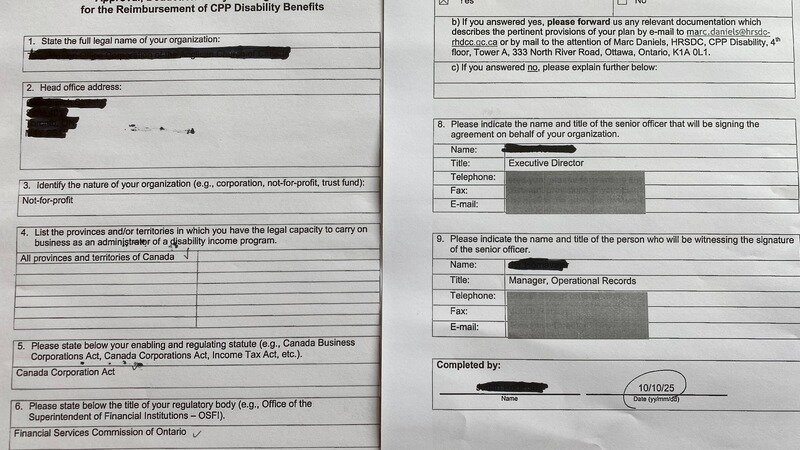
This is the form. The gateway. The mechanism that makes it all possible.
What you’re looking at is a document I obtained through an Access to Information request.
It’s the application form that allows private organizations—including private insurers—to enter into agreements with the federal Minister to lay claim to CPP Disability (CPPD) benefits that belong to disabled Canadians.
This is how they do it:
Not through legislation.
Not through provincial approval.
Not through contributor consent.
But through a simple form.
No scrutiny.
No requirement to prove an excess disability benefit has been paid.
No evidence of a contractual relationship with the disabled person.
No privity of contract.
Just a few boxes, a signature, and a claim to your pension.
This document confirms what I’ve been trying to warn Canadians about.
Section 65(3) of the Canada Pension Plan Act allows this form to unlock access to your public pension—earned through your mandatory contributions—and divert it to the private sector.
And here’s what the form doesn’t ask:
What disability supports are provided.
Whether the organization pays long-term disability that exceeds wage replacement.
Whether any accommodations are offered to the contributor.
Whether the contributor even knows their pension will be taken.
Instead, it simply asks if the organization pays any disability benefit (short or long term)—but doesn’t even require an answer.
It identifies the applicant as an “administrator of a disability income program,” and that title is taken entirely at face value.
No evidence.
No requirement to prove anything.
No verification at all.
The label alone is enough.
And just like that?
Application approved.
Access granted to public disability pensions—pensions meant to support Canadians who are too disabled to work in any occupation.
Once submitted, the Minister approves the application, and a reimbursement agreement is signed.
From that moment forward, CPPD payments are redirected to the private insurer, and the disabled contributor may never know what happened—or why—until it’s too late.
I never saw the agreement.
I didn’t even know it existed.
That’s why I’m trying so hard to be heard.
I want you to know—so together, we can make change.
When I finally found out about the agreement, I requested a copy. I was denied.
It took many attempts under Access to Information before I finally received it.
And once I did, the truth started to unravel.
The agreement authorizes the Minister of Human Resources and Skills Development to:
“Deduct from any CPP disability benefits payable to a beneficiary, an amount up to the amount of the excess disability benefits paid by the Administrator to that beneficiary, and remit that amount to the Administrator.”
That’s it.
And to make matters worse, the Minister is “saved harmless.”
The federal government unlocks the door to your pension—but accepts no responsibility for the reliability or honesty of the insurer’s claim.
There is no obligation to verify whether an excess was actually paid.
No duty to the disabled person.
No liability at all.
And yet, the Minister knows exactly what these agreements do:
They shield insurers from the Insurance Act.
This is the cruel reality of being severely disabled in Canada:
The people entrusted to protect your pension open the door—and walk away.
You’re left to face the financial devastation alone.
The agreement does not authorize insurers to:
Automatically seize or offset ongoing monthly CPPD payments.
Take CPPD as a standing entitlement.
Treat CPPD as a permanent income reduction strategy.
But in practice? That’s exactly what happens.
Insurers seize monthly CPPD payments indefinitely.
They don’t just recover a one-time overpayment—they permanently reduce their own payout by the value of CPPD, and they call it an “offset.”
And the justification?
“To ensure recipients have a financial incentive to return to work.”
— CLHIA Submission to Parliament, 2003
Instead of protecting the most vulnerable, the system is used to create economic discomfort for the severely disabled—as a motivator.
And insurers are shielded from the Insurance Act by the existence of a federal agreement—an industry known to be profit-driven, left to police itself.
No oversight.
No discretion.
No accountability.
Just blind trust that the private sector will act in good faith—while seizing public pensions from the severely disabled.
This is what I’m fighting to expose.
If you’ve already signed my petition—thank you.
If you haven’t yet, please do. Your voice matters more than you know.
Let others see this for themselves.
Let them understand what’s really happening behind the scenes.
Because nowhere in the Canada Pension Plan does it say that our contributions are collected to be handed over to a private insurer.
Want to know if your insurer has made this deal?
Not all insurers line up at this unlocked door.
And we don’t know who has—until tragedy strikes and you apply for CPPD.
But there’s one way to check:
Google “ISP-1618C.”
This will launch a Service Canada PDF form.
It’s the form insurers use to provide their banking details for reimbursement.
At the top of the form, you’ll see a dropdown menu labeled “Insurer Information.”
Click it.
That menu lists the insurers who have entered into reimbursement agreements—agreements that allow them to take away your public pension property, when you need it most, when you become severely disabled.
Please—take a moment to look.
Check if your insurer is on the list.
And if they are—tell someone.
We earned our pensions.
They were never meant to be given away.
It’s time for accountability.
It’s time for answers.
It’s time to close the door that was quietly opened behind our backs.
We didn’t contribute to CPP so it could be handed to private insurers.
We contributed because we believed in a promise—
That if we became too disabled to work, our country would stand by us. Granting our disability pension benefit to help with restrictions and impairment. We paid for it.
That promise has been broken.
Now it’s our turn to demand it back.
Please keep signing.
Keep sharing.
Keep speaking up.
We need our voices to be louder than the silence that let this happen.
Because if we don’t fight for our pensions—who will?
I can speak first-hand:
If you become severely disabled, you will need daily assistance and accommodations.
Your pension will be needed to help make your disability bearable.
It’s not extra—it’s essential.
Let’s end this silence.
Let’s close the door.
Together.
Sign.
Share to social media.
Email a friend.
Talk to a neighbor.
Make others aware.
Help me, so that I can help you.
Before my reality, becomes your reality.