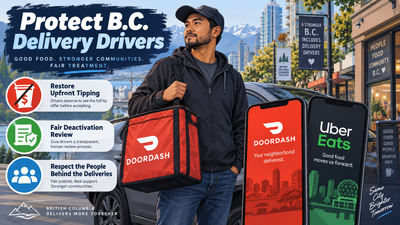

Protect B.C. Delivery Drivers: Restore Upfront Tipping and Stop Unfair Deactivation
The Issue
We are app-based delivery drivers and supporters in British Columbia asking the Province of British Columbia to strengthen protections for workers using food-delivery and other app-based platforms.
B.C.'s 2024 gig-worker regulations introduced important protections, including minimum compensation for engaged time, mileage allowances, wage statements, and rules concerning suspension and deactivation.
We support keeping these protections.
However, drivers are asking the Province to examine two additional issues that can have a major effect on our income:
1. The loss of upfront tipping options
2. Sudden or potentially mistaken account deactivations, including decisions involving automated systems
1. Restore a clear optional tipping choice at checkout like before
Note : This is for Doordash and UBER EATS mainly. Skip the dishes hasn't removed upfront tip option.
Before B.C.'s new gig-worker rules, customers using many delivery platforms could select a tip while placing their order.
After the new rules were introduced, some platforms changed their apps so that tipping occurs later in the ordering or delivery process.
For delivery workers, tips have historically represented an important part of total earnings.
The concern is that if fewer customers see or use the tipping option, the reduction in tip income can offset some or all of the additional income created by B.C.'s minimum-pay and mileage protections.
For example, an illustrative situation could look like this:
Before
Platform earnings: $18
Customer tips: $8
Total gross earnings: $26
After
Platform earnings: $21.89
Mileage allowance: $3.50
Customer tips: $1
Total gross earnings: $26.39
These numbers are only an example and are not intended to represent every driver's earnings.
The point is that a law designed to improve driver compensation may produce only a small increase in total gross earnings for some workers if a significant source of tip income disappears at the same time.
Vehicle expenses also reduce a driver's effective take-home income
There is another important part of this calculation: app-based delivery workers frequently use their own vehicles to perform the work.
Drivers are responsible for costs associated with operating those vehicles, which can include:
• fuel
• oil changes and routine maintenance
• tires and brakes
• repairs
• additional kilometres placed on the vehicle
• insurance-related costs
• cleaning and other operating expenses
• long-term wear, tear and vehicle depreciation
B.C.'s own consultation with gig workers identified fuel and vehicle-maintenance costs as significant concerns for workers. The Province introduced the per-kilometre expense allowance specifically to compensate workers for costs associated with using a personal vehicle for app-based work.
This means the mileage allowance should not necessarily be viewed in the same way as ordinary disposable income.
For example, if a driver receives:
$21.89 in platform earnings
plus
$3.50 in mileage allowance
plus
$1 in tips
the driver's gross receipts may be approximately $26.39, but part of that money is intended to compensate for the cost of operating the vehicle used to earn that income.
The driver's actual economic benefit can therefore be lower after accounting for fuel, maintenance, repairs, tires, depreciation and other vehicle expenses.
This is another reason why the disappearance of significant tip income matters.
Tips can provide income above the minimum compensation and expense reimbursement required by law rather than simply replacing money that drivers must eventually spend operating and maintaining their vehicles.
If customers once again had a clear opportunity to tip while checking out, drivers who receive voluntary customer tips could potentially see gross earnings closer to or above $30 per engaged hour in some periods, depending on order volume, trip distance and customer tipping.
That is not a guaranteed earnings level and will vary significantly between workers.
The broader point is that restoring the tipping option could allow B.C.'s compensation reforms to increase workers' overall earnings, rather than having higher statutory platform compensation partly offset by the loss of a previous source of tip income.
New York City provides a useful example
New York City has taken a different approach.
Beginning in 2026, restaurant and grocery delivery apps were required to provide customers with a clear opportunity to tip before or at checkout while still allowing customers to choose not to tip.
According to the New York City Department of Consumer and Worker Protection, average tips on restaurant deliveries increased from approximately $1.18 per delivery during the four weeks before enforcement to $2.29 during the four weeks afterward.
Customers remained free to decide whether to tip.
We ask B.C. to examine this approach and consider requiring app-based delivery platforms to provide customers with a clear, optional tipping choice before or at checkout.
We are not asking for mandatory tipping.
We are asking that customers be given the choice at the point when they place their order.
2. Stronger protections against unfair AI or Algorithm based or mistaken deactivations
For many delivery workers, access to a platform account means access to their income.
A sudden deactivation can immediately prevent a worker from earning money while vehicle payments, insurance, rent, fuel, groceries and other expenses continue.
Drivers understand that platforms need the ability to respond quickly to genuine fraud, serious misconduct and safety concerns.
However, workers should also have meaningful protections when an account is suspended or deactivated because of inaccurate information, customer complaints, identity-verification problems, fraud-detection systems or other automated processes.
B.C.'s existing regulations provide some protections.
Platforms generally must provide advance written notice for temporary suspensions, except in circumstances such as serious misconduct or immediate safety risks, and workers must be given reasons for permanent removal from a platform.
However, B.C.'s current rules do not require every platform to establish a meaningful reconsideration or appeal process for a temporary suspension.
That leaves an important gap.
A driver can potentially lose access to an important source of income while having limited ability to speak with a person who has the authority to investigate the evidence and correct a mistaken decision.
Automated decision-making deserves particular attention
This issue is increasingly important as large platforms use automated fraud detection, identity verification, ratings systems and algorithmic tools to manage very large numbers of workers.
Automated systems can be useful, but a decision that removes someone's ability to earn income should have appropriate safeguards.
This concern is not theoretical.
In August 2026, the Dutch Data Protection Authority announced a fine of nearly €825 million against Uber after concluding that certain driver-account suspensions and deactivations between 2018 and 2022 involved prohibited fully automated decision-making without sufficient human involvement.
The regulator emphasized the serious consequences that account blocking can have for a driver's income.
Uber disputes the regulator's conclusions and has challenged the decision.
The Netherlands case involves European privacy law and does not establish that the same conduct is occurring in British Columbia. However, it demonstrates why governments around the world are examining safeguards surrounding automated decisions that can remove a person's access to work.
What we are asking the Province of British Columbia to consider
We respectfully ask the B.C. government and Minister of Labour to consider strengthening app-based worker protections by:
1. Restoring upfront tipping choice
Require delivery platforms to give customers a clear and optional opportunity to tip their delivery worker before or at checkout.
Customers should remain free to select no tip and should also be able to add or modify a tip afterward.
2. Recognizing the difference between gross earnings and real take-home income
When evaluating whether B.C.'s gig-worker compensation rules are producing their intended results, consider the vehicle operating costs borne by workers—including fuel, maintenance, repairs, tires and vehicle depreciation—as well as changes in customer tip income.
The effectiveness of the regulations should be assessed using workers' overall economic outcomes, not simply the headline hourly minimum.
3. Requiring meaningful human review of serious deactivation decisions
Where a suspension or permanent deactivation is based substantially on an automated system, require meaningful review by a person with authority to examine the evidence and reverse an incorrect decision, subject to reasonable exceptions where immediate action is necessary for safety or legal reasons.
4. Providing workers with clear reasons and relevant information
Workers should receive sufficiently specific information to understand why their account was restricted and what information they may provide to challenge the decision, subject to reasonable privacy, safety and fraud-prevention limitations.
5. Establishing a genuine appeal or reconsideration process
Workers should have access to a clearly explained review process with reasonable timelines and a decision made after consideration of the worker's response.
6. Addressing prolonged loss of income caused by incorrect deactivation
The Province should examine appropriate remedies for workers who lose access to platform work because of a deactivation that is subsequently determined to have been made in error.
7. Collecting data on deactivations
The Province should consider requiring major platforms to report anonymized statistics concerning suspensions, permanent deactivations, appeals, reversals and processing times so policymakers can determine whether existing protections are working.
Our overall request
We support B.C.'s goal of improving employment standards for app-based workers.
We are asking the Province to examine whether the current system is achieving that goal in practice.
For drivers, total compensation and real take-home income matter—not simply one component of compensation.
A higher minimum earnings standard is valuable, but workers also pay significant costs to keep the vehicles used for this work running.
Mileage compensation helps address those expenses, but it should not obscure the difference between gross platform payments and income that workers actually retain after operating costs.
Likewise, minimum-pay protections provide limited security if a worker can suddenly lose access to their account and cannot obtain a meaningful review of a potentially mistaken decision.
We therefore ask B.C. to preserve its existing gig-worker protections while considering additional rules that:
Keep minimum engaged-time pay
Keep mileage compensation
Protect customer tips
Restore a clear optional checkout tipping choice
Consider vehicle costs and net worker income when evaluating whether the law is working
Require meaningful safeguards against mistaken automated deactivations
Provide workers with a fair and accessible review process
The purpose of B.C.'s gig-worker reforms was to improve working conditions and compensation for app-based workers.
We believe preserving customer choice to tip at checkout could help ensure that minimum-pay and mileage protections result in a meaningful improvement in overall earnings rather than simply replacing tip income that workers previously received.
We intend to present this petition and its signatures to the B.C. Minister of Labour and the Province of British Columbia and ask that these issues be considered as part of the ongoing evaluation of protections for app-based workers.
If you are a B.C. delivery or ride-hail worker who has experienced reduced tipping, high vehicle operating costs, an incorrect suspension or deactivation, difficulty obtaining human support, or another issue related to these protections, we encourage you to share your experience when signing.
Personal customer information, addresses, order numbers and other private information should not be posted publicly.

27
The Issue
We are app-based delivery drivers and supporters in British Columbia asking the Province of British Columbia to strengthen protections for workers using food-delivery and other app-based platforms.
B.C.'s 2024 gig-worker regulations introduced important protections, including minimum compensation for engaged time, mileage allowances, wage statements, and rules concerning suspension and deactivation.
We support keeping these protections.
However, drivers are asking the Province to examine two additional issues that can have a major effect on our income:
1. The loss of upfront tipping options
2. Sudden or potentially mistaken account deactivations, including decisions involving automated systems
1. Restore a clear optional tipping choice at checkout like before
Note : This is for Doordash and UBER EATS mainly. Skip the dishes hasn't removed upfront tip option.
Before B.C.'s new gig-worker rules, customers using many delivery platforms could select a tip while placing their order.
After the new rules were introduced, some platforms changed their apps so that tipping occurs later in the ordering or delivery process.
For delivery workers, tips have historically represented an important part of total earnings.
The concern is that if fewer customers see or use the tipping option, the reduction in tip income can offset some or all of the additional income created by B.C.'s minimum-pay and mileage protections.
For example, an illustrative situation could look like this:
Before
Platform earnings: $18
Customer tips: $8
Total gross earnings: $26
After
Platform earnings: $21.89
Mileage allowance: $3.50
Customer tips: $1
Total gross earnings: $26.39
These numbers are only an example and are not intended to represent every driver's earnings.
The point is that a law designed to improve driver compensation may produce only a small increase in total gross earnings for some workers if a significant source of tip income disappears at the same time.
Vehicle expenses also reduce a driver's effective take-home income
There is another important part of this calculation: app-based delivery workers frequently use their own vehicles to perform the work.
Drivers are responsible for costs associated with operating those vehicles, which can include:
• fuel
• oil changes and routine maintenance
• tires and brakes
• repairs
• additional kilometres placed on the vehicle
• insurance-related costs
• cleaning and other operating expenses
• long-term wear, tear and vehicle depreciation
B.C.'s own consultation with gig workers identified fuel and vehicle-maintenance costs as significant concerns for workers. The Province introduced the per-kilometre expense allowance specifically to compensate workers for costs associated with using a personal vehicle for app-based work.
This means the mileage allowance should not necessarily be viewed in the same way as ordinary disposable income.
For example, if a driver receives:
$21.89 in platform earnings
plus
$3.50 in mileage allowance
plus
$1 in tips
the driver's gross receipts may be approximately $26.39, but part of that money is intended to compensate for the cost of operating the vehicle used to earn that income.
The driver's actual economic benefit can therefore be lower after accounting for fuel, maintenance, repairs, tires, depreciation and other vehicle expenses.
This is another reason why the disappearance of significant tip income matters.
Tips can provide income above the minimum compensation and expense reimbursement required by law rather than simply replacing money that drivers must eventually spend operating and maintaining their vehicles.
If customers once again had a clear opportunity to tip while checking out, drivers who receive voluntary customer tips could potentially see gross earnings closer to or above $30 per engaged hour in some periods, depending on order volume, trip distance and customer tipping.
That is not a guaranteed earnings level and will vary significantly between workers.
The broader point is that restoring the tipping option could allow B.C.'s compensation reforms to increase workers' overall earnings, rather than having higher statutory platform compensation partly offset by the loss of a previous source of tip income.
New York City provides a useful example
New York City has taken a different approach.
Beginning in 2026, restaurant and grocery delivery apps were required to provide customers with a clear opportunity to tip before or at checkout while still allowing customers to choose not to tip.
According to the New York City Department of Consumer and Worker Protection, average tips on restaurant deliveries increased from approximately $1.18 per delivery during the four weeks before enforcement to $2.29 during the four weeks afterward.
Customers remained free to decide whether to tip.
We ask B.C. to examine this approach and consider requiring app-based delivery platforms to provide customers with a clear, optional tipping choice before or at checkout.
We are not asking for mandatory tipping.
We are asking that customers be given the choice at the point when they place their order.
2. Stronger protections against unfair AI or Algorithm based or mistaken deactivations
For many delivery workers, access to a platform account means access to their income.
A sudden deactivation can immediately prevent a worker from earning money while vehicle payments, insurance, rent, fuel, groceries and other expenses continue.
Drivers understand that platforms need the ability to respond quickly to genuine fraud, serious misconduct and safety concerns.
However, workers should also have meaningful protections when an account is suspended or deactivated because of inaccurate information, customer complaints, identity-verification problems, fraud-detection systems or other automated processes.
B.C.'s existing regulations provide some protections.
Platforms generally must provide advance written notice for temporary suspensions, except in circumstances such as serious misconduct or immediate safety risks, and workers must be given reasons for permanent removal from a platform.
However, B.C.'s current rules do not require every platform to establish a meaningful reconsideration or appeal process for a temporary suspension.
That leaves an important gap.
A driver can potentially lose access to an important source of income while having limited ability to speak with a person who has the authority to investigate the evidence and correct a mistaken decision.
Automated decision-making deserves particular attention
This issue is increasingly important as large platforms use automated fraud detection, identity verification, ratings systems and algorithmic tools to manage very large numbers of workers.
Automated systems can be useful, but a decision that removes someone's ability to earn income should have appropriate safeguards.
This concern is not theoretical.
In August 2026, the Dutch Data Protection Authority announced a fine of nearly €825 million against Uber after concluding that certain driver-account suspensions and deactivations between 2018 and 2022 involved prohibited fully automated decision-making without sufficient human involvement.
The regulator emphasized the serious consequences that account blocking can have for a driver's income.
Uber disputes the regulator's conclusions and has challenged the decision.
The Netherlands case involves European privacy law and does not establish that the same conduct is occurring in British Columbia. However, it demonstrates why governments around the world are examining safeguards surrounding automated decisions that can remove a person's access to work.
What we are asking the Province of British Columbia to consider
We respectfully ask the B.C. government and Minister of Labour to consider strengthening app-based worker protections by:
1. Restoring upfront tipping choice
Require delivery platforms to give customers a clear and optional opportunity to tip their delivery worker before or at checkout.
Customers should remain free to select no tip and should also be able to add or modify a tip afterward.
2. Recognizing the difference between gross earnings and real take-home income
When evaluating whether B.C.'s gig-worker compensation rules are producing their intended results, consider the vehicle operating costs borne by workers—including fuel, maintenance, repairs, tires and vehicle depreciation—as well as changes in customer tip income.
The effectiveness of the regulations should be assessed using workers' overall economic outcomes, not simply the headline hourly minimum.
3. Requiring meaningful human review of serious deactivation decisions
Where a suspension or permanent deactivation is based substantially on an automated system, require meaningful review by a person with authority to examine the evidence and reverse an incorrect decision, subject to reasonable exceptions where immediate action is necessary for safety or legal reasons.
4. Providing workers with clear reasons and relevant information
Workers should receive sufficiently specific information to understand why their account was restricted and what information they may provide to challenge the decision, subject to reasonable privacy, safety and fraud-prevention limitations.
5. Establishing a genuine appeal or reconsideration process
Workers should have access to a clearly explained review process with reasonable timelines and a decision made after consideration of the worker's response.
6. Addressing prolonged loss of income caused by incorrect deactivation
The Province should examine appropriate remedies for workers who lose access to platform work because of a deactivation that is subsequently determined to have been made in error.
7. Collecting data on deactivations
The Province should consider requiring major platforms to report anonymized statistics concerning suspensions, permanent deactivations, appeals, reversals and processing times so policymakers can determine whether existing protections are working.
Our overall request
We support B.C.'s goal of improving employment standards for app-based workers.
We are asking the Province to examine whether the current system is achieving that goal in practice.
For drivers, total compensation and real take-home income matter—not simply one component of compensation.
A higher minimum earnings standard is valuable, but workers also pay significant costs to keep the vehicles used for this work running.
Mileage compensation helps address those expenses, but it should not obscure the difference between gross platform payments and income that workers actually retain after operating costs.
Likewise, minimum-pay protections provide limited security if a worker can suddenly lose access to their account and cannot obtain a meaningful review of a potentially mistaken decision.
We therefore ask B.C. to preserve its existing gig-worker protections while considering additional rules that:
Keep minimum engaged-time pay
Keep mileage compensation
Protect customer tips
Restore a clear optional checkout tipping choice
Consider vehicle costs and net worker income when evaluating whether the law is working
Require meaningful safeguards against mistaken automated deactivations
Provide workers with a fair and accessible review process
The purpose of B.C.'s gig-worker reforms was to improve working conditions and compensation for app-based workers.
We believe preserving customer choice to tip at checkout could help ensure that minimum-pay and mileage protections result in a meaningful improvement in overall earnings rather than simply replacing tip income that workers previously received.
We intend to present this petition and its signatures to the B.C. Minister of Labour and the Province of British Columbia and ask that these issues be considered as part of the ongoing evaluation of protections for app-based workers.
If you are a B.C. delivery or ride-hail worker who has experienced reduced tipping, high vehicle operating costs, an incorrect suspension or deactivation, difficulty obtaining human support, or another issue related to these protections, we encourage you to share your experience when signing.
Personal customer information, addresses, order numbers and other private information should not be posted publicly.
The Decision Makers

Petition Updates
Share this petition
Petition created on 17 September 2026